
What if a simple family gift or a deceased estate settlement triggered a massive, unexpected tax bill that could have been entirely avoided? It is a common fear for many homeowners, especially when you are staring down the barrel of complex Revenue NSW regulations and the mandatory digital-only lodgment rules that now govern the state. Managing a transfer of property title nsw used to be a matter of physical paperwork; today, it is a high-stakes digital compliance exercise where precision is your best protection.
We understand that the shift to platforms like PEXA and the introduction of the mandatory 2026 Edition Contract for Sale can feel overwhelming. This solicitor-led guide is designed to cut through the jargon and provide a clear, pragmatic roadmap for your transaction. You will learn how to navigate the 2025-2026 fee structures, identify critical tax exemptions, and ensure your title is legally secure. From understanding the 9% foreign buyer surcharge to mastering the electronic settlement process, we provide the expert strategy you need to move forward with total confidence.
Key Takeaways
- Master the “Digital Mandate” by understanding how PEXA and NSW LRS work together to secure your property interests electronically.
- Calculate your potential costs accurately by learning how Revenue NSW assesses stamp duty for a transfer of property title nsw based on current market valuations.
- Follow a structured roadmap that covers every essential stage, from initial title searches to final electronic lodgment and settlement.
- Identify specific tax exemptions and concessional rates available for deceased estates and family property transfers to protect your financial position.
- Minimise the risk of expensive administrative errors and LRS requisition fees by adopting a professional, solicitor-led approach to the digital settlement process.
Understanding Property Title Transfers in New South Wales
A transfer of property title nsw is the formal legal process of shifting ownership from one person or entity to another. It is the final, binding step in any property dealing, ensuring that the public record accurately reflects who holds the legal rights to a piece of land. In New South Wales, we rely on the Torrens Title system, a sophisticated method of land registration where the state government guarantees the accuracy of the register. This system provides a level of certainty that older, deed-based systems simply cannot match. Under this framework, the register itself is the definitive proof of ownership.
We have moved decisively past the era of physical paperwork. Since October 2021, paper Certificates of Title have been abolished in favour of electronic versions (eCT). If you have an old, yellowing deed tucked away in a safe, it’s likely defunct as a legal instrument. Modern property law is built on digital precision. Today, a secure title is the result of a clear formula: verified identity + digital lodgment = guaranteed ownership. This shift has replaced traditional ceremony with tech-driven efficiency, making the process faster and less prone to manual error.
When is a Title Transfer Necessary?
Property ownership isn’t static, and several life events can trigger the need for a formal change. You might need to organise a transfer when gifting a home to your children, adding a spouse to a deed, or finalising a property settlement. It is also a critical requirement when executing a will to move assets from a deceased estate to beneficiaries. Sometimes, the change is more subtle. Owners often need to adjust their “manner of holding” from joint tenants to tenants in common. This specific legal shift allows for greater flexibility in how your share of the property is distributed in your future estate planning.
The Role of Land Registry Services (LRS)
NSW Land Registry Services (LRS) acts as the state’s central source of truth for every square metre of land. Every transfer must be lodged and recorded here to be legally effective against third parties. Don’t assume a signed contract is enough; an unrecorded transfer leaves your ownership vulnerable and legally incomplete. Once a transfer is submitted, the LRS issues a unique “Dealing” number. Think of this as a tracking number for your asset. It provides a transparent audit trail from the moment of lodgment to final registration. Professional oversight combined with LRS registration ensures your most valuable asset remains legally secure and beyond dispute.
The Digital Landscape: NSW LRS, Revenue NSW, and PEXA
The transfer of property title nsw is no longer a manual errand involving couriers and paper forms. It is now a sophisticated digital transaction. Since 2019, electronic lodgment has been the mandatory standard for almost all property dealings in the state. This “Digital Mandate” ensures that the NSW Land Registry Services (LRS) remains a high-integrity, secure database. The centrepiece of this modern ecosystem is PEXA (Property Exchange Australia). PEXA acts as a virtual settlement room where solicitors, financial institutions, and government bodies meet to exchange documents and funds in real-time. It provides immediate confirmation that a deal is done, effectively eliminating the “lost in the mail” anxiety of the past.
Before any title moves, you must satisfy the state’s financial gatekeeper. Revenue NSW Transfer Duty must be assessed and paid, or a formal exemption granted, before the LRS will register the change. The system is designed to be watertight; the digital “Electronic Notice of Sale” (eNOS) ensures that once the transfer is registered, local councils and water authorities are notified automatically. This synergy between departments creates a seamless pathway for ownership, provided the digital data aligns perfectly across all platforms.
Why You Cannot Lodge a Transfer Yourself
Security is the primary reason the digital system remains restricted. To participate in an electronic exchange, a party must be a “Subscriber.” This is usually a solicitor or licensed conveyancer who has undergone rigorous vetting. These professionals are responsible for the Verification of Identity (VOI) process, which is a high bar for digital security. They must verify that the person gifting or selling the land is exactly who they claim to be. Without a Subscriber to sign the digital dealings, the LRS gate remains firmly closed. This protective layer is why most owners partner with an experienced property lawyer to manage the compliance requirements.
Transitioning from Paper to eCT
If you are still holding a physical Certificate of Title in a safe or filing cabinet, it’s important to understand its current status. Since 2021, paper certificates have no legal effect in NSW. Your ownership is now represented by an electronic title (eCT) within the LRS database. The power to deal with the land is managed through a digital mechanism called “Control of the Right to Deal” (CoRD). If a bank holds a mortgage over your home, they hold the CoRD. If the land is unencumbered, your legal representative manages this digital consent on your behalf. This paperless system has significantly reduced fraud and simplified the administrative burden of property management.
Stamp Duty and Lodgment Fees: Navigating the Costs
Navigating the financial side of a transfer of property title nsw requires a clear distinction between two separate government bodies. First, you have NSW Land Registry Services (LRS), which charges a flat administrative fee. For the 2025-2026 financial year, the standard lodgment fee is $175.70. Second, you have Revenue NSW, which collects transfer duty. While the LRS fee is fixed, transfer duty is almost always “ad valorem.” This means the tax is calculated based on the higher of the purchase price or the current market value. If you are gifting a house to a family member for a nominal sum, Revenue NSW will still expect duty paid on what the property is actually worth in the open market.
For the 2025-2026 financial year, properties valued between $1,240,001 and $3,721,000 attract a base duty of $50,212 plus 5.5% of the value over the lower threshold. If the property exceeds $3,721,000, the premium rate kicks in. Additionally, foreign buyers must account for a 9% surcharge purchaser duty if the contract was exchanged on or after 1 January 2025. These figures demonstrate why precision is non-negotiable. Our “innovative veteran” perspective is simple: never guess your tax liability. Most inter-generational transfers between parents and children are fully dutiable at market value. Missing this detail can derail a family’s financial planning and lead to aggressive debt recovery from the state.
Common Exemptions and Concessions
Section 68 of the Duties Act 1997 provides a vital pathway for those formalising property settlements following a marriage or de facto relationship breakdown. These transfers are typically exempt from duty. Similarly, deceased estates benefit from significant concessions. Moving property from a deceased person to an executor or a beneficiary named in a will usually incurs only a nominal fee rather than full ad valorem duty. This is a critical distinction that ensures assets are passed to the next generation without a crippling tax burden. However, these exemptions aren’t automatic; they require specific evidence and correct legal characterisation during the digital lodgment process. Executors managing this process should also understand the broader probate application process to ensure all legal authority is properly established before a title transfer can proceed.
The Valuation Process
Because Revenue NSW bases tax on market value, a compliant valuation is the cornerstone of any non-arm’s length transfer. Your Valuer-General’s notice or a local agent’s appraisal will not suffice. You need a formal report from a registered valuer that meets specific criteria. This includes a detailed analysis of comparable sales and a clear justification for the final figure. Under-declaring the value of a property is a high-risk strategy. Revenue NSW has sophisticated audit tools to identify discrepancies, and the resulting penalties often far outweigh the initial tax savings. Ensuring your valuation is “contemporaneous” and professional is the best way to avoid a costly audit.
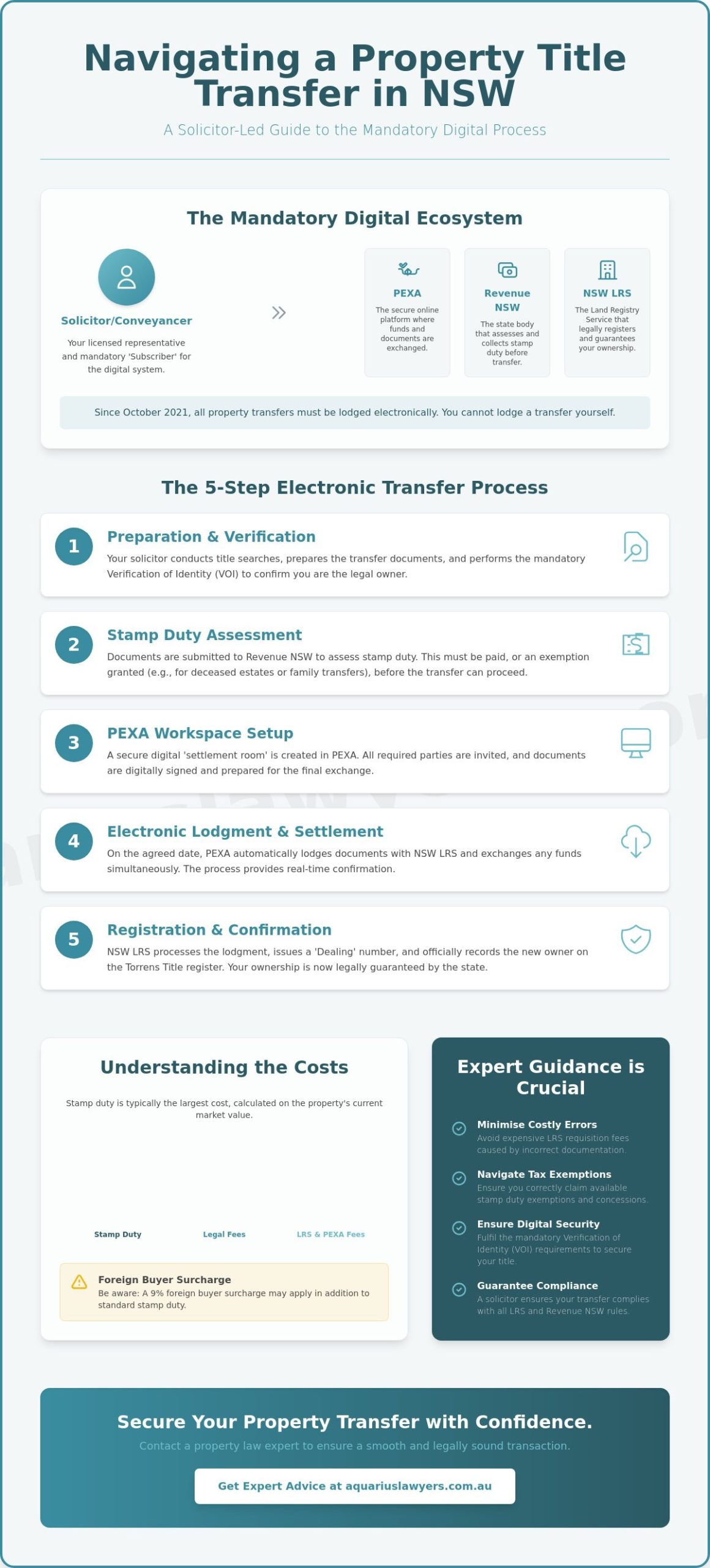
Step-by-Step Guide: How to Transfer a Property Title in NSW
Executing a transfer of property title nsw follows a strict, sequential workflow. Precision is the price of entry in a digital-first system. If you miss a single step or miscalculate a timeline, the entire settlement can collapse, often resulting in penalty interest or LRS requisition fees. While the process is now almost entirely paperless, the legal obligations remain as heavy as ever. Following this roadmap ensures your transaction moves from a handshake to a registered interest without unnecessary friction.
- Step 1: Title Search. We begin by pulling a current title search from the LRS. This confirms the exact “manner of holding” and identifies any caveats, easements, or mortgages that must be cleared before the title can move.
- Step 2: Valuation and Duty Assessment. For non-arm’s length transactions, such as gifting property, you must obtain a registered valuation. This allows your solicitor to calculate the exact transfer duty liability through Revenue NSW.
- Step 3: Drafting and Compliance. Your legal representative prepares the digital Transfer document. From 1 June 2026, many transactions will also require the mandatory “2026 Edition Contract for Sale,” which adopts a digital-first approach to clauses and disclosures.
- Step 4: Verification of Identity (VOI). All parties must have their identities verified to a high standard. This is a non-negotiable security layer designed to prevent title fraud in the Australian market.
- Step 5: PEXA Lodgment and Settlement. The transaction is finalised in the PEXA workspace. For a single title transfer, the PEXA fee is approximately $140. Once the digital “keys” are exchanged, the LRS is notified, and ownership is updated instantly.
The Crucial Mortgage Factor
The bank is often the bottleneck in a title transfer. If there is an existing mortgage on the property, you must lodge a “Discharge of Mortgage” form with your lender. This process typically takes between 10 to 20 business days. It’s important to distinguish between a simple name change and a refinance. If you are adding a person to the title but keeping the loan, the bank must approve the new party and issue a new mortgage. This adds layers of complexity and requires careful coordination between your solicitor and the bank’s legal team. To avoid delays, you should seek legal advice for property transfers as soon as you decide to change ownership.
Verification of Identity (VOI) Standards
Identity fraud is a sophisticated threat, which is why the VOI standards are incredibly stringent. The “Face-to-Face” rule requires your solicitor to physically see you and your original documents, or use approved encrypted technology that meets government standards. You will generally need to provide a 100-point ID check, usually consisting of a current Australian Passport and a Driver’s Licence. From 1 July 2026, expanded Anti-Money Laundering (AML/CTF) regulations will require even deeper scrutiny. These rules exist to ensure that when a transfer is lodged, the LRS can be 100% certain that the person signing the document actually has the legal right to do so.
Ensuring a Smooth Settlement: Why Professional Guidance Matters
Attempting a DIY transfer of property title nsw often leads to what we call the “requisition trap.” Small administrative errors, such as a misspelt name or an incorrect title reference, cause the LRS to halt the process immediately. These errors cost more than just time; they attract government fees and can leave your legal interests in limbo. Professional guidance provides a protective layer, ensuring that every digital “i” is dotted and “t” is crossed before the final button is pressed in PEXA. This precision is the difference between a secure asset and a costly legal headache.
Budget certainty is another critical factor. Many people fear the unknown costs of legal transitions, but a fixed-fee approach for property transfers removes that anxiety. It allows you to plan your finances with confidence, knowing exactly what the professional service will cost from the outset. This transparency is particularly valuable in complex family matters or deceased estate settlements where emotions are high and clarity is at a premium. By choosing a structured legal pathway, you trade stress for certainty.
Common Pitfalls to Avoid
One frequent error involves incorrectly identifying the “Manner of Holding.” Selecting Joint Tenants when you intended to be Tenants in Common can have drastic consequences for your estate planning and how your share of the property is treated in a will. Similarly, many owners fail to account for Land Tax adjustments during the transfer, leading to unexpected liabilities post-settlement. Perhaps most critically, you must meet the strict 3-month deadline for stamping documents at Revenue NSW. Missing this window results in interest charges that quickly erode any perceived savings from a DIY attempt. Precision in these early stages prevents a cascade of financial issues later.
The Aquarius Pathway
At Aquarius Lawyers, we apply maritime-grade precision to the complex world of property law. Our “Steady Guide” philosophy means we handle the technical heavy lifting while you focus on the transition. We utilise advanced technology to streamline the Verification of Identity (VOI) and digital lodgment phases, providing you with a transparent and efficient pathway to ownership. This methodology combines our deep traditional credentials with a forward-thinking, tech-savvy perspective. We believe that legal results should be delivered with pragmatism and common sense, ensuring your title is secure without unnecessary ceremony. To get started, you can organise your NSW property transfer with Aquarius Lawyers today.
Secure Your Property Future with Digital Precision
Managing a transfer of property title nsw doesn’t have to be a source of stress. We’ve explored a digital landscape where PEXA and the LRS demand absolute accuracy, and we’ve highlighted the critical tax exemptions that can protect your family’s wealth. The synergy of traditional legal credentials and modern technology is the formula for a seamless transition. By understanding the costs and the mandatory digital steps, you’ve already taken the first step toward a successful settlement.
Aquarius Lawyers brings maritime-grade precision to every property matter. Led by recognised legal innovator Katherine Hawes, our team provides the local expertise you need across Sydney and Shellharbour. We offer fixed-fee conveyancing options to ensure you have total budget certainty from start to finish. Don’t leave your most valuable asset to chance in a complex digital environment. Our pragmatism and tech-savvy approach ensure your title is legally secure without the usual administrative friction.
Secure your property interests with our expert NSW conveyancing team.
We’re ready to help you navigate the pathway to a legally secure and stress-free property future.
Frequently Asked Questions
Can I transfer property to a family member for $1 in NSW?
Yes, you can legally transfer property for a nominal sum like $1, but Revenue NSW will still calculate stamp duty based on the full market value. They use an “ad valorem” assessment for non-arm’s length transactions to ensure tax is paid on the asset’s true worth. You will need a formal valuation from a registered valuer to satisfy these tax requirements during the transfer of property title nsw.
How long does a property title transfer take in NSW?
A standard transfer usually takes between two and four weeks to complete from start to finish. The most significant variable is the time your bank takes to process a discharge of mortgage, which typically requires 10 to 20 business days. Once all parties are ready in the PEXA workspace, the actual digital settlement and registration happen almost instantly.
Do I need a new Certificate of Title after the transfer?
No, you won’t receive a physical deed because paper Certificates of Title were abolished in NSW on 11 October 2021. All property ownership is now recorded as an electronic title (eCT) within the Land Registry Services database. After your transfer is registered, your solicitor will provide you with a copy of the updated Title Search as confirmation of your ownership.
What is the difference between Joint Tenants and Tenants in Common?
Joint Tenants hold the property together as a single legal entity with a right of survivorship; if one owner dies, the property passes automatically to the survivor. Tenants in Common hold specific, defined shares (such as 50/50 or 70/30) in the property. These shares do not pass automatically to the other owner and must be distributed according to the instructions in your will.
Is stamp duty payable if I inherit a property in NSW?
Inheriting a property through a will or intestacy usually attracts a nominal duty fee rather than the full ad valorem rate. For the 2025-2026 period, this is typically a small fixed charge to Revenue NSW to process the transmission. However, if you are “buying out” other beneficiaries or if the transfer falls outside the specific terms of the will, full duty may apply to that portion of the transaction.
Can I change a property title without a solicitor?
While it is legally permissible to represent yourself, it’s practically very difficult due to the “Digital Mandate.” Almost all transfers in NSW must be lodged through PEXA, and only authorised “Subscribers” like solicitors or conveyancers have access to this platform. You would also need to meet strict Verification of Identity (VOI) standards that are difficult to facilitate as a private individual.
What are the current LRS lodgment fees for 2026?
The standard lodgment fee for a transfer of property title nsw is $175.70 for the 2025-2026 financial year. These fees are set by NSW Land Registry Services and are generally adjusted on 1 July each year. You should also budget for the PEXA platform fee, which is approximately $140 for a single title transfer as of May 2026.
How do I remove a deceased person’s name from a property title?
If the property was held as Joint Tenants, you must lodge a “Notice of Death” with the LRS along with a certified copy of the death certificate. If the deceased held the property as a Tenant in Common or was the sole owner, the executor will need to lodge a “Transmission Application.” This process usually requires a Grant of Probate from the Supreme Court of NSW to verify the executor’s authority. Families navigating this situation can benefit from understanding the full probate application process for Australian estates to ensure the executor’s legal authority is correctly established before any title dealings can proceed.
Disclaimer
Please note that legal rules change and this is not a substitute nor construed as legal advice. It is general information only.