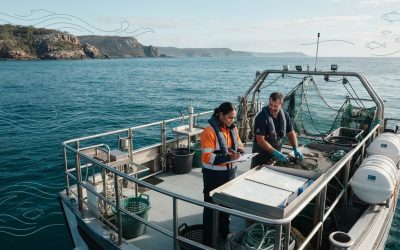
What if a single piece of prohibited kit in your locker didn’t just lead to a $500 on-the-spot fine, but resulted in the permanent seizure and destruction of your entire vessel? It’s a sobering reality for many. Between 2024 and 2025, the Australian Fisheries Management Authority (AFMA) seized and destroyed over 60 vessels for serious breaches. Understanding illegal fishing gear fines australia is no longer just about avoiding a minor penalty. It’s about protecting your boat, your gear, and your professional reputation from a multi-layered legal risk that can escalate in an instant.
We understand the frustration of trying to untangle the web of state and Commonwealth rules. You want to stay compliant, but the fear of an accidental breach or a heavy-handed prosecution is a constant weight on your shoulders. This guide provides the clarity you need to navigate these waters with confidence. We’ll examine the 2025-26 penalty schedules across every jurisdiction, clarify which gear will land you in hot water, and explain the strategic legal pathways available if you’re facing a fisheries charge.
Key Takeaways
- Identify the specific legal differences between state and federal rules to ensure your kit is compliant across all Australian waters.
- Master the penalty unit system to calculate the true cost of illegal fishing gear fines australia and avoid the shock of maximum court-imposed penalties.
- Recognise how the “intent to use” rule works, where simply possessing prohibited gear near a waterway can trigger a prosecution.
- Learn about the automatic forfeiture process that puts your vessel, vehicle, and livelihood at risk the moment fisheries officers intervene.
- Establish a clear action plan for handling interactions with fisheries officers, focusing on protecting your rights and avoiding self-incrimination during a recorded statement.
What Constitutes Illegal Fishing Gear in Australia?
Staying on the right side of the law begins with knowing exactly what’s in your tackle box. In Australia, the definition of illegal fishing gear isn’t just about the item itself; it’s about the context of its use. Under the Fisheries Management Act 1991 (Cth) and various state legislations, gear is classified based on its potential to cause indiscriminate damage to marine ecosystems. Authorities such as the Australian Fisheries Management Authority (AFMA) manage Commonwealth waters, while state bodies like the NSW Department of Primary Industries (DPI) or the Victorian Fisheries Authority (VFA) oversee coastal and inland areas. Understanding illegal fishing gear fines australia requires recognising this jurisdictional split, as a net that is legal in one state could be a criminal offence in another.
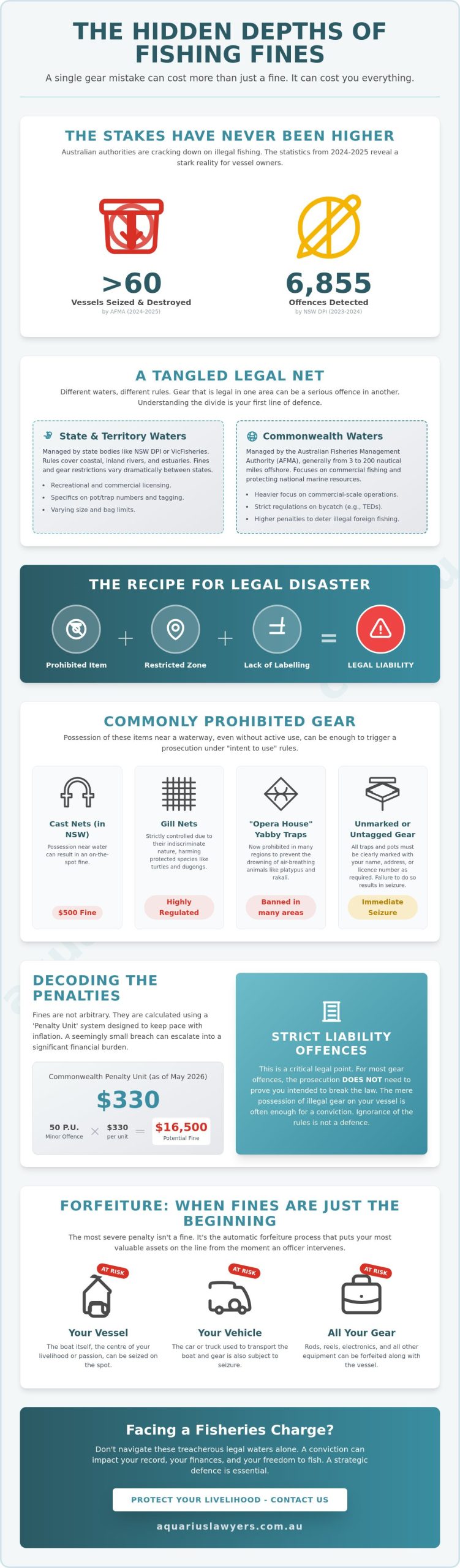
A simple formula defines your risk: Prohibited Item + Restricted Zone + Lack of Labelling = Legal Liability. There is a critical distinction between “illegal gear” and the “illegal use of legal gear.” For instance, a crab trap is generally legal, but using it without the required floats or tags makes it illegal. These regulations exist for a reason. They protect biodiversity by preventing the accidental capture of non-target species and ensure that overfishing doesn’t collapse local fish stocks. In the 2023-24 period alone, NSW DPI detected 6,855 offences and seized 1,762 items of gear, proving that authorities are actively monitoring compliance.
Prohibited Gear Types in New South Wales and Beyond
Commonly banned items include cast nets in NSW, where their possession near water can result in a $500 on-the-spot fine. Gill nets are strictly controlled because they don’t discriminate between a target fish and a protected turtle or dugong. In many regions, “Opera House” style yabby traps are now prohibited to prevent the drowning of platypus and rakali. A major pitfall for many fishers is the “unmarked gear” trap. If your traps or pots don’t clearly display your name, address, or licence number according to state-specific requirements, they are considered illegal gear and are subject to immediate seizure.
Commercial vs. Recreational Gear Restrictions
The law draws a hard line between recreational and commercial activities. Commercial licences permit the use of large-scale equipment, such as longlines or industrial-sized traps, that are strictly forbidden for the public. Possessing a “commercial quantity” of gear without the appropriate permit is a fast track to a court attendance notice. For example, while a recreational fisher might be allowed two crab traps in certain waters, possessing ten suggests a commercial intent. This threshold is a primary focus for fisheries officers during inspections. Because rules vary wildly, always verify local gear limits before crossing state borders; what works in Queensland might be a serious offence in South Australia.
Illegal Fishing Gear Fines Australia: The Penalty Framework
The financial cost of a fisheries offence is calculated using a “Penalty Unit” system. This mechanism ensures that fines remain consistent with inflation without requiring constant legislative updates. Fines aren’t static. They are indexed to the economy. As of May 2026, the value of a single Commonwealth penalty unit has been indexed to $330 to reflect current economic conditions. This means a seemingly minor offence carrying 50 penalty units quickly scales into a five-figure liability. Understanding illegal fishing gear fines australia requires a clear-eyed look at how these numbers compound, especially when multiple charges are laid simultaneously.
Most gear offences operate under a “strict liability” framework. This is a critical legal distinction. Strict liability means the prosecution doesn’t need to prove you intended to break the law; the mere presence of prohibited gear on your vessel is enough to secure a conviction. Whether you were unaware of a recent rule change or simply forgot to remove an old trap, the financial impact remains the same. While fisheries officers can issue on-the-spot infringement notices for minor breaches, serious or repeat offences are escalated to the Local Court, where the maximum penalties are significantly higher.
Commonwealth vs. State Penalties
Federal and state authorities operate under different penalty ceilings. In Commonwealth waters, the focus is often on commercial-scale deterrence. Recent enforcement actions have resulted in significant penalties for foreign fishers, with masters of vessels receiving individual fines of $15,000 in late 2025. At the state level, the stakes are equally high for recreational and local commercial operators. In New South Wales and Victoria, the maximum penalty for possessing prohibited gear can exceed $22,000 for a first offence. If you’ve been served a summons, seeking advice from a specialist in Fisheries Law is the first step in mitigating these risks.
The Risk of Imprisonment and Criminal Records
Fines are often just the starting point. For serious commercial poaching or persistent recidivism, the court’s focus shifts from financial deterrence to custodial sentences. In November 2025, a recidivist master was sentenced to 15 weeks of imprisonment for continued breaches of the Fisheries Management Act. Beyond the immediate loss of liberty, a criminal conviction for a fisheries offence can have long-term consequences for employment and international travel. However, legal pathways like a “Section 10” dismissal in NSW allow a magistrate to find a person guilty without recording a formal conviction, provided a compelling case is made regarding the offender’s character and the circumstances of the breach.
Common Gear Offences and Prohibited AU Equipment
While large-scale enforcement often makes the headlines, the majority of illegal fishing gear fines australia stems from everyday recreational oversights. A common point of friction is the use of “Opera House” style yabby traps. These devices were once staples of Australian freshwater fishing, but they are now prohibited in many jurisdictions, including all public waters in New South Wales and Victoria. The ban exists to protect air-breathing mammals like platypuses and rakali from drowning. Using these traps in restricted areas isn’t just a minor breach. It’s an environmental offence that carries heavy financial weight.
Fisheries officers also keep a close watch on the “intent to use” trap. You don’t actually have to be caught with a line in the water to face a penalty. Under many state laws, simply possessing prohibited gear in, on, or adjacent to waters where its use is illegal is enough to constitute an offence. This means if you have a cast net in your boat while in NSW waters, you’re liable for a fine even if the net is dry and tucked away. Recent cases highlighted by the AFMA demonstrate the severity of illegal fishing penalties in Australia, where combined fines and vessel seizures serve as a stark warning to all operators.
Nets, Traps, and Pots: The Compliance Checklist
Precision is your best defence against a court attendance notice. Mesh size requirements are strictly enforced, and a difference of just a few millimetres can be the catalyst for a $500 on-the-spot fine. For lobster and crab pots, escape gaps are mandatory. These gaps allow juvenile fish and non-target species to exit the trap safely, preventing unnecessary by-catch. Furthermore, buoy marking is a non-negotiable requirement. Every piece of set gear must be correctly labelled with your name and contact details. Unmarked gear is often treated as abandoned or “ghost gear” and is subject to immediate seizure by patrolling officers.
Electronic and Spear Fishing Restrictions
Technology has outpaced traditional regulations in some areas, leading to a crackdown on electronic lures and certain underwater torches. While some jurisdictions allow torches for general navigation, using them specifically to “stun” or attract fish can lead to a prosecution. Spear fishing is also subject to tight geographic restrictions. Protected zones, such as those designed to safeguard the Blue Groper in NSW, are heavily monitored. It’s a simple equation: Wrong Zone + Prohibited Gear = Maximum Penalty. Ignorance of local zone maps is not a valid legal defence, so always check the latest digital charts before you head out.
Forfeiture and Seizure: When Fines are Only the Beginning
A fine is a one-off financial hit, but forfeiture is a permanent loss of capital. Under the Fisheries Act and Commonwealth legislation, officers have the authority to seize anything they believe was used in the commission of an offence. This includes your catch, your tackle, and your transport. When calculating the total impact of illegal fishing gear fines australia, you must account for the “automatic forfeiture” rule. In many jurisdictions, once a conviction is recorded, any seized gear is automatically forfeited to the Crown. You don’t get a second chance to buy it back. Even if you aren’t convicted, the storage fees alone can run into thousands of dollars, making the recovery of your property a financial nightmare.
Vessel and Vehicle Seizure
Your boat or ute isn’t just a way to get to the ramp. In the eyes of the law, it’s an “instrument of crime” if it facilitated an offence. If you use your vehicle to transport prohibited gill nets or unmarked traps, that vehicle is at immediate risk of seizure. This isn’t a theoretical threat. A Melbourne man recently lost his ute permanently after it was used in connection with golden perch gear offences. The legal logic is clear: Illegal Gear + Transport to Water = Total Asset Risk. Reclaiming a seized vessel involves filing a formal application with the court, a process that requires a strategic legal approach to prove the hardship or lack of involvement of the owner.
Disqualification from Holding a Licence
For professionals, the most damaging penalty isn’t the loss of hardware. It’s the loss of the right to operate. A serious gear offence often triggers a review of your “fit and proper person” status. This status is the bedrock of your ability to hold a commercial licence or quota. If you’re found to be no longer “fit and proper,” you face the cancellation of your commercial fishing quotas or a court-ordered ban from all fishing activities for five years or more. Protecting your livelihood requires a proactive defence. If your quota is under threat, consulting a Fisheries Lawyer Australia is the best way to navigate the administrative appeals process and defend your professional standing.
If your equipment or vessel has been taken, you need to act before the forfeiture becomes permanent. Contact Aquarius Lawyers to discuss a strategy for recovering your property.
Defending a Fisheries Prosecution with ‘The Fish Lawyer’
Receiving a Court Attendance Notice (CAN) or an infringement notice for illegal fishing gear fines australia is a high-pressure moment that requires immediate, calculated action. Your first move shouldn’t be an emotional one. While the instinct is often to explain yourself to the officer on the spot, you must recognise that anything you say can be used to build the prosecution’s case. The most effective strategy begins with a simple rule: do not provide a recorded statement or participate in a formal interview without legal representation. Silence is a right, not an admission of guilt.
Successfully navigating illegal fishing gear fines australia requires more than just a basic understanding of the rules. Because many fisheries offences are “strict liability,” the prosecution doesn’t have to prove you intended to break the law. However, legal defences such as an “honest and reasonable mistake of fact” can be used to challenge a charge. This defence applies if you can prove you held a genuine belief that your actions were legal and that a reasonable person in your position would have believed the same. In rare cases, the defence of “necessity” may also apply if the gear was used to prevent a greater harm or in an emergency situation.
Navigating the Local Court Process
The Local Court process offers two primary pathways: pleading “Not Guilty” to contest the facts or pleading “Guilty with an explanation” to seek a lighter sentence. If you choose to contest the charge, your lawyer will scrutinise the technical evidence. This includes challenging the accuracy of gear measurements or the specific location where the gear was allegedly used. Fisheries law is highly technical. A difference of a few millimetres in mesh size or a slight discrepancy in GPS coordinates can be the difference between a heavy fine and a dismissed case. Providing character references and evidence of a prior clean record can also help mitigate the outcome if a guilty plea is the best strategic option.
Why Katherine Hawes is the Specialist You Need
Katherine Hawes, widely known as “The Fish Lawyer,” brings a unique blend of maritime, aquaculture, and fisheries expertise to your defence. She understands that your vessel and your licence represent more than just hobby equipment; they are your livelihood. With a proven track record of defending fisheries prosecutions across regional NSW and Sydney, Katherine uses a pragmatic, no-nonsense approach to protect clients from excessive penalties. She focuses on the synergy between traditional legal strategy and a deep, practical knowledge of the fishing industry to achieve the best possible results in court.
Facing a fisheries charge? Contact Aquarius Lawyers today for a confidential consultation and start building a defence that protects your future on the water.
Securing Your Future on the Water
Compliance is your best insurance policy. By mastering the distinction between state and federal rules and ensuring every trap is correctly marked, you eliminate the risk of accidental breaches. We’ve seen how illegal fishing gear fines australia can escalate from a simple notice to the permanent loss of a vessel. Protecting your gear and your right to fish requires a proactive approach to maintenance and a deep understanding of local zone maps. When you take the time to audit your kit, you protect your assets from the “automatic forfeiture” rules that catch many off guard.
If you find yourself in the sights of fisheries officers, remember that expert advice is your most valuable tool. Principal Katherine Hawes, known as “The Fish Lawyer,” provides specialist expertise in Fisheries and Maritime Law across Sydney and regional NSW. You don’t have to navigate the complexities of the Local Court alone. Protect your livelihood and defend your rights—speak to The Fish Lawyer today. With the right strategy and a steady guide, you can resolve these legal challenges and get back to what matters most: being out on the water.
Frequently Asked Questions
Can fisheries officers enter my private property to inspect gear?
Yes, fisheries officers have broad powers under state legislation to enter land or premises if they suspect illegal gear is being stored or used. While they generally require a warrant to enter a private dwelling, they can inspect sheds, yards, and vehicles parked on your property. Cooperating with an inspection is usually the best approach, but you don’t have to provide a statement without legal advice.
How much is a penalty unit in Australia for 2026?
As of May 2026, the Commonwealth penalty unit is indexed at $330. State based penalty units vary across the country and are often adjusted annually on 1 July. It is these units that determine the total illegal fishing gear fines australia you might face. Because the value of these units increases over time, the financial risk of a fisheries offence continues to climb each year.
What happens if I accidentally use the wrong size mesh on my crab pot?
You remain legally liable even if the error was accidental. Fisheries offences are “strict liability” matters, meaning the prosecution only needs to prove the gear was used, not that you intended to break the law. A minor mesh discrepancy can lead to an on-the-spot fine of $500 or more. Officers will also seize the non-compliant gear on the spot to prevent further use.
Can I get my boat back if it was seized for illegal fishing gear?
It is possible to recover a seized vessel, but you must act before the automatic forfeiture rules take effect. This typically involves making a formal application to the court and proving that the seizure causes extreme hardship or that the owner was not involved in the offence. Reclaiming a boat is a technical legal process that often requires a strategic application to a magistrate.
Do I need a lawyer for a fisheries infringement notice?
While you can simply pay a minor fine, a lawyer is essential if the notice could impact your commercial licence or result in a criminal record. For professionals, an infringement notice can be used as evidence that you are no longer a “fit and proper person” to hold a quota. A specialist can help you negotiate a withdrawal or a lesser penalty that protects your livelihood.
Are yabby traps illegal in all Australian states?
No, but “Opera House” style traps are strictly prohibited in all public waters in New South Wales, Victoria, and the ACT. Other states like Queensland and South Australia have specific size and entrance requirements to protect air-breathing animals. Using the wrong trap type is a common source of illegal fishing gear fines australia, so always verify the specific design rules for each state.
What is the maximum fine for commercial fisheries gear offences?
Maximum fines for commercial gear offences can exceed $180,000 for serious breaches involving priority species like abalone or rock lobster. For corporate entities, these penalties can be significantly higher. Beyond the base fine, courts can also impose additional penalties based on the commercial value of the illegal catch, which can quickly double or triple the total financial liability.
Can I be banned from fishing for a first-time gear offence?
Yes, courts have the power to impose a fishing ban even for a first-time offence if the breach is deemed serious. While a minor recreational slip-up usually results in a fine, offences involving commercial quantities of gear or prohibited nets often lead to a disqualification. These bans can last from several months to five years or more, depending on the severity of the case.
Disclaimer
Please note that legal rules change and this is not a substitute nor construed as legal advice. It is general information only.