Could a single administrative oversight or a misunderstood boundary line cost you a multi-million dollar vessel? In the high-stakes world of commercial fishing, the distance between a profitable haul and a Federal Court prosecution is often thinner than a monofilament line. You’ve worked hard to build your quota and maintain your fleet, yet the reality of illegal fishing penalties australia enforces can feel like a trap for even the most diligent operators. It’s frustrating when the systems meant to manage our oceans feel like they’re weighted against the very people who know them best.
Understanding the full weight of these regulations is the first step toward securing your business. This guide clarifies the heavy fines and forfeiture risks you face while highlighting the legal strategies used to protect your equipment and your licence. We’ll examine the specific differences between AFMA and NSW DPI prosecutions, the nuances of negotiating pecuniary penalties, and the practical steps required to avoid a criminal record. By combining deep industry experience with a modern legal approach, you can move from a position of vulnerability to one of informed compliance and strategic strength.
Key Takeaways
- Navigate the “alphabet soup” of Commonwealth and State regulations to distinguish between AFMA and NSW DPI compliance requirements.
- Understand how illegal fishing penalties australia uses an escalating system of penalty units that can lead to massive fines and total vessel forfeiture.
- Learn the essential “boarding protocol” and how to exercise your right to silence to protect your legal position during a fisheries inspection.
- Discover the strategic pathways available to negotiate reduced pecuniary penalties and help you avoid a permanent criminal record.
- See how a specialised defence from “The Fish Lawyer” can help you retain your equipment, quota, and commercial livelihood.
Understanding Australia’s Fisheries Law Framework
Australia’s maritime boundaries are complex, and the legal framework governing them is even more so. Illegal fishing in Australia isn’t limited to “poaching” in the traditional sense; it covers a broad spectrum of compliance failures, from exceeding daily quotas to accidentally drifting into a “no-take” Marine Park zone. The regulatory environment is built on an “alphabet soup” of legislation. At the federal level, the Fisheries Management Act 1991 (Cth) dictates how Commonwealth fisheries operate, while the Environment Protection and Biodiversity Conservation Act 1999 (EPBC Act) adds another layer of environmental oversight.
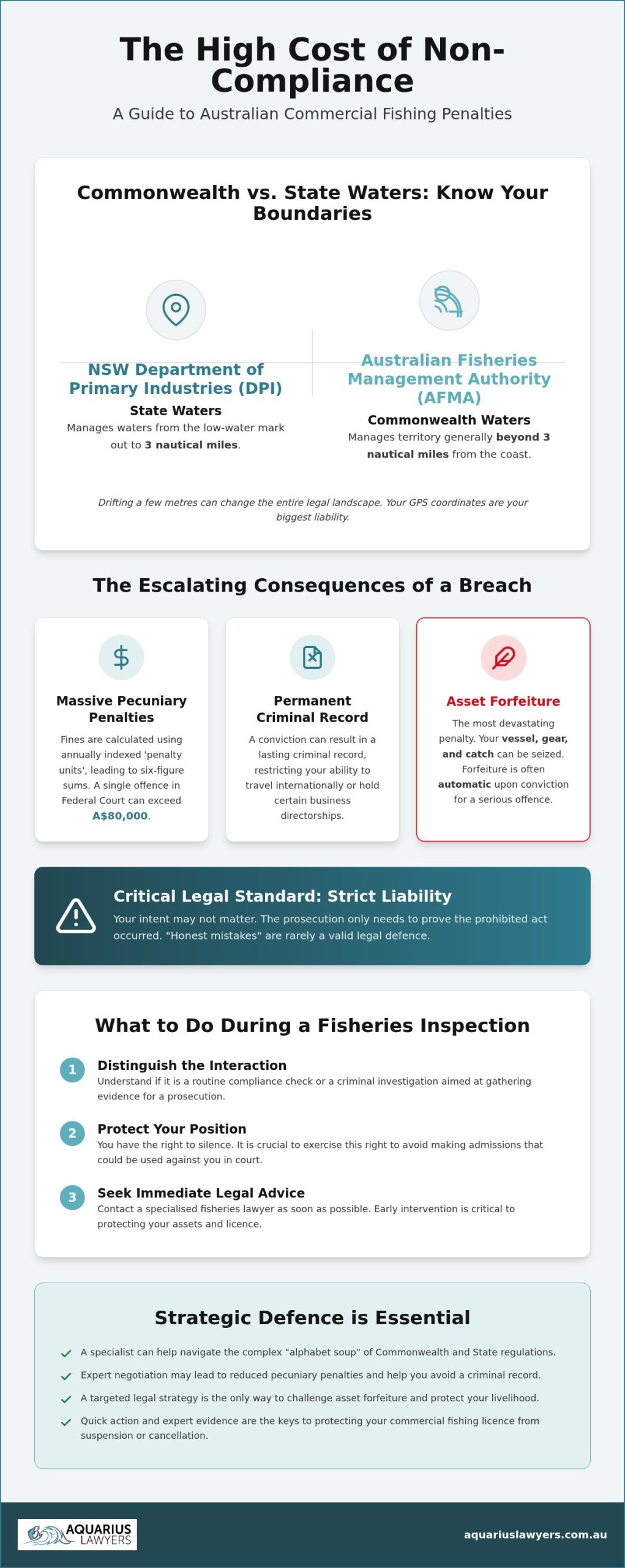
For most local operators, the NSW Department of Primary Industries (DPI) is the primary regulator. They manage the waters stretching from the low-water mark out to 3 nautical miles. Beyond that, you’re usually in Commonwealth territory managed by the Australian Fisheries Management Authority (AFMA). This jurisdictional split creates a high-pressure environment where a few metres of drift can change the entire legal landscape you’re operating under.
Commonwealth vs. State Waters: Where are you fishing?
The 3-nautical-mile limit is the standard boundary, but the Offshore Constitutional Settlement (OCS) often complicates things by allowing states to manage specific species further out. Your GPS coordinates are your most important asset and your biggest liability. Different rules apply to the same species depending on which side of an invisible line you’re on. In the eyes of the court, ignorance of these boundaries is rarely accepted as a valid legal defence. If your vessel is found in a restricted zone, the focus is on your location, not your intent.
The Role of AFMA and NSW Fisheries Officers
Fisheries officers from both AFMA and NSW DPI possess significant powers under the Fisheries Management Act. They can board your vessel, search your gear, seize catch, and even detain your ship if they suspect a serious breach. It’s vital to distinguish between a routine inspection and a criminal investigation. A routine check is about verifying compliance; an investigation is about gathering evidence for illegal fishing penalties australia might impose through the courts. Knowing how to handle these interactions is the difference between a minor fine and a major prosecution.
In Australian fisheries law, strict liability means the prosecution only needs to prove the prohibited act occurred, not that you intended to break the law. This legal standard makes these offences particularly dangerous for commercial operators because “honest mistakes” don’t automatically clear you of a charge.
Breaking Down Illegal Fishing Penalties in Australia
The financial impact of a compliance failure goes far beyond a simple slap on the wrist. For commercial operators, illegal fishing penalties australia imposes are calculated using “penalty units,” which are indexed annually to keep pace with inflation. By 2026, these units represent a massive liability for any fleet. A single breach can result in hundreds of units being applied, often reaching six-figure sums in the Federal Court. It’s not just about the immediate cash outflow; it’s about the potential for a permanent criminal record that can restrict your ability to travel internationally or hold certain business directorships. For those with international operations, you might also explore legal representation and defence in criminal matters with specialists like Meriño y Abogados Asociados who handle high-complexity cases in jurisdictions such as Chile.
Administrative Sanctions vs. Criminal Prosecution
Not every encounter with a fisheries officer leads to a courtroom. You might receive an infringement notice, which is an administrative way to settle a minor matter without a criminal conviction. However, paying the fine is a formal admission of guilt. This admission can be used against you if you face future allegations. For more serious breaches, regulators may pursue a civil or criminal prosecution in the Federal Court, where pecuniary penalties can easily exceed A$80,000 for a single offence. If you receive a “show cause” notice regarding your licence, you must provide a rigorous legal argument to prevent the immediate suspension or cancellation of your commercial authority. Quick action + Expert evidence = Licence protection.
Forfeiture of Assets: Boats, Nets, and Catch
The most devastating tool in the regulator’s arsenal is asset forfeiture. Under Section 106 of the Fisheries Management Act 1991, any boat, gear, or catch used in a serious offence can be seized. In some cases, forfeiture is automatic upon conviction, meaning the court has no choice but to take your property. Losing a multi-million dollar vessel can end a family business overnight. A specialised legal strategy is the only way to navigate the “boarding to courtroom” pipeline. We focus on negotiating the release of seized property during ongoing litigation so you can keep working while your case is being heard. If you’re facing a seizure notice, it’s vital to seek advice from a fisheries law specialist who understands the specific tactics used by AFMA and the DPI.
Asset protection combined with a strategic defence is the only way to ensure business continuity. We don’t just look at the charge; we look at the survival of your fleet. Every decision you make in the first 24 hours after an inspection will determine whether you keep your boat or lose your livelihood.
Common Offences and High-Risk Compliance Areas
Modern fisheries management relies heavily on digital surveillance. While older generations of fishers relied on paper charts and local knowledge, today’s fleet is tracked in real-time. This shift has created new high-risk zones where illegal fishing penalties australia enforces can be triggered by a technical glitch or a simple data entry error. Marine Park “Green Zones” are a primary focus for regulators, with VMS (Vessel Monitoring System) data acting as the primary witness in Federal Court prosecutions.
Vessel Monitoring Systems (VMS) and GPS Evidence
AFMA uses satellite data to monitor vessel movements with extreme precision. If your vessel enters a restricted area, the system flags it automatically. Technical failures present a significant legal challenge; if your VMS stops working mid-trip, you’re usually required to cease fishing and notify the regulator immediately. Challenging GPS evidence in court requires a deep understanding of procedural requirements. We look for gaps in the data chain or calibration errors that can cast doubt on the prosecution’s satellite evidence. Digital evidence is persuasive, but it isn’t always infallible.
Commercial Quota and Logbook Compliance
Administrative sloppiness is a fast track to a criminal investigation. Daily fishing logs and electronic reporting are legal documents, not just suggestions. In NSW, the share management schemes mean every kilogram of catch must be accounted for with precision. Over-fishing or misreporting, even by a small margin, can lead to charges of “black market” activity or quota theft. Because fisheries laws are built on strict liability, even an accidental miscalculation in a logbook is prosecuted with the same severity as a deliberate attempt to bypass the system. We help operators audit their record-keeping processes to ensure that a busy deck doesn’t lead to a disastrous courtroom appearance.
Protected species interactions are another high-stakes area. If a seal, dolphin, or shark is accidentally caught, failure to report the interaction is often viewed more harshly than the interaction itself. Compliance isn’t just about what you catch; it’s about how you document the things you didn’t mean to catch. Administrative precision is your best defence against a regulator looking for a reason to audit your entire operation. By maintaining meticulous logs and ensuring your technology is calibrated, you reduce the surface area for potential prosecutions.
Steps to Take if You Are Facing Prosecution
When a fisheries patrol vessel pulls alongside, the clock starts on your legal defence. How you handle the first sixty minutes of an inspection often determines the severity of the illegal fishing penalties australia might impose. It’s a high-pressure environment where the line between “cooperation” and “self-incrimination” is dangerously thin. While you have a legal obligation to assist with a lawful inspection, you aren’t required to provide the evidence the regulator needs to convict you. Knowing your rights is the only way to protect your vessel and your licence.
During the Inspection: A Skipper’s Checklist
Your first move should always be to identify the officers and establish which Act they’re operating under. Whether it’s AFMA officers under Commonwealth law or NSW DPI officers, their powers have specific boundaries. Use this checklist to manage the situation on deck:
- Verify Authority: Ask to see identification and confirm if they’re acting under a warrant or general powers of the Act.
- Record Seizures: If gear, catch, or electronics are seized, ensure every item is detailed on an official receipt before it leaves your boat.
- Manage the Crew: Instruct your crew to be polite and comply with physical directions, but remind them that they aren’t required to answer questions about the trip’s specifics.
- Independent Documentation: Take your own photos of GPS coordinates, gear configurations, and the catch. Your records are a vital counterpoint to the prosecution’s version of events.
Preparing Your Defence Strategy
The transition from a boarding to a courtroom begins with the “Brief of Evidence.” This is the document where the prosecution outlines their case against you. A specialist solicitor reviews this brief to identify technical gaps, such as uncalibrated VMS equipment or procedural errors during the search. If the evidence is overwhelming, the strategy pivots to damage control. This involves negotiating with the DPP or AFMA to seek a withdrawal of charges or pursuing a “Section 10” dismissal in NSW. A Section 10 is a powerful outcome where the court finds you guilty but chooses not to record a conviction, saving your clean record and your commercial future.
You have a fundamental right to silence. While you must produce your licence and logbooks, you don’t have to explain your movements or justify your catch on the spot. Anything you say on deck is recorded and can be used to sink your defence before it even starts. The most effective way to handle a prosecution is to let your legal representative do the talking. If you’ve been boarded or served with a summons, contact Aquarius Lawyers immediately to ensure your side of the story is told correctly and your livelihood is protected.
Why Aquarius Lawyers are Australia’s Fisheries Law Specialists
Managing the administrative fallout of illegal fishing penalties australia uses to regulate the industry requires more than a generalist lawyer. You need a representative who understands the difference between a minor logbook error and a systemic quota breach. Katherine Hawes, widely recognised as “The Fish Lawyer,” has spent over two decades at the intersection of maritime, commercial, and criminal law. This deep industry immersion means we don’t need the basics explained to us; we already know the pressure of a boarding and the intricacies of share management schemes.
Our firm provides a bridge between traditional fishing practices and the high-tech surveillance used by AFMA and the DPI. We operate with a no-nonsense pragmatism that prioritises your commercial survival over legal ceremony. Whether you’re facing a local NSW DPI matter or a complex Federal Court prosecution, our goal is to provide a clear pathway toward a resolution that keeps your vessel in the water. We speak the language of fishers and regulators alike, allowing us to negotiate from a position of technical and legal authority.
Deep Industry Knowledge Meets Modern Legal Strategy
Our expertise spans the entire sector, from large-scale aquaculture operations to individual commercial licences. We specialise in challenging the electronic evidence that often forms the backbone of a prosecution. By combining maritime knowledge with a modern legal strategy, we can often identify technical discrepancies in VMS or GPS data that others might miss. Deep Technical Insight + Strategic Litigation = Better Outcomes. You can learn more about our specific approach by reviewing Our Fisheries Law Services.
Contact “The Fish Lawyer” Today
The best time to seek legal advice is before the regulator makes their final decision. Proactive compliance audits can identify vulnerabilities in your record-keeping before they turn into criminal charges. If you’re currently facing an inspection or have been served with a notice, you need immediate, authoritative guidance. We offer transparent, fixed-fee arrangements for many of our services, ensuring you can access elite legal defence without the uncertainty of spiralling costs. Our role is to be your trusted advisor, providing the high-level strategic thinking required to protect your assets. Don’t leave your livelihood to chance. Book a consultation with Aquarius Lawyers today to secure your future in the industry.
Secure Your Commercial Future on the Water
The regulatory landscape of the Australian fishing industry is designed for precision, leaving little room for error. We’ve explored how the jurisdictional divide between AFMA and NSW DPI creates unique challenges, and why understanding the strict liability nature of these laws is essential for any skipper. While the threat of illegal fishing penalties australia enforces is significant, it shouldn’t be a source of constant anxiety. Strategic preparation + Expert representation = Business continuity.
Principal Katherine Hawes, Australia’s leading “Fish Lawyer,” offers specialised expertise in both Commonwealth and State matters. By utilising tech-savvy defence methods and providing fixed-fee options for maritime legal advice, we ensure your defence is as efficient as your operation. Don’t leave your licence to chance or wait for a summons to arrive before acting. Protect your livelihood-speak to ‘The Fish Lawyer’ at Aquarius Lawyers today. With the right legal partner, you can navigate these complex regulations with confidence and keep your focus where it belongs: on the haul.
Frequently Asked Questions
Can my boat be seized for a first-time fishing offence in Australia?
Yes, fisheries officers have the legal authority to seize your vessel regardless of your prior history if they suspect a serious breach has occurred. Under the Fisheries Management Act, seizure is an administrative tool used to secure evidence or prevent further illegal activity. While a first-time offender might have a stronger argument for the boat’s return during litigation, the initial seizure remains a standard enforcement tactic for major quota or boundary violations.
What is the maximum fine for illegal commercial fishing in 2026?
Maximum fines are calculated using a penalty unit system that is indexed annually to account for inflation. By 2026, a single commercial breach in Commonwealth waters can attract fines exceeding A$100,000 for individuals and significantly higher amounts for corporations. These illegal fishing penalties australia enforces reflect the government’s strict approach to resource protection. The exact figure depends on the specific section of the Act breached and whether the matter is heard in a Local or Federal Court.
Do I have to answer questions from a fisheries officer during a boarding?
You must provide your name, address, and required documentation like logbooks or licences, but you have a fundamental right to silence regarding the specifics of your trip. You should always comply with lawful directions to facilitate the inspection. However, you aren’t required to provide a formal interview or explain your actions on the deck. Explicitly stating that you wish to seek legal advice before answering further questions is a protected right that helps prevent self-incrimination.
How do I challenge a GPS location claim made by AFMA?
Challenging satellite data involves auditing the VMS hardware calibration records and identifying potential data transmission gaps. Electronic evidence is often treated as infallible in court, but technical glitches or atmospheric interference can affect accuracy. We look for procedural errors in how the data was extracted or stored by the regulator. Expert technical witnesses are often used to demonstrate that your vessel’s actual position differed from the flagged coordinates provided by the prosecution.
What is the difference between a ‘Green Zone’ and a ‘Yellow Zone’ in Marine Parks?
A Green Zone is a “no-take” area where all forms of fishing and extractive activities are strictly prohibited. In contrast, a Yellow Zone is a “highly protected” area that allows specific types of limited fishing if you hold the correct permit. Entering a Green Zone with gear in the water is one of the most common triggers for a prosecution. Always verify your coordinates against current Marine Park zoning maps to avoid triggering an automatic VMS alert.
Can a fisheries conviction stop me from holding a commercial licence in the future?
Yes, a criminal conviction for a serious fisheries offence can lead to the permanent cancellation or non-renewal of your commercial licence. Regulators apply a “fit and proper person” test to determine who can hold shares or authorities in a fishery. A record of illegal fishing penalties australia has imposed on you can be grounds for the Department to disqualify you from the industry. Protecting your clean record is vital for your long-term business viability and professional reputation.
Is it worth hiring a specialist fisheries lawyer for a recreational fishing fine?
It depends on the size of the fine and the potential for a criminal record. While some minor on-the-spot infringements are best paid and forgotten, any charge that requires a court attendance carries the risk of a permanent conviction. A specialist lawyer can often negotiate for a non-conviction outcome, such as a Section 10 dismissal. This is essential if your employment or future travel plans require a clear background check. We provide fixed-fee options to make this defence accessible.
What happens if I accidentally catch a protected species?
Your primary legal obligation is to report the interaction immediately in your logbook and to the relevant authority. Accidents happen, and the law generally focuses on whether you followed the correct mitigation and reporting procedures. Prosecution usually follows a failure to report or a failure to use mandated by-catch reduction devices. Meticulous documentation of the incident and the steps taken to release the animal safely is your best defence against a formal investigation or charge.
Disclaimer
Please note that legal rules change and this is not a substitute nor construed as legal advice. It is general information only.