With 209 Indonesian fishers prosecuted in Darwin Local Court since July 2025, the Australian government is sending a blunt message: the margin for error on the water has never been thinner. You understand that your boat is more than just equipment; it’s your livelihood and your legacy. Facing a notice for illegal fishing penalties in Australia is a high-stakes crisis that triggers immediate anxiety over vessel forfeiture and the potential loss of commercial quotas. It’s a stressful intersection of Commonwealth and State jurisdictions where a single misstep can lead to a permanent criminal record.
This strategic guide provides the clarity you need to navigate these complex waters and protect your assets from aggressive enforcement. We will examine the current 330 dollar penalty unit value and the specific triggers for licence suspension under the Fisheries Management Act 1991. By understanding the synergy between technical compliance and robust legal defence, you can minimise financial impacts and ensure your future in the industry remains secure. We’ll move from the basics of jurisdictional confusion to the practical application of a modern maritime legal strategy.
Key Takeaways
- Distinguish between Commonwealth and State jurisdictions to understand which specific fisheries laws and enforcement agencies apply to your location.
- Review the tiered structure of illegal fishing penalties australia, ranging from on-the-spot fines to the “Vessel Destruction” protocol for serious breaches.
- Recognise the unique “strict liability” standards that apply to commercial fishers and how demerit points can permanently jeopardise your fishing licence.
- Explore strategic legal defences, such as the “Mistake of Fact” doctrine or challenging the technical accuracy of GPS and measuring equipment.
- Learn why a specialised legal approach that merges maritime expertise with criminal law is essential for protecting your assets and professional future.
Navigating the Australian Fisheries Legal Framework in 2026
Illegal fishing is defined as any activity involving the use of prohibited gear or the harvesting of species in breach of allocated quotas. It’s a broad legal net that catches both the intentional poacher and the commercial operator who miscalculates their position or gear specifications. In 2026, the regulatory environment is tighter than ever. Compliance isn’t just about following the rules; it’s about understanding the complex web of legislation that governs every nautical mile of Australian waters. Avoiding the most severe illegal fishing penalties australia offers requires a precise knowledge of where one jurisdiction ends and another begins.
Commonwealth vs. State Jurisdictions
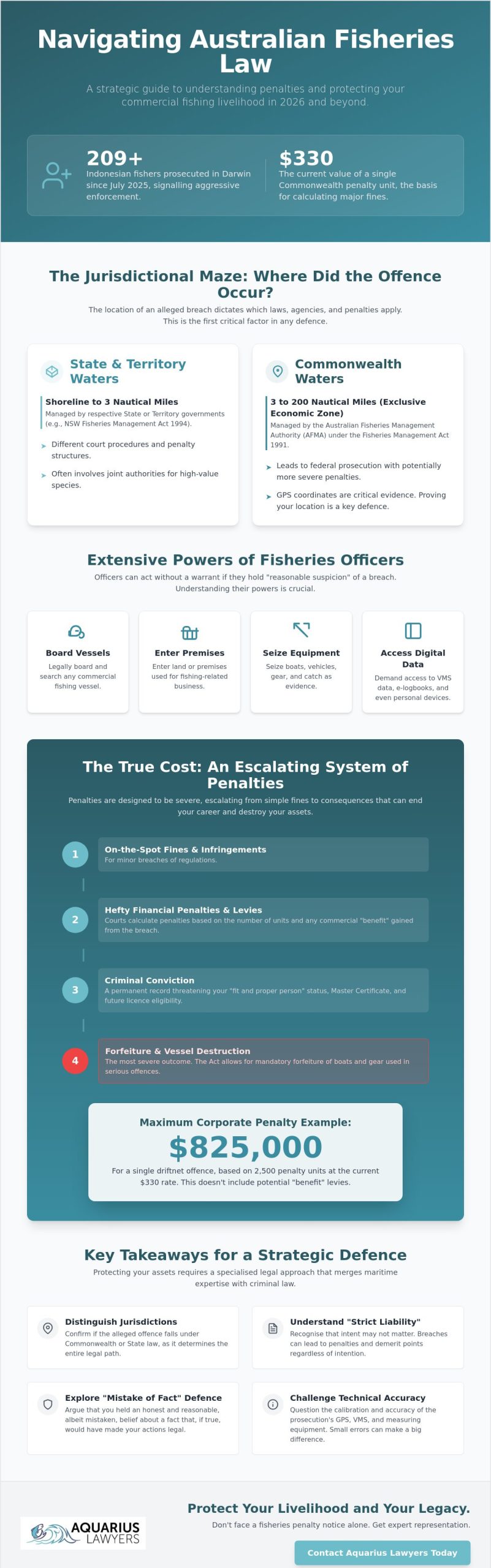
The jurisdictional divide is usually where the most significant legal confusion starts for commercial fishers. Generally, State and Territory governments manage fisheries from the shoreline out to the 3-nautical-mile limit. Beyond that boundary, extending to the 200-nautical-mile Exclusive Economic Zone, the Australian Fisheries Management Authority (AFMA) takes charge under the Fisheries Management Act 1991. However, this isn’t a simple line in the sand. Joint authorities often manage high-value species like tuna, snapper, or prawns across both zones to ensure biological sustainability.
The location of an alleged offence dictates your entire legal strategy. A breach within state waters, such as those governed by the NSW Fisheries Management Act 1994, may lead to different court procedures than a federal prosecution. We often see cases where the prosecution’s evidence hinges on GPS coordinates that sit right on the edge of these boundaries. Proving you were on the right side of the 3-mile line can be the difference between a state-level infringement and a heavy Commonwealth prosecution.
Powers of Fisheries Officers
Fisheries officers possess extensive powers that often surprise even seasoned masters. They don’t just check your catch; they have the legal authority to board vessels, enter premises, and seize equipment without a warrant if they have “reasonable suspicion” of a breach. This power is grounded in the need for rapid enforcement at sea, but it isn’t limitless. Officers must still act within the bounds of administrative law and procedural fairness.
In 2026, the scope of an inspection has evolved. Officers can now legally demand access to:
- Real-time Vessel Monitoring System (VMS) data and historical track logs.
- Electronic logbooks and digital catch records.
- Personal digital devices if they are suspected of containing evidence of illegal transactions or coordinates.
Understanding the limits of “reasonable suspicion” is vital. While officers can search your vessel, they cannot overstep into areas of your life or business that aren’t relevant to the suspected offence. Knowing when to comply and when to protect your digital privacy is a critical part of managing illegal fishing penalties australia wide.
Understanding the True Cost: Fines, Forfeitures, and Jail Time
A common misconception in the industry is that a fine is simply a business expense. It isn’t. The real weight of illegal fishing penalties australia wide comes from a tiered system designed to escalate rapidly from on-the-spot infringements to indictable criminal offences. For serious corporate breaches in 2026, the financial ceiling is immense; a body corporate can face fines of up to 2,500 penalty units, which at the current rate of $330 per unit, translates to a massive $825,000 for a single driftnet offence. Beyond the money, a conviction creates a permanent shadow. It directly threatens your “fit and proper person” status, which is the foundation of your Master Certificate and your ability to remain a skipper.
The Fisheries Management Act 1991 provides the Commonwealth with a formidable arsenal. This includes the “Vessel Destruction” protocol. While frequently applied to foreign incursions, the legislative framework also allows for the mandatory forfeiture of domestic boats and gear used in certain serious offences. Losing your vessel doesn’t just stop your current trip; it ends your career.
Financial Penalties and Levies
Courts now look beyond the standard fine to calculate a “benefit” penalty. This is a formula designed to ensure that no one profits from a breach. If the illegal catch was worth $50,000, the court can impose a penalty that strips that entire value on top of the base fine. When you add court-ordered prosecution costs and the inevitable spike in your commercial insurance premiums, the financial equation becomes lopsided. A single mistake can wipe out years of legitimate profit. Managing these risks requires a proactive approach to protecting your commercial assets before the matter reaches a magistrate.
Asset Forfeiture and Gear Seizure
When fisheries officers seize your nets, traps, or electronics, they are taking your tools of trade. The legal process for recovering these items is notoriously slow and technical. The Commonwealth has the power to hold seized property until the conclusion of proceedings, which can take months or even years. We focus on strategic arguments to prevent this. By demonstrating that the gear is essential for your ongoing lawful livelihood, it’s sometimes possible to negotiate its release under specific conditions. However, if the court moves toward permanent forfeiture, you need a defence that proves the “proportionality” of the penalty. Seizing a million-dollar vessel for a minor, first-time gear technicality is often an overreach that can be successfully challenged with the right maritime legal strategy.
Commercial Fishing Penalties vs. Recreational Infringements
While a recreational fisher might face a few hundred dollars for an extra snapper or an undersized flathead, the professional operator exists in a completely different legal reality. Commercial fishing is governed by “strict liability.” This means the prosecution does not need to prove you intended to exceed your quota or use the wrong mesh size. They only need to prove the act occurred. This legal standard makes managing illegal fishing penalties australia wide an exercise in extreme precision. For the master of a vessel, a single oversight by a deckhand is often enough to trigger a prosecution that threatens the entire enterprise.
Beyond the initial court appearance, the relevant Department (such as NSW DPI or AFMA) uses a demerit point system that functions as a slow-motion threat to your licence. Accumulate enough points and you will receive a “show cause” notice. This is a high-pressure administrative hurdle where you must justify your continued operation in the industry. It’s effectively a final warning before the permanent cancellation of your livelihood. Unlike recreational bag limit errors, which are usually settled with a simple fine, commercial breaches trigger a cascade of regulatory scrutiny that can last for years.
High Stakes for Commercial Quota Holders
For quota holders, a conviction is a financial anchor. It isn’t just about the immediate fine; it’s about the “taint” placed on the licence. A business with a history of serious breaches under the Fisheries Management Act 1991 becomes significantly harder to sell or transfer. In the tight-knit maritime community, your corporate identity is your most valuable asset. A public record of illegal activity can lead to the loss of supply contracts and the erosion of trust with regulators. We focus on protecting that reputation through aggressive early intervention and strategic negotiation with the Department.
Aquaculture Compliance and Biosecurity
The aquaculture sector faces a unique set of compliance pressures that move beyond simple catch limits. Here, the focus shifts to biosecurity and environmental protection. Failing to report a disease outbreak or an accidental release of stock can trigger massive penalties under both fisheries and environmental legislation. These cases often hinge on complex scientific data rather than GPS coordinates. Defending an aquaculture breach requires a different strategy. It’s an equation where technical evidence meets regulatory pragmatism. You need a defence that understands the biology of the farm as well as the letter of the law to ensure your operation remains viable.
Strategic Defence: Options for Challenging a Penalty Notice
Receiving a penalty notice feels like a dead end. Many operators simply pay the fine to make the problem go away, but this is a tactical error that ignores the long-term impact on your licence. In the context of illegal fishing penalties australia wide, a strategic defence starts the moment you are stopped. It involves a meticulous review of the Department’s evidence and an assessment of whether the prosecution can actually prove every element of the alleged breach. Proactive legal intervention is the only way to shift the narrative from a simple admission of guilt to a nuanced legal argument.
One of the most effective tools is the “Mistake of Fact” defence. While we established that fisheries offences are generally strict liability, you may be acquitted if you held an honest and reasonable belief in a state of facts that, if true, would have made your conduct lawful. For example, if your GPS unit was malfunctioning despite regular maintenance, or if you relied on official but incorrect department maps, you may have a pathway to a dismissal. This isn’t about making excuses. It’s about demonstrating that you exercised due diligence as a professional mariner. Negotiating with the Department before the matter reaches a magistrate can often result in a withdrawal of charges or a reduction to a less serious infringement.
Challenging the Evidence
Never assume the prosecution’s data is infallible. We look for gaps in the chain of custody for seized biological evidence or technical failures in measuring equipment. Did the officer use a certified wedge to measure your mesh size? Was the GPS unit used by the Department calibrated within the last six months? Small technical variances often lead to massive legal wins. Using expert witnesses to counter Departmental claims can turn a “guilty” verdict into an “unproven” case. A “clean skin” record combined with strong character references from industry leaders can also be used as leverage during these negotiations.
The Court Process for Fisheries Matters
If your matter proceeds to the Local or Federal Court, the goal shifts to mitigation and record protection. For many commercial fishers, a “Section 10” dismissal is the gold standard. It means the court finds the offence proven but chooses not to record a criminal conviction. This is vital for retaining your “fit and proper person” status and protecting your future ability to hold quotas. Representing yourself is a recipe for disaster. The complexity of maritime law means you’ll likely miss the administrative loopholes that a specialist would exploit. If you are facing a prosecution, you should engage an expert fisheries lawyer to protect your livelihood before the first hearing date.
Why Expert Representation is Critical for Fisheries Matters
Facing a prosecution is a multi-dimensional threat. It’s a combination of criminal law and commercial risk that requires more than a generalist solicitor. We take what we call a “Fish Lawyer” approach. This means we blend a deep-seated passion for the maritime industry with surgical legal precision. When you are up against the full resources of the state or federal government, you need a defender who understands the difference between a technical gear failure and a deliberate breach. We don’t just read the law; we understand the reality of working on the water.
We organise a multi-front defence to protect every aspect of your operation. While a criminal lawyer might focus solely on the fine, we simultaneously manage the commercial fallout. This includes protecting your fishing concessions, quotas, and the “fit and proper person” status required for your Master Certificate. We also leverage the same technology used by enforcement agencies. By analysing Vessel Monitoring System (VMS) and GPS data, we can often disprove alleged incursions into closed areas or marine parks. This data-driven strategy is a core part of how we mitigate illegal fishing penalties australia wide.
Certainty is vital when your livelihood is on the line. We offer fixed-fee arrangements so you know exactly where you stand without the anxiety of mounting hourly bills. This allows us to focus entirely on the result rather than the clock. It’s a pragmatic, no-nonsense way to manage a high-stress situation, ensuring that your legal costs don’t become a second penalty in their own right.
The Aquarius Lawyers Advantage
Katherine Hawes is a niche expert for a niche industry. With decades of experience, she provides the high-level strategic thinking of a veteran combined with a modern, tech-savvy methodology. We have a proven track record in defending NSW commercial fishers against aggressive Departmental actions. We move easily between the Local Court and administrative tribunals to ensure your rights are protected at every level. Whether you are based in the city or along the coast, you can contact our Sydney or Shellharbour offices for an urgent consultation.
Protecting Your Future on the Water
Prevention is always more cost-effective than a cure. We conduct proactive compliance audits to identify vulnerabilities in your reporting or gear before they become a liability. This is especially critical for aquaculture startups and quota investors who are navigating a rapidly changing regulatory landscape. If you’re already in the crosshairs, don’t wait for the court date to act. Managing illegal fishing penalties australia requires immediate, decisive action. Facing a charge? Contact Aquarius Lawyers today for a confidential discussion.
Secure Your Future on the Water
The regulatory environment in 2026 leaves no room for complacency. Understanding the jurisdictional boundaries between State and Commonwealth waters is your first line of defence against aggressive enforcement. The true weight of illegal fishing penalties australia wide is found in the administrative aftermath; licence suspensions and demerit points can be far more damaging than a one-off fine. Protecting your commercial quotas and your professional reputation requires a strategy that addresses both the immediate charge and the long-term viability of your business.
Navigating these waters requires a trusted advisor who values results over ceremony. Principal Katherine Hawes, widely recognised as “The Fish Lawyer”, offers a sophisticated synergy of commercial and criminal maritime expertise. With offices in Sydney and regional NSW, we bridge the gap between complex legislation and practical sea-going experience. Speak with The Fish Lawyer about your fisheries matter to ensure your case is handled with the intellectual versatility it deserves. You’ve worked hard to build your business; we’re here to help you keep it.
Frequently Asked Questions
Can I lose my boat for a first-time illegal fishing offence?
Yes, the court possesses the authority to order the forfeiture of your vessel even for a first offence if the breach is considered serious. This typically applies to significant incursions into protected marine parks or the use of prohibited, destructive gear. While magistrates often prefer financial penalties for first-time domestic offenders, they won’t hesitate to seize assets if they believe it’s necessary to deter future illegal activity.
How do fisheries demerit points work in New South Wales?
New South Wales operates a demerit point system where points are recorded against your commercial fishing licence for specific breaches of the Fisheries Management Act 1994. These points accumulate over a rolling period. If you reach a certain threshold, you’ll receive a “show cause” notice. This is a formal administrative process where you must justify why your licence should not be suspended or cancelled permanently.
What should I do if a fisheries officer boards my vessel?
You should remain calm, be professional, and follow all lawful directions from the boarding officers. You’re legally required to provide your name and address, show your catch, and allow an inspection of your gear and logs. Don’t volunteer extra information or admit guilt on the spot. It’s best to note the details of the inspection and contact a legal advisor as soon as the officers depart.
Is it possible to appeal a fisheries penalty notice after paying it?
No, you generally cannot appeal or challenge a penalty notice once the fine has been paid. Paying the fine is legally viewed as an admission of the offence and finalises the matter. If you believe you have a valid defence or that the notice was issued in error, you must elect to have the matter heard in court instead of paying the notice.
What are the penalties for unintentional by-catch of protected species?
Unintentional by-catch can still trigger illegal fishing penalties australia wide because fisheries law is largely based on strict liability. This means the prosecution doesn’t have to prove you intended to catch the species. However, your best protection is immediate and honest reporting. Failing to report an interaction with a protected species is often treated as a far more serious offence than the accidental catch itself.
Can a fisheries conviction prevent me from working internationally?
A criminal conviction for a fisheries offence can definitely impact your ability to work in foreign jurisdictions. Many international maritime authorities and visa departments require you to disclose your criminal record. A conviction can damage your “fit and proper person” status, which is essential for holding a Master Certificate or securing a position as a skipper in overseas EEZs.
How much does a fisheries lawyer cost for a court representation?
Legal costs vary significantly depending on whether you’re entering a plea in mitigation or proceeding to a full defended hearing. Many specialist firms now utilise fixed-fee arrangements for specific stages of the court process. This provides you with financial certainty during a stressful time and ensures you aren’t surprised by mounting hourly rates while your livelihood is at stake.
Do I need a lawyer for a recreational fishing fine?
While you might not need a lawyer for a small recreational fine, you should seek advice if you hold a commercial fishing licence or a Master Certificate. Even a recreational conviction can be used by the Department to question your suitability to hold a professional licence. In these high-stakes situations, a brief consultation can help you avoid a “show cause” notice further down the track.
Disclaimer
Please note that legal rules change and this is not a substitute nor construed as legal advice. It is general information only.