Chasing a debt on dry land is a headache, but when your debtor can literally sail their assets into international waters, standard collection tactics just won’t cut it. To master marine debt recovery australia, you need more than just a stern letter of demand; you need the tactical leverage provided by the Admiralty Act 1988. It’s a high-stakes environment where the difference between a recovered invoice and a total loss often comes down to how quickly you can move before a vessel crosses a state or international border.
We understand that the high cost of traditional litigation often feels disproportionate to the debt value, leaving many operators feeling stuck between a rock and a hard place. It’s frustrating to deal with complex jurisdictional overlaps while your cash flow remains tied up in unpaid accounts. This expert guide provides a clear pathway to securing your interests and recovering what you’re owed without unnecessary legal bloat. We’ll break down the strategic use of maritime liens, explain the importance of the Federal Court’s specialised procedures, and show you how to combine traditional experience with modern methodology to turn the tide on elusive debtors through cost-effective resolution.
Key Takeaways
- Understand why standard collection methods fail at the shoreline and how the Admiralty Act 1988 provides the specific legal leverage needed for maritime claims.
- Learn to identify the “secret” power of maritime liens and statutory rights that allow you to take legal action directly against a vessel to secure your unpaid invoices.
- Discover why vessel arrest is the ultimate recovery tool in Australia and how the involvement of the Admiralty Marshal often forces debtors to settle accounts immediately.
- Master a step-by-step tactical pathway for marine debt recovery australia, from issuing high-impact letters of demand to using technology for real-time asset tracking.
- Explore how to manage your legal risk with fixed-fee arrangements that provide cost certainty while you pursue outstanding debts across state or international borders.
Understanding Marine Debt Recovery in the Australian Legal Context
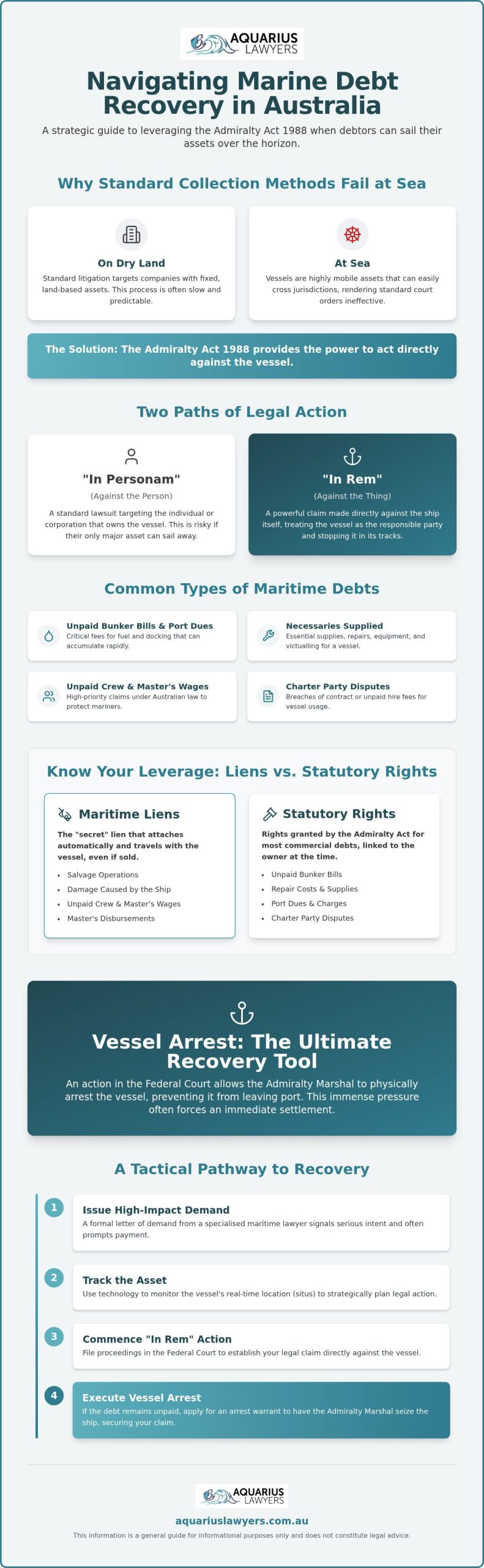
Marine debt recovery australia is a tactical operation that requires a deep understanding of how assets move across water. At its core, this process involves reclaiming unpaid fees for ship repairs, supplies, wages, or professional services provided to a vessel. Standard debt collection often hits a wall in the maritime sector because ships are inherently mobile. A debtor can sail their primary asset out of Australian waters before a standard court order is even processed. This mobility makes traditional “land-based” litigation risky and often ineffective.
The Admiralty Act 1988 (Cth) is the backbone of our recovery strategy. It provides creditors with the power to pursue “In Rem” actions, which are claims made directly against the ship itself rather than just the company that owns it. Suing “In Personam” targets the individual or corporation, but “In Rem” allows you to stop the ship in its tracks. This distinction is vital because it treats the vessel as the responsible party, ensuring that the asset remains within reach while the dispute is resolved.
Common Types of Maritime Debts in Australia
Maritime debts vary in complexity, but they all represent a significant threat to your cash flow. We frequently handle matters involving:
- Unpaid bunker bills and port dues: Fuel and docking fees are the lifeblood of shipping, and non-payment can lead to massive arrears.
- Necessaries supplied to a vessel: This is a broad term in maritime law covering essential supplies like repairs, victualling, and equipment.
- Unpaid crew wages: Australian law prioritises the rights of those who keep the ship moving, often giving these claims high priority.
- Charter party disputes: Disputes over unpaid hire fees or contract breaches require precise legal intervention to resolve.
The Jurisdictional Challenge: State vs. Federal Courts
Choosing the right court is a strategic decision that impacts both cost and speed. For smaller commercial debts where the vessel isn’t the primary focus, the NSW Local Court or similar state jurisdictions might be appropriate. However, for anything involving vessel arrest, the Federal Court of Australia has exclusive authority under the Admiralty Act. As of July 2026, the filing fee for a corporation to commence a proceeding in the Federal Court is $5,255. Identifying the “situs” of the debt, or the physical location of the vessel and the performance of the contract, is the first step in deciding where to file. Don’t waste time in a court that lacks the power to seize the asset you’re chasing.
Maritime Liens vs. Statutory Rights: Knowing Your Leverage
In the high-stakes environment of marine debt recovery australia, not all debts carry the same legal weight. Your ability to recover funds depends on whether you hold a maritime lien or a statutory right of action. These legal mechanisms provide the leverage needed to secure payment, but they operate under very different rules. Understanding these differences is the first step in deciding whether to pursue a vessel or the company behind it.
The Power of the Maritime Lien
A maritime lien is often called a “secret” lien because it exists automatically. You don’t need to register it or provide public notice for it to be valid. Under Australian law, these liens typically arise from specific, high-priority claims:
- Salvage operations that saved the vessel from peril.
- Damage caused by a ship, such as a collision or allision.
- Unpaid crew and master’s wages.
- Master’s disbursements for essential ship business.
The true power of a maritime lien is its durability. It travels with the ship. Even if the vessel is sold to a new, unsuspecting owner, the lien remains attached to the hull. This makes it an incredibly potent tool for recovery. However, you must act before the claim is superseded by later costs or expires under statutory time limits. Timing is everything.
Statutory Rights of Action in Rem
Most commercial debts, such as unpaid bunker bills, repair costs, or equipment supplies, fall under “statutory rights of action in rem.” These rights are granted by Sections 17, 18, and 19 of the Admiralty Act 1988. Unlike maritime liens, these rights only exist as long as the person who was the owner or charterer when the debt arose still owns or controls the vessel when you start the court action. If the ship is sold before you file your claim, your right to sue the ship vanishes. This creates a race against time. You must convert your standard invoice into a formal claim against the vessel before the debtor can offload the asset. It’s a binary outcome; you either have a claim against the ship, or you’re left chasing a potentially empty shell company.
When a ship is arrested and sold, the money is distributed according to a strict hierarchy. Generally, the Admiralty Marshal’s expenses are paid first. Maritime liens follow, then registered ship mortgages, and finally statutory rights holders. Knowing where your claim sits in this order is essential for managing litigation risk. At Aquarius Lawyers, we specialise in auditing your invoices to determine which pathway offers the highest probability of success. If you’re unsure where your claim sits, contact our marine law team for a strategic review of your position and to secure your place in the queue.
Vessel Arrest in Australia: The Ultimate Recovery Tool
Vessel arrest is the heavy artillery of marine debt recovery australia. It’s the most effective way to force a debtor to the table because a ship sitting idle in port is a ship losing money. When the Admiralty Marshal executes an arrest warrant, the vessel is taken into the custody of the Federal Court, effectively freezing the owner’s primary asset. This immediate pressure often triggers a settlement offer before the ship even misses its next tide. It’s a high-impact move that shifts the power dynamic instantly in your favour.
However, this power comes with a significant price tag and strict responsibilities. As of July 2026, the Federal Court filing fee to commence a proceeding is $5,255 for a corporation or $1,805 in other cases. Beyond the filing fee, you must provide an undertaking to the Marshal to cover the costs of safely keeping the vessel. These costs include the Marshal’s hourly salary plus a 20% loading for overheads, along with berthing fees and insurance. Getting the paperwork wrong can lead to a claim for “wrongful arrest,” where you might be liable for the shipowner’s lost profits. This is why expert counsel is non-negotiable before pulling the trigger on an arrest.
The Step-by-Step Arrest Process
The process begins with preparing a robust “Affidavit of Support” to satisfy the Court that a valid maritime claim exists. Once the warrant is issued, the Admiralty Marshal or their delegate physically “tags” the vessel, usually by affixing the warrant to the mast or bridge. From that moment, the ship is in the custody of the Court. Any attempt to move the vessel without permission is a contempt of court, carrying severe penalties. The Marshal then manages the vessel’s maintenance and security, funded by the arresting party’s deposit, until the debt is paid or the ship is sold.
Tactical Considerations for Small Businesses
Is arrest worth it for a $20,000 debt? It’s a pragmatic question. When you factor in the $5,255 corporate filing fee and Marshal’s deposits, the upfront costs can be significant. In many cases, the mere threat of arrest or the filing of the writ is enough to secure a “Letter of Undertaking” (LOU) from the ship’s P&I Club. An LOU is a guarantee from an insurer that they will pay the debt if the claim is proven, providing security without the high cost of a physical arrest. We often use the arrest process as a catalyst for mediation, forcing a no-nonsense settlement that protects your cash flow without the need for a full trial.
A Step-by-Step Pathway to Recovering Your Marine Debt
Successful marine debt recovery australia requires a methodical sequence of actions that blend legal precision with maritime logistics. It isn’t enough to simply be right; you must be ready to act before the vessel disappears over the horizon. A structured pathway ensures you don’t waste resources on empty threats while letting the debtor slip away. By following a clear strategic plan, you move from being a frustrated creditor to a proactive claimant with significant leverage.
The Critical First 48 Hours
Speed is your greatest ally when a debt goes unpaid. The first 48 hours should be dedicated to a rapid intelligence gathering operation. You need to assemble every contract, invoice, and piece of correspondence that proves the debt. Simultaneously, we recommend conducting a comprehensive “Ship Search” to identify the vessel’s current registered owners, any existing mortgages, and potential encumbrances. This data tells us if the ship is a viable target for recovery. We then issue a “No-Nonsense” Letter of Demand. This isn’t a standard reminder; it’s a formal signal of legal readiness that clearly outlines the intent to invoke Admiralty jurisdiction if payment isn’t received immediately.
While the demand is being processed, asset tracking becomes the priority. We use advanced tracking technology to monitor the vessel’s movements in real-time. Knowing exactly which port a ship is heading to allows us to have the necessary paperwork ready for filing the moment it enters Australian waters. You can’t arrest what you can’t find, so maintaining a digital eye on the asset is a vital part of our modern methodology.
Formal Legal Proceedings and Mediation
If the demand letter doesn’t trigger payment, the next step is filing the claim in the appropriate jurisdiction. While the Federal Court is the venue for vessel arrests, some smaller commercial disputes might be better suited for state-based mediation. The Australian marine industry is a tight-knit community, and a pragmatic settlement is often preferable to a scorched-earth legal battle. We use tech-integrated solutions to streamline document discovery, making the process faster and more cost-effective for our clients. In cases where the debt is indisputable, such as unpaid bunker bills with signed delivery receipts, we may pursue a Summary Judgement to bypass a lengthy trial and move straight to execution.
Execution is the final phase where the court’s decision is turned into actual cash flow. This might involve the judicial sale of the vessel or the seizure of other corporate assets. If you’re currently facing an unpaid invoice and need a clear strategy to get paid, contact our debt recovery experts to begin the recovery process today.
Why Aquarius Lawyers is Your Trusted Marine Debt Advisor
Choosing a representative for marine debt recovery australia isn’t just about finding a solicitor; it’s about partnering with a team that understands the rhythm of the wharf and the complexities of the courtroom. We don’t just see a case number; we see a business whose cash flow is being hindered by a debtor’s refusal to play by the rules. Our approach is built on a simple but effective formula: deep legal credentials plus real-world maritime grit equals efficient recovery. We move between high-level strategic thinking and no-nonsense practical advice to ensure you aren’t just winning a legal argument, but actually getting paid.
As an “innovative veteran” in the field, we prioritise efficiency over ceremony. We use modern technology to track assets and manage document discovery, but we back it up with traditional experience that knows how to read the subtle signals of a maritime dispute. Whether you’re a ship repairer in a regional port or a multinational supplier in the Sydney CBD, we provide a steady, common-sense guide through the legal fog. Our goal is to find the shortest, most cost-effective pathway to a resolution, keeping your interests protected at every turn.
Niche Expertise in Fisheries and Aquaculture
The Australian marine sector is diverse, and a “one-size-fits-all” approach to debt collection often fails. We possess specialised knowledge in recovering debts related to commercial fishing licences and quotas, assets that require a very specific legal touch. In the aquaculture space, we assist infrastructure providers and suppliers who face unique challenges. We understand the biological and seasonal factors that affect your debtors. This industry-specific insight allows us to anticipate excuses and counter them with facts, ensuring that your claim remains a priority even during difficult seasonal shifts.
Fixed Fees and Cost-Effective Solutions
Legal fees shouldn’t be a source of additional stress when you’re already chasing unpaid invoices. We’ve removed the “billable hour” anxiety by offering transparent fixed-fee arrangements for many of our services, including the drafting of formal letters of demand and specific court filings. This pricing model provides you with the cost certainty needed to make informed decisions about your litigation risk. We believe that professional expertise should be accessible and pragmatic, not hidden behind a veil of dense jargon and unpredictable costs. Our focus remains on protecting your bottom line while we fight for the money you’re owed.
If you’re tired of waiting for payment and want a representative who understands the unique pressures of the Australian maritime industry, it’s time to act. Organise a consultation with our marine debt specialists today to secure your interests and get your cash flow back on track.
Securing Your Maritime Interests and Protecting Your Cash Flow
Navigating the complexities of the Admiralty Act 1988 requires a balance of legal precision and practical industry knowledge. We’ve explored how understanding the difference between maritime liens and statutory rights defines your recovery strategy, and why vessel arrest remains the ultimate tool for bringing debtors to the table. Successful marine debt recovery australia isn’t just about filing paperwork; it’s about acting with speed and using the right jurisdictional leverage before an asset leaves our waters.
With offices in the Sydney CBD and regional NSW, Aquarius Lawyers provides the local reach and global perspective needed to resolve these high-stakes disputes. Principal Katherine Hawes, widely known as “The Fish Lawyer,” brings specialised expertise in fisheries and aquaculture to every claim. We believe in providing clear pathways and cost certainty through fixed-fee options, ensuring you can fight for what you’re owed without the anxiety of the billable hour.
Don’t let unpaid invoices sink your operations. Contact Aquarius Lawyers for a fixed-fee marine debt assessment and let us help you turn the tide on outstanding debts. You’ve done the work; now it’s time to ensure you get paid.
Frequently Asked Questions
Can I arrest a ship in Australia for any unpaid debt?
You can only arrest a ship for specific maritime claims defined by the Admiralty Act 1988 (Cth), such as unpaid crew wages, ship repairs, or port dues. General commercial debts that don’t relate to the vessel’s operation or maintenance usually don’t qualify for this specific legal remedy. Identifying whether your invoice meets the statutory criteria is the first step in successful marine debt recovery australia, as a wrongful arrest can lead to significant liability for damages.
How much does it cost to arrest a vessel in the Federal Court?
As of July 2026, the Federal Court of Australia charges a corporate filing fee of A$5,255 to commence a proceeding. You must also provide an undertaking to the Admiralty Marshal to cover the costs of the arrest, which include the Marshal’s hourly salary plus a 20% loading for overheads. These funds are used for berthing fees, insurance, and vessel maintenance. It’s common for the Court to require an initial deposit of several thousand dollars to cover these immediate out-of-pocket expenses.
What is a maritime lien and how does it differ from a standard debt?
A maritime lien is a powerful legal right that attaches directly to the vessel and survives a change in ownership. Unlike a standard debt, which is a claim against a person or company, the lien follows the ship even if it’s sold to an innocent third party. These liens are “secret” because they don’t require registration. They typically cover high-priority claims like salvage, crew wages, or damage caused by a ship collision, giving you a superior position in the hierarchy of creditors.
Can I recover marine debt if the vessel has already left Australian waters?
You can still pursue recovery, but the process becomes significantly more complex once a vessel crosses into international or foreign waters. Australian courts generally lose the power to arrest a ship once it leaves our jurisdiction. In these cases, we often pivot to international mediation or “In Personam” actions against the owning company. Alternatively, we use real-time tracking technology to monitor the vessel’s movements, allowing us to act immediately if the ship returns to any Australian port.
How long does the marine debt recovery process typically take?
The timeline varies based on the debtor’s response, but the threat of vessel arrest often triggers payment within days. A formal Letter of Demand usually allows seven to fourteen days for a response. If we proceed to arrest, many owners settle immediately to avoid the high costs of an idle ship. However, if the matter proceeds to a full trial in the Federal Court, the process can take several months or longer depending on the complexity of the evidence and the Court’s schedule.
Is it possible to recover legal costs as part of my marine debt claim?
In most Australian jurisdictions, the successful party is entitled to recover a portion of their legal costs from the debtor. The Federal Court of Australia typically follows the principle that “costs follow the event,” meaning the loser pays. Inclusion of a “Cost Recovery Clause” in your original service contract further strengthens your position. However, these awards usually cover “party and party” costs rather than your entire legal bill, so strategic efficiency remains vital for your bottom line.
Do I need a specialised maritime lawyer or will a general commercial solicitor do?
Marine debt recovery australia involves niche legislation like the Admiralty Act 1988 that most general commercial solicitors rarely encounter. Specialised practitioners understand the technicalities of vessel arrest and the strict hierarchy of maritime claims. Using a generalist risks procedural errors, such as a wrongful arrest, which can lead to massive damage claims against you. A maritime specialist provides the specific tactical leverage required to secure a ship and force a settlement without unnecessary legal bloat.
What happens if the vessel owner goes into liquidation during the process?
If a shipowner enters liquidation, your position depends on whether you hold a maritime lien or a statutory right. Maritime liens generally survive insolvency and are paid out of the ship’s sale proceeds before most other creditors. Statutory rights holders may find themselves ranked as unsecured creditors if the vessel wasn’t arrested before the liquidation began. This highlights why acting quickly to secure your interest is essential; waiting even a few days can be the difference between full recovery and a total loss.
Disclaimer
Please note that legal rules change and this is not a substitute nor construed as legal advice. It is general information only.