Imagine a routine port call in Brisbane or Fremantle suddenly grinding to a halt because of a suspected oily water separator fault or an accidental spill. In Australian waters, a minor technical oversight quickly escalates into a high-stakes legal crisis. You’re likely feeling the pressure of Australia’s “zero tolerance” enforcement, where a single Commonwealth penalty unit has risen to A$330 for offences committed after November 2024. Engaging an experienced vessel detention lawyer australia is often the difference between a managed resolution and a business-ending catastrophe.
We understand that the overlap of the Protection of the Sea Act and various state regulations feels like a minefield designed to catch you out. You want to protect your crew from criminal liability and keep your fleet moving without being buried under millions in security demands. This article provides the clarity you need to handle an investigation without losing your ship or your sanity. We’ll examine the 2026 AMSA National Compliance Plan and provide a clear, no-nonsense roadmap for defending your vessel and your reputation against aggressive prosecution. Expert defence plus proactive compliance equals business survival.
Key Takeaways
- Clarify the complex web of federal and state marine pollution laws to ensure your vessel stays compliant across all Australian jurisdictions.
- Understand the 2026 penalty structures and how a vessel detention lawyer australia protects your business from crippling fines and criminal charges.
- Master the “First 48 Hours” rule to manage early statements and protect your legal rights during AMSA or EPA investigations.
- Adopt a proactive compliance strategy that uses regular audits and updated SOPEPs to turn legal risk into operational certainty.
- Gain a pragmatic defence strategy that prioritises business survival by blending traditional maritime experience with modern, tech-savvy methodology.
Navigating Australia’s Marine Pollution Laws (MARPOL & Beyond)
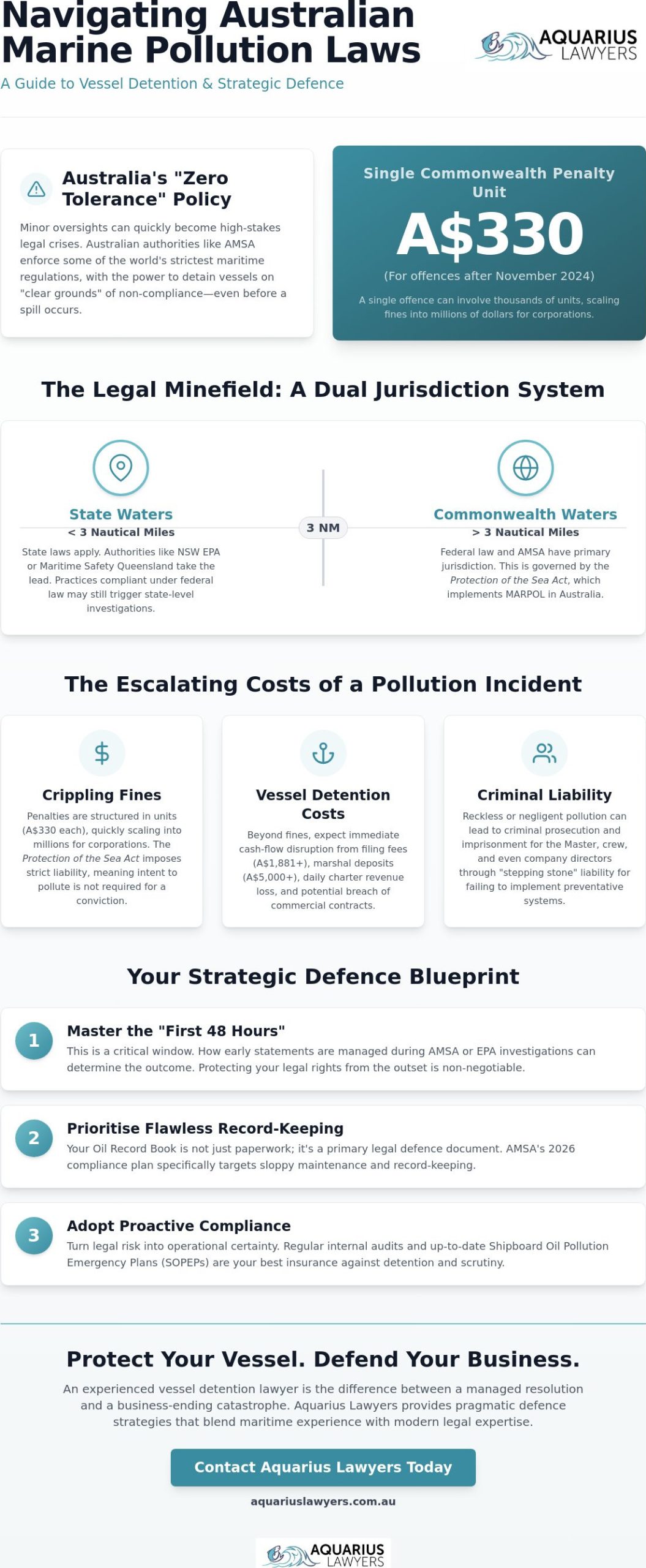
Australia’s coastline is one of the most strictly regulated maritime environments on the planet. If you’re operating a commercial vessel, you aren’t just dealing with international standards; you’re operating within a layered legal framework where federal and state authorities share the watch. The Australian Maritime Safety Authority (AMSA) acts as the primary regulator, enforcing a “zero tolerance” policy that is arguably the toughest in the Southern Hemisphere. Their focus isn’t limited to major oil spills. They target everything from chemical discharge and sewage to the estimated 130,000 tonnes of plastic that leak into Australian waters annually. Under International Marine Pollution Laws like the MARPOL 73/78 convention, AMSA has the power to stop your operations cold. A vessel detention lawyer australia is critical here because AMSA can detain your ship on “clear grounds” of non-compliance, even if a single drop of pollutant hasn’t hit the water.
The Interplay Between State and Federal Jurisdiction
The legal landscape changes based on your distance from the shore. Generally, the “three nautical mile rule” determines who has the final say. Inside three miles, state legislation and bodies like the NSW Environment Protection Authority (EPA) or Maritime Safety Queensland take the lead. Outside that limit, Commonwealth law applies. This dual system creates legal traps. A practice that is technically compliant under federal law might still trigger an investigation under state environmental statutes. This overlap is where many operators stumble, facing double the scrutiny and potentially conflicting directives during an incident. It’s a complex puzzle that requires a pragmatic legal strategy to solve.
The Protection of the Sea (Prevention of Pollution from Ships) Act
This Act is effectively the bible for maritime operators in Australia. It translates MARPOL into local law and introduces a concept that catches many by surprise: strict liability. In plain English, this means the prosecution doesn’t always need to prove you intended to pollute. If the discharge happened, the offence is often complete. “I didn’t mean to” isn’t a valid legal defence in this context. Your best defence starts with paperwork. Maintaining a flawless Oil Record Book is a legal requirement, not a suggestion. AMSA’s 2025-2026 compliance plan specifically targets shipboard maintenance and record-keeping. If your records are sloppy, a vessel detention lawyer australia will have a much harder time arguing against a detention order or a heavy fine.
The True Cost of a Spill: Penalties, Fines, and Criminal Liability
In Australia, the bill for a marine pollution incident arrives in several layers, and none of them are cheap. Under the Protection of the Sea (Prevention of Pollution from Ships) Act 1983, the financial penalties are structured to penalise corporations far more heavily than individuals, yet both face staggering risks. As of late 2024, a single Commonwealth penalty unit is valued at A$330. For a corporation, a single offence can involve thousands of these units, quickly scaling into millions of dollars. Beyond the fines, reckless or negligent pollution can lead to criminal prosecution and imprisonment for masters and crew members. This is where a vessel detention lawyer australia becomes your most vital asset. We help you manage the fallout before a technical investigation turns into a permanent criminal conviction.
The immediate fines are often just the tip of the iceberg. Clean-up Notices issued by AMSA or state EPAs require you to fund remediation efforts that can easily exceed the value of the vessel itself. Then there is the detention. While your ship is arrested, you are paying filing fees (A$1,881 for companies) and marshal deposits of at least A$5,000, all while losing daily charter revenue and potentially breaching commercial contracts. It is a cash flow strangulation that many smaller operators simply cannot survive without a pragmatic defence strategy.
Corporate vs Individual Responsibility
Can a director be held personally liable for a crew member’s mistake? In the Australian maritime sector, the answer is often yes. Directors and managers can face “stepping stone” liability if they failed to implement systems to prevent the breach. The law distinguishes between a genuine accident and negligent oversight. If you can prove a robust culture of due diligence, the court is often more inclined to view the incident as a mitigating factor rather than a systemic failure. We focus on demonstrating that your business prioritises compliance, even when things go wrong.
The Impact on Commercial Licences
For those in the primary production sector, a pollution conviction is a direct threat to your livelihood. Australian maritime law uses “Fit and Proper Person” tests for the holding of commercial fishing or aquaculture licences. A criminal record for environmental damage can trigger a mandatory review, potentially leading to the suspension or permanent loss of your quota. If you are facing this risk, consulting a fisheries lawyer australia is essential to protect your long-term assets and ensure your reputation remains intact within the industry.
Managing these risks requires more than just insurance; it requires a steady, common-sense guide who understands the high stakes of the maritime world. If you are currently under investigation, it is wise to seek a legal review of your position before making any formal statements to authorities.
Strategic Defence: How to Respond to an Investigation
The first 48 hours following a suspected pollution incident are the most critical for your business survival. This is the window where the foundation of your legal defence is laid. Every statement made by the master or crew, every entry in the logbook, and every digital record from onboard sensors becomes potential evidence. In Australia, regulators like AMSA are highly efficient at gathering data during the initial boarding. Engaging a vessel detention lawyer australia immediately ensures that your rights are protected before you provide information that could be used against you in a criminal court. Early tactical advocacy is the best way to prevent a minor technical fault from becoming a major liability.
You have a right to legal representation and, in many circumstances, a right to silence during formal interviews. While you must cooperate with safety directions, you are not required to provide self-incriminating evidence without proper advice. We focus on preserving the digital and physical paper trail. This includes securing engine room logs, GPS data, and internal communications. A proactive defence starts with a clear-headed assessment of the facts. We negotiate directly with regulators to prevent a detention order from turning into a long-term arrest. Our goal is to get your vessel back into service as quickly as possible, minimising the impact on your operational cash flow.
Navigating the Investigation Process
The investigation process follows a strict sequence. First, immediate notification is a legal requirement. Delaying a report of a spill can be a separate, serious offence. Second, expect a thorough boarding and inspection. Maritime officers will scrutinise everything from your Shipboard Oil Pollution Emergency Plan (SOPEP) to the physical state of your valves. Finally, if authorities suspect a breach, they will issue a caution before a formal interview. This is the PACE equivalent in Australian law. Never enter these interviews without a legal advisor who understands the nuances of maritime regulation. Practical wisdom beats panic every time.
Defending a Prosecution in Court
If the matter proceeds to court, several statutory defences may apply. Under Australian law, you might be cleared if the discharge was necessary to save a life or was the result of a sudden, unforeseen event that could not have been prevented. These aren’t just excuses. They are complex legal arguments that require backing from expert witnesses. We work with marine surveyors and environmental scientists to challenge the prosecution’s version of events. A vessel detention lawyer australia will tell you that a guilty plea should be the absolute last resort. It should only be considered after a comprehensive review of the entire brief of evidence. Strategy wins cases, and we prioritise results over ceremony.
Proactive Compliance: Protecting Your Business from Scrutiny
The most effective legal strategy is the one that keeps you out of the courtroom entirely. In the maritime industry, we use a simple but powerful formula: Clear Procedures + Regular Audits = Reduced Legal Risk. While we’ve discussed the high cost of penalties and the intensity of investigations, the best way to safeguard your livelihood is through a culture of proactive compliance. Waiting for an AMSA inspector to find a fault is a gamble you don’t need to take. Working with a vessel detention lawyer australia before an incident occurs allows you to identify gaps in your safety management system and fix them on your own terms. It’s about building a defensive perimeter around your operations.
Your Shipboard Oil Pollution Emergency Plan (SOPEP) shouldn’t be a dusty binder sitting on a shelf. It must be a living document that every crew member understands and can execute under pressure. Compliance is as much about people as it is about pipes and valves. Training your team on their legal obligations, rather than just technical operations, ensures they understand that an entry in the Oil Record Book is a legal declaration. To dive deeper into regional requirements, see our guide on Marine Pollution Laws: Staying Compliant in NSW. A legal audit of your current manuals can reveal hidden liabilities before they become expensive detention orders.
Risk Management for Aquaculture and Fisheries
Aquaculture and commercial fishing operations face unique environmental hurdles that go beyond standard shipping risks. Feed runoff, chemical disposal, and waste management are under constant scrutiny by state regulators. If you’re operating in Australian waters, implementing a specific legal compliance framework is the only way to meet modern standards. We recommend using technology like IoT sensors to provide a real-time, digital paper trail of your operations. This data acts as an objective witness in your favour if a regulator ever questions your environmental impact. It turns “we think we’re compliant” into “we can prove we’re compliant.”
Contractual Protections and Insurance
Your legal safety net is only as strong as your paperwork. Reviewing your charterparties and supply contracts for robust pollution indemnity clauses is a pragmatic step every owner should take. You need to know exactly who carries the financial burden if a spill occurs during a third-party operation. Equally important is your insurance policy. Don’t assume your standard cover includes the specialised costs of a vessel detention lawyer australia or the specific statutory fines following a conviction. Many policies have exclusions that only a legal professional can spot. Managing the fallout of a ship arrest on your existing commercial contracts requires a strategic approach to avoid secondary breach-of-contract claims.
If you haven’t reviewed your compliance manuals or insurance fine print in the last twelve months, contact us for a comprehensive legal audit of your maritime operations to ensure your business is fully protected.
Why Aquarius Lawyers is Your Trusted Maritime Partner
Choosing the right legal partner is about finding a balance between high-level strategic thinking and relatable, everyday wisdom. At Aquarius Lawyers, we bridge that gap. Led by Katherine Hawes, known across the industry as “The Fish Lawyer,” our firm brings a down-to-earth pragmatism to complex maritime disputes. We aren’t just academics in suits. We understand the practicalities of a working vessel deck as well as the nuances of the courtroom. If you’re facing an AMSA investigation, a vessel detention lawyer australia from our team prioritises one thing: getting your ship back on the water as quickly as possible. We value results over ceremony, ensuring your business stays afloat while we handle the regulatory pressure.
Our firm operates as an “innovative veteran.” We combine decades of traditional maritime credentials with a forward-thinking, tech-savvy methodology. Whether we’re using digital data to challenge a pollution report or drafting proactive compliance audits, our approach is always solution-oriented. We offer accessible legal counsel with offices in Sydney and Shellharbour, providing a local presence for both metropolitan and regional operators. Working with a vessel detention lawyer australia who understands the local landscape helps you manage your overheads, especially since we focus on cost-effective, fixed-fee arrangements for specific maritime matters. You get certainty in your legal costs and confidence in your defence strategy.
A Niche Expertise You Won’t Find in Big Law
While Big Law firms focus on high-level corporate interests and container ship casualties, we understand the specific grit of the local industry. Our niche expertise is built on a deep understanding of the Australian commercial fishing and aquaculture sectors. We have a proven track record in defending everyone from individual skippers in regional NSW to innovative aquaculture startups in the emerging blue economy. Because we’re a multi-disciplinary firm, we move easily between criminal, commercial, and marine law. This versatility is crucial when a pollution incident triggers both a criminal investigation and a commercial contract dispute. We provide a single, steady hand to guide you through every legal challenge, ensuring your commercial interests are never sacrificed for legal ceremony.
Get in Touch for a No-Nonsense Consultation
A legal crisis doesn’t have to be confusing. We speak plain English, not archaic legal jargon, ensuring you always understand your position and your options. If you’re worried about a recent boarding or want to shore up your compliance before the next AMSA inspection, start with an initial advisory session. We’ll provide a clear-headed assessment of your situation and a pragmatic pathway forward. Don’t let a technical oversight or a complex regulation sink your livelihood. You can protect your maritime business today with Aquarius Lawyers and gain the confidence that comes with expert, down-to-earth representation.
Secure Your Vessel’s Future and Operational Continuity
Australia’s zero-tolerance approach to marine pollution means that a single technical oversight can quickly threaten your entire livelihood. We’ve explored how early tactical advocacy and robust compliance strategies can mitigate the risk of crippling fines and criminal charges. By prioritising a culture of due diligence and understanding the interplay between federal and state laws, you can turn regulatory pressure into operational certainty. Engaging a vessel detention lawyer australia early in an investigation is the most effective way to protect your crew and keep your fleet moving.
Principal Katherine Hawes, known as The Fish Lawyer, offers specialist expertise in Fisheries, Marine, and Aquaculture Law that you won’t find at a generalist firm. With offices in Sydney and Shellharbour, we provide regional accessibility and a down-to-earth approach that values results over ceremony. We speak plain English and offer the pragmatic guidance needed to navigate today’s complex maritime environment. Don’t wait for a detention order to find out if your compliance holds up. Book a consultation with The Fish Lawyer today to secure your business. Your reputation is worth defending, and we’re here to help you stay on the water with confidence.
Frequently Asked Questions
What is the maximum fine for marine pollution in Australia?
Fines are calculated using penalty units, which are currently valued at A$330 for Commonwealth offences committed on or after 7 November 2024. For a corporation, a major pollution offence can involve thousands of these units, meaning the maximum penalty can easily exceed A$10 million for a single incident. The final amount depends on whether the prosecution is handled under federal law or specific state environmental statutes.
Can I be jailed for an accidental oil spill in NSW?
Imprisonment is generally reserved for cases involving gross negligence or wilful misconduct rather than simple accidents. However, under the NSW Protection of the Environment Operations Act, reckless or intentional acts that cause serious environmental harm can lead to jail terms for masters or directors. While a genuine accident usually results in a fine, the legal threshold for negligence is often lower than many operators realise.
Do I have to report a minor spill if I cleaned it up immediately?
Yes, you must report any discharge of a prohibited substance regardless of your successful clean-up efforts. Failing to notify the authorities “without delay” is a standalone offence that often carries heavier penalties than the spill itself. Australian regulators take a dim view of delayed reporting, as it prevents them from verifying the incident’s impact and your remediation methods.
What is the difference between AMSA and the EPA in a pollution case?
The primary difference is their area of jurisdiction. AMSA is the federal regulator responsible for vessel safety and pollution in Commonwealth waters, which generally start three nautical miles from the coast. The EPA, along with state maritime bodies, manages incidents that occur within that three-mile limit. It’s common for both agencies to collaborate during a major investigation into a vessel’s compliance history.
Does my marine insurance cover fines for pollution?
Most P&I insurance policies cover the costs of clean-up, remediation, and your legal defence, but they often exclude statutory fines. Insurers generally won’t pay fines that result from a criminal conviction or instances of gross negligence. It is vital to have your vessel detention lawyer australia review your policy’s fine print to understand exactly what financial risks remain on your balance sheet.
How long do I have to report a pollution incident to the authorities?
The law requires you to report an incident “as soon as reasonably practicable,” which in practice means immediately after the vessel and crew are safe. There is no grace period for administrative convenience. If you wait several hours to consult your head office before notifying AMSA or the state EPA, you risk being charged with failing to report a pollution incident.
What should I do if an AMSA officer wants to interview me without a lawyer?
You should politely decline to answer substantive questions until you have sought legal advice. While you must cooperate with immediate safety directions and provide required vessel documentation, you have a right to legal representation during a formal interview. Contacting a vessel detention lawyer australia before the interview begins is the best way to ensure your statements aren’t used against you in a later prosecution.
Can a marine pollution conviction affect my commercial fishing quota?
Yes, a conviction for an environmental offence can directly threaten your commercial fishing or aquaculture licence. Regulatory bodies like AFMA and state fisheries departments apply “Fit and Proper Person” tests to licence holders. A criminal record for pollution can trigger a mandatory review, which may result in the suspension or permanent cancellation of your quota and your ability to work in the industry.
Disclaimer
Please note that legal rules change and this is not a substitute nor construed as legal advice. It is general information only.