Your vessel’s insurance policy won’t keep you out of a criminal courtroom. That’s the reality facing commercial operators, vessel masters, and port facility managers across Australia’s maritime sector, and it’s one that catches far too many people off surprise. If you’re searching for a marine pollution lawyer Australia can rely on, chances are you’re already grappling with something serious: a spill, an AMSA investigation, or a prosecution notice that’s landed on your desk with very little warning.
That instinct to treat a pollution incident as an administrative inconvenience is completely understandable. The paperwork is complex, the regulations are layered across Commonwealth and State jurisdictions, and the difference between an AMSA matter and a Transport for NSW matter isn’t always obvious from the outside. Add the spectre of personal criminal liability for an accidental discharge, and it’s easy to see why operators feel overwhelmed.
This article cuts through that confusion. You’ll gain a clear picture of how Australia’s strict liability framework actually works, what your obligations are in the critical hours following an incident, and how a structured legal defence strategy can protect both your commercial licences and your reputation. Let’s get into it.
Key Takeaways
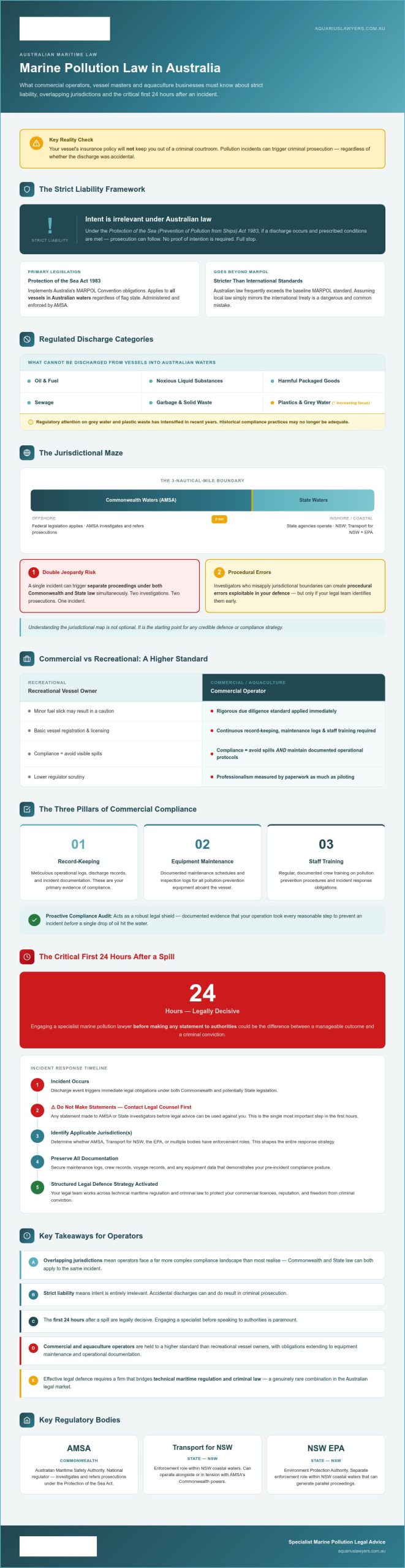
- Australia’s marine pollution laws operate across overlapping Commonwealth and State jurisdictions, meaning commercial operators face a far more complex compliance landscape than most realise until it’s too late.
- Strict liability provisions mean that intent is irrelevant — if a discharge occurs, prosecution can follow regardless of whether it was accidental, making proactive compliance and meticulous record-keeping your first line of defence.
- The critical first 24 hours after a spill are legally decisive; engaging a specialist marine pollution lawyer Australia operators can rely on before making any statement to authorities could be the difference between a manageable outcome and a criminal conviction.
- Commercial and aquaculture operators are held to a higher standard of due diligence than recreational vessel owners, with obligations extending well beyond simply avoiding spills to encompass equipment maintenance and operational documentation.
- Strategic legal defence in this space requires a firm that bridges technical maritime regulation and criminal law — a combination that is far rarer than most operators assume when searching for representation.
What is Marine Pollution Law in Australia?
At its core, marine pollution law governs what can and cannot be discharged from vessels into Australian waters. That covers oil, noxious liquid substances, harmful packaged goods, sewage, garbage, and increasingly, plastics and grey water. The regulatory framework is dense, deliberately so, because the consequences of getting it wrong extend far beyond a single vessel or operator.
Australia’s approach is built on two foundations: international treaty obligations and domestic legislation that often goes further than those treaties require. That combination creates a compliance environment where operators can be caught out not by ignoring the rules, but by assuming Australian law simply mirrors the international standard.
Key Legislation: The Protection of the Sea Act
The primary Commonwealth instrument is the Protection of the Sea (Prevention of Pollution from Ships) Act 1983, which implements Australia’s obligations under the MARPOL Convention. It applies to all vessels operating in Australian waters, regardless of flag state. The Australian Maritime Safety Authority (AMSA) is the national regulator responsible for enforcement, investigation, and prosecution referrals under this framework.
What separates Australian law from the baseline MARPOL standard is the strict liability structure embedded in the Act. Strict liability means no proof of intention is required. If a discharge occurs, and the prescribed conditions are met, prosecution can follow. Full stop. Operators who approach compliance as a paperwork exercise rather than a genuine operational priority are particularly exposed under this model.
Regulatory attention has also intensified around grey water discharge and plastic waste in recent years, reflecting both community expectations and evolving enforcement priorities. Operators should not assume that historical compliance practices remain adequate without reviewing current AMSA guidance.
State vs Commonwealth Jurisdiction
Here’s where it gets genuinely complex. The three-nautical-mile limit broadly marks the boundary between Commonwealth jurisdiction and State jurisdiction, but that line is not always clean in practice. Within NSW coastal waters, Transport for NSW and the Environment Protection Authority (EPA) both have enforcement roles that can operate alongside, or sometimes in tension with, AMSA’s Commonwealth powers.
Jurisdictional overlap creates two practical risks. First, an operator can face separate proceedings under both Commonwealth and State law arising from the same incident. Second, procedural errors made by investigators who misapply jurisdictional boundaries can sometimes be leveraged as part of a defence strategy, but only if your legal team identifies them early.
For anyone searching for a marine pollution lawyer Australia operators can trust, understanding this jurisdictional map isn’t optional. It’s the starting point for any credible defence or compliance strategy.
The Regulatory Maze: Compliance for Commercial and Aquaculture Operators
Commercial vessel owners operate under a microscope. Unlike recreational boaties, who might receive a caution for a minor fuel slick, commercial and aquaculture operators are held to a rigorous standard of due diligence. In the eyes of the regulator, your professionalism is measured by your paperwork as much as your piloting. This means compliance isn’t just a matter of avoiding a visible spill; it’s a continuous cycle of record-keeping, equipment maintenance logs, and staff training.
A proactive Compliance Audit acts as a robust legal shield, providing documented evidence that your operation has taken every reasonable step to prevent an incident before a single drop of oil hits the water. If you’re looking to fortify your business against statutory risk, a marine law specialist can identify the gaps in your current protocols before they become liabilities.
Pollution Risks in the Aquaculture Sector
Aquaculture leases present a unique set of legal challenges that traditional maritime law often overlooks. You aren’t just managing a vessel; you’re managing a coastal ecosystem. This involves balancing biosecurity protocols with the management of chemical discharges and nutrient loading. Failure to manage these can lead to heavy fines under both State and Commonwealth law.
Passive pollution is a growing area of concern for regulators. Farm infrastructure, such as degrading plastics or treated timber, can lead to statutory offences even if no specific “incident” has occurred. Principal Katherine Hawes, widely known as “The Fish Lawyer,” works closely with aquaculture startups and established farms to build compliance directly into their business plans, ensuring biosecurity and environmental obligations are met from day one.
Mandatory Record Keeping and SOPEPs
The Shipboard Oil Pollution Emergency Plan (SOPEP) is your primary defence document, but an outdated plan is a significant liability. If your SOPEP hasn’t been reviewed to reflect current operational realities, it becomes evidence of negligence rather than a tool for mitigation. Regulators expect these plans to be living documents, not something that gathers dust in a locker.
During an AMSA audit, your Oil Record Book is the first thing an inspector will request. Administrative errors in these logs often lead to “technical” pollution offences, where the fine is triggered by the failure to record an action correctly, rather than an actual discharge. When facing these high-stakes audits, having a marine pollution lawyer Australia operators trust can help you navigate the specific requirements of the Protection of the Sea Act and avoid unnecessary penalties for simple clerical mistakes.
Statutory Prosecutions: When an Incident Becomes a Criminal Matter
A pollution incident doesn’t stay in the regulatory lane for long. Once AMSA refers a matter to the Commonwealth Director of Public Prosecutions, or a State authority escalates its investigation, you’re no longer dealing with an administrative process. You’re in the criminal jurisdiction, with everything that entails: formal charges, a public record, and the real prospect of penalties that can end a business or put an individual behind bars.
The penalties under the Protection of the Sea (Prevention of Pollution from Ships) Act 1983 are serious. For corporations, fines can reach into the millions of dollars depending on the nature and scale of the discharge. For individual officers and masters, custodial sentences are not theoretical; they’re on the table. These aren’t numbers designed to frighten; they’re the legislated ceiling that prosecutors can pursue, and they’ve been applied in Australian courts.
This is where the strict liability trap bites hardest. As established earlier, intent is irrelevant to the charge itself. But intent, context, and operational conduct are absolutely relevant to penalty, to the availability of defences, and to how a skilled legal team frames your position before the court. “I didn’t mean to” won’t get you acquitted. A well-constructed technical and legal defence might.
The “innovative veteran” approach to defending these matters means combining rigorous legal strategy with the kind of technical knowledge that can actually challenge the prosecution’s evidence at its foundations. That’s the edge that separates a credible defence from a reactive one.
Defending the Master and the Owner
Personal liability is one of the most misunderstood aspects of maritime prosecution. A vessel’s Master can face charges even if they were off-watch at the time of a discharge, because their duty of command doesn’t clock off. Corporate structures offer limited protection too; directors and senior officers can be held personally liable where they’ve failed to take reasonable steps to prevent an offence. The corporate veil in maritime law is thinner than most operators assume. One strategic pathway worth exploring early is the negotiation of an Enforceable Undertaking with the regulator, which, in appropriate circumstances, can resolve a matter without a criminal conviction on the record.
The Role of Expert Evidence in Pollution Trials
Technical evidence is often where prosecutions are won or lost. Hydrographic modelling can dispute whether a discharge originated from your vessel at all. Challenging AMSA’s sampling methodology and chain of custody procedures can undermine the evidentiary foundation of the case. This is where engaging a marine pollution lawyer Australia operators trust becomes decisive; a legal team that understands fisheries science and environmental monitoring doesn’t just cross-examine witnesses, it dismantles assumptions. That cross-disciplinary fluency, sitting at the intersection of maritime regulation, environmental science, and criminal law, is precisely what Aquarius Lawyers brings to these matters.
Incident Management: The Critical First 24 Hours
The moments immediately following a spill or discharge are legally perilous in a way that most operators simply aren’t prepared for. Every statement made on board, every radio transmission, every entry logged in the hours after an incident can be subpoenaed and used in court. The environment is chaotic, the pressure is intense, and the instinct to explain yourself is entirely human. That instinct can cost you everything.
AMSA officers and Water Police carry significant powers of entry, search, and seizure. They can board your vessel without a warrant in many circumstances, compel the production of records, and interview crew members on the spot. Knowing what you’re legally required to provide, and what you’re entitled to withhold, is not something you should be working out in real time.
Your two goals in those first 24 hours are non-negotiable: mitigate the environmental harm, and protect your legal rights. These objectives aren’t in conflict. They run in parallel. One critical tool for achieving the second is understanding Legal Professional Privilege, which is the legal protection that shields communications between a client and their lawyer, and documents created for the dominant purpose of obtaining legal advice, from being compelled as evidence by a regulator or court. If you commission an internal incident report, the circumstances under which it’s prepared will determine whether it’s protected or discoverable.
Step-by-Step Response Protocol
Follow this sequence without deviation:
- Trigger your SOPEP immediately. Notify AMSA and the relevant Port Authority as required. Delayed notification is itself an offence, and regulators treat it as evidence of a cover-up rather than confusion.
- Cease non-essential communications on board. Don’t discuss what happened, who was responsible, or what the cause might be until you’ve spoken to legal counsel. That includes conversations between crew members in earshot of investigators.
- Document everything contemporaneously. Photographs, GPS logs, weather conditions, sea state, and equipment status at the time of the incident all form the factual foundation of your defence. Gaps in this record are difficult to fill later.
- Do not submit to an AMSA interview without a solicitor present. This isn’t obstruction; it’s your right. An interview without legal representation is one of the most common ways a manageable incident becomes a criminal conviction. Contact a marine pollution lawyer Australia operators can rely on before you say a word.
Dealing with Vessel Arrest and Detention
AMSA has the power to detain a vessel until adequate security is provided, typically in the form of a bank guarantee or a Letter of Undertaking (LOU) from your P&I Club or insurer. An LOU is generally the faster pathway; it avoids the liquidity pressure of a cash guarantee and signals to the regulator that your operation is professionally managed. Getting your P&I Club on the phone within hours, not days, is essential.
Every day your vessel sits under detention is a commercial loss. Minimising that loss of hire window requires simultaneous legal and commercial action: challenging the detention conditions where grounds exist, progressing the LOU negotiation, and maintaining open communication with your insurer. These aren’t sequential steps; they happen concurrently, which is exactly why having a single legal team that understands both the regulatory and commercial dimensions matters so much.
If you’re facing an active investigation or vessel detention right now, contact Aquarius Lawyers to get the right legal framework in place before the situation escalates further.
Why Aquarius Lawyers is Your Strategic Maritime Partner
Most law firms will tell you they handle maritime matters. Few can tell you the difference between a SOPEP deficiency and a biosecurity breach without pausing to look it up. That distinction matters enormously when you’re facing an AMSA investigation or a statutory prosecution where the technical details are the whole ballgame.
Aquarius Lawyers occupies a genuinely rare position in Australian legal practice: a firm that combines deep niche expertise in marine, fisheries, and aquaculture law with a robust criminal defence capability. That combination isn’t accidental. It’s the product of deliberate practice-building around the specific legal risks that commercial operators, vessel masters, and aquaculture businesses actually face. When you’re searching for a marine pollution lawyer Australia operators can rely on, you need both dimensions working together, not a generalist firm learning your industry on your time.
Principal Katherine Hawes, widely known as “The Fish Lawyer,” brings a perspective to pollution matters that no volume-based firm can replicate. Her background in fisheries law means she understands the operational realities of commercial fishing and aquaculture from the inside, not just as regulatory abstractions. That translates directly into sharper instructions to experts, more targeted cross-examination, and a defence strategy built on how your industry actually works.
A Proactive Approach to Maritime Law
The best pollution defence is the one you build before anything goes wrong. Aquarius Lawyers works with operators to develop compliance frameworks that hold up under audit scrutiny, covering Oil Record Book procedures, SOPEP currency, and staff training protocols. Fixed-fee options are available for compliance reviews and contract drafting, giving your business genuine cost certainty rather than an open-ended hourly meter. The firm also integrates digital evidence tools into defence preparation, using GPS data, AIS records, and electronic logs to construct a factual timeline that challenges prosecutorial assumptions at their foundation.
Size isn’t the same as capability. Larger regional practices may offer breadth, but breadth without specialist depth is a liability in a statutory prosecution. What Aquarius Lawyers offers instead is direct access to senior legal counsel who knows this space, combined with the agility to respond quickly when a situation escalates.
Contact ‘The Fish Lawyer’ Today
With offices in Sydney and regional NSW, the firm is positioned to respond to incidents across Australia’s major ports and coastal operations. Whether you’re managing an active investigation, preparing for an AMSA audit, or building a compliance programme from scratch, the pathway forward starts with a direct conversation.
Protect your maritime future and get in touch with Aquarius Lawyers today. Don’t wait for a prosecution notice to find out whether your legal representation understands the difference between a noxious liquid substance and a harmful packaged good. That knowledge should already be in your corner.
Your Maritime Future Starts With the Right Legal Partner
Australia’s marine pollution framework is unforgiving by design. Strict liability provisions don’t care about your intentions, jurisdictional overlaps create exposure most operators never see coming, and the critical decisions made in the first hours after an incident can define the outcome of everything that follows. Getting those decisions right requires specialist knowledge that sits at the intersection of technical maritime regulation and criminal law.
That’s precisely the ground that Aquarius Lawyers occupies. With Principal Katherine Hawes, “The Fish Lawyer,” bringing genuine fisheries and aquaculture expertise to every matter, the firm delivers cost-effective, strategic solutions that a generalist practice simply can’t match. Whether you’re building a compliance framework before anything goes wrong, or you’re already facing an AMSA investigation, the pathway forward is the same: get the right expertise in your corner early.
Don’t wait for a prosecution notice to find out whether your legal team truly understands this space. Secure expert maritime defence with Aquarius Lawyers today, and approach your operations with the confidence that comes from having a specialist marine pollution lawyer Australia operators can genuinely rely on.
Frequently Asked Questions
What are the immediate reporting requirements for a marine pollution incident in Australia?
You must notify AMSA and the relevant Port Authority as soon as practicable after a discharge occurs or is discovered. Delayed notification is itself a separate offence under the Protection of the Sea (Prevention of Pollution from Ships) Act 1983, and regulators treat it as evidence of deliberate concealment rather than simple confusion. The specific notification pathway depends on where the incident occurred and which jurisdiction applies.
Practically speaking, trigger your SOPEP first, then make the required notifications. Document the time and method of every communication you make. If you’re uncertain whether your notification obligations have been fully met, contact a specialist before submitting any written incident report, because the way that document is prepared affects whether it’s protected by legal professional privilege.
Can a vessel master be jailed for an accidental oil spill?
Yes. Custodial sentences are a genuine possibility for Masters under Australia’s marine pollution framework, not a theoretical worst case. Because the offences carry strict liability, the fact that a discharge was accidental doesn’t remove criminal exposure. Individual Masters can face personal prosecution regardless of whether the vessel owner is also charged, and the duty of command doesn’t pause when you’re off-watch.
That said, the circumstances surrounding an accidental spill, including your SOPEP compliance, your response protocol, and your operational record-keeping, are directly relevant to penalty and to the construction of a credible defence. Engaging a marine pollution lawyer Australia operators can rely on before making any statement to investigators is the single most important step a Master can take.
What is the difference between MARPOL and Australian domestic pollution laws?
MARPOL is the international convention that sets baseline standards for preventing vessel-source pollution globally. Australia ratified MARPOL and implemented it domestically through the Protection of the Sea (Prevention of Pollution from Ships) Act 1983. The critical distinction is that Australian domestic law often imposes stricter obligations and higher penalties than the MARPOL baseline requires.
Operators who assume that meeting MARPOL standards means they’re compliant with Australian law are taking a significant risk. State legislation adds another layer entirely, with NSW EPA and Transport for NSW carrying enforcement powers within coastal waters that operate alongside, not instead of, AMSA’s Commonwealth jurisdiction. Compliance requires understanding both frameworks simultaneously.
How much are the fines for marine pollution in NSW for 2026?
Penalty amounts under both Commonwealth and State legislation are calculated using penalty units, and those unit values are periodically updated. Under the Protection of the Sea Act, corporate penalties can reach into the millions of dollars for serious discharges, while individual officers and Masters face substantial fines in addition to potential custodial sentences. NSW State penalties under environment protection legislation operate separately and can apply concurrently.
Because penalty unit values are subject to legislative adjustment, we’d recommend verifying current figures directly with AMSA or through a specialist maritime lawyer rather than relying on any single published figure. What doesn’t change is the structure: corporations face higher ceilings than individuals, and repeat offences or aggravating conduct attract significantly elevated penalties.
Does my marine insurance cover the cost of a criminal defence lawyer?
Standard hull and machinery policies generally don’t cover criminal defence costs. P&I Club cover may extend to certain legal expenses connected to a pollution incident, particularly civil liability and regulatory response costs, but criminal defence representation is frequently excluded or subject to specific conditions. Assuming your insurer will cover your solicitor’s fees in a prosecution is a mistake that operators make far too often.
Review your P&I Club rules and your hull policy wording carefully, ideally before an incident occurs rather than after. Your P&I Club should be contacted promptly following any incident to preserve your cover entitlements, but their interests and your personal criminal defence interests aren’t always aligned. Independent legal representation protects you in ways that insurer-appointed advisers may not.
What should I do if AMSA officers board my vessel for a pollution inspection?
Cooperate with lawful boarding, but understand the boundaries of what you’re legally required to provide. AMSA officers have broad powers to inspect records, take samples, and interview crew, but those powers have limits. Produce your Oil Record Book, your SOPEP, and your certificates as requested. Don’t volunteer additional information, commentary, or explanations beyond what’s formally required.
Crew members have the right to decline an interview until legal counsel is present, and exercising that right isn’t obstruction. If the inspection escalates into a formal investigation, or if officers begin seizing documents and equipment, contact a specialist maritime lawyer immediately. The statements made during an unguided inspection are frequently the foundation of a subsequent prosecution.
Can I be prosecuted for pollution if the spill happened outside the 12-nautical-mile limit?
Yes. Australia’s jurisdiction under the Protection of the Sea Act extends well beyond 12 nautical miles for vessels operating in Australian waters, which includes the Exclusive Economic Zone extending to 200 nautical miles from the baseline. Foreign-flagged vessels transiting Australian waters can also face prosecution depending on the circumstances of the discharge and the flag state’s treaty arrangements with Australia.
The 12-nautical-mile mark is often confused with the outer limit of Australian enforcement jurisdiction, but it actually marks the boundary between the territorial sea and the contiguous zone. Discharges in the EEZ can still attract Commonwealth prosecution, particularly for oil and noxious liquid substances. If your incident occurred offshore, the precise location matters enormously to the jurisdictional analysis.
What is ‘strict liability’ and how does it affect my maritime pollution case?
Strict liability means the prosecution doesn’t need to prove you intended to cause a discharge. If the physical act of discharging a prohibited substance into Australian waters is established, the offence is made out regardless of your mental state at the time. There’s no defence of “I didn’t mean to” or “I didn’t know it was happening.” The offence attaches to the act itself.
What strict liability doesn’t eliminate is your ability to mount a technical defence or challenge the prosecution’s evidence. Disputing whether the discharge actually occurred, whether it originated from your vessel, or whether the sampling methodology was sound are all legitimate pathways. Penalty mitigation, enforceable undertakings, and the factual context of your response all remain relevant. Strict liability makes prosecution easier to initiate; it doesn’t make a well-constructed defence impossible.
Disclaimer
Please note that legal rules change and this is not a substitute nor construed as legal advice. It is general information only.