A single accidental discharge in NSW waters can now trigger a corporate fine of up to A$10 million, effectively ending your commercial operations overnight. You have likely spent years building your fishing or aquaculture business, only to find yourself caught in a confusing web of AMSA and NSW EPA regulations that feel increasingly punitive. It is completely natural to feel overwhelmed by the threat of a criminal record or the potential loss of your hard-earned quotas due to a mechanical failure or an honest mistake.
You can protect your assets and your reputation by implementing a proactive legal strategy that prioritises administrative compliance as much as physical containment. This article explores the impact of the Environment Protection Legislation Amendment Act 2024 and explains how a specialist vessel seizure lawyer nsw can help you avoid or minimise these life-altering penalties. We will outline the exact steps needed to safeguard your aquaculture licences and provide a clear roadmap for staying on the right side of the Land and Environment Court. By combining traditional maritime experience with a modern, strategic approach, you can ensure your business remains resilient against shifting environmental laws.
Key Takeaways
- Identify the broad range of substances classified as marine pollution in NSW, including sewage, plastics, and environmental factors like noise and light.
- Clarify the regulatory boundaries between AMSA and the NSW EPA to avoid jurisdictional confusion and ensure total compliance in all Australian waters.
- Understand the severe financial risks of the tiered penalty system and how a vessel seizure lawyer nsw can protect your assets from aggressive enforcement.
- Implement a 2026 compliance checklist focusing on rigorous maintenance records and documented staff training to mitigate the risk of strict liability offences.
- Learn how expert legal representation can challenge forensic evidence or negotiate reduced charges to safeguard your commercial fishing quotas and aquaculture licences.
What Constitutes Marine Pollution Under Australian Law?
Australian marine law is notoriously strict. For a commercial operator, understanding What is Marine Pollution? starts with recognising that “pollution” goes far beyond a visible oil slick. Under the Protection of the Sea (Prevention of Pollution from Ships) Act 1983, marine pollution is any discharge of harmful substances into the sea. This encompasses everything from fuel and chemicals to plastics and sewage. In sensitive NSW environments, such as marine parks or aquaculture zones, the definition expands even further. Authorities now monitor noise, heat, and artificial light, as these can disrupt local ecosystems and trigger heavy penalties under the Protection of the Environment Operations (POEO) Act.
It is vital to differentiate between the types of discharge. An accidental discharge might occur due to a burst hydraulic line, while an operational discharge involves the planned release of treated waste that must meet strict MARPOL standards. Illegal dumping, however, is the intentional disposal of waste to save on costs. Regardless of the category, the NSW EPA has the power to intervene. If your business is accused of a breach, a vessel seizure lawyer nsw can help determine if the discharge was legally “permitted” or if the prosecution has failed to meet the necessary evidentiary thresholds.
The Scope of Harmful Substances
Modern regulations are designed to be all-encompassing. Under the 2026 standards, MARPOL categories include Annex I (Oil), Annex II (Noxious Liquid Substances), and Annex III (Packaged Harmful Substances). For NSW operators, “grey water” and sewage are particularly high-risk areas. Discharging untreated sewage in a harbour or near an oyster lease is a fast-track to a Tier 1 prosecution. Under the Protection of the Sea (Prevention of Pollution from Ships) Act 1983, a harmful substance is defined as any substance which, if introduced into the sea, is liable to create hazards to human health, harm living resources and marine life, damage amenities, or interfere with other legitimate uses of the sea.
Strict Liability: Why “I Did Not Mean To” Is Not a Defence
Most environmental offences in Australia are “strict liability” crimes. This means the prosecution does not have to prove you intended to pollute. They only need to prove the discharge occurred from your vessel. In court, “I didn’t mean to” carries very little weight. Instead, your primary legal shield is the “due diligence” defence. You must prove that you took every reasonable precaution to prevent the incident. A specialised vessel seizure lawyer nsw will scrutinise the prosecution’s evidence, often finding flaws in how water samples were collected or how forensic data was mapped to your vessel’s position. Proving a rigorous maintenance schedule and clear staff protocols is often the only way to avoid a conviction when the law assumes you are at fault.
Navigating the Maze of NSW and Commonwealth Regulations
Managing a commercial vessel in NSW means answering to two different masters. The Australian Maritime Safety Authority (AMSA) manages Commonwealth waters, but once you cross into state territory, the NSW Environment Protection Authority (EPA) takes charge. Their authority stems from the Protection of the Environment Operations Act 1997 (POEO Act), a piece of legislation designed for aggressive enforcement. When a spill happens in a local harbour or estuary, the hierarchy of authority is usually swift. The EPA leads the environmental response, while Transport for NSW handles the navigational safety aspects. This dual-layered oversight creates a complex regulatory environment where a single mistake can lead to multiple prosecutions.
Commonwealth vs. State Jurisdiction
The 3-nautical-mile limit is more than just a geographic marker; it’s a legal boundary. Inside this zone, NSW state laws apply. Outside it, the “Protection of the Sea” suite of Commonwealth legislation governs your actions. Both systems are built on the foundations of the international MARPOL convention, ensuring that Australian enforcement remains consistent with global maritime standards. Understanding these jurisdictional nuances is essential for any maritime legal defence. A mistake in identifying which law applies can lead to a flawed response that worsens your legal standing and increases your exposure to fines.
Powers of Investigation and Entry
Inspectors from the EPA or Maritime NSW have significant leeway regarding investigation and entry. They can board your vessel without a warrant if they have reasonable grounds to believe a pollution incident has occurred. Once on board, they can seize logs, take photographs, and extract samples. This is where things get legally tricky. You might think you have a standard right to silence, but the POEO Act complicates this. While you can’t be forced to incriminate yourself, you often have a statutory obligation to provide factual information during a formal audit. Navigating this fine line requires immediate professional advice.
Engaging a vessel seizure lawyer nsw early ensures that you meet your legal obligations without providing the prosecution with unnecessary ammunition. Having a vessel seizure lawyer nsw by your side during these interviews provides the professional barrier needed to protect your commercial interests. Interviews with AMSA or the EPA are high-stakes environments where a single misspoken sentence can result in a Tier 1 charge. It is always better to have a trusted advisor manage the flow of information before a formal statement is recorded.
The High Cost of Non-Compliance: Fines and Penalties
The financial landscape for marine operators in New South Wales shifted dramatically in early 2024. With the commencement of the Environment Protection Legislation Amendment (Stronger Regulation and Penalties) Act 2024, the cost of a mistake on the water has effectively doubled. For a commercial fishing business or an aquaculture lease holder, these figures are no longer just regulatory hurdles; they are potential business-ending events. Authorities now categorise offences under a tiered system within the Protection of the Environment Operations Act 1997 and the Marine Pollution Act 2012, ensuring that the punishment matches the perceived level of negligence or intent.
Tier 1 offences represent the most serious breaches, involving wilful or negligent disposal of waste. For corporations, the maximum court-imposed fine now reaches A$10 million. Individuals face up to A$2 million in fines and a potential seven-year prison sentence. Even Tier 2 offences, which operate on a strict liability basis where intent is irrelevant, carry heavy weights. Corporations can be fined up to A$2 million, while individuals may face A$1 million. If a violation is ongoing, daily penalties of up to A$120,000 for companies can accumulate rapidly, making immediate legal intervention essential.
Financial Penalties and Clean-up Costs
The headline fine is often only the beginning of the financial fallout. Under the “polluter pays” principle, NSW courts ensure that the government recaps every cent spent on containment and remediation. This includes the cost of deploying booms, chemical dispersants, and specialised cleaning crews. These administrative and clean-up costs can easily outstrip the initial fine. You should also be aware that many marine insurance policies contain “pollution exclusion” clauses or specific limits that may not cover criminal fines or the full extent of a multi-million dollar clean-up order. Relying on a vessel seizure lawyer nsw to negotiate the scope of these orders is often the only way to keep a business solvent after an incident.
Licence Suspension and Criminal Records
A pollution conviction does more than drain your bank account; it threatens your right to work. The NSW Department of Primary Industries (DPI) applies a “fit and proper person” test to all commercial fishing and aquaculture licence holders. A criminal record for an environmental offence can trigger an immediate review or suspension of your permits. For vessel masters, this can mean the end of a career. However, there are pathways to resolution that avoid the harshest outcomes. We often work to negotiate “Enforceable Undertakings,” where a business agrees to specific environmental improvements or community projects in exchange for the EPA dropping or reducing formal charges. This strategic approach protects your licence and avoids the permanent stain of a criminal conviction on your record.
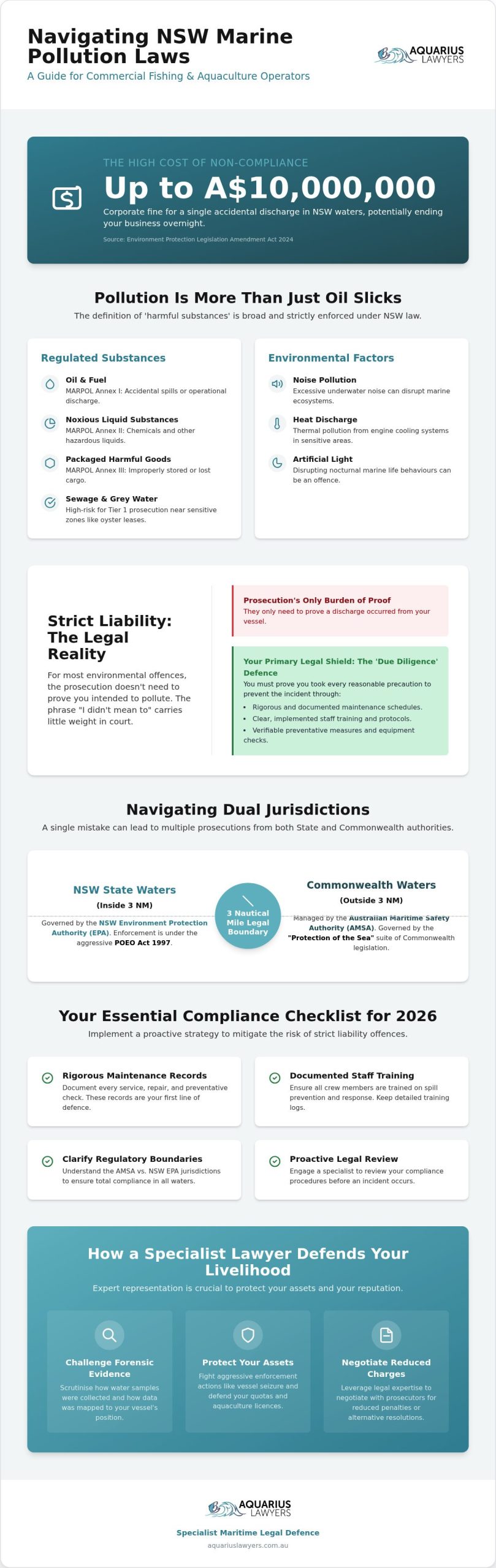
Your Essential Marine Pollution Compliance Checklist for 2026
Compliance is your primary defence against prosecution. In the eyes of the NSW EPA or AMSA, if an action was not documented, it did not happen. To safeguard your business from the tiered penalties discussed earlier, you must maintain a rigorous administrative trail that proves due diligence. Use this checklist to ensure your vessel meets the 2026 standards for commercial operations in Australian waters:
- Maintenance Logs: Ensure all oily water separators and sewage treatment systems are serviced by certified technicians. Keep these records on board and easily accessible for inspection.
- Staff Training: Maintain a training register. Every deckhand and engineer must have documented proof of training in spill response protocols and MARPOL requirements.
- Oil Record Book: Treat this as a legal shield. A well-maintained Oil Record Book can be the deciding factor in defending an investigation, as it provides a chronological history of fluid management.
- Spill Response Equipment: Audit your spill kits and containment booms monthly. Ensure they meet specific NSW maritime regulations for your vessel’s size and class.
The First 24 Hours: Incident Response Protocol
A spill is a crisis. Your response in the first 24 hours determines if it remains a manageable incident or becomes a business-ending catastrophe. Immediate notification is mandatory. Failing to report an incident to AMSA or the NSW EPA can result in separate, often heavier, charges than the pollution itself. Once the authorities are notified, focus on evidence preservation. Take high-resolution photos of the scene and record precise GPS coordinates before the tide or weather alters the environment.
The most critical rule during this window is to protect your legal position. While you must cooperate with safety directives, you should not provide a voluntary statement to investigators until you have spoken to a specialised vessel seizure lawyer nsw. Investigators are trained to gather evidence for prosecution, not to find excuses for your business. Saying nothing until your legal representative arrives is a right, not a sign of guilt.
Reviewing Your Shipboard Oil Pollution Emergency Plan (SOPEP)
Your SOPEP is a living document. If it still contains contact details from three years ago, it is effectively useless in a modern legal audit. Ensure your plan includes updated 2026 NSW emergency contacts and clear, step-by-step procedures for your current crew. A plan on paper is only half the battle; the law requires you to test it. Regular, documented drills are the only way to prove to a court that you have exercised due diligence.
Do not wait for a crisis to find the holes in your strategy. You can contact Aquarius Lawyers to conduct a comprehensive audit of your compliance documents and SOPEP before the EPA or AMSA steps on board. Identifying a paperwork error now is significantly cheaper than defending a strict liability charge in the Land and Environment Court later.
How a Marine Pollution Lawyer Defends Your Livelihood
A prosecution for marine pollution doesn’t have to result in the end of your business. While the NSW EPA wields significant power, their case often relies on technical evidence that is susceptible to challenge. A specialised vessel seizure lawyer nsw understands that a successful defence is built on scrutiny. We focus on the “chain of custody” for water samples and forensic data. If an investigator failed to follow strict collection protocols or if there is a gap in the sample’s history, that evidence may become inadmissible in the Land and Environment Court. Expert technical scrutiny + strategic negotiation = protected commercial assets.
Negotiation is just as critical as courtroom litigation. We work directly with the NSW EPA to reclassify charges, aiming to reduce a Tier 1 allegation of criminal negligence down to a Tier 2 strict liability offence. This shift is the difference between a potential prison sentence and a manageable financial penalty. In the NSW Local Court, we can also explore the “Honest and Reasonable Mistake of Fact” defence. This applies when you held a genuine, albeit mistaken, belief in a set of facts that, if true, would have made your actions legal. It is a high bar, but it remains a powerful tool for masters who acted in good faith during a crisis.
Even when a breach is admitted, the right legal representation focuses on mitigation. We present the court with a clear picture of your business’s financial health and your history of compliance. By demonstrating that a maximum fine would lead to insolvency, we advocate for penalties that are proportionate rather than destructive. Protecting your livelihood requires a vessel seizure lawyer nsw who understands that your commercial fishing quotas and aquaculture licences are your most valuable assets.
Why Katherine Hawes is “The Fish Lawyer” You Need
Katherine Hawes has built a reputation as “The Fish Lawyer” by operating at the precise intersection of marine pollution and commercial fisheries law. She provides a no-nonsense, pragmatic approach that prioritises results over ceremony. Whether you are facing a tribunal in Sydney or a local court in Shellharbour, Katherine brings a blend of traditional credentials and modern strategic thinking to your case. This dual expertise ensures that your defence considers both the immediate criminal charges and the long-term impact on your commercial permits.
Strategic Legal Defence for Aquaculture and Fisheries
Aquaculture operators face unique challenges when a pollution event occurs. Regulators often lack a deep understanding of how stock is managed or how specific discharges impact different species. We defend your business against unfair targeting by providing the technical context that officials miss. We ensure the court understands the biological realities of your lease, preventing the “one-size-fits-all” approach that often leads to excessive penalties. Protect your commercial interests-contact Aquarius Lawyers today.
Secure Your Commercial Future on the Water
The regulatory landscape in NSW has never been more challenging for commercial operators. With the 2024 penalty increases now in full effect, the difference between a minor incident and business insolvency often comes down to the quality of your documentation and the speed of your legal response. You have worked hard to secure your fishing quotas and aquaculture licences; don’t let an administrative oversight or an accidental discharge put them at risk.
By maintaining rigorous maintenance logs and an updated SOPEP, you build the due diligence defence necessary to withstand an EPA audit. If you are facing an investigation, engaging a vessel seizure lawyer nsw early provides the professional barrier needed to challenge evidence and negotiate for reduced charges. Principal Katherine Hawes, known as “The Fish Lawyer,” brings deep expertise in both NSW and Commonwealth maritime regulations to every case. With accessible offices in Sydney and Shellharbour, Aquarius Lawyers offers the pragmatic, no-nonsense support you need to stay compliant and profitable.
Secure your business with expert marine law advice: Contact Aquarius Lawyers. You have built a successful livelihood; now is the time to ensure it is protected for the long term.
Frequently Asked Questions
What should I do immediately after an accidental oil spill in NSW?
You must immediately notify the NSW EPA or the Australian Maritime Safety Authority (AMSA) to avoid “failure to report” charges. Once the spill is contained, take high-resolution photos and record precise GPS coordinates. These actions help prove you acted with due diligence. It is also vital to contact a vessel seizure lawyer nsw before providing any formal recorded statements to investigators to ensure your legal rights are protected from the start.
Can I be held personally liable for a pollution incident caused by my crew?
Yes, vessel owners and masters are frequently held personally liable for the actions of their crew under Australian maritime law. Most environmental offences are strict liability matters. This means the prosecution doesn’t need to prove you intended for the spill to happen. If a crew member makes a mistake, the law often places the ultimate responsibility on your shoulders as the person in charge of the commercial operation.
What is the difference between a Tier 1 and Tier 2 marine pollution offence in NSW?
Tier 1 offences involve wilful or negligent acts and carry the heaviest penalties, including potential imprisonment for individuals. Tier 2 offences are strict liability breaches where the prosecution only needs to prove the discharge occurred. While Tier 2 penalties are lower than Tier 1, they can still result in fines of up to A$2 million for corporations. A vessel seizure lawyer nsw focuses on negotiating these charges down to the lowest possible tier.
Does my marine insurance cover environmental fines and clean-up costs?
Most marine insurance policies cover containment and clean-up costs, but they rarely cover criminal fines or penalties. You should carefully review your policy for “pollution exclusion” clauses that might leave you personally responsible for the financial fallout. If your insurer denies a claim for legal defence costs, professional advice is necessary to challenge that decision and protect your business’s cash flow during the investigation.
How long does the NSW EPA have to launch a prosecution after a spill?
The NSW EPA generally has three years from the date of the offence to commence a prosecution under the POEO Act. In some cases, this period can be extended if the evidence of the pollution only comes to light at a later date. This long window of liability means you must keep your maintenance logs and Oil Record Books secure for several years to defend against any delayed investigations or audits.
Can a marine pollution conviction stop me from holding a commercial fishing licence?
Yes, a conviction can lead to the suspension or permanent loss of your NSW commercial fishing or aquaculture licence. The Department of Primary Industries (DPI) uses a “fit and proper person” test to evaluate all licence holders. A criminal record for a serious environmental breach suggests a failure to meet these standards. This makes a strong legal defence essential for anyone whose livelihood depends on state-issued maritime permits.
Is it possible to avoid court through an Enforceable Undertaking?
It is often possible to avoid a court-ordered conviction by negotiating an Enforceable Undertaking with the regulator. This is a legally binding agreement where you commit to specific environmental improvements or community projects instead of facing a trial. While it involves a financial commitment, it avoids the permanent stain of a criminal record and the risk of the maximum court-imposed fines.
Do I need a maritime lawyer if the spill was only minor?
You should seek legal advice even for minor spills because “on-the-spot” fines in NSW can still reach A$5,000 for corporations. Accepting a fine without advice is an admission of guilt that can be used against you in future licensing reviews or insurance renewals. A quick consultation helps you understand if the fine is contestable or if there were procedural errors in the way the evidence was gathered.
Disclaimer
Please note that legal rules change and this is not a substitute nor construed as legal advice. It is general information only.