
Your vessel’s hull protects your crew at sea, but your maritime business legal structure is the only thing protecting your family’s home from a maritime accident or pollution event. Operating as a sole trader in the commercial fishing or charter industry is like heading into a gale in a leaky dinghy; it leaves your personal assets completely exposed to unpredictable liabilities. You’ve likely felt the frustration of juggling conflicting AMSA safety standards and NSW Fisheries requirements while watching too much of your hard-earned income disappear into the taxman’s pocket.
We believe that your legal setup should be as sturdy and reliable as your best ship. This guide will show you how to choose a structure that safeguards your marine assets and ensures long-term commercial success in Australia. We’ll break down the strategic ‘two-entity’ model for maximum asset protection and explain how to manage the 2026 regulatory landscape, including the current $636 ASIC registration fee and the 25% tax rate for base rate entities. You’ll gain a clear pathway to a business that’s compliant, tax-efficient, and ready for future succession or sale.
Key Takeaways
- Understand why maritime liens allow debts to attach to your vessel, making standard business protections insufficient on the water.
- Compare the risks and benefits of different setups to determine if your current business is a ‘leaky dinghy’ or a secure commercial vessel.
- Master the ‘two-entity’ model to isolate your valuable marine assets and fishing quotas from the risks of daily operations.
- Learn how to design a maritime business legal structure that meets strict AMSA and NSW Fisheries ‘fit and proper’ requirements.
- Gain a strategic roadmap for future-proofing your business, allowing for smooth succession or an eventual profitable sale.
Why Maritime Business Legal Structure Matters in Australia
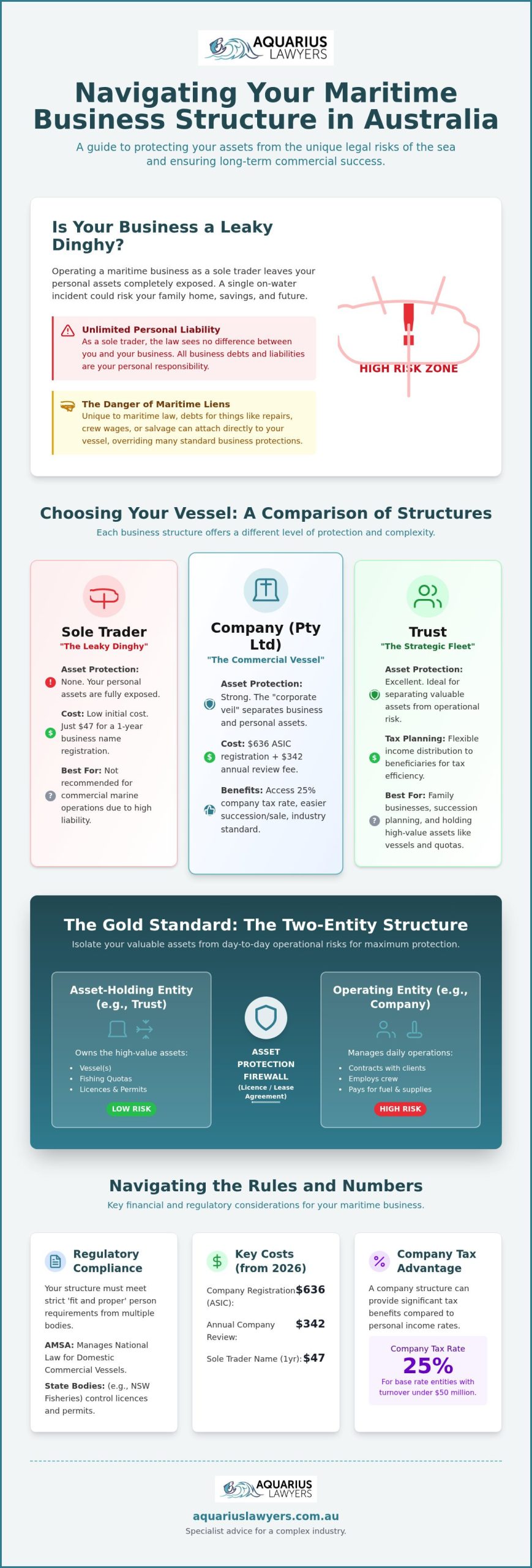
Australia’s coastline is a place of opportunity, but for a business owner, it’s also a landscape of unique legal risks. Standard commercial protections that work for a retail shop or a local tradie often fall short once you cross the high-tide mark. This is why your choice of maritime business legal structure is the most critical decision you’ll make for your commercial future. In the maritime world, liability doesn’t just follow the person; it can follow the vessel itself through a “maritime lien.” This means a debt or a claim for damages can attach to your boat regardless of who was at the helm or if the business has changed hands. If your structure isn’t robust, a single incident can sink your personal finances along with your ship.
The Reality of Maritime Liability
A simple collision or a mechanical failure leading to a pollution event can trigger costs that far exceed the value of your vessel. Under the Navigation Act 2012, the obligations for safety and environmental protection are stringent. For sole traders, there is no corporate veil to hide behind. You are personally responsible for every litre of fuel spilled and every dollar of salvage costs. Maritime law frequently overrides the standard consumer or commercial protections found on land. This means you can’t rely on standard business logic to save you. A secure structure acts as a bulkhead, ensuring that a disaster in one part of your life doesn’t flood the rest. High-risk operations + inadequate legal shielding = total asset exposure.
State vs Federal: Where Your Business Sits
Operating a commercial vessel means answering to multiple masters. The Australian Maritime Safety Authority (AMSA) manages the National Law for Domestic Commercial Vessels (DCVs), setting the standard for safety and certification across the country. However, state-based bodies like Transport for NSW or various fisheries departments still control the licences and permits that allow you to actually earn a living. Your structure needs to be flexible enough to handle these overlapping jurisdictions. For example, NSW Fisheries management requirements might dictate who can hold a certain quota, which directly influences how you should organise your company or trust. Getting this balance right is the difference between a business that scales and one that gets caught in a net of red tape. Strategic structure + regulatory compliance = commercial resilience.
Choosing Your Vessel: Sole Trader, Company, or Trust?
Selecting the right maritime business legal structure is like picking the right hull for the conditions you expect to face. While there are four main Australian business structures to consider, each performs differently when hit by the swells of maritime liability. You need a setup that doesn’t just work on a calm day but holds firm when a legal storm breaks.
Starting as a sole trader is the “dinghy” approach. It’s simple and inexpensive, costing just $47 for a one-year business name registration as of July 2026. However, it offers zero protection. If your vessel causes damage or a fuel spill, your house, car, and personal savings are all on the line. For most commercial operators, this level of risk is simply too high for comfort.
The Pty Ltd Company for Marine Operators
A Proprietary Limited (Pty Ltd) company is the industry standard for a reason. It creates a separate legal personality. This means the company owns the boat and the debt, not you personally. Registering a new company with ASIC in 2026 costs $636, with an annual review fee of $342. This structure makes it much easier to transfer vessel registrations or commercial licences if you decide to sell the business later. It also allows you to access the 25% company tax rate for base rate entities, provided your turnover is below $50 million.
Being a director isn’t a “get out of jail free” card. If you’re found to have been personally negligent or traded while insolvent, the courts can “pierce the corporate veil.” In maritime incidents involving safety breaches, the protection of a company structure can be challenged. This is where expert marine law advice becomes vital to ensure your operational procedures match your legal safeguards.
Using Trusts in the Maritime Industry
For many Australian fishing families, a discretionary or family trust is the strategic choice. Trusts are excellent for asset shielding and tax planning. A common setup involves the trust owning the vessel and fishing quota, while a separate company handles the day-to-day operations. This layering adds a secondary level of protection for your most valuable assets. If the operating company faces a claim, the boat and quota held in the trust remain out of reach.
Trusts also provide the flexibility needed for the seasonal nature of commercial fishing. You can distribute income to family members in lower tax brackets, which is particularly useful when a bumper season follows a quiet one. Most importantly, a trust allows for smooth succession. It ensures the “family boat” and hard-earned quotas stay within the family for generations without the massive tax triggers of a direct sale. Partnerships and joint ventures are also options, particularly for collaborative marine projects or vessel-sharing arrangements, but these require rock-solid agreements to ensure one partner’s mistake doesn’t sink the other’s finances.
Asset Protection Strategies for Shipowners and Quota Holders
Owning a commercial vessel is a high-stakes investment. If your boat is involved in a collision or a fuel spill, maritime law allows for “in rem” claims, which are legal actions taken directly against the ship itself. This means your most valuable asset can be arrested and sold to settle a debt even if you weren’t personally at fault. To combat this, smart operators use a two-entity maritime business legal structure. One company (the Holding Co) owns the vessel and the quota, while a second company (the Operating Co) handles the daily work, crew, and contracts. By leasing the boat from your Holding Co to your Operating Co, you create a legal firewall. If the Operating Co gets sued, the vessel belongs to a different legal person and is significantly harder to reach.
When setting up this model, you must ensure you comply with Australian Maritime Safety Authority (AMSA) ship registration requirements. The Holding Co must be correctly listed as the owner on the Australian Register of Ships to make the separation of assets legally binding. This isn’t just paperwork; it’s the foundation of your protection strategy. Without correct registration, the “corporate veil” between your companies becomes dangerously thin.
Insulating High-Value Assets
Leasing your vessel between your own entities requires a formal, written agreement to be effective. This lease should be at a commercial rate to satisfy both tax requirements and legal scrutiny. This strategy is equally vital for aquaculture operators. Your leases and high-value infrastructure, such as pens and processing equipment, should be held in a separate entity from the one managing the daily biological risks and labour. If a disease outbreak or a contract dispute hits the operational side, your core assets remain shielded. Don’t rely on insurance alone. While insurance is a necessary backstop, policies have exclusions and limits that can leave you stranded. A robust structure protects you when the insurance company refuses to pay.
The Personal Property Securities Register (PPSR) is another tool you can’t afford to ignore. If your Holding Co leases equipment to your Operating Co, you must register that interest on the PPSR. This ensures your Holding Co has “priority” over the asset if the Operating Co enters liquidation. It’s a simple, low-cost step that prevents your equipment from being sold to pay off the Operating Co’s creditors.
The ‘Fish Lawyer’ Perspective on Quota Protection
Commercial fishing quotas are often worth more than the boats that catch them. In 2026, with indicative lease prices for Gummy Shark at $4.75 per kilo and Spanish Mackerel at $2.99 per kilo, your quota is a major target in any legal dispute. Statutory Fishing Rights are recognised as a form of property under Australian law, providing holders with a divisible and transferable interest in a fishery. If your quota is held by the same entity that employs the crew or signs the supply contracts, you’re risking your entire livelihood on a single mistake. Separating quota ownership from operational risk ensures that even if a contract dispute sinks the operating business, your right to fish remains secure and ready for a new start.
Regulatory Compliance: AMSA, Fisheries, and National Law
Compliance isn’t just about ticking boxes; it’s about ensuring your chosen maritime business legal structure can actually hold the permits you need to operate. Many owners overlook the fact that regulatory bodies don’t just look at the vessel; they look at the “person” behind it. In a corporate context, that “person” is your company and its directors. If your structure is messy, your applications for new licences or renewals can hit a dead end before you even leave the wharf.
Fisheries authorities across Australia, especially under the Fisheries Management Act in NSW, apply a strict “Fit and Proper Person” test. This means if a director of your company has a history of serious maritime or fisheries offences, the entire company may be barred from holding a commercial fishing licence or aquaculture lease. Your structure must be designed to isolate these risks. A clean, well-organised corporate entity makes it far easier to demonstrate to regulators that your business is a professional operation capable of meeting its safety and environmental obligations.
Licensing and Permits
The intersection of corporate law and fisheries regulation is complex. For example, your structure directly affects your ability to hold a NSW Commercial Fishing Licence or secure Aquaculture Development Approvals. You must also maintain valid Certificates of Operation and Survey with the Australian Maritime Safety Authority (AMSA). As of July 2026, AMSA has indexed its fees by 4.6 per cent, with an hourly rate for non-standard services now sitting at $272. If your business structure doesn’t clearly define who is responsible for vessel safety, you risk costly delays and potential fines during an audit. Ensuring your paperwork matches your operational reality is the only way to avoid the “compliance gap” that sinks so many small marine businesses.
Employment and Workplace Relations
Your maritime business legal structure must also account for the people on board. Using the “two-entity” model mentioned earlier, the Operating Co typically employs the crew, while the Holding Co owns the vessel. This setup is vital for managing seafarer employment contracts and liability for workplace injuries. Maritime law often intersects with state-based Workers’ Compensation in ways that standard land-based businesses never encounter. You are also bound by “General Safety Duties” under the National Law, which requires everyone from the owner to the deckhand to ensure the safety of the vessel. If your structure is too opaque, you may find yourself personally liable for safety breaches despite having a company in place.
Regulatory requirements are constantly evolving. For instance, updated fire safety standards under Marine Order 15 came into effect in April 2026, and a review of helicopter operations under Marine Order 27 is due by October 2026. Keeping up with these changes requires a legal partner who understands the “fish” side of the law. If you are concerned that your current setup won’t pass a regulatory inspection, it’s time to seek expert guidance. Contact the team at Aquarius Lawyers to organise a strategic compliance review of your maritime operations.
Setting Your Course: The Aquarius Lawyers Approach
In the marine industry, a one-size-fits-all maritime business legal structure is a recipe for disaster. Just as you wouldn’t use a river punt for offshore trawling, you shouldn’t use a standard retail business model for a commercial fishing or aquaculture operation. Each enterprise has unique drafts, loads, and risks. At Aquarius Lawyers, we don’t just provide generic legal documents; we design a seaworthy architecture for your commercial life. Led by Principal Katherine Hawes, known across the industry as “The Fish Lawyer,” our firm bridges the gap between traditional maritime expertise and modern strategic thinking. We understand that your business is often your greatest asset and your family’s future, which is why we treat your structural integrity with the same seriousness you treat your vessel’s maintenance.
Bespoke Maritime Legal Solutions
Our approach is built on a signature formula: Traditional Maritime Experience + Modern Commercial Strategy = Long-term Asset Protection. We tailor structures specifically for commercial fishers, charter operators, and aquaculture farms. This involves integrating elements of commercial law, property law, and international law to provide holistic protection for your fleet and quotas. We understand the “blue economy” because we are active participants in it. Whether you are navigating the complexities of international maritime boundaries or local NSW aquaculture leases, we provide a clear pathway through the legal fog. For startups in the fisheries and aquaculture sectors, Katherine Hawes offers the niche authority needed to establish a solid foundation from day one, ensuring you don’t start your journey with a structural leak.
Secure Your Maritime Future
Your legal setup shouldn’t be a “set and forget” project. As your fleet expands or your quota holdings grow, your structure must evolve to keep pace. We work closely with your accountant to ensure your legal protections and tax efficiencies are perfectly aligned. This collaboration ensures that your business remains agile, compliant, and ready for whatever the 2026 regulatory environment throws your way. We move easily between high-level strategic thinking and the practical, everyday wisdom required to run a boat or a farm. From the initial consultation to the final execution of your legal architecture, we act as your trusted advisor on the water. Don’t wait for a legal incident to test your hull’s integrity. Organise a consultation with Aquarius Lawyers to review your maritime structure today.
Secure Your Commercial Future on the Water
Your business deserves a legal hull that’s as strong as your vessel. We’ve explored how a robust maritime business legal structure acts as a vital bulkhead, separating your hard-earned assets and fishing quotas from operational risks. By moving away from the exposure of a sole trader setup and embracing the ‘two-entity’ model, you ensure that a single accident doesn’t sink your family’s financial security. Compliance with AMSA safety standards and NSW Fisheries requirements is no longer a burden when your corporate architecture is designed for transparency and resilience.
Principal Katherine Hawes, Australia’s renowned ‘Fish Lawyer,’ brings specialist expertise in maritime, fisheries, and aquaculture law to every consultation. With multiple NSW office locations, our team provides the local support and technical knowledge needed to navigate the unique challenges of the blue economy. You don’t have to face complex regulations alone. Secure your marine assets with a strategic legal review from Aquarius Lawyers. Take the proactive step today to ensure your business remains profitable and protected for years to come.
Frequently Asked Questions
Can I change my maritime business structure after I’ve already registered my vessel?
Yes, you can restructure your business at any stage, though it involves more than just a name change. You’ll need to transfer the vessel’s title on the Australian Register of Ships and update your Certificates of Operation with AMSA. It’s important to consider potential stamp duty implications and capital gains tax triggers. Transitioning from a sole trader to a company is a standard pathway as your fleet grows and your risk profile changes.
Is a family trust better than a company for a commercial fishing business?
Neither is universally superior, as they solve different problems. A Proprietary Limited company is the gold standard for limiting personal liability. A family trust, however, offers unmatched flexibility for distributing seasonal fishing income and managing succession. Most successful commercial fishing operations use a hybrid model. This setup allows the company to handle high-risk operations while the trust holds the valuable assets and manages family wealth.
What is a maritime lien, and how does my business structure protect me from one?
A maritime lien is a unique legal claim that “sticks” to the vessel itself to secure debts like salvage costs or crew wages. Your maritime business legal structure protects you by ensuring these claims stay confined to the boat. By using a separate company to own the ship, you prevent a lien from becoming a personal debt that could threaten your family home or other land-based investments.
Do I need a different legal structure for aquaculture versus commercial fishing?
The fundamental legal entities are similar, but the strategic focus changes. Aquaculture businesses must prioritise the protection of long-term seabed leases and expensive fixed infrastructure. Commercial fishing structures focus more on the mobility of vessels and the security of statutory fishing rights. While both benefit from asset separation, the way you document internal leases and manage environmental liability will vary significantly between these two sectors.
How does the ‘two-entity’ model work for protecting my boat?
This model protects your boat by creating a legal “firewall” between your assets and your risks. One entity owns the vessel and does nothing else. A separate operating entity hires the crew and signs the contracts. If the operating company faces a massive claim for a collision or breach of contract, the vessel remains safe because it’s owned by an entirely different legal person that wasn’t involved in the incident.
What are the common legal mistakes small maritime businesses make in Australia?
Operating as a sole trader is the most frequent and dangerous mistake we see. Many owners also fail to record their internal equipment leases on the Personal Property Securities Register (PPSR). Without this registration, your holding company could lose the vessel to creditors if the operating company enters liquidation. Neglecting to update AMSA and Fisheries records after a structural change is another common trap that leads to heavy fines.
Will my business structure affect my marine insurance premiums?
It certainly can. Insurers view a sophisticated business structure as a sign of a well-managed, lower-risk operation. Clear documentation of roles and a formal separation of assets suggest that the business takes its safety and legal obligations seriously. While it won’t replace a clean claims history, a professional maritime business legal structure helps build the “risk story” your broker needs to negotiate better rates with underwriters.
How do I ensure my business structure complies with both AMSA and NSW Fisheries?
Compliance requires a dual-track approach that satisfies two different sets of rules. You must ensure your directors meet the “Fit and Proper Person” standards for NSW Fisheries licences while maintaining the safety management systems required by AMSA. Your corporate records must always match your vessel registrations. Regular legal audits are the best way to ensure your structure hasn’t drifted away from the operational requirements of the National Law.
Disclaimer
Please note that legal rules change and this is not a substitute nor construed as legal advice. It is general information only.