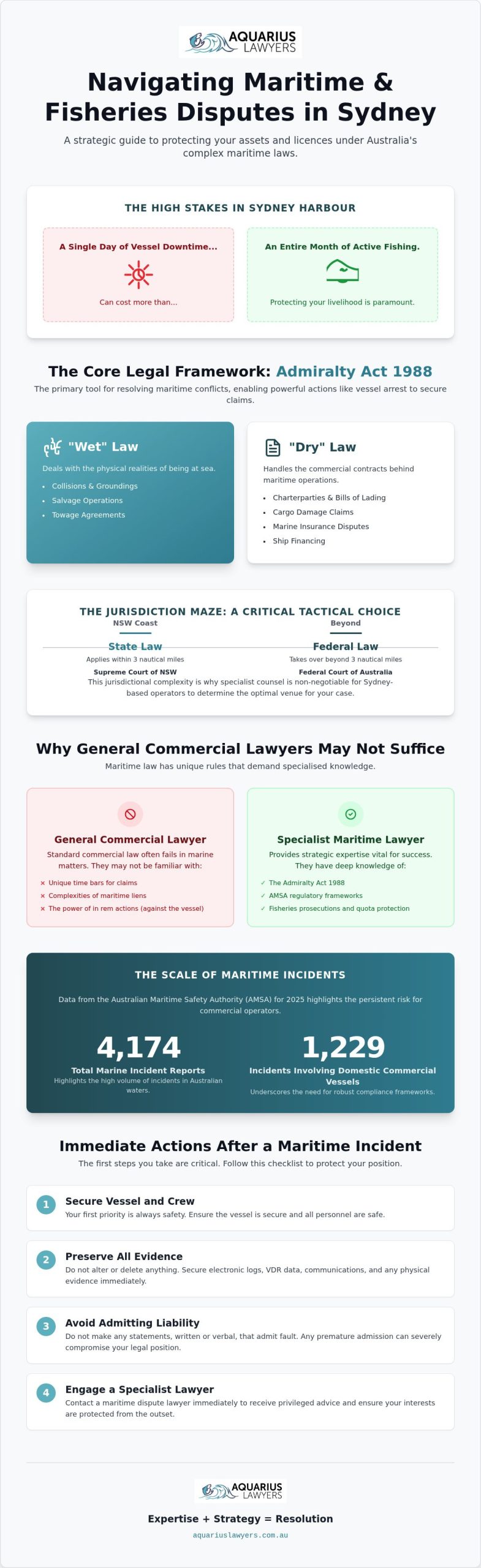
A single day of vessel downtime in Sydney Harbour can cost your commercial operation more than a month of active fishing. When high financial risks collide with the complex jurisdictional overlaps of State and Federal law, the pressure to find a resolution is immense. You’ve worked hard to secure your commercial fishing quotas and maritime assets, so facing a legal stalemate that threatens your livelihood is a stress no operator wants. Engaging a specialist maritime dispute lawyer sydney provides the strategic, down-to-earth expertise needed to navigate the specific “wet” jurisdiction of the Admiralty Act 1988.
Expertise plus strategy equals resolution. We understand that in the maritime world, time is quite literally money. This article outlines how to protect your assets and licences through cost-effective litigation or mediation while managing the latest 2026 regulatory updates from AMSA. You’ll discover the essential steps to resolve marine and fisheries conflicts quickly, ensuring your business stays afloat despite the shifting tides of Australian maritime regulations and the ongoing complexities of the merchant fleet landscape.
Key Takeaways
- Learn how the Admiralty Act 1988 governs Sydney-based maritime litigation and how to navigate the complex overlap between State and Federal jurisdictions.
- Understand why standard commercial law often fails in marine matters and why a specialised maritime dispute lawyer sydney is vital for managing unique time bars and maritime liens.
- Gain practical strategies for defending fisheries prosecutions and protecting commercial quotas to ensure your aquaculture or fishing operation remains viable.
- Identify the immediate actions required following a maritime incident, such as preserving electronic logs and avoiding premature admissions of liability.
- Discover how combining traditional maritime expertise with modern legal technology creates a cost-effective pathway to resolving high-stakes marine conflicts.
Understanding Maritime Disputes in Sydney and NSW
Sydney’s waterways are some of the busiest in the southern hemisphere. Between the constant flow of container ships through Port Botany and the commercial fishing fleets operating out of the Sydney Fish Markets, the potential for conflict is high. A maritime dispute isn’t just a boating safety issue; it’s a commercial roadblock that can halt operations and drain resources. Whether it’s a dispute over cargo damage or a complex vessel collision, having a maritime dispute lawyer sydney on your side ensures that your interests are protected under the specific framework of maritime law.
The Admiralty Act 1988 (Cth) is the primary tool used to resolve these conflicts in Australia. It allows for unique legal actions, such as the arrest of a ship to secure a claim, which is a powerful lever in negotiations. In practice, we divide these matters into “wet” and “dry” law. Wet law deals with the physical realities of being at sea, including salvage, collisions, and groundings. Dry law handles the commercial contracts, such as ship financing and cargo claims, that keep the industry moving. In Sydney, these categories often overlap. Specialised Knowledge + Practical Experience = Commercial Certainty.
Common Triggers for Maritime Litigation
Disputes rarely happen in a vacuum. They usually stem from a breakdown in commercial expectations or unforeseen incidents on the water. Common triggers include:
- Charterparties and Bills of Lading: Disagreements over vessel hire, laytime, or damage to freight during transit.
- Marine Insurance: Disputes regarding policy coverage, especially when liability limitations are invoked after a significant incident.
- Salvage and Towage: Conflicts over the “success” of a salvage operation or the fees associated with towage agreements in Sydney Harbour.
In 2025, the Australian Maritime Safety Authority (AMSA) received 4,174 marine incident reports. While not every report leads to a courtroom, the high volume of incidents highlights the persistent risk for any commercial operator in NSW waters.
Jurisdiction: State vs. Federal Courts
Determining where to file a claim is a critical tactical choice that affects both the speed and cost of resolution. The Federal Court of Australia has broad powers under the Admiralty Act, making it the preferred venue for many commercial disputes and ship arrests. However, the Supreme Court of NSW is also a powerful forum for maritime matters, particularly those with a strong local connection or involving property disputes. Navigating the geographical limits of NSW coastal waters is vital. Generally, State law applies within three nautical miles of the coast, but Federal law takes over beyond that limit. This jurisdictional complexity is why specialist counsel is non-negotiable for Sydney-based operators.
Key Areas of Admiralty and Fisheries Law Expertise
Resolving a conflict on the water requires a distinct set of tools compared to a land-based commercial disagreement. One of the most effective methods for debt recovery in the shipping world is the vessel arrest. Under the Admiralty Act 1988, a claimant can literally stop a ship in its tracks to ensure a debt is paid or security is provided. This is a high-stakes manoeuvre that demands the precision of an experienced maritime dispute lawyer sydney. Beyond recovery, managing marine pollution and environmental compliance in NSW is increasingly complex, especially with stricter electronic record-keeping requirements under upcoming MARPOL amendments.
Aquaculture operators face their own unique set of hurdles. Navigating the legal requirements for farm operators involves a deep understanding of both environmental impact and commercial sustainability. In 2025, the Australian Maritime Safety Authority (AMSA) received 1,229 reported incidents involving Domestic Commercial Vessels (DCVs). This statistic underscores the importance of robust compliance frameworks. Expertise plus proactive strategy equals long-term asset protection.
The Fish Lawyer Advantage
Katherine Hawes, widely recognised as “The Fish Lawyer”, brings a unique perspective to fisheries and aquaculture law. It’s not just about knowing the rules; it’s about understanding the industry from the deck up. We focus on protecting commercial fishing licences from regulatory overreach and defending operators against prosecutions. For instance, with the ongoing prohibition on line fishing for Eastern Blue Groper in NSW continuing through 2026, staying compliant is a moving target. Whether you are facing a criminal matter related to an alleged illegal catch or a dispute over a commercial quota, we provide a grounded, no-nonsense pathway to resolution. If you are navigating these regulatory waters, it is wise to consult a specialist in marine law before a minor infringement turns into a licence-threatening crisis.
Commercial Maritime Contracts
The “dry” side of maritime law is where many disputes are won or lost before they even reach a court. A robust contract is your first line of defence. We provide legal oversight for everything from boat repair and maintenance agreements to complex marina management and berth licences. In an era where 228 injuries were reported on DCVs in 2025, employment law for seafarers and contractors is also a critical area of focus. Ensuring your Safety Management Systems (SMS) meet the requirements of Marine Order 504 is no longer optional. Modern efficiency plus traditional expertise equals a contract that actually protects your bottom line. We layer this niche knowledge into every agreement, ensuring that your commercial interests are as secure as your vessel’s moorings.
Why General Commercial Lawyers May Not Suit Maritime Matters
Hiring a standard commercial lawyer for a seafaring conflict is like asking a car mechanic to fix a jet engine. The principles might seem similar, but the mechanics are worlds apart. A maritime dispute lawyer sydney understands that the sea has its own set of rules that often override terrestrial law. Generalists often treat vessel disputes like property or lease disagreements, but this approach ignores the unique legal “personality” of a ship. In maritime law, the vessel itself can be held liable for its debts, a concept that simply doesn’t exist in standard Australian commercial law.
The complexity of maritime liens is a prime example. Unlike standard commercial security interests that require registration on the PPSR, a maritime lien can attach to a ship automatically without a written agreement. It “travels” with the vessel, even if the ship is sold to a new owner who has no idea the debt exists. A generalist lawyer might miss this, leading to a total loss of security. Furthermore, time is a much harsher master at sea. While you might have six years to sue for a breach of a land-based contract, maritime law imposes much tighter deadlines. For instance, cargo claims generally have a one-year time bar, and collision claims are limited to three years under the Admiralty Act 1988. Precise Knowledge + Fast Action = Protected Rights.
The Nuance of Maritime Liability
Standard contract law doesn’t account for the “Limitation of Liability” conventions that are standard in shipping. These international rules allow a shipowner to cap their total financial exposure based on the vessel’s tonnage, regardless of the actual damage caused. This can be a shock to plaintiffs expecting full compensation. In Admiralty proceedings, we often initiate actions in rem, meaning the lawsuit is against the ship itself. Identifying the “real” defendant and understanding these liability caps is essential to prevent jurisdictional errors that can lead to a case being dismissed before it even begins.
Strategic Dispute Resolution
We believe in a “no-nonsense” approach that values results over ceremony. While we are veterans in the courtroom, we often find that mediation is a more cost-effective pathway for our clients. Our methodology blends traditional credentials with modern efficiency. We use contemporary technology to streamline evidence collection, such as analysing electronic record-keeping data now permitted under MARPOL. By integrating digital forensics with niche legal expertise, we reconstruct incidents with high precision. This “Innovative Veteran” strategy ensures that we resolve conflicts rapidly, keeping your maritime assets protected and your operations moving.
Immediate Steps to Take in a Maritime Dispute
You must preserve all electronic logs, AIS data, and digital communications immediately to ensure a factual record of the incident remains intact. In the high-pressure environment of a vessel collision or a cargo dispute, the natural instinct to apologise or explain can be your greatest legal liability. Avoid making any “admissions of liability” in the heat of the moment, whether over the radio or in person. Anything you say to a counterparty or a regulatory officer can be used as evidence in future litigation. It is vital to secure expert legal advice from a maritime dispute lawyer sydney before you provide a formal response to enquiries from the Australian Maritime Safety Authority (AMSA) or NSW Maritime.
When a dispute involves an unpaid debt or a breach of a maritime contract, the process often moves toward issuing a Writ in Rem. This is the specific legal instrument required to initiate a vessel arrest under the Admiralty Act 1988. It’s a sophisticated tactical move that requires precision and speed. With 4,174 marine incidents reported to AMSA in 2025 alone, the regulatory net is cast wide. Taking the right steps in the first hour can be the difference between a swift resolution and a protracted, expensive court battle. Prompt Action + Specialised Counsel = Strategic Leverage.
Evidence Preservation on the Water
Evidence is the currency of maritime law. Beyond digital logs, you should immediately collect witness statements from your crew and any bystanders who saw the incident. Document all physical damage with high-resolution, time-stamped photography from multiple angles. For incidents occurring near Port Botany or within Sydney Harbour, we can often access Vessel Traffic Services (VTS) data to reconstruct vessel movements with pinpoint accuracy. This objective data often proves far more reliable than the fading memories of stressed witnesses.
Initial Legal Consultation
Preparation is the key to a productive first meeting with your maritime solicitor. You should bring your Safety Management System (SMS) documentation, commercial fishing licences, and any relevant charterparties or repair agreements. We assess the strength of your claim early to prevent you from wasting resources on a losing battle. We also provide clarity on costs; while complex litigation is often billed hourly, we offer fixed-fee options for specific commercial and property transactions. If you find yourself in the middle of a conflict on the water, you should request a consultation with our maritime legal team to establish your defensive perimeter immediately.
Strategic Maritime Representation in Sydney
Aquarius Lawyers provides a bridge between high-level Admiralty law and the practical realities of the NSW maritime industry. While our physical base is in the heart of the city, our reach extends across the state’s coastline. We understand that a maritime dispute lawyer sydney must be as comfortable discussing commercial fishing quotas in regional ports as they are arguing a vessel arrest in the Federal Court. This intellectual versatility allows us to protect your interests regardless of where your conflict arises. We don’t just solve problems; we prevent them.
By integrating broad commercial law expertise with niche marine specialist knowledge, we provide a 360-degree view of your legal health. Traditional Experience + Modern Methodology = Strategic Advantage. This is the hallmark of our “Innovative Veteran” persona. We value results over ceremony, opting for a grounded, down-to-earth pragmatism that cuts through the dense jargon often found in maritime litigation. Whether you’re a small-scale aquaculture operator or a large commercial shipping firm, we offer a steady, common-sense guide through the most turbulent legal waters.
Our Sydney and Regional Presence
Located at Level 13, King Street, our office is an accessible hub for Sydney-based businesses and vessel operators. However, we recognise that the maritime community isn’t confined to the CBD. We actively support the Shellharbour and regional NSW maritime sectors, ensuring that operators outside the metropolitan area receive the same high-calibre counsel. For local Sydney businesses engaged in global trade, we also provide international maritime law support. This involves navigating the complexities of foreign jurisdictions and international conventions while maintaining a clear focus on your Australian commercial interests.
Getting Started with Aquarius Lawyers
The pathway from an initial inquiry to a final resolution is designed to be direct and transparent. We start by establishing a foundation of facts, then apply our unique methodology to find the most efficient route to a solution. This often involves proactive risk management. We review your current contracts and Safety Management Systems to identify vulnerabilities before they lead to litigation. If a dispute is already underway, we act as your trusted advisor, offering high-level strategic thinking to secure your assets. To take the first step toward protecting your maritime business, you can organise a consultation with Aquarius Lawyers today. Katherine Hawes and her team are ready to provide the expert fisheries and marine counsel you need to stay ahead of the tide.
Protecting Your Commercial Interests at Sea
Navigating the “wet” jurisdiction of Australian Admiralty law requires more than just a general understanding of commercial contracts; it demands a specialist who knows the deck as well as the courtroom. Specialist knowledge of the Admiralty Act is non-negotiable when high-stakes conflicts arise, as unique time bars and maritime liens can quickly sink a case handled by a generalist. By acting fast to preserve electronic logs and seeking counsel before responding to regulatory enquiries, you establish a defensive perimeter around your maritime assets. Engaging a maritime dispute lawyer sydney ensures that your commercial fishing quotas and vessel operations are protected by a strategy that balances traditional credentials with modern efficiency.
Katherine Hawes, our Principal Solicitor known as “The Fish Lawyer”, provides authoritative yet approachable representation from our Sydney CBD and regional NSW offices. Whether you’re managing a vessel arrest or defending a fisheries prosecution, we provide the pragmatic, no-nonsense guidance you need to achieve a swift resolution. Don’t let a legal stalemate disrupt your livelihood. You can secure expert maritime legal advice from Aquarius Lawyers and regain your focus on the water. With the right strategic partner, even the most complex maritime conflict becomes a manageable hurdle on the path to success.
Frequently Asked Questions
What is the difference between a maritime lawyer and a general solicitor?
A maritime lawyer focuses on the unique “wet” and “dry” laws governing the sea, whereas a general solicitor usually handles land-based commercial matters. Engaging a maritime dispute lawyer sydney ensures you’re protected by specific knowledge of the Admiralty Act 1988. This includes understanding maritime liens and the unique liability caps that don’t exist in standard terrestrial law. Expertise in this niche area prevents costly jurisdictional errors that a generalist might overlook.
Can I arrest a vessel in Sydney Harbour for unpaid debts?
You can arrest a vessel in Sydney Harbour for certain “maritime claims” such as unpaid repair bills, crew wages, or salvage fees. This is achieved by issuing a Writ in Rem in the Federal Court of Australia. It’s a powerful tactical move that effectively freezes the asset until the debt is paid or security is provided, preventing the ship from leaving Port Jackson. Because an arrest is a high-stakes manoeuvre, it requires precise legal execution to avoid claims of “wrongful arrest”.
How do I appeal a NSW fisheries licence suspension?
Appeals against a NSW fisheries licence suspension are typically handled through the NSW Civil and Administrative Tribunal (NCAT). You must act quickly, as strict time limits apply to lodging an application for review. We recommend reviewing the specific grounds for the suspension, such as alleged quota breaches or gear infringements, before presenting a case that demonstrates regulatory compliance or mitigating circumstances. Protecting your livelihood requires a grounded, evidence-based approach to the tribunal.
What courts in Sydney handle maritime disputes?
The Federal Court of Australia and the Supreme Court of NSW are the primary forums for maritime litigation in Sydney. The Federal Court has broad national jurisdiction over Admiralty matters, including vessel arrests and cargo claims. The Supreme Court of NSW often handles commercial disputes with a local connection or property-related marine issues. Selecting the right forum is a strategic decision that affects the speed and cost of your resolution.
How much does a maritime dispute lawyer cost in Sydney?
Costs for maritime legal services depend on the complexity of the conflict and the required resolution pathway. While many firms use traditional hourly rates for complex litigation, some offer fixed-fee options for specific commercial contracts or property transactions. We focus on providing a “no-nonsense” service that values efficiency, ensuring your legal spend is directed toward achieving a practical commercial outcome rather than unnecessary ceremony.
Does Australian maritime law apply to international vessels in Port Botany?
Australian maritime law applies to all vessels within our territorial waters, including international container ships docked at Port Botany. This includes compliance with the Admiralty Act 1988 and international conventions like MARPOL and SOLAS. International operators must also adhere to AMSA’s National Compliance Plan, which covers Safety Management Systems and pollution prevention standards. When a dispute involves a foreign-flagged vessel, international law and local regulations often overlap, requiring a sophisticated legal strategy.
What should I do if my vessel is involved in a collision in NSW waters?
Your first priority is the safety of all persons on board, followed by reporting the incident to AMSA or NSW Maritime as required by law. Once safety is secured, you should immediately preserve all electronic logs and AIS data. Avoid admitting liability to other parties at the scene. Collecting witness statements and time-stamped photos of the damage provides the evidentiary foundation your maritime dispute lawyer sydney needs to protect your interests in future proceedings.
How long do I have to file a maritime claim in Australia?
Time limits for maritime claims are significantly shorter than the standard six-year limit for general commercial contracts. For cargo damage claims, you generally have only one year from the date of discharge to commence proceedings. Claims arising from vessel collisions under the Admiralty Act 1988 must be filed within three years. Missing these deadlines often results in your right to claim being permanently extinguished, so seeking advice early is essential.
Disclaimer
Please note that legal rules change and this is not a substitute nor construed as legal advice. It is general information only.