
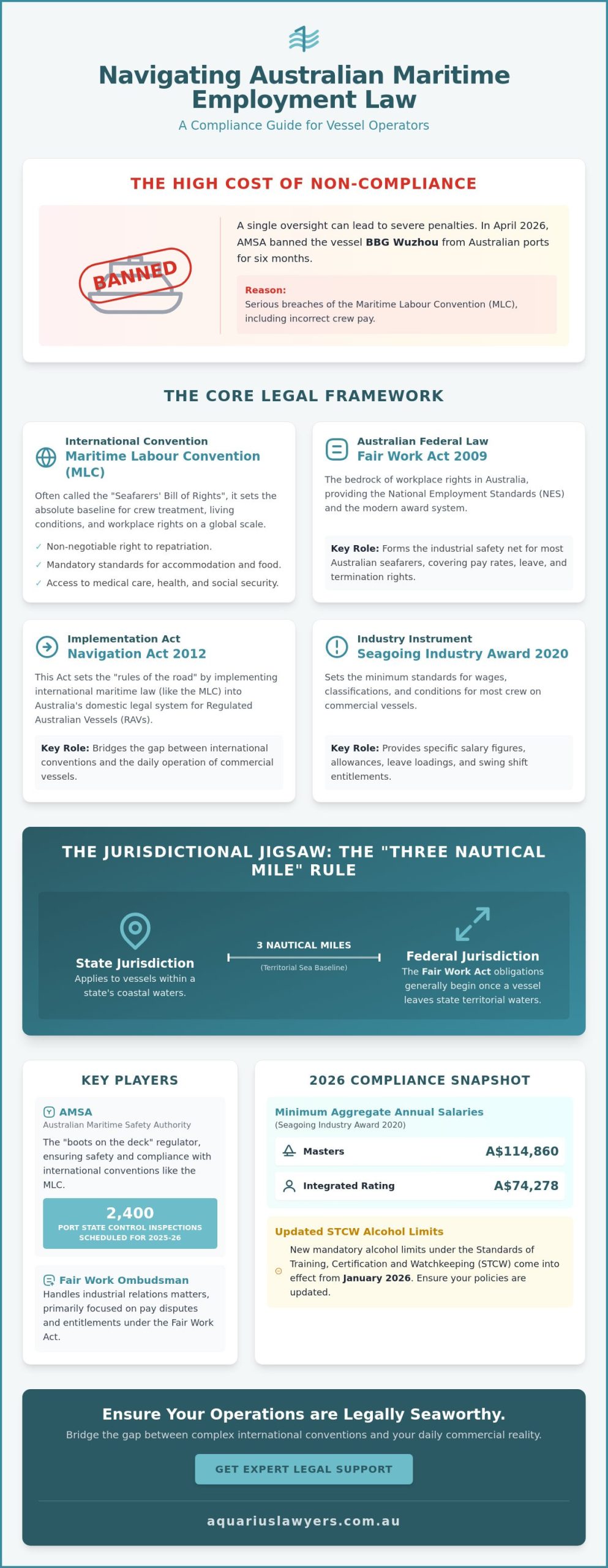
What if a single administrative oversight in your crew’s pay led to your vessel being banned from Australian ports for six months? This isn’t a hypothetical risk; in April 2026, AMSA banned the BBG Wuzhou until October after discovering serious breaches of the Maritime Labour Convention. It’s a stark reminder that staying on the right side of maritime employment law requires more than just good intentions. It demands a precise alignment of the Fair Work Act 2009 and international treaty obligations to ensure your operations remain seaworthy and compliant.
You likely find the jurisdictional overlap between State and Federal laws frustrating, especially when trying to determine which Award applies to your crew once they leave territorial waters. We understand that drafting a valid Seafarer Employment Agreement feels like a high-stakes gamble against the 2,400 Port State Control inspections AMSA has scheduled for the 2025-26 period. This guide provides a clear pathway to compliance, helping you master the interplay between international standards and Australian workplace rights. We’ll examine the new January 2026 STCW alcohol limits and the updated minimum salaries, such as the A$114,860 aggregate annual salary for Masters, so you can build a legally robust framework and avoid costly industrial relations disputes.
Key Takeaways
- Clarify the “Three Nautical Mile” rule to determine exactly where State jurisdiction ends and Federal Fair Work Act obligations begin.
- Identify the mandatory compliance pillars of the Maritime Labour Convention to ensure your Seafarer Employment Agreements (SEAs) withstand AMSA scrutiny.
- Learn how to integrate the Seagoing Industry Award 2020 into bespoke contracts that align with modern maritime employment law standards.
- Understand the specific industrial relations requirements for foreign vessels operating under Australian coastal trading licenses to avoid costly port detentions.
- Discover how strategic legal support in fisheries and aquaculture law can bridge the gap between complex international conventions and your daily commercial reality.
What is Maritime Employment Law in Australia?
Think of maritime employment law as a specialised hybrid where industrial relations meets admiralty law. It isn’t just about standard HR policies. It’s a complex framework designed to protect workers in an environment that is inherently mobile and often dangerous. While the Fair Work Act 2009 remains the bedrock of workplace rights for most Australian seafarers, the rules of the game change the moment a vessel leaves the wharf. Standard employment law often fails to account for the unique realities of life at sea, such as mandatory rest periods, international safety standards, and the physical isolation of the workplace.
Effective compliance is a simple equation: National Employment Standards + International Conventions = Operational Security. To achieve this, the Australian Maritime Safety Authority (AMSA) plays a critical role. While the Fair Work Ombudsman handles pay disputes, AMSA ensures that the living and working conditions on board meet the rigorous standards of the Maritime Labour Convention. They act as the primary regulator for safety and the implementation of international treaties. They are the boots on the deck, ensuring that safety and employment rights aren’t just theoretical concepts but practical realities during their thousands of annual inspections.
The Seagoing Industry Award 2020 and Beyond
In 2026, the Modern Award system remains the primary tool for setting minimum standards. Most crew members on commercial vessels fall under the Seagoing Industry Award 2020. This instrument covers various classifications, from an Integrated Rating with a minimum aggregate annual salary of A$74,278 to senior engineering officers. These figures are comprehensive, built to include aggregate overtime components and specific allowances. You’ll need to determine if your operations align with this award or the Port Authorities Award, as the entitlements for leave loadings, swing shifts, and victualling allowances differ significantly between the two.
The Role of the Navigation Act 2012
If the Fair Work Act provides the rights, the Navigation Act 2012 sets the “rules of the road” for how those rights are applied on Regulated Australian Vessels (RAVs). This Act is the primary vehicle for implementing international maritime law within our domestic borders. Your legal exposure depends heavily on your vessel’s registration status. Domestic Commercial Vessels (DCVs) often operate under a different compliance burden compared to RAVs. Knowing where your vessel sits in this hierarchy is the first step in drafting a contract that won’t be torn apart during an industrial dispute or an audit. It’s about bridging the gap between commercial necessity and statutory obligation.
The Maritime Labour Convention (MLC) and Seafarer Rights
The Maritime Labour Convention (MLC) is often called the “Seafarers Bill of Rights”. In Australian waters, it serves as the absolute baseline for how crew members must be treated. While the Fair Work Act provides the industrial safety net, the MLC adds a layer of international protection that covers everything from the quality of bedding to the right to return home. Understanding how these global standards mesh with domestic maritime employment law is vital for any operator. It isn’t just about being a good employer; it’s about meeting a non-negotiable shipowner obligation that persists across every nautical mile.
One of the most critical rights under the MLC is the non-negotiable right to repatriation. If a contract ends or a seafarer is no longer able to carry out their duties, the shipowner must cover the cost of getting them home. This includes health and social security protections that must remain active regardless of where the vessel is currently located. Failing to provide these basics doesn’t just lead to unhappy crew; it invites severe regulatory intervention. Compliance is a formula: International Standards + Local Enforcement = Operational Continuity.
Minimum Standards for On-Board Living
Living standards in 2026 have evolved to reflect a modern understanding of mental and physical health at sea. Accommodation and recreational facilities are no longer considered “extras”. They are mandatory requirements. AMSA has the power to detain any vessel where food, catering, or medical care falls below the prescribed standards. For long-haul voyages, the expectations for fresh water and nutritious food are strictly monitored. If an inspector finds that your vessel is cutting corners on crew welfare, they won’t hesitate to halt your operations until the issue is rectified.
SEAs vs. Standard Contracts
You might be tempted to use a standard office contract for your deckhands, but this is a significant legal risk. A standard agreement simply doesn’t account for the specific requirements of Australian maritime workplace laws. A Seafarer Employment Agreement (SEA) must contain specific clauses that an office contract lacks, such as clear termination notice periods, precise wage calculations, and guaranteed hours of rest.
The SEA acts as the primary evidence of compliance during an AMSA inspection. Without a valid SEA that incorporates the Seagoing Industry Award 2020 or a relevant enterprise agreement, you’re effectively flying blind. If you’re unsure if your current contracts meet the 2026 standards, seeking advice on maritime employment law can help you shore up your legal defences before the next inspection. These agreements must be clear, written in a language the seafarer understands, and signed by both parties to be legally robust.
Jurisdictional Jigsaw: State, Federal, or International?
Operators often assume the Fair Work Act is a universal blanket. It isn’t. The reality of maritime employment law is a jurisdictional jigsaw where the rules change based on your distance from the coast. The “Three Nautical Mile” rule is the primary dividing line. Within this zone, State industrial relations laws can still apply to certain commercial operations. Once you cross that line, you enter Federal territory where the Fair Work Act takes precedence. However, even this isn’t a hard rule. If you are operating a foreign-flagged vessel under a coastal trading licence, you must navigate a complex blend of international treaty obligations and Australian workplace standards. For operators based in New South Wales, working with experienced maritime law firms in Sydney who understand both the local regulatory environment and international conventions is essential to managing this complexity effectively.
The conflict between Flag State and Port State law is where most disputes arise. While your vessel might be registered in a foreign nation (the Flag State), Australia (the Port State) has the right to enforce the Maritime Labour Convention (MLC) while you are in our waters. This means AMSA can intervene in wage disputes or safety breaches regardless of the ship’s registry. It’s a common misconception that Fair Work covers every scenario. In reality, the “winner” in a legal dispute often depends on the specific wording of the Seafarer Employment Agreement and the vessel’s current geographical coordinates.
Working Outside Territorial Waters
When Australian citizens work on international voyages, their legal status becomes murky. On the High Seas, the law of the Flag State generally governs the vessel. This creates significant risks for workers’ compensation and liability. If a seafarer is injured in international waters, the pathway to a claim is rarely straightforward. Past case law shows that without a robust contract, employees can find themselves in a legal vacuum where neither Australian nor international law provides a clear remedy. You need to ensure your contracts specifically address these “blue water” scenarios to prevent expensive litigation.
Modern Slavery and Supply Chain Compliance
By 2026, the focus on modern slavery has shifted from mere policy to active auditing. Australian maritime businesses now face stricter reporting requirements to ensure their supply chains are free from exploitation. This is particularly relevant when using international recruitment agencies for crew. You can’t just take a provider’s word for it. Practical steps, such as auditing your maritime labour providers and reviewing the actual conditions of international crews, are now essential for regulatory safety. It’s about protecting your brand and ensuring your maritime employment law framework is ethically sound and legally compliant.
Drafting Robust Maritime Employment Agreements
A solid agreement is the anchor of your vessel’s legal safety. It isn’t enough to rely on a generic template or a standard office contract. You need a bespoke framework that satisfies the “Better Off Overall Test” (BOOT). This ensures your crew isn’t disadvantaged compared to the Seagoing Industry Award 2020. In Australian maritime employment law, the BOOT is the final word. If your bespoke agreement fails this test, you’re exposed to significant back-pay claims and Fair Work Commission intervention. It’s a simple equation: Precise Drafting + Award Alignment = Litigation Immunity.
Managing fatigue is a critical operational pillar that must be hard-coded into your contracts. Fatigue isn’t just a safety issue; it’s a litigation magnet. Your agreements must mandate strict record-keeping for hours of rest to comply with both the MLC and the STCW Code. Specifically, seafarers must have a minimum of 10 hours of rest in any 24-hour period and 77 hours in any seven-day period. If a maritime incident occurs and your logs show crew members were overworked, your legal defence will crumble before it even reaches a courtroom.
Your “No-Nonsense” checklist for a compliant maritime contract should include:
- Clear breakdown of aggregate salaries including overtime components.
- Specific “Hours of Rest” clauses that mirror AMSA’s current enforcement standards.
- Defined repatriation triggers that specify exactly when the shipowner’s cost-bearing duty begins.
- Dispute resolution steps that prioritise mediation to keep matters out of the Federal Court.
Managing Performance and Conduct at Sea
Disciplining a crew member in the middle of the ocean is vastly different from an office setting. Your policies must be iron-clad and accessible. As of 1 January 2026, the STCW Code has introduced stricter alcohol limits for seafarers that must be reflected in your on-board manuals. Your drug and alcohol policy must be explicit to stand up in the Fair Work Commission. Clear, on-board grievance procedures are also a mandatory MLC requirement. They provide a vital pressure valve, allowing issues to be resolved before they escalate into formal litigation.
Redundancy and Termination in Maritime Roles
Termination at sea carries unique financial obligations that don’t exist on land. When a contract ends early, the shipowner is almost always responsible for repatriation costs. This includes travel, accommodation, and food until the seafarer reaches their home port. You also need to account for sea-service bonuses and accrued leave in the final pay calculation. In a seasonal industry like commercial fishing, avoiding unfair dismissal claims requires a disciplined approach to performance documentation and fixed-term contract wording. If you need to shore up your legal defences, it’s time to consult an expert in maritime employment law to ensure your fleet is protected.
Strategic Solutions with Aquarius Lawyers
Navigating the intersection of commercial fishing and workplace rights requires more than just a law degree. It demands a deep-seated understanding of the industry’s rhythm. At Aquarius Lawyers, known widely as “The Fish Lawyer”, we specialise in bridging the gap between high-level legal theory and the gritty reality of life on the water. We don’t just provide advice; we offer a strategic pathway to compliance that protects your assets and your reputation. Whether you’re managing a single trawler or a multi-state aquaculture operation, our focus is on proactive risk management. By auditing your fleet’s compliance with maritime employment law before an AMSA inspector steps on deck, we turn potential liabilities into operational strengths.
Navigating AMSA audits and Fair Work disputes shouldn’t be a source of constant stress. Our methodology combines decades of traditional experience with a modern, tech-savvy approach to problem-solving. We help you move from reactive crisis management to a state of permanent readiness, ensuring that every Seafarer Employment Agreement is as robust as the vessels they cover. This proactive stance is a simple formula: Expert Auditing + Bespoke Drafting = Regulatory Confidence.
Niche Expertise in Fisheries and Aquaculture
The fisheries and aquaculture sectors face unique industrial challenges that standard law firms often overlook. Commercial fishing is dictated by quotas and seasonal shifts, which makes “standard” employment contracts virtually useless. You need agreements that account for the ebb and flow of the season while remaining strictly compliant with the Fair Work Act. In the aquaculture space, staffing often involves a complex mix of property rights and employment law, particularly when dealing with land-based facilities or offshore leases. We protect your business from the “Solar Cowboys” of the industry; those who offer quick fixes without understanding the long-term regulatory consequences of maritime operations.
A Modern Pathway to Maritime Compliance
Efficiency is the hallmark of a well-run maritime business. We advocate for a modern approach to compliance, utilising technology to track mandatory hours of rest and contract expiry dates with precision. This data-driven strategy ensures you’re never caught off guard by a regulatory change or an expiring qualification. To make this expertise accessible, we offer fixed-fee options for maritime contract reviews, providing you with price certainty and professional peace of mind. If you want to ensure your operations are legally watertight, Organise a consultation with Aquarius Lawyers today.
Securing Your Fleet’s Future in Australian Waters
Mastering the jurisdictional jigsaw between State and Federal laws is no longer an optional extra. It is a prerequisite for operational survival. You have seen how a robust Seafarer Employment Agreement acts as your primary defence during an AMSA inspection, protecting you from the heavy penalties and vessel bans that follow non-compliance. Staying ahead of maritime employment law in 2026 requires a blend of traditional maritime wisdom and modern legal strategy. It is about ensuring your contracts satisfy the “Better Off Overall Test” while meeting international treaty obligations.
Led by Katherine Hawes, “The Fish Lawyer”, our Sydney-based team provides specialised expertise in niche fisheries and aquaculture law with an international maritime reach. We bridge the gap between commercial reality and legal theory to keep your business moving forward. Secure your maritime workforce with expert legal advice from Aquarius Lawyers. With the right legal framework in place, you can focus on navigating the blue economy with absolute confidence and clarity.
Frequently Asked Questions
Does the Fair Work Act apply to foreign crew on Australian-registered vessels?
Yes, the Fair Work Act 2009 applies to all employees on Australian-flagged vessels, including foreign nationals. This remains true even when the vessel is operating outside Australian territorial waters. It’s a common trap to assume nationality dictates the applicable law. In reality, the ship’s registry is the primary trigger for Australian workplace protections and minimum standards.
What are the maximum “Hours of Rest” for seafarers under Australian law?
Seafarers must receive a minimum of 10 hours of rest in any 24-hour period and at least 77 hours in any seven-day period. These are not just guidelines; they are mandatory safety standards enforced by AMSA. You must maintain accurate on-board records to prove compliance. Fatigue is a major factor in maritime incidents, and failing to meet these minimums creates significant legal liability for the operator.
Can I dismiss a crew member while the vessel is still at sea?
You can terminate a crew member at sea if there is a serious breach of conduct or a safety risk, but your repatriation obligations begin immediately. You cannot simply offload a worker at the next port without a transition plan. You’re responsible for their passage back to their home port, including accommodation and victualling. Unfair dismissal laws still apply, so documented evidence of the misconduct is essential.
What is a Seafarer Employment Agreement (SEA) and is it mandatory?
A Seafarer Employment Agreement is a mandatory written contract required by the Maritime Labour Convention for all crew members. It serves as the primary evidence of a fair working relationship during regulatory audits. Every SEA must clearly state the terms of employment, including wages, leave entitlements, and health protections. Without one, your vessel is at high risk of detention by AMSA during a port inspection.
Are aquaculture workers covered by the same laws as seagoing crew?
Aquaculture workers are typically covered by different industrial instruments than seagoing crew. While seafarers usually fall under the Seagoing Industry Award 2020, aquaculture staff are often governed by the Seafood Processing Award or State-based agreements. It’s vital to identify the correct award early. Applying maritime employment law meant for deep-sea vessels to a near-shore fish farm can lead to significant overpayment or compliance errors.
How does workers’ compensation work for injuries sustained in international waters?
Workers’ compensation for injuries in international waters depends on the vessel’s registry and the specific terms of the employment contract. If the ship is Australian-registered, the Seafarers Rehabilitation and Compensation Act 1992 often provides the framework. However, for foreign-flagged vessels, the situation is more complex. You need specific insurance and clear contractual clauses to ensure your crew is covered and your business is protected from litigation.
What happens if my vessel is detained by AMSA for an employment breach?
If AMSA detains your vessel for an employment breach, the commercial consequences are immediate and severe. You’ll face daily port fees, missed delivery windows, and potential long-term bans from Australian ports, similar to the six-month ban handed to the BBG Wuzhou in April 2026. Rectifying the breach usually requires back-paying all affected crew and passing a follow-up inspection before the vessel is cleared to sail.
Do I need a specific maritime lawyer for a simple employment contract?
Engaging a specialist maritime lawyer is highly recommended because standard employment contracts don’t account for the Navigation Act or the MLC. A generalist solicitor might miss the nuances of repatriation duties or aggregate overtime calculations. When evaluating your options, understanding how to select from the leading maritime law firms in Sydney can make the difference between a contract that holds up under scrutiny and one that exposes you to costly Fair Work Commission proceedings. Getting it right at the drafting stage is a simple equation: Niche Expertise + Bespoke Contracts = Reduced Risk. It’s a proactive step that prevents expensive disputes in the Fair Work Commission later on.
Disclaimer
Please note that legal rules change and this is not a substitute nor construed as legal advice. It is general information only.