Securing an aquaculture development approval in Australia is less about filling out forms and more about managing a strategic negotiation between your commercial vision and environmental stewardship. It is understandable if you feel overwhelmed by the overlap of state and federal agencies or the A$6,577 referral fee required under the EPBC Act. These regulatory hurdles, combined with the uncertainty of Native Title and Crown land access, can stall even the most robust business plans before the first cage is in the water.
We believe that clarity is the best tool for progress. This guide provides the expert legal insights you need to master the complex Australian regulatory pathway and protect your investment from unnecessary friction. We will outline the essential permits for your specific region, provide strategies to minimise costly delays, and help you build a business plan that is legally sound. By the end of this article, you will have a clear roadmap to move your project from a proposal to a productive reality.
Key Takeaways
- Map the multi-tiered hierarchy of Australian authorities, from local council development applications to federal EPBC Act requirements.
- Identify the specific triggers that determine whether your project qualifies for a streamlined process or requires a full aquaculture development approval.
- Develop a proactive approach to managing Native Title and water rights to prevent these complex hurdles from becoming permanent roadblocks.
- Recognise how a “Duty of Care” toward marine plants and mangroves can be integrated into your business plan as a commercial advantage rather than a burden.
- Learn why a strategic legal perspective outperforms basic compliance when protecting your long-term interests in the Australian blue economy.
Understanding Aquaculture Development Approval in Australia
An aquaculture development approval is the essential legal gateway for any commercial aquatic farming venture in this country. It isn’t just a piece of paper; it’s your licence to operate within a shared public environment. Unlike traditional land-based agriculture where you typically hold freehold title over the soil, the “blue economy” functions within public waterways and coastal zones. This shared nature requires a higher level of oversight. You aren’t just managing a crop; you’re managing a public resource that belongs to all Australians.
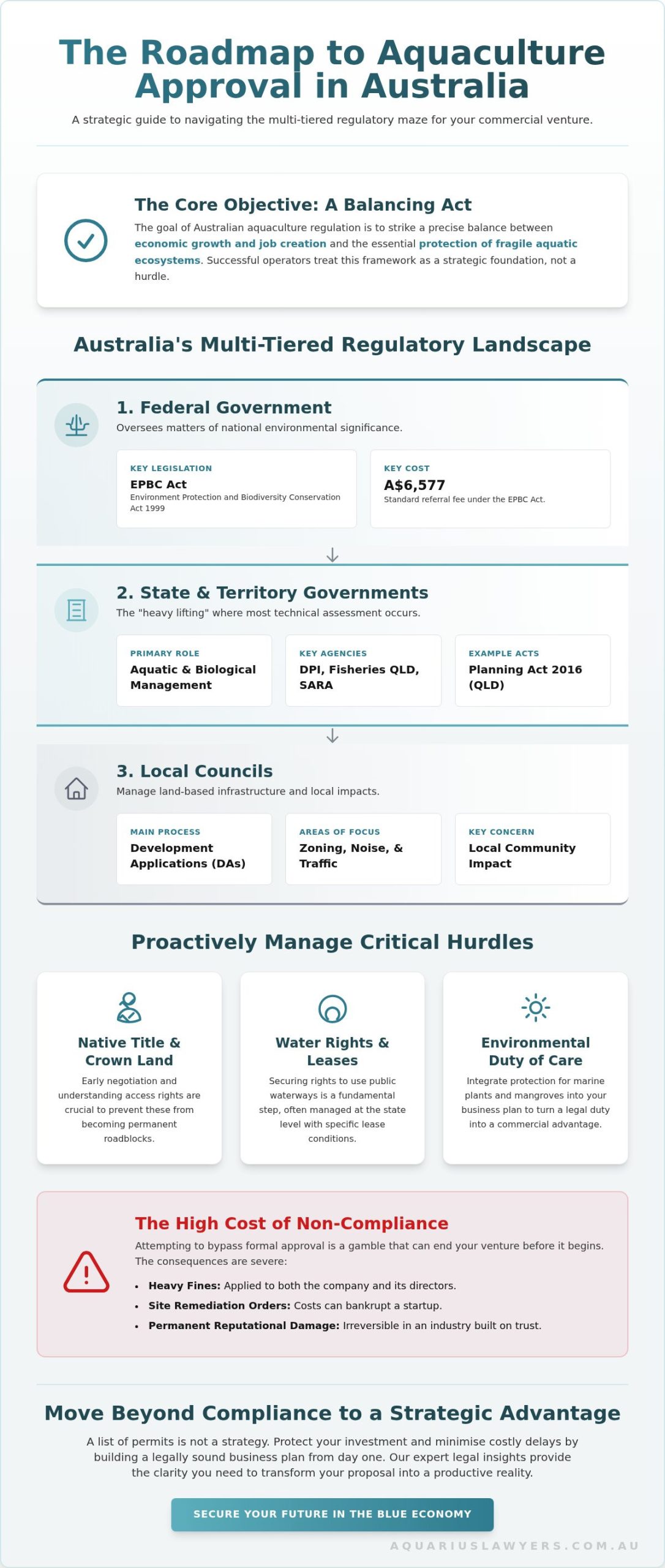
The core objective of the regulatory framework is to strike a precise balance. Authorities want to see economic growth and job creation, but they must weigh this against the protection of fragile aquatic ecosystems. This leads to a coordinated approval process involving multiple tiers of government. From local councils managing land-based infrastructure to state departments overseeing water leases, every step is designed to ensure your business plan is sustainable. Gaining a deeper understanding of Aquaculture in Australia reveals that successful operators are those who view these regulations as a strategic foundation rather than a hurdle.
Why is Aquaculture Regulated So Heavily?
The intensity of regulation reflects the unique risks of farming in water. Biosecurity is the primary concern. An outbreak in a commercial pen doesn’t stay confined; it can rapidly devastate wild fish stocks and local biodiversity. Additionally, the government acts as a gatekeeper for public resource management. Since you’re often using Australian waterways for private enterprise, regulators must ensure your operation doesn’t unfairly impact other maritime industries. This includes protecting the interests of commercial fishers, tourism operators, and recreational boaters who all share the same space.
The Consequences of Non-Compliance
Attempting to bypass a formal aquaculture development approval is a high-stakes gamble that rarely pays off. The legal repercussions are severe. Under the Fisheries Management Act and various state Planning Acts, heavy fines can be levied against both the company and its directors. Perhaps more damaging are compulsory site remediation orders. These orders can force you to restore a marine environment to its original state at your own expense, a cost that can easily bankrupt a startup. Beyond the financial ruin, the reputational damage within the Australian sustainable seafood market can be permanent. In an industry built on trust and environmental credentials, a single compliance failure can end your commercial future before it truly begins.
The Multi-Tiered Regulatory Landscape: From Local Councils to Federal Acts
Securing an aquaculture development approval in Australia requires navigating a structural maze that spans three distinct levels of government. It isn’t just about ticking boxes; it’s about understanding how local, state, and federal mandates intersect. At the base, local councils manage land-based impacts through Development Applications (DAs), focusing on noise, traffic, and local zoning. Above them, state departments like the NSW Department of Primary Industries (DPI) or Fisheries Queensland oversee the actual biological and aquatic management. Finally, the Commonwealth steps in whenever a project touches on matters of national significance.
For many operators, the Australian Business Licence and Information Service (ABLIS) serves as a logical starting point to identify the permits required for a specific location. However, a list of permits is not a strategy. You must account for legislation like the Planning Act 2016 in Queensland or the Environmental Planning and Assessment Act in NSW. These laws dictate how your proposal is assessed and which agencies have the power to stop it. A National Aquaculture Legislation Overview shows that while states hold primary responsibility, the constitutional reach of federal law can often surprise unprepared proponents. Consulting a fisheries law specialist early in the process can help you map these tiers before you commit significant capital.
State-Level Approvals: The Heavy Lifting
The state level is where the bulk of the technical assessment occurs. In Queensland, the State Assessment and Referral Agencies (SARA) act as a single point of contact to coordinate multi-agency responses, which streamlines the process. You don’t just need development consent to build; you also need an “Aquaculture Authority.” This is your legal right to farm a specific species. In NSW, the 2025-2026 fee schedule sets the annual permit contribution at a flat rate of A$574, but the complexity increases for marine-based operations compared to land-based systems. Marine sites often require additional seabed leases and more intensive environmental monitoring protocols. Operators planning to farm in New South Wales should review the detailed requirements for securing an aquaculture licence NSW under the Fisheries Management (Aquaculture) Regulation 2024 to ensure their documentation meets DPI standards from the outset.
Federal Oversight: When Does the Commonwealth Step In?
Federal intervention is triggered by the Environment Protection and Biodiversity Conservation Act (EPBC Act) if your project impacts Matters of National Environmental Significance (MNES). If you’re operating near the Great Barrier Reef, you’ll also need to navigate the Great Barrier Reef Marine Park Authority (GBRMPA). The referral fee to determine if your project is a “controlled action” under the EPBC Act is A$6,577 as of May 2026. Beyond environmental concerns, the Commonwealth also regulates the export of aquaculture products. If your business plan involves shipping high-quality Australian seafood to international markets, you must meet strict federal biosecurity and trade standards to gain export clearance.
Assessing Your Project: Accepted vs. Assessable Development
Determining whether your project is classified as “Accepted Development” or “Assessable Development” is the first major fork in the road. This classification dictates the level of scrutiny your business will face and the total cost of your aquaculture development approval. Accepted development generally covers low-impact activities that don’t require a full assessment, provided they strictly adhere to a predetermined set of requirements. Assessable development, conversely, triggers a comprehensive Development Application (DA) because the project’s scale or location presents a higher risk to the surrounding environment.
Regulators use the State Development Assessment Provisions (SDAP) as the primary benchmark for these decisions. The SDAP contains the specific performance outcomes and acceptable solutions your project must meet to gain approval. To navigate this effectively, the pre-lodgement phase is your most valuable tool. Meeting with state agencies before you lodge your formal application allows you to identify potential “deal-breakers” early. It’s a proactive step that prevents you from wasting thousands of dollars on technical reports for a site that might be fundamentally unsuitable.
Low-Impact Operations: The Fast Track
Small-scale, land-based recirculating aquaculture systems (RAS) often fall into the low-impact category. If your system is designed to contain all waste and has a minimal footprint, you might bypass the more gruelling assessment tiers. Routine maintenance of existing, approved structures also typically avoids new triggers. However, you must be wary of “bracket creep.” This occurs when minor incremental changes to your production capacity or site layout suddenly push your project over the threshold into assessable status. Even a small expansion can change your legal obligations overnight, so it’s vital to monitor your operational limits closely.
High-Impact Projects: The Full Approval Pathway
High-impact projects involve more complex environmental interactions and always require a full aquaculture development approval. Sea-cage operations in open water and large-scale pond systems are the primary examples here. These projects are scrutinised for their potential to discharge wastewater or create barriers in natural waterways that might impede fish movement. If your development is within or adjacent to a Declared Fish Habitat Area, the level of assessment intensifies. In these sensitive zones, the government’s priority is the protection of marine plants and nursery grounds, meaning your environmental impact studies must be exceptionally robust to prove your project’s viability.
Critical Hurdles: Native Title, Environment, and Water Rights
Many operators balk at the cost of environmental studies, viewing them as a bureaucratic sinkhole. It’s a common objection, but these studies are actually your primary insurance policy against future litigation. A thorough environmental assessment proves that your operation meets its legal “Duty of Care” toward marine plants and mangroves. Under various state Fisheries Acts, damaging these habitats without a permit can lead to massive fines. Securing your aquaculture development approval also requires navigating the Crown Land Management Act. Since most aquaculture occurs on public land or water, obtaining a lease from the Crown is a prerequisite that involves intense scrutiny of your business’s long-term viability.
Environmental Impact Statements (EIS)
Choosing between a full Environmental Impact Statement (EIS) and a simpler Statement of Environmental Effects (SEE) depends on your project’s scale and its potential for “controlled actions.” If your proposal impacts matters of national environmental significance, the referral fee under the EPBC Act is A$6,577 as of May 2026. For projects deemed a controlled action, assessment fees can range from A$8,010 to over A$25,583 depending on the complexity. Technical focus usually lands on nutrient loading, escapee management, and noise pollution. If you are operating in Queensland, you must also factor in annual fees for Environmentally Relevant Activities (ERA), which sit at A$5,644.80 for marine enclosures over one hectare. Engaging a marine law specialist to vet these reports before submission ensures the science matches the legal requirements, preventing costly delays if the Minister requests more information at A$1,701 per request.
Native Title and Cultural Heritage
Native Title is often viewed with uncertainty, yet it is a standard part of the Australian legal landscape. In many jurisdictions, you will encounter the “Right to Negotiate” for aquaculture leases on Crown land. Rather than viewing this as a delay, successful operators treat it as a business strategy. Building positive, transparent relationships with Traditional Owners ensures a long-term social licence to operate. Cultural heritage clearances can influence where you place your pens or land-based sheds, so addressing these factors during site selection is a pragmatic move. It prevents late-stage redesigns and fosters a collaborative environment that benefits the local community and your commercial interests alike.
Securing Your Future: Why Legal Strategy Outperforms Simple Compliance
Compliance is often viewed as a defensive hurdle. You tick the boxes to avoid a fine. However, a truly successful aquaculture development approval is built on a proactive legal strategy that treats regulations as a framework for commercial growth. At Aquarius Lawyers, we function as the “innovative veteran” in the room. We combine deep, traditional credentials in maritime law with a modern, tech-savvy approach to problem-solving. This intellectual versatility allows us to move beyond simple paperwork and into the realm of strategic project management.
Katherine Hawes, widely recognised as “The Fish Lawyer,” provides a unique service that integrates commercial law with niche fisheries expertise. We don’t just review your application; we project manage the entire approval pathway. This involves coordinating with environmental consultants, negotiating with state agencies, and ensuring your operational timeline remains realistic. To provide your startup with predictable costs, we offer fixed-fee arrangements for many of our services. This transparency ensures that legal fees don’t become an uncontrolled variable in your capital expenditure budget.
What Happens if Your Application is Refused?
A refusal isn’t necessarily the end of your project. In New South Wales, you have the right to appeal certain decisions in the Land and Environment Court. While litigation is a powerful tool, we often find that mediation is a more cost-effective and timely path to resolution. Many successful appeals hinge on demonstrating that the proposed environmental safeguards exceed the “acceptable solutions” outlined in the SDAP. We focus on identifying these technical openings to turn a “no” into a conditional “yes,” saving your business months of potential downtime.
The Aquarius Lawyers Advantage
Our approach is grounded in the synergy between maritime law and commercial property leases. We provide strategic advice on business plans to ensure they meet legal benchmarks from day one. This foresight prevents the “bracket creep” mentioned earlier, where minor operational changes might accidentally void your existing permits. Whether you are navigating the complexities of Crown land access or need a robust framework for international export, we provide the steady, common-sense guidance required to succeed in the Australian blue economy. Protect your investment and ensure your business plan is legally sound from the outset. Organise a consultation with Aquarius Lawyers today to secure your future in the industry.
Charting Your Course in the Australian Blue Economy
The path to a successful aquaculture development approval is rarely a straight line. It requires a sophisticated understanding of how local zoning, state fisheries mandates, and federal environmental laws intersect. By identifying whether your project is accepted or assessable development early, you can allocate your capital more efficiently and avoid the common traps of bracket creep or unforeseen Native Title complications. Success in this industry isn’t just about biological expertise; it’s about building a robust legal foundation that protects your commercial interests over the long term.
Principal Katherine Hawes, known across the industry as “The Fish Lawyer,” offers the specialist expertise in Fisheries and Marine Law you need to navigate these waters with confidence. With offices in Sydney and Regional NSW, our team provides the down-to-earth, pragmatic advice required to move your project from a concept to a compliant, profitable reality. Don’t leave your investment to chance. Secure your aquaculture future with expert legal strategy from Aquarius Lawyers. Your vision for a sustainable aquatic venture deserves a partner who understands both the law and the water.
Frequently Asked Questions
How long does it typically take to get aquaculture development approval in Australia?
The timeline for an aquaculture development approval typically ranges from 6 to 18 months depending on the project’s complexity. If your proposal requires a federal referral under the EPBC Act, you should expect the process to take longer. Early engagement with state agencies during the pre-lodgement phase is the most effective way to identify potential delays and streamline your path to a final decision.
Can I start a small-scale aquaculture farm without a full development application?
Small-scale operators can often bypass a full DA if their project qualifies as “accepted development” under state planning laws. This usually applies to land-based recirculating systems that have a minimal footprint and contain all waste on-site. However, you must still comply with specific self-assessable codes. If your production capacity exceeds certain thresholds, your project will automatically trigger a more rigorous assessable development pathway.
What is the difference between an aquaculture licence and a development approval?
A development approval grants permission to use the land or seabed for a specific purpose, whereas an aquaculture licence authorises the biological activity of farming fish. Think of the DA as the “building permit” and the licence as your “operating permit.” You generally cannot hold one without the other. Both documents work together to define the legal boundaries and environmental responsibilities of your commercial operation. NSW-based operators can find a detailed breakdown of the licensing process in our guide to securing an aquaculture licence NSW under the current regulatory framework.
How much does the environmental assessment for an aquaculture project cost?
Environmental assessment costs vary significantly based on the scale of your project and the specific jurisdiction. For example, the federal referral fee to determine if a project is a “controlled action” is A$6,577 as of May 2026. In Queensland, technical assessment fees for an aquaculture development approval are tiered, ranging from A$698.10 for Level 1 up to A$20,691.49 for Level 5 assessments.
Do I need a separate permit to discharge wastewater from my fish farm?
Wastewater discharge usually requires a separate environmental authority or an Environmentally Relevant Activity (ERA) permit. These permits ensure that any discharge meets strict water quality standards to protect local ecosystems. In Queensland, the annual fee for an ERA involving land-based crustacean farming is A$1,724.80 as of July 2025. Marine-based operations in enclosures often face higher annual fees, currently set at A$5,644.80.
What happens if there is a Native Title claim on the area I want to farm?
A Native Title claim triggers a legal requirement to negotiate with the Traditional Owners of the land or water. This process usually involves seeking an Indigenous Land Use Agreement (ILUA) or exercising the “Right to Negotiate.” It’s a standard part of doing business on Crown land in Australia. Successful operators view these negotiations as an opportunity to build a sustainable social licence within the local community.
Can Aquarius Lawyers help with approvals in states other than NSW?
Aquarius Lawyers provides nationwide legal support for the aquaculture industry across all Australian states and territories. While our physical offices are in Sydney and Regional NSW, our expertise in federal legislation and international maritime law allows us to manage complex approvals anywhere in the country. We act as a central point of contact for operators who need consistent legal strategy across multiple jurisdictions.
Is it possible to appeal a local council decision on an aquaculture DA?
You have the legal right to appeal local council decisions through specialised state courts, such as the Land and Environment Court in NSW. If your DA is refused or if the conditions imposed are commercially unviable, mediation is often the first step toward a resolution. We focus on identifying technical grounds for appeal, such as demonstrating that your environmental management plan exceeds the required performance outcomes.
Disclaimer
Please note that legal rules change and this is not a substitute nor construed as legal advice. It is general information only.