Your multi-million dollar aquaculture project shouldn’t be held hostage by a local council’s misunderstanding of state-level environmental impact assessments. It’s a common reality for many Australian operators who find themselves stuck in a regulatory black hole where overlapping jurisdictions and unpredictable costs stall progress indefinitely. You’ve likely felt the weight of these hurdles, especially when dealing with complex Native Title negotiations or stakeholder objections that seem designed to block your path. Engaging an aquaculture dispute resolution lawyer early in the process is often the difference between a project that sinks and one that thrives.
At Aquarius Lawyers, we understand that you’re looking for a clear pathway to a granted licence and a reduced time-to-market. This guide provides the expert strategies you need to master the multi-agency approval process and resolve even the most stubborn regulatory barriers. We’ll preview the latest 2026 fee structures in New South Wales, explain how to draft environmental management plans that withstand legal appeals, and share practical insights from The Fish Lawyer at Aquarius Lawyers to ensure your venture remains legally sound from day one.
Key Takeaways
- Identify the specific “lead agency” in your state to simplify the coordination of local, state, and Commonwealth regulatory requirements.
- Navigate high-risk hurdles such as Native Title obligations and Marine Park zoning with a proactive legal strategy to prevent project-ending delays.
- Implement a strategic five-step roadmap, beginning with pre-lodgement consultations, to secure essential whole-of-government advice early in the process.
- Partner with an aquaculture dispute resolution lawyer to identify potential regulatory conflicts and resolve hurdles before they escalate into costly litigation.
- Develop robust environmental management plans designed to withstand stakeholder objections and ensure your aquaculture licence remains legally secure.
Aquaculture Development Approval: Why is it So Complex?
Aquaculture development approval is the formal legal authorisation required to cultivate aquatic organisms commercially in Australian waters or land-based facilities. As the Aquaculture in Australia sector continues to expand toward a projected 453,000 tonnes by 2034, the regulatory environment has become increasingly crowded. Obtaining a licence isn’t a simple “tick-the-box” exercise. It’s a strategic negotiation with multiple authorities that often have competing priorities.
Proponents face a “Three-Tier” challenge. You must navigate local council planning schemes, state-based fisheries legislation, and Commonwealth environmental protections simultaneously. This complexity is compounded by the distinction between development and non-development works. While the Planning Act in your state governs the physical footprint and land use, the Fisheries Act regulates the biological and operational aspects. If these two streams aren’t perfectly aligned, your project can stall before the first cage is in the water. This is why engaging an aquaculture dispute resolution lawyer early is a protective step. They ensure that the conditions of your development consent don’t contradict your aquaculture permit, preventing a legal stalemate between agencies.
The cost of getting it wrong is high. Beyond the immediate risk of application refusal, non-compliance can lead to heavy fines, remediation orders, or permanent project shutdowns. Under the Fisheries Management Amendment (Enforcement) Bill 2026 in NSW, penalties for damaging infrastructure or stealing stock have increased to $44,000. For an operator, a single regulatory oversight can result in a site being declared unusable, wiping out years of capital investment.
The Legal Framework for Australian Aquaculture
The primary driver for most projects is the Fisheries Management Act 1994 (NSW) or its interstate equivalents, such as the Aquaculture Act 2001 in South Australia. These acts establish the permit system and set the baseline for operational conduct. However, federal intervention via the Environment Protection and Biodiversity Conservation (EPBC) Act often triggers if your farm sits near a RAMSAR wetland or impacts migratory species. The 2026 regulatory shift across Australia now places a much heavier emphasis on “aquaculture authority codes” and performance bonds, making the legal landscape more stringent than ever before.
Why “DIY” Applications Often Lead to Disputes
Many operators attempt to manage applications themselves, only to find their Environmental Management Plans (EMPs) rejected. Common mistakes include failing to address specific water quality triggers or ignoring pre-lodgement advice from state agencies. When an agency objects, it often leads to a formal dispute. An aquaculture dispute resolution lawyer helps you navigate these objections by restructuring your EMP to meet technical requirements while protecting your commercial interests. Proper stakeholder consultation is also vital. Without it, you risk formal appeals from local residents or maritime users that can trap your project in the Land and Environment Court for years.
The Regulatory Maze: Coordinating Multi-Agency Requirements
Succeeding in the Australian aquaculture sector requires more than just biological expertise. You must master a web of government bodies that often speak different regulatory languages. While most states designate a “Lead Agency”, such as NSW DPI Fisheries, this doesn’t mean you only have one door to knock on. You’re effectively managing a coalition of interests, from environmental protection to maritime safety. Each agency has the power to stall your project if their specific criteria aren’t met.
In Queensland, the State Assessment and Referral Agency (SARA) attempts to streamline this by centralising the referral process. However, the technical burden remains high. Local governments control the land-based side of your operation, overseeing zoning, shore-based infrastructure, and waste discharge permits. If your land-based hatchery doesn’t meet local council sewage requirements, your entire marine lease could become a stranded asset. The Environment Protection Authority (EPA) is another critical player, setting benchmarks for water quality and nutrient discharge. If these benchmarks are set without a commercial reality check, they can cripple your margins. This is where an aquaculture dispute resolution lawyer adds value. They negotiate with the EPA to ensure your licence conditions are both environmentally responsible and commercially viable.
NSW Specific: Navigating Sydney and Regional Approvals
Sydney Harbour and Botany Bay are high-stakes environments for aquaculture. Here, you must satisfy NSW Maritime and the Port Authority regarding navigational safety and exclusion zones. The density of commercial shipping means your lease boundaries are often contested. In regional NSW, the focus often pivots to Crown land access and the complexities of oyster lease renewals. These renewals are frequently challenged by new coastal developments or changes in waterway usage. Securing legal oversight for these renewals ensures that your tenure remains protected against shifting local priorities.
Stakeholder Consultation: A Legal Necessity
Community pushback is one of the most common reasons for project delays. Legally documenting your engagement process is essential to prevent future disputes. This isn’t just about holding a public meeting; it involves strategic responses during the “Have your say” exhibition phase. By addressing objections with evidence-based legal arguments, you can neutralise appeals before they reach a tribunal. For industry-wide insights, organisations like Seafood Industry Australia provide excellent resources, but your local strategy must be site-specific. An aquaculture dispute resolution lawyer can help you manage these “Have your say” periods to protect your commercial interests, ensuring that public objections don’t turn into permanent roadblocks.
High-Risk Hurdles: Native Title, Marine Parks, and Waterway Barriers
Beyond the standard permits, three specific hurdles often act as “project killers” for Australian aquaculture. These are not mere administrative delays. They are legal landmines that can terminate a venture before the first harvest. Understanding the nuances of Australian aquaculture legislation is vital, but the practical application of these laws in the field is where most operators stumble. Misinterpreting a single clause in a zoning plan can lead to an immediate refusal of your application.
Native Title represents the most significant commercial risk. Under the Native Title Act 1993, proponents must address the rights of Traditional Owners. This isn’t a checkbox. It’s a legal obligation. If your lease overlaps with a Native Title claim, you face a choice: the “Right to Negotiate” or an Indigenous Land Use Agreement (ILUA). An ILUA is often the preferred pathway. It provides long-term certainty and builds a partnership rather than a conflict. However, mismanaging these negotiations can lead to indefinite delays. An aquaculture dispute resolution lawyer ensures that your consultation process is culturally respectful and legally watertight, preventing appeals that could freeze your operations.
Marine Park zoning adds another layer of restriction. While “General Use” zones may allow for specific aquaculture activities, “Sanctuary” zones are strictly off-limits. Proposing a farm in the wrong zone is a non-starter. Similarly, waterway barrier works require specific permits to ensure fish passage isn’t impeded. If you’re building a weir or a causeway for a land-based facility, you’re under the microscope. The penalties for getting this wrong are severe. Destroying marine vegetation, such as mangroves or seagrasses, without a permit can result in massive fines and mandatory remediation orders.
Native Title Negotiations for Aquaculture
Negotiations must move beyond consultation into genuine collaboration. Overlapping claims are common in coastal waters. A successful strategy involves early engagement and clear benefit-sharing frameworks. We have seen cases where existing marine leases were challenged because the original approval process failed to account for non-exclusive Native Title rights. Fixing these issues retrospectively is expensive. It’s far better to secure an ILUA during the feasibility stage. This proactive approach turns a potential hurdle into a stable foundation for your business.
Environmental Impact Statements (EIS)
A full EIS is usually triggered if your project is deemed “designated development” due to its scale or location in sensitive areas. Your documentation must meet benchmarks like “State Code 17” in Queensland or equivalent environmental standards elsewhere. Under the EPBC Act, the legal threshold for federal intervention is whether the project has, or is likely to have, a “significant impact” on a matter of national environmental significance. Legally, a “significant impact” is defined as an impact that is important, notable, or of consequence, having regard to its context or intensity. An aquaculture dispute resolution lawyer helps you define this threshold accurately to avoid unnecessary federal triggers while ensuring your state-level compliance is beyond reproach.
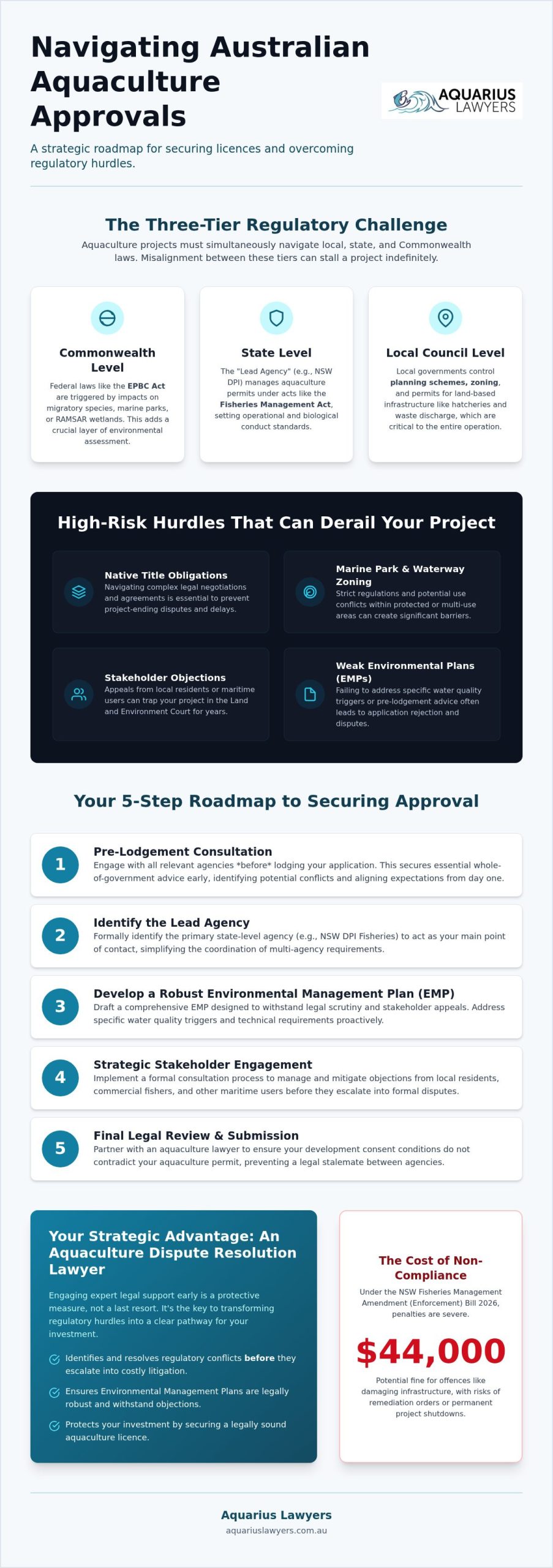
Your 5-Step Roadmap to Securing Aquaculture Approval
Government websites often list what you need, but they rarely explain the legal strategy required to actually secure it. Obtaining an aquaculture licence isn’t just about filing paperwork. It’s a chronological sequence designed to de-risk your investment. This roadmap ensures you build a project that regulators want to approve by front-loading your effort to avoid back-end litigation. Following a logical flow from concept to compliance is the most efficient way to reduce your time-to-market.
Step 1: The Power of Pre-Lodgement
Requesting a formal pre-lodgement meeting is a commercial must. This is where you identify “fatal flaws” in your proposal before you spend thousands on technical surveys or site designs. These meetings provide whole-of-government advice, bringing agencies like DPI Fisheries and the EPA to the same table. Aquarius Lawyers facilitates these high-level discussions, ensuring that agency feedback is documented and addressed early. It’s about creating a pathway to “yes” before the clock officially starts.
Step 2: Site Selection and Tenure
You must confirm access to state land or water through a lease or permit before proceeding. Tenure is the foundation of your business. Without it, your application has no legal standing and cannot progress through the assessment phase.
Step 3: Drafting for Success
Moving beyond generic templates is vital for a successful outcome. Your Environmental Management Plan (EMP) must be customised for your specific species and site conditions. From a legal perspective, you need to address biosecurity and disease management with enough detail to satisfy the most cautious regulator. Under the 2026-27 fee schedule, permit application fees in NSW can reach A$856 for certain classes. A “decision-ready” application ensures you don’t waste these non-refundable fees on a proposal that isn’t legally sound. When an application is complete and robust, it reduces the likelihood of a request for further information (RFI), which is the number one cause of approval delays.
Step 4: Assessment and Public Notification
This is the stage where your project enters the public eye. Managing the statutory clock here is critical. If objections arise, an aquaculture dispute resolution lawyer can help you craft strategic responses that protect your commercial interests while satisfying regulatory concerns.
Step 5: Post-Approval Compliance
Securing the licence is only half the battle. You must meet ongoing monitoring and reporting conditions to keep your operation legal. Talk to The Fish Lawyer today to begin your pre-lodgement strategy and secure your farm’s future.
Strategic Legal Support: How The Fish Lawyer Protects Your Investment
Aquaculture is a high-stakes industry where minor legal oversights often lead to stranded assets. You don’t just need a lawyer; you need a specialist who understands the biological and maritime realities of your farm. A generalist property lawyer might handle a land purchase, but they won’t understand the specific nuances of a Class A aquaculture permit or the complexities of the Fisheries Management Act. Specialist expertise + proactive strategy = long-term security. This is the formula we use to protect your commercial interests and ensure your operation remains resilient.
Risk mitigation is about staying ahead of the regulatory curve. With the introduction of the Fisheries Management Amendment (Enforcement) Bill 2026, the cost of non-compliance has skyrocketed. Fines of up to A$44,000 for stock theft or infrastructure damage mean you need robust legal frameworks in place to protect your property. An aquaculture dispute resolution lawyer acts as your first line of defence. Whether you’re facing a fisheries prosecution or defending against a permit appeal from a local stakeholder, having a lawyer who speaks the language of the regulators is invaluable. We leverage established relationships with state regulators to streamline communication and resolve hurdles before they reach a courtroom.
Beyond the Approval: Ongoing Compliance and Growth
Securing your licence is just the beginning of the journey. You must manage annual reporting requirements and licence renewals to avoid suspension or cancellation. For example, the NSW 2026-27 fee schedule includes a flat-rate permit contribution of A$598, and missing these payments or failing to update your Environmental Management Plan can trigger unwanted audits. As your business grows, you’ll need legal support for farm expansion projects and the protection of your intellectual property. Your proprietary farming techniques and biosecurity protocols are valuable assets that require specific legal safeguards to ensure your competitive edge remains intact in a global market.
Why Aquarius Lawyers?
Aquarius Lawyers offers the “Fish Lawyer” advantage. Principal Katherine Hawes is a recognised leader in the field, blending deep industry credentials with a modern, tech-savvy approach. We provide cost-effective solutions for everyone from small-scale oyster startups to large-scale commercial finfish fleets. We value results over ceremony, offering the steady, common-sense guidance you need to thrive in a complex regulatory environment. Our goal is to handle the legal complexities so you can focus on growing your business. Book a consultation with Katherine Hawes to discuss your aquaculture project today.
Securing Your Farm’s Future in a Changing Regulatory Tide
Mastering the Australian aquaculture landscape requires more than just operational grit; it demands a sophisticated legal strategy that anticipates hurdles before they become project-killers. By prioritising pre-lodgement consultations and building robust environmental management plans, you’re not just ticking boxes. You’re protecting your capital from the unpredictable costs of regulatory delays. Whether you’re navigating the 2026 fee shifts or managing complex Native Title negotiations, having a steady guide ensures your venture remains on a clear pathway to commercial success.
Engaging an aquaculture dispute resolution lawyer early allows you to resolve conflicts with state agencies or local stakeholders before they escalate into costly litigation. Principal Katherine Hawes, Australia’s leading “Fish Lawyer”, provides the specialised expertise in NSW Fisheries compliance and maritime law needed to protect your investment. From Sydney Harbour to regional fleets, we offer the down-to-earth pragmatism required to turn regulatory challenges into operational wins. Secure your aquaculture future with expert legal advice from The Fish Lawyer. We’re here to help you build a sustainable and legally sound business that stands the test of time.
Frequently Asked Questions
How long does it typically take to get aquaculture development approval in NSW?
Approval times in NSW generally range from 6 to 12 months for standard permits, though complex projects involving state significant development can take much longer. The 2026 regulatory environment has introduced stricter sustainability checks, which can influence processing times. Engaging an aquaculture dispute resolution lawyer early ensures your application is “decision-ready,” which is the most effective way to avoid administrative delays and requests for further information.
Do I need a separate licence for each species I intend to farm?
Yes, your permit is generally specific to the species and method of cultivation authorised by the department. In NSW, permits are categorised into classes, such as Class A for extensive pond culture or Class E for multi-species. If you wish to pivot from oysters to seaweed, or add a new finfish species, you must apply for a permit variation. This process involves a formal request and a variation fee, which ranges from A$171 to A$427 depending on the permit class.
Can I transfer an aquaculture licence if I buy an existing farm?
You can transfer an aquaculture licence, but it isn’t an automatic right that comes with the property title. Both the current holder and the buyer must apply to the relevant state department, such as NSW DPI, for a formal transfer. The department assesses the incoming operator’s fitness and may require a performance bond. It’s vital to conduct thorough due diligence to ensure the licence is in good standing before finalising any purchase agreement.
What are the main reasons aquaculture applications are refused?
Applications are most commonly refused due to inadequate Environmental Management Plans (EMPs) or unresolved stakeholder objections. If your proposal significantly impacts “matters of national environmental significance” under the EPBC Act or fails to address biosecurity risks, regulators will likely reject it. Other fatal flaws include proposing a farm in a “Sanctuary” zone of a Marine Park or failing to secure land-based tenure for essential shore-side operations.
How much does the aquaculture approval process cost in legal and agency fees?
Agency fees in NSW for new permits range from A$341 for Class A to A$856 for Class D as of July 2026. These are non-refundable administrative costs paid to the government. Legal fees vary based on project complexity, especially if you require an aquaculture dispute resolution lawyer to manage Native Title negotiations or formal appeals. Investing in specialised legal strategy early often saves thousands by preventing the need for costly remediation or court appearances later.
What happens if my farm is located in a Marine Park?
Farming in a Marine Park is possible, but it depends entirely on the specific zoning plan for that area. Most aquaculture is restricted to “General Use” zones and is strictly prohibited in “Sanctuary” zones. You will need an additional permit from the Marine Park authority, and your EMP must demonstrate that your operations won’t degrade the park’s conservation values. This often involves more rigorous water quality monitoring and stricter waste management protocols.
Is an Environmental Impact Statement (EIS) always required for land-based aquaculture?
An Environmental Impact Statement (EIS) isn’t always mandatory for land-based farms, but it’s often triggered by the scale or location of the development. If your project is classified as “designated development” under state planning laws, a full EIS is required. For smaller operations, a less intensive Statement of Environmental Effects (SEE) might suffice. It’s a matter of meeting the specific thresholds set by your local council and state fisheries department.
How does Native Title affect my ability to secure a marine lease?
Native Title can significantly impact your ability to secure a lease if the area is subject to a claim or determination. Under the Native Title Act 1993, you must follow the “future act” provisions, which may involve the Right to Negotiate or establishing an Indigenous Land Use Agreement (ILUA). Failing to correctly address these rights can lead to your lease being declared invalid or stuck in legal limbo for years. Securing an ILUA is usually the most stable pathway for long-term tenure.
Disclaimer
Please note that legal rules change and this is not a substitute nor construed as legal advice. It is general information only.