
Most executors treat the probate application process as a mere paperwork chore to be endured during a period of grief. In reality, a Grant of Probate is the most powerful legal shield you can hold, protecting you from personal liability while honouring your loved one’s final wishes. It is the vital mechanism that transforms a complex list of assets into a protected inheritance for beneficiaries.
We understand that staring down the NSW Supreme Court’s digital registry while managing family expectations is exhausting. You are likely worried about bureaucratic errors, the 2026 filing fee increases, or being held personally responsible for estate debts. We have built this guide to replace that anxiety with a logical, no-nonsense strategy for settling an estate. In our experience, traditional expertise plus modern efficiency equals a faster resolution for everyone involved.
You will learn exactly how to navigate the current court requirements, meet the strict six-month filing deadline, and avoid the common pitfalls that cause lengthy delays. From the first online notice to the final court seal, this is your clear pathway to a successful probate application.
Key Takeaways
- Understand why a Grant of Probate acts as a vital legal shield, protecting executors from personal liability while ensuring assets reach their intended beneficiaries.
- Navigate the five critical stages of the probate application process, from publishing notices on the NSW Online Registry to final court lodgement.
- Learn to manage the 2026 digital mandate efficiently, avoiding common paperwork pitfalls and technical requisitions that often stall estate distribution.
- Identify strategies to meet the strict six-month filing deadline, even when dealing with complex assets or inconsistent documentation.
- Discover how a tech-savvy approach to estate law provides fixed-fee transparency and reduces the administrative burden on grieving families.
What is Probate and Why is it Essential in NSW?
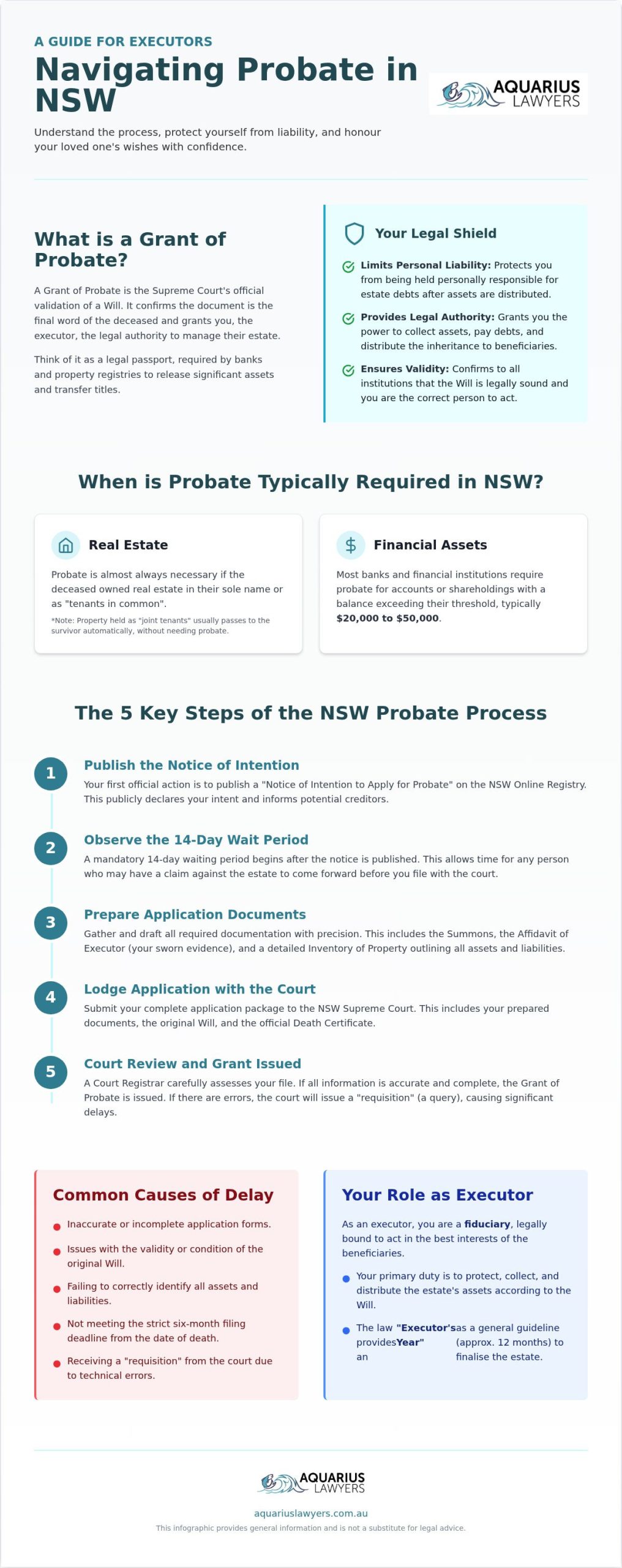
A Grant of Probate is the Supreme Court’s official stamp of approval on a Will. It confirms that the document is the final, valid word of the deceased and that you, as the named executor, have the legal authority to manage their affairs. While the foundational concept of What is Probate remains consistent across many jurisdictions, the Succession Act 2006 (NSW) and the Supreme Court Rules 1970 (NSW) dictate the specific rules we follow here in New South Wales.
Think of Probate as a legal passport. Without it, you’ll find most doors firmly locked. Banks, share registries, and Land Registry Services (LRS) aren’t being difficult when they ask for this document; they are protecting themselves. They require the Court’s seal before they’ll release significant funds or transfer property titles to ensure they aren’t handing assets to the wrong person or moving property based on an invalid Will.
The most critical reason to start the probate application process is the protection it offers you. Acting as an executor carries personal risk. If you distribute assets to beneficiaries and a creditor later emerges with a valid claim, you could be held personally liable for that debt. Obtaining a Grant of Probate, combined with the correct statutory notices, creates a legal shield that limits your liability and ensures you can settle the estate with confidence.
When is a Grant of Probate Required?
In NSW, you’ll almost certainly need probate if the deceased owned real estate in their sole name or as “tenants in common.” If the property was held as “joint tenants,” it usually passes automatically to the survivor without probate. For cash assets, most Australian banks set a threshold between $20,000 and $50,000. If the balance exceeds this, they’ll freeze the account until they see the Grant. Small estates consisting only of low-value personal items might bypass the formal probate application process, but you should always verify these thresholds with each individual institution first.
The Role of the Executor
As an executor, you are a fiduciary. This means you have a strict legal duty to act in the best interests of the beneficiaries, putting their needs above your own. There is a concept in NSW law known as the “Executor’s Year,” which suggests you have roughly twelve months to wrap up the estate’s affairs. While this isn’t a hard deadline, beneficiaries often expect progress within this timeframe. Getting the initial application right prevents “requisitions,” which are formal queries from the Court that can stall the process for months. Accuracy is your best defence against family friction and potential litigation.
The 5 Key Steps of the NSW Probate Application Process
The probate application process is a methodical sequence. It is not about speed; it is about precision. In New South Wales, the Supreme Court requires absolute certainty before granting an executor the power to manage a deceased person’s assets. This journey follows a predictable five-step path that balances transparency with legal protection. Following the NSW probate application process correctly is the difference between a smooth transition and a months-long bureaucratic nightmare.
The sequence typically unfolds as follows:
- Publishing the Notice: You must inform the public and potential creditors of your intention to apply.
- The Wait Period: A mandatory 14-day interval follows the notice, allowing any claimants to come forward.
- Preparation of Documents: This involves drafting the Summons, the Affidavit of Executor, and the Inventory of Property.
- Lodging the Application: You submit the original Will, the Death Certificate, and your drafted evidence to the Registry.
- Court Review: A Registrar assesses the file for errors before issuing the formal Grant.
Accuracy + Adherence = Efficiency. If you skip a step or miscalculate a date, the Court will issue a requisition, effectively hitting the pause button on your application. For many families, partnering with a specialist in Wills and Estates ensures these technical hurdles are cleared on the first attempt.
Step 1: The Notice of Intention to Apply
Precision in your public notice is non-negotiable. You must publish this notice on the NSW Online Registry at least 14 days before you lodge your formal application. This notice acts as a legal alarm for creditors and family members who may wish to contest the Will or claim a debt. If the wording is vague or the deceased’s name is misspelled, the Court will likely require you to republish, resetting your 14-day clock and delaying the entire probate application process.
Step 3: Drafting the Affidavit of Executor
This document is your formal testimony to the Court. You must prove the death by providing the original Death Certificate and identify the specific Will you are propounding. If the deceased left multiple codicils or informal notes, you must address these clearly to avoid confusion. The Inventory of Property is equally critical; it must list every NSW-based asset, from bank accounts to real estate, with documented values. Any discrepancy between the Will and your inventory can trigger a formal query from the Registrar.
Once your documents are lodged, the Registry begins its assessment. In 2026, most uncontested applications are processed within 20 working days, provided the paperwork is flawless. The final result is the Grant of Probate, a sealed document that serves as your ultimate authority to distribute the estate and fulfil your loved one’s final wishes.
NSW Online Registry: Navigating Digital Filing in 2026
By 2026, the NSW Supreme Court has firmly moved into a digital-first era. The days of bulky paper bundles and physical counter filings are largely over. Now, the probate application process begins at your keyboard. This shift is designed to streamline estate administration, but it requires executors to be both precise and tech-literate to avoid costly delays.
Since the 2026 digital mandate, paper filings have become the exception, reserved only for specific complex scenarios or where technology access is a genuine barrier. For most, the first step is creating an account on the NSW Online Registry or RedCrest portal. This setup is your gateway to the Court. It is a pragmatic, no-nonsense system, but accuracy is paramount from the very first click. For a detailed walkthrough of the portal’s technical requirements, the official NSW Online Registry guide provides essential assistance for new users.
Here is the hybrid reality: while the data entry is digital, the Will remains a physical artefact. You must still mail or deliver the original, physical Will to the Court Registry after e-filing your summons. The Court will not issue a Grant until they have compared your high-resolution digital scans against the physical document. This “digital-plus-physical” requirement is where many DIY executors stumble, often forgetting that the physical Will must be kept in its original state, without any new staple marks or paperclips.
Once approved, you won’t receive a thick parchment with a traditional wax seal. Instead, the Court issues a digital Grant featuring an electronic seal and a unique verification code. Banks, share registries, and land titles offices now verify these documents through a secure online portal. This modern approach means that once you have the Grant, the actual distribution of assets can happen significantly faster than in previous decades.
The Digital Inventory of Assets
Precision is the only currency the Online Registry accepts. You must categorise every asset, from bank accounts and shares to regional real estate holdings. The system automatically calculates your filing fee based on the gross value of the NSW estate. As of July 2026, remember that estates valued under $100,000 attract no filing fee, while those exceeding $5 million face a $7,399 charge. High-quality scans are non-negotiable; if a Registrar cannot clearly read a witness signature or a specific clause in your scan, they will issue a requisition, effectively halting your progress.
Troubleshooting the Online Process
System error messages are a common source of anxiety when navigating the probate application process digitally. Often, these are simply caused by file size limits or incorrect document formats. If you encounter persistent technical issues, it is often a sign that the matter has moved beyond a standard application. If the system feels overwhelming or the estate involves complex international assets, it is usually more efficient to step back and seek professional guidance rather than risking a formal rejection from the Registry. Cybersecurity must also be a priority; ensure you are using two-factor authentication to protect the sensitive financial data of the deceased’s legacy.
Avoiding ‘Paperwork Pitfalls’: Common Causes of Delay
Most delays in the probate application process aren’t caused by Court backlogs. They are caused by “requisitions.” A requisition is the Court’s formal version of a “please explain” letter. When a Registrar identifies an error, inconsistency, or missing detail in your filing, they issue a requisition that effectively freezes your application until you provide a satisfactory response. This can add weeks or even months to the timeline, increasing the anxiety of beneficiaries and creditors alike.
Name discrepancies are a frequent trigger for these delays. If the deceased is named “Jimmy Smith” in the Will but the Death Certificate identifies them as “James Smith,” the Court cannot simply assume they are the same person. You’ll need to provide an Affidavit of Identity to bridge the gap. Similarly, discovering assets after the Grant has been issued is a significant administrative headache. It requires an “Additional Inventory of Property” and further filing fees, which is why a thorough asset search before starting the probate application process is vital for efficiency.
While only about 1.5% of probate matters in NSW face formal objections or caveats, the risk of a requisition is much higher for DIY applications. If you want to ensure your filing is bulletproof from day one, seeking fixed-fee probate assistance can prevent these common bureaucratic traps.
The ‘Due Execution’ Dilemma
The physical condition of the Will is a silent witness to its history. In NSW, the Court is incredibly strict about “due execution.” If a Registrar spots staple holes where no staple currently exists, or marks from paperclips, they will suspect that a codicil or a later Will has been removed. You may be forced to file an Affidavit of Due Execution to prove the document hasn’t been tampered with. Never pull a Will apart to scan it for the online portal; the original must remain in its exact found state to satisfy the Court’s requirements.
Managing Creditors and Family Provision Claims
This is where your protection as an executor is truly tested. Under NSW law, you should generally wait six months from the date of death before distributing assets. However, family provision claims can be lodged up to 12 months after the date of death. If you distribute the estate’s assets too early and a successful claim is later made, you could be held personally liable to pay that claim out of your own pocket. Proactive communication with all potential claimants and adhering to the statutory notice periods is your only reliable defence against personal financial loss.
How Aquarius Lawyers Streamlines Your Probate Journey
The probate application process should not feel like a solo trek through a bureaucratic wilderness. At Aquarius Lawyers, we view estate administration as a technical challenge that yields to the right combination of traditional expertise and modern methodology. Our approach is built on a simple equation: 20 years of specialised legal experience + integrated digital systems = a seamless path to resolution for your family.
We recognise that executors are often managing significant grief alongside their legal duties. Our role is to act as your steady, common-sense guide. By providing fixed-fee transparency, we remove the anxiety of escalating legal bills and the “decision fatigue” that often accompanies estate matters. Whether you are based in the heart of Sydney or require the accessibility of our Shellharbour office for regional NSW matters, our team provides the high-level strategic thinking you expect from a veteran firm with the agility of a tech-savvy practice.
Our assistance extends far beyond simply obtaining the Court’s seal. Because our firm also specialises in Property Law and Commercial Law, we provide a complete solution for the actual transfer of land titles and the distribution of complex business assets to beneficiaries. This end-to-end service ensures you are protected from personal liability while fulfilling the deceased’s final wishes with absolute precision.
Our Strategic Methodology
We have refined a proactive system designed to bypass the common causes of delay discussed earlier in this guide. Our methodology includes:
- Initial Audit: We conduct a deep-dive review of the Will and Death Certificate to identify “red flags,” such as name discrepancies or “due execution” issues, before the application is lodged.
- Seamless Filing: We manage the entire NSW Online Registry portal on your behalf, ensuring every digital scan and data entry meets the strict 2026 Registrar standards.
- Direct Access: You receive grounded advice directly from Principal Katherine Hawes and our specialised team, ensuring you have a trusted advisor by your side at every milestone.
Next Steps for Executors
Efficiency in estate administration begins with early preparation. To get started, we recommend organising your “executor toolkit,” which includes the original physical Will, the Death Certificate, and a preliminary list of the deceased’s assets and liabilities. Once you have these documents, we can conduct a formal assessment of the estate’s complexity and provide a clear roadmap for the probate application process ahead.
Ready to move forward? Book a consultation with our Wills and Estates team today.
Securing the Legacy with Confidence and Clarity
Navigating the probate application process in 2026 demands a balance of traditional legal rigour and digital proficiency. You now understand that a Grant of Probate is more than a court document; it is your ultimate protection against personal liability and the key to a smooth asset distribution. By mastering the five-step sequence and avoiding common paperwork pitfalls like name inconsistencies or improper document handling, you ensure the deceased’s final wishes are honoured without unnecessary delay.
At Aquarius Lawyers, Principal Katherine Hawes brings over 20 years of expertise to every estate matter. We combine this “innovative veteran” perspective with fixed-fee transparency and specialised knowledge in Wills and Estates to simplify even the most complex regional or Sydney-based applications. From the initial online notice to the final property transfer, we provide the grounded, no-nonsense strategy you need during a difficult time.
Secure your estate with expert legal guidance—Contact Aquarius Lawyers. You have the tools to manage this responsibility, and we’re ready to help you get it right the first time.
Frequently Asked Questions
How long does the probate application process take in NSW in 2026?
An uncontested probate application process is typically processed by the Supreme Court within 20 working days, or approximately four weeks. This timeframe begins only after the formal application is lodged. You must also factor in the mandatory 14-day waiting period after publishing your initial notice and the time required to gather accurate valuations for all estate assets.
What are the current Supreme Court of NSW filing fees for probate?
Filing fees in NSW are calculated based on the gross value of the assets located within the state as of July 2026. Estates valued at less than $100,000 attract no filing fee. For larger estates, fees scale from $960 for assets up to $249,999, reaching $7,399 for estates worth $5 million or more. You should also budget $59 for the mandatory online notice of intention.
Can I apply for probate myself without a solicitor?
You have the legal right to apply as a self-represented executor, though the technical complexity makes this a challenging path. Recent satisfaction reports for the NSW Online Registry highlight significant user frustration with the digital filing portal. Small errors in your affidavit or inventory often lead to court requisitions, which freeze the probate application process and delay the distribution of assets to beneficiaries.
What happens if there is no Will?
If the deceased died without a valid Will, you must apply for a Grant of Letters of Administration rather than Probate. This process follows the intestacy rules set out in the Succession Act 2006 (NSW), which dictates a specific formula for asset distribution. It generally requires more extensive evidence to prove you are the person most entitled to manage the estate, such as a spouse or de facto partner.
Do I need probate if all assets were held in joint names?
Probate is generally not required if all assets, such as real estate or bank accounts, were held as “joint tenants.” Under the right of survivorship, these assets pass automatically to the surviving owner. You simply need to lodge a Notice of Death with Land Registry Services for property or provide a Death Certificate to the relevant bank to update the ownership records.
What is a ‘Reseal’ of probate and when is it required?
A Reseal is necessary when a Grant of Probate has already been issued in another Australian state or a recognised overseas jurisdiction, but the deceased also owned assets in NSW. Instead of starting a new application from scratch, the NSW Supreme Court attaches its seal to the existing grant. This authorises the executor to manage NSW assets, such as a local holiday home or shareholding.
Can I access the deceased’s bank account to pay for the funeral before probate?
Most Australian banks will release funds from a deceased person’s account to pay for funeral expenses before probate is granted. You must present the funeral director’s invoice or a receipt to the bank. In most cases, the bank will pay the funeral home directly from the available funds, ensuring the service is covered while the rest of the estate’s assets remain frozen.
How do I find out if a probate application has already been lodged?
You can verify if an application is underway by searching the NSW Online Registry’s “Search Probate Notices” section. Because every executor must publish a Notice of Intention to Apply at least 14 days before filing, a search of the deceased’s name will reveal if the process has started. This transparency helps prevent multiple or conflicting applications for the same estate.
Disclaimer
Please note that legal rules change and this is not a substitute nor construed as legal advice. It is general information only.