
Imagine returning to the wharf only to face a $110,000 fine and a decade-long ban from the industry you love. It sounds extreme, but for a single individual, the maximum penalty for exceeding fishing quota nsw can reach 1,000 penalty units, with each unit currently valued at $110. You likely feel that the regulations are becoming tighter and the compliance paperwork more exhausting every season. It’s a stressful reality where a simple reporting error or an overfilled bin can transform from a minor oversight into a strategic threat to your livelihood.
We understand that the pressure to perform on the water often clashes with increasingly complex legal standards. This guide provides the clarity you need to manage these risks effectively. You’ll learn how the demerit point system operates, why certain Category A offences trigger automatic points, and the specific steps you must take if a Fisheries Officer approaches your vessel. Whether you’re a commercial operator or a dedicated recreational fisher, knowing the mechanics of the law is your best line of defence. We’ve broken down the current 2026 regulations to ensure you can stay on the water and keep your licence secure.
Key Takeaways
- Grasp the legal framework of the *Fisheries Management Act 1994* and how it dictates your daily operations through Total Allowable Catch (TAC) limits.
- Review the current financial penalty for exceeding fishing quota nsw, including the difference between on-the-spot fines and high-stakes court prosecutions.
- Uncover the risks of the demerit point system and the specific “Category A” offences that pose the most immediate threat to your commercial licence.
- Learn the essential protocol for interacting with Fisheries Officers to ensure you don’t inadvertently waive your rights or compromise your legal standing.
- See how a specialised approach to Fisheries Law can provide a strategic pathway for those facing allegations in the NSW Local Court or NCAT.
Understanding NSW Fishing Quotas and the Law
The Fisheries Management Act 1994 serves as the primary legal framework for every drop of water in New South Wales. It’s a complex piece of legislation designed to balance commercial viability with environmental health. At its core, the Act empowers the Total Allowable Catch (TAC) Committee to set limits on how much of a specific species can be harvested each season. While the Australian Fisheries Management Authority (AFMA) handles Commonwealth waters, the NSW Department of Primary Industries (DPI) manages state jurisdictions with a firm, zero-tolerance approach. They view a quota breach as a direct theft from the future of the industry. This is why the potential penalty for exceeding fishing quota nsw is so severe. A quota breach occurs the moment you exceed the weight or number of fish allocated to your specific licence, regardless of the reason or intent behind the harvest.
The Role of Share Management Fisheries
Commercial fishing in NSW operates on a share-based system where your investment translates directly into harvest rights. Think of your shares as a percentage of the total available resource. When the TAC is set, your shareholding determines exactly how many kilograms or units you can legally land. This system relies heavily on the FishOnline platform for real-time reporting. You’re legally required to lodge reports before you reach the wharf or shortly after landing. Failing to lodge a Catch Disposal Record (CDR) or miscalculating your remaining balance isn’t just a clerical error; it’s a breach of your share management plan. In this industry, compliance equals security. If your records don’t match your haul, the DPI will likely initiate an investigation that could lead to heavy fines or the loss of shares.
Recreational vs. Commercial Quota Breaches
The law draws a sharp line between a weekend angler and a commercial operator. While recreational fishers deal with bag limits, commercial fishers are bound by strict quotas that carry much higher stakes. Most fisheries offences fall under the concept of “strict liability.” This means the prosecution doesn’t need to prove you intended to break the law. If you’re over the limit, you’re liable. It doesn’t matter if your scales were slightly out of calibration or if a deckhand made a recording mistake. This legal reality is why a commercial penalty for exceeding fishing quota nsw frequently leads straight to criminal prosecution in the Local Court, bypassing simple on-the-spot fines. Understanding this “no-excuses” framework is the first step in protecting your commercial livelihood and maintaining your professional standing.
Financial Penalties: On-the-Spot Fines vs. Court Prosecutions
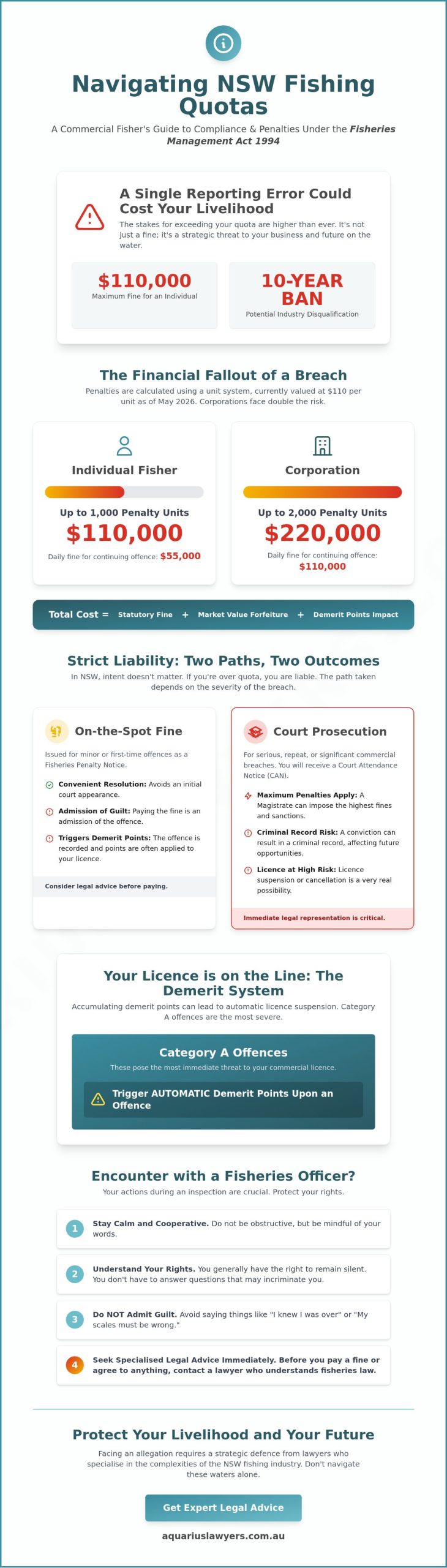
NSW fisheries enforcement doesn’t operate on a one-size-fits-all basis. Instead, authorities use a tiered system that scales with the severity of the breach. The primary mechanism for calculating these fines is the “Penalty Unit” system. As of May 2026, a single penalty unit in NSW is valued at $110. This might sound manageable in isolation, but the totals climb rapidly. For an individual, the maximum financial penalty for exceeding fishing quota nsw is 1,000 penalty units, totalling $110,000. Corporations face even steeper consequences, with maximums reaching 2,000 units or $220,000. If the offence continues over multiple days, the court can impose additional daily fines of $55,000 for individuals and $110,000 for companies.
The financial impact often follows a specific equation: Statutory Fine + Market Value Forfeiture + Demerit Points = A strategic threat to your business. This formula ensures that any profit gained from illegal activity is completely stripped away, often leaving the fisher in a significant financial deficit.
On-the-Spot Penalty Notices
For minor or first-time slips, a Fisheries Officer might exercise discretion by issuing a Fisheries penalty notice. These are “on-the-spot” fines that allow you to resolve the matter without a day in court. While paying the fine is convenient, you must remember that doing so is an admission of the offence. This admission will stay on your record and, for commercial fishers, will likely trigger demerit points. You have the right to challenge the notice in the Local Court, but you should only take this path after a careful review of the evidence against you.
Maximum Penalties in the NSW Local Court
Serious breaches or repeat offences typically result in a Court Attendance Notice (CAN). Once a matter reaches a Magistrate, the stakes change. The court considers several factors during sentencing, including the commercial value of the fish, the environmental impact on the local ecosystem, and your previous compliance history. Beyond the standard fines, the court can impose “forfeiture” penalties. These are additional fines equal to the market value of the illegal catch. For the most severe cases involving fraud or large-scale illegal operations, the Fisheries Management Act 1994 even allows for terms of imprisonment. If you find yourself facing a Magistrate, engaging a firm that understands the intricacies of Fisheries Law can help you present a grounded, pragmatically-focused defence.
Demerit Points and the Risk to Your Commercial Fishing Licence
While a hefty fine hurts the hip pocket, the demerit point system is the silent killer of commercial livelihoods. This scheme operates entirely separately from the financial penalty for exceeding fishing quota nsw. It’s a rolling record of your professional compliance. Under the 2026 regulations, quota contraventions are classified as Category A offences. These represent the most serious breaches on the water. Unlike minor infractions that might only trigger points on a second or subsequent offence, Category A breaches accrue demerit points every single time you’re found liable. There is no “free pass” for a first-time quota slip.
The formula for your business survival is direct: 200 points = a 10-year industry ban. These points have a long lifespan, staying attached to your record for 10 years from the date they’re accrued. If you hit that 200-point threshold, the Department of Primary Industries (DPI) will disqualify you from the commercial fishing industry for a decade. This doesn’t just stop you from working on a boat. It can lead to the suspension of shares in a single share class for ten years. During this period, your ability to trade or lease those shares is effectively frozen. A productive asset quickly becomes a legal and financial anchor.
Automatic vs. Discretionary Suspensions
Some offences are so grave they trigger immediate action. The Secretary of the DPI possesses broad powers to suspend or cancel authorities if they believe serious misconduct has occurred. It’s vital to remember that demerit points aren’t just tied to a specific boat; they’re tied to the person and the licence holder. You can’t simply swap vessels or change names to wipe the slate clean. This personal accountability makes every catch a high-stakes event for your long-term security. If you’re managing multiple shares or licences, one mistake can create a domino effect across your entire operation.
Appealing a Demerit Point Decision
If you receive notice of demerit points or an impending suspension, you aren’t without options. The NSW Civil and Administrative Tribunal (NCAT) serves as the primary venue for fisheries appeals. However, you must act with urgency. There are strict time limits for lodging an appeal, typically within 28 days of receiving the decision. This is where professional advice in Fisheries Law becomes essential. We don’t just look at the points; we examine the methodology behind the DPI’s decision. Successfully navigating an NCAT review requires a blend of technical maritime knowledge and sharp strategic thinking to protect your right to work and your investment in the industry.
What to Do if You are Alleged to Have Exceeded Your Quota
The moment a Fisheries Officer steps onto your deck, your professional future is on the line. While it’s tempting to explain away a discrepancy or offer a justification for a heavy haul, your immediate priority must be the protection of your legal standing. The reality of the industry is that technical errors happen. Equipment fails, and environmental conditions can push a catch over the limit before you’ve had a chance to weigh it accurately. In these high-pressure moments, a clear head is your most valuable asset. Accurate Documentation + Immediate Legal Advice = A Strategic Shield against licence suspension.
You must treat every interaction with authorities as a formal legal proceeding. Fisheries Officers are trained to gather evidence, and their “informal chats” on the wharf often end up as central components of a brief of evidence. You have a right to remain silent beyond providing your basic identification and licence details. Politely declining to answer questions until you’ve spoken with a lawyer isn’t an admission of guilt; it’s a necessary step in ensuring you don’t inadvertently provide a statement that could be used against you in the NSW Local Court.
Interacting with Fisheries Officers
You’re legally required to produce your commercial or recreational licence and provide your name and address upon request. However, a Fisheries Officer’s power to search your vessel or premises is not unlimited. While they have broad authority under the Fisheries Management Act 1994, there are procedural boundaries they must follow. You should remain professional and cooperative with physical directives, but don’t feel pressured to sign documents or agree to recorded interviews on the spot. Document the interaction yourself if possible, noting the time, the officers involved, and any specific gear failures or conditions you mentioned at the time of the search.
Building a Defence Strategy
A successful defence often hinges on the evidence you collect in the hours following an allegation. This includes GPS logs that prove your location, weigh-in receipts from the co-op, and maintenance logs for your scales or reporting technology. While the law often operates on strict liability, defences such as “mistake of fact” or “duress” can be powerful when backed by concrete data. A Section 10 dismissal allows the court to find the offence proven but discharge the matter without recording a conviction, which is a critical result for anyone hoping to avoid the long-term demerit point consequences of a penalty for exceeding fishing quota nsw. If you are facing an investigation, securing representation from an expert in Fisheries Law ensures that your side of the story is told through a strategic, evidence-based lens.
How Aquarius Lawyers Protects Your Livelihood
Protecting your place in the blue economy requires more than just general legal knowledge. It demands a specialist who understands the rhythm of the tides and the rigidity of the Fisheries Management Act 1994. Katherine Hawes, widely known as “The Fish Lawyer,” brings decades of experience in Australian maritime law to the table. She provides a grounded, pragmatic approach to legal defence that generalist directories simply can’t match. When you’re facing a penalty for exceeding fishing quota nsw, you don’t need a lecture on compliance; you need a strategic pathway to protect your commercial assets and your reputation.
Our methodology combines traditional legal credentials with a tech-savvy understanding of modern fisheries management. We move quickly to get to the heart of the matter. Whether it’s a dispute over real-time reporting via FishOnline or a complex share management issue, we provide clear, punchy directives to help you secure your future. We operate on a simple formula: Specialist Knowledge + Strategic Advocacy = Asset Protection. We believe that your livelihood is worth defending with a no-nonsense attitude that values results over ceremony.
Our Fisheries Law Expertise
We represent a diverse range of clients across the maritime sector, including commercial fishers, charter operators, and aquaculture businesses. Our work often involves high-stakes negotiations with the Department of Primary Industries (DPI) to reduce charges or mitigate the impact of demerit points. We’ve seen how a well-structured argument can change the course of a prosecution in the NSW Local Court or an appeal in NCAT. From the moment an investigation begins through to the final court hearing, we offer comprehensive support designed to minimise the strategic threat to your business. We don’t just react to problems; we help you organise your compliance to prevent future issues from surfacing.
Contact The Fish Lawyer Today
Legal issues on the water don’t get better with time. Waiting for a court date to arrive before seeking expert advice is a gamble you can’t afford to take. We are available for urgent consultations across Sydney and regional NSW, ensuring that fishers from Eden to Tweed Heads have access to top-tier representation. Take a proactive step today to secure your licence and your legacy. You can book a consultation with Aquarius Lawyers to discuss your case with a team that truly understands the fisheries industry.
Securing Your Future on the Water
Facing an allegation regarding the penalty for exceeding fishing quota nsw is a high-stakes moment that requires a specialised response. We have explored how the combination of strict financial fines and the long-term demerit point scheme can effectively end a commercial career. Success in these matters often comes down to early intervention and a methodical review of the DPI’s evidence. By documenting every technical detail and knowing your rights during search operations, you build a foundation for a stronger defence.
Principal Katherine Hawes is a recognised expert in Marine and Fisheries Law with specific expertise in NSW Local Court fisheries prosecutions. With offices in Sydney and Shellharbour, we provide regional NSW accessibility for fishers who value a no-nonsense, strategic approach to their legal challenges. Don’t let a single bad day on the water dictate the next ten years of your professional life. Our team is ready to provide the clarity and confidence you need to resolve these complex issues efficiently.
Protect your commercial fishing future; speak with The Fish Lawyer today.
Your livelihood is built on hard work and traditional expertise. We are here to ensure the law works to protect that investment and keep you on the water.
Frequently Asked Questions
What is the maximum fine for exceeding a fishing quota in NSW?
For a single individual, the maximum fine is $110,000, which represents 1,000 penalty units. Corporations face even steeper consequences, with maximum fines reaching $220,000. If an offence continues over several days, additional daily penalties of up to $55,000 for individuals and $110,000 for companies can apply. Courts may also impose a “forfeiture” fine equal to the market value of the illegal catch to ensure no profit is gained from the breach.
Can I lose my commercial fishing licence for a single quota breach?
While a single breach rarely results in immediate permanent cancellation, it often triggers demerit points that threaten your long-term licence security. Quota contraventions are Category A offences, meaning points are accrued for every violation. If you accumulate 200 demerit points within a rolling ten-year period, you face a mandatory 10-year disqualification from the commercial fishing industry. This disqualification effectively shuts down your ability to work or trade shares during that decade.
How long do demerit points stay on my fisheries record?
Demerit points remain active on your record for 10 years from the date of the offence. This long lifespan means that even minor errors made years apart can eventually combine to reach the 200-point threshold for industry disqualification. It’s a cumulative system designed to monitor compliance over a professional fisher’s entire career. Maintaining a clean record over the long term is the only way to protect the value of your commercial shares.
Do I have to attend court for a fisheries offence in NSW?
You only need to attend court if you receive a Court Attendance Notice (CAN) or if you choose to “elect” to have a penalty notice heard by a Magistrate. Serious quota breaches almost always result in a CAN, requiring a personal appearance at the NSW Local Court. For minor matters, paying a penalty notice on the spot resolves the fine without a court date, though it still counts as an admission of the offence.
What happens if my quota breach was caused by a faulty scale or gear?
NSW fisheries law operates on a “strict liability” basis, meaning you can be found liable even if the breach was accidental or caused by equipment failure. However, technical malfunctions are critical factors in your defence strategy. Documenting gear failure immediately through logs or photos can help in negotiating with the DPI or in mitigating the penalty for exceeding fishing quota nsw during sentencing. It’s about demonstrating that you took all reasonable steps to remain compliant.
Can Fisheries Officers seize my boat and equipment for a quota violation?
Yes, Fisheries Officers possess broad powers under the Fisheries Management Act 1994 to seize any boat, gear, or vehicle they believe was used in the commission of an offence. Seized property is often held as evidence until the conclusion of court proceedings, which can take months. In the most serious cases, the court has the power to order the permanent forfeiture of the vessel and equipment upon conviction, representing a massive capital loss.
Is it possible to appeal a decision made by NSW Fisheries?
You can appeal most administrative decisions, such as licence suspensions or demerit point allocations, through the NSW Civil and Administrative Tribunal (NCAT). Strict time limits apply, typically requiring you to lodge an application within 28 days of receiving the notice. NCAT provides an independent review of the DPI’s actions. This process allows you to challenge the fairness of a decision or the methodology used to calculate your catch weight and subsequent points.
What is the difference between a penalty notice and a court attendance notice?
A penalty notice is an “on-the-spot” fine that allows you to pay a set amount to resolve the matter without a criminal conviction. A Court Attendance Notice (CAN) is far more serious, requiring you to appear before a Magistrate to answer for the offence. While a penalty notice is simpler, a CAN carries much higher potential fines, a higher risk of demerit points, and the possibility of a recorded criminal conviction that could impact your future employment.
Disclaimer
Please note that legal rules change and this is not a substitute nor construed as legal advice. It is general information only.