
Paying for a commercial asset does not guarantee you actually own it. If a vendor owes debt against an item, running an accurate personal property securities register check is the only reliable way to stop a secured lender from repossessing your equipment without warning. Without a verified search, you risk inheriting someone else’s liability.
You shouldn’t have to decipher dense legal bureaucracy, second-guess grantor ABNs, or wrestle with mismatched serial numbers just to safeguard your capital. A simple administrative mistake when investigating security interests can leave your business unprotected against registered finance claims.
This practical guide teaches you how to perform, read, and verify an official search so you can confirm an asset is clear of active security interests before transferring purchase funds. We step through the exact search identifiers to use, explain how to interpret technical search certificates, and show you how to secure clean legal title with confidence.
Key Takeaways
- Conducting a timely personal property securities register check establishes clear legal title and shields your purchases against third-party repossession claims.
- Distinguish between serial-numbered goods and general commercial assets to ensure you search the correct identifiers, including VINs, HINs, or corporate ACNs.
- Learn to interpret official search certificates accurately, confirming whether listed collateral schedules contain active financial charges.
- Avoid critical registration traps, such as single-character search errors or searching trading names rather than formal legal entities.
- Implement protective contractual warranties and formal releases before transferring settlement funds for high-value commercial assets and maritime assets.
What a Personal Property Securities Register Check Actually Protects
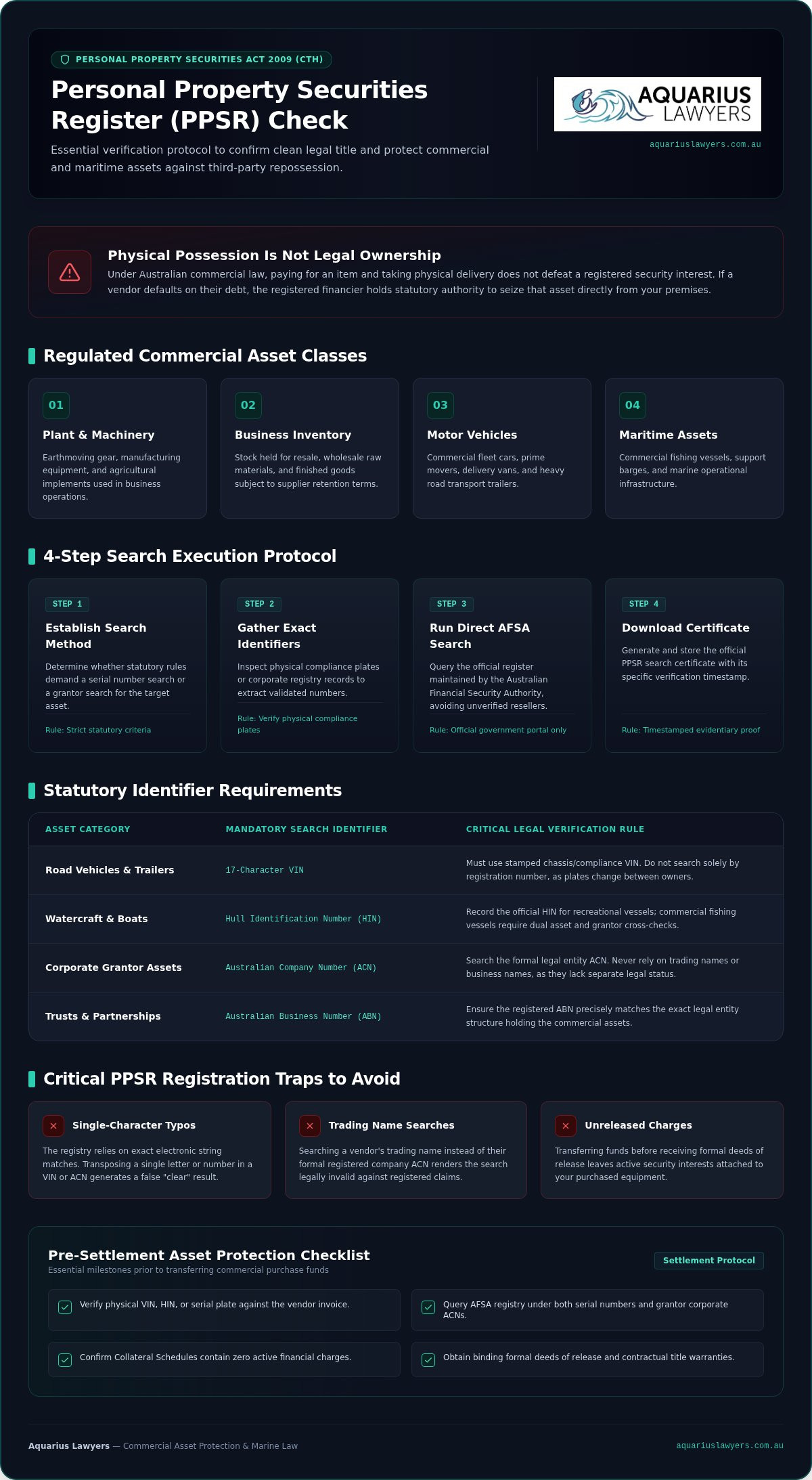
Every commercial transaction hinges on one crucial reality: physical possession is not legal ownership. Many buyers assume that paying for an asset and taking physical delivery confers absolute title. Under the Personal Property Securities Act 2009 (Cth), that assumption can cost your company everything. A rigorous Personal Property Securities Register (PPSR) check lets you inspect the national electronic database to discover whether financial institutions or suppliers hold active claims against the property you want to buy.
The register covers almost all valuable personal property outside of real estate. When conducting due diligence across Australian operations, your searches must account for several distinct asset classes:
- Commercial plant and machinery: Earthmoving gear, manufacturing equipment, and agricultural implements.
- Business inventory: Stock held for resale, wholesale raw materials, and finished goods.
- Motor vehicles: Fleet cars, prime movers, delivery vans, and heavy transport trailers.
- Maritime assets: Commercial vessels, support barges, and associated maritime equipment.
Neglecting a timely personal property securities register check exposes your business to third-party claims. If a vendor defaults on their loan, the registered financier holds statutory authority to seize that asset straight from your premises, leaving you with an empty warehouse and an expensive unsecured claim against a defaulting seller.
Understanding Security Interests Under Australian Law
Under Australian law, a security interest is an interest in personal property that secures payment of a debt or the performance of an obligation. Financiers, equipment leasing firms, and trade creditors register these interests to establish formal priority. Registration establishes a public claim under federal law, granting that lender superior priority rights over any subsequent buyer. Physical possession alone cannot overturn a properly registered financing statement.
The Risk of Statutory Asset Repossession
Buying in good faith will not save your balance sheet. Australia’s legal regime prioritises perfection: a properly registered security interest survives private handshakes, standard invoices, and physical transfers of custody. If the previous owner leaves unpaid liabilities, the secured creditor enforces repossession rights directly against the collateral. Engaging dedicated asset protection legal services ensures you verify clear title and demand binding release documentation before funds leave your control.
How to Perform a Personal Property Securities Register Check Step-by-Step
Executing an effective search requires a structured approach. A quick search on an incomplete serial number provides false security, leaving your transaction exposed. Following a rigorous four-step sequence ensures you uncover every registered encumbrance before releasing settlement funds:
- Establish the search method: Determine whether your target asset demands a serial number search or a grantor search based on statutory rules.
- Gather exact identifiers: Inspect physical compliance plates or corporate documentation to record verified identification numbers.
- Run the search directly: Query the official government register of security interests maintained by the Australian Financial Security Authority (AFSA), bypassing third-party resellers.
- Download the certificate: Obtain the official search certificate and record its exact generation timestamp.
Completing a methodical personal property securities register check transforms raw registry records into enforceable buyer protection under Australian commercial law.
Gathering Identifiers for Different Asset Classes
Different property categories require distinct identification criteria under the statutory regulations:
- Road vehicles and trailers: Use the 17-character Vehicle Identification Number (VIN) stamped on the chassis or compliance plate. Avoid searching solely by registration plate numbers, as plates can change between owners.
- Watercraft and commercial vessels: For recreational boats, record the official Hull Identification Number (HIN). If you are purchasing a commercial fishing vessel or larger maritime plant, search the official vessel name alongside the Australian General Shipping Register or state maritime registry identifiers.
- Corporate business assets: When buying un-serialised commercial plant or inventory, use the vendor entity’s Australian Company Number (ACN) or Australian Business Number (ABN).
Executing the Search on the National Registry
Always log in directly to the official AFSA online portal. Third-party aggregate websites often charge inflated rates for repackaged information and may fail to provide the statutory certificate required by law. Select your specific search type, input your collected identifier without spaces, and submit the query. Paying the nominal statutory search fee generates your immediate result.
Archiving Your Search Certificate for Legal Protection
The system generates an official search certificate bearing a unique search number and a precise date and time stamp. You must download and archive this digital document immediately. Under federal extinguishment rules, this certificate provides statutory evidence that you searched the register prior to acquisition. When negotiating high-value equipment or vessel acquisitions, obtaining advice on your transaction from seafood and marine legal services ensures your contractual warranties and search timing shield you against competing claims.
How to Read and Interpret PPSR Search Results Accurately
Generating a search certificate is straightforward, but interpreting the text demands technical precision. When you perform a PPSR check, the resulting documentation presents either a statement affirming that no security interests are registered, or a detailed schedule of active registrations. If the register returns active registrations, each entry outlines a legally enforceable claim against the asset that must be resolved before purchase funds are released.
Every active registration certificate contains four critical components that outline your practical risk:
- Registration number: The unique identifier assigned by the national registry to that specific financing statement.
- Secured party details: The legal name, ACN, and contact information of the bank, private lender, or trade supplier asserting the claim.
- Collateral class: The statutory classification of the encumbered property, defining the scope of the charge.
- End date: The registration expiry date, confirming whether the security interest remains legally active or has expired.
A rigorous personal property securities register check requires you to evaluate whether any listed security interest attaches directly to the item you intend to buy.
Decoding Collateral Classes and Grantor Information
Collateral classes indicate how broadly the lender has framed their security. While motor vehicles require precise serialisation, general business assets are often captured under broad category headings. Scrutinise whether the schedule lists “All Present and After-Acquired Property” (often referred to as an AllPAP registration). An AllPAP charge acts as a floating debenture across every corporate asset the vendor owns, including equipment you might be negotiating to purchase privately. Verify that grantor entity details match your seller’s verified corporate structure perfectly.
Spotting Red Flags: PMSI Registrations
Always inspect the certificate for an active “Purchase Money Security Interest” (PMSI) indicator. A PMSI is created when a financier provides funds specifically to purchase an asset, or when a supplier delivers inventory on retention-of-title terms. Because Australian law grants PMSI registrations super-priority over standard floating charges, a PMSI holder possesses statutory rights to repossess that machinery immediately if the vendor defaults, regardless of other creditor claims.
Verifying Stolen and Written-Off Asset Registers
Serial number searches for motor vehicles and trailers automatically cross-reference the Written-Off Vehicles Register (WOVR) and national police theft databases. These sections highlight whether a vehicle has been recorded as an economic write-off, an inspected repairable write-off, or active stolen property. Uncovering a stolen marker demands immediate termination of negotiations. For high-value transactions involving business fixtures or land-attached equipment, engaging specialist Property Legal Services ensures clear title is confirmed before executing binding contracts.
Common PPSR Search Traps and Costly Mistakes
Algorithmic precision governs the register. The database does not correct spelling errors, interpret intent, or suggest close phonetic matches. An administrative typo can completely strip away your statutory protection under Australian commercial law, leaving you exposed if a lender repossesses the asset. Avoiding these common procedural errors ensures your due diligence holds up under legal scrutiny.
State-based regulatory records also cause widespread confusion. Holding a state transport registration slip or marine boat licence does not prove clear financial title. Those systems track administrative registration, not legal encumbrances or security interests.
Identifier Errors and Serial Number Mismatches
A single transposed character renders your search certificate legally ineffective against a secured party. Confusing the numeral 0 with the letter O, or mistaking the number 1 for a capital I, returns an empty result for an encumbered asset. Similarly, querying an engine number when a formal 17-digit VIN exists fails statutory search standards for road vehicles. Always physically inspect the asset plate directly rather than relying on digital photographs sent by a vendor.
Timing Gaps: The Peril of Outdated Search Certificates
Secured creditors can register a financing statement right up to the point of transfer. Holding a search certificate generated days or weeks prior creates severe commercial exposure. Prudent practice requires a two-stage approach: conduct an initial check during price negotiations, then execute a final personal property securities register check on the day of settlement immediately before releasing funds. This settlement-day record preserves your statutory extinguishment defences.
Entity Search Confusion: ABN Versus ACN
Searching trading names yields zero enforceable results. The law categorises corporate grantors by formal entity status. For incorporated companies, you must search the Australian Company Number (ACN), as searching an Australian Business Number (ABN) or trading alias can miss registered general security agreements. Trusts present another common trap: because a trust is not a standalone legal entity, searches must target the corporate or individual trustee that owns the property.
Protect your capital from unrecorded encumbrances and structural search flaws by booking our Asset Protection Legal Services before executing high-value purchase contracts.
Securing Commercial Assets: When to Engage Legal Counsel
High-value commercial acquisitions involve risks that extend far beyond routine database searches. When purchasing complex plant, industrial equipment, or maritime operations, an unassisted personal property securities register check only provides raw data. It does not resolve registered charges or draft enforceable release terms. Engaging experienced legal counsel transforms that registry check into enforceable commercial security.
Legal practitioners establish vital procedural firewalls across several core areas:
- Transaction structuring: Aligning settlement payments directly with the removal of verified registrations.
- Distressed asset protection: Insulating your purchase against clawback risks if the vendor faces imminent insolvency.
- Discharge verification: Ensuring financial institutions lodge valid financing change statements rather than ambiguous email promises.
Strategic legal guidance ensures unencumbered title transfers smoothly, protecting your capital investment from day one.
Securing Undertakings to Discharge and Formal Releases
Never rely on a vendor’s verbal assurance that debt has been cleared. When a search uncovers active financing statements, legal counsel obtains a formal payout figure alongside a legally binding undertaking to discharge from the secured financier. This formal document obliges the lender to remove its registration upon receipt of settlement funds. Retaining settlement funds in trust until the lender executes a registry amendment notice prevents you from paying for an encumbered asset.
Safeguarding Maritime Assets and Specialized Plant
Marine transactions operate under an intersection of statutory rules. Acquiring a commercial fishing vessel involves reviewing personal property registers, state fisheries records, and the Australian General Shipping Register. To understand the maritime property rules governing these complex transfers, consult our specialised advice via seafood and marine legal services. Coordinating these searches eliminates hidden maritime liens and unperfected claims before completing settlement.
Drafting Contractual Title Warranties and Indemnities
Standard sale receipts provide zero contractual protection. Legal counsel drafts explicit seller title warranties confirming the asset passes to you free of all liens, charges, and encumbrances. These clauses are paired with immediate indemnity provisions, making the seller personally liable for any undisclosed securities or third-party repossession attempts. Proactive title drafting delivers reliable legal recourse if a disputing creditor emerges. Secure your next commercial transaction by scheduling a consultation through Aquarius Lawyers.
Take Control of Your Commercial Title and Protect Your Capital
Verifying clear legal title remains your ultimate safeguard when investing in commercial plant, equipment, or vessels. Conducting an accurate personal property securities register check eliminates transactional uncertainty, exposes active encumbrances, and halts statutory repossession actions before they threaten your enterprise. Pairing exact serial or grantor searches with disciplined settlement timing ensures your company never inherits a seller’s unpaid debt.
Resolving complex collateral schedules demands sharp tactical oversight and practical legal solutions. Backed by over 20 years of commercial and maritime legal expertise, Principal Solicitor Katherine Hawes applies proven asset protection and due diligence frameworks for Australian businesses across every jurisdiction. You can eliminate ownership disputes and defective releases long before transferring settlement funds. Take decisive action to protect your balance sheet today. Safeguard your commercial asset acquisitions with Aquarius Lawyers and finalise your commercial transactions with absolute confidence.
Frequently Asked Questions
Can a car be repossessed if I have a clean personal property securities register check?
Generally no, provided you searched using the exact Vehicle Identification Number (VIN) immediately before completing settlement and meet the extinguishment rules under federal law. When you buy consumer goods without notice of an existing security interest, you normally take the asset free of encumbrances. However, business transactions or searches executed days prior to payment leave gaps where a newly registered claim can still attach.
How much does an official personal property securities register check cost in Australia?
Official searches carry a nominal statutory fee set directly by the Australian Financial Security Authority (AFSA). Performing your search directly through the official national government portal guarantees access to the minimum statutory rate without commercial markup. Beware of third-party aggregate websites that repackage identical public registry records while adding substantial private administrative fees for basic search certificates.
What is the difference between a VIN check and a PPSR check?
A vehicle identification number check generally refers to reviewing registration records or reported written-off history through transport authorities. In contrast, an official personal property securities register check investigates financial liabilities registered nationally against that unique 17-digit identifier. A VIN inspection confirms the vehicle’s physical specification, whereas a registry search confirms whether banks or credit providers hold legal claims over it.
Can an asset be registered on the PPSR without the owner knowing?
Yes, an asset can be registered without the current owner’s direct knowledge. If an entity grants a floating security charge over all present and after-acquired property to a financier, that security interest automatically attaches to newly acquired gear. Additionally, a prior owner might have pledged the property as loan security without resolving the registered financing statement before selling the asset to you.
What happens if a financier fails to remove a PPSR registration after debt payout?
Financiers remain under a strict legal obligation to remove registrations once the underlying debt is cleared. If an encumbrance lingers, you can submit a formal amendment demand requiring the secured party to lodge a financing change statement. If the lender fails to act within statutory timeframes, you can apply directly to the Registrar to initiate administrative removal proceedings.
Does a PPSR check confirm who legally owns the vehicle or equipment?
No, the register does not establish legal ownership. It functions purely as a public noticeboard for registered security interests, financial charges, and encumbrances. A clean search certificate confirms that no financiers hold active registered claims against that specific serial number or grantor, but you still require clear sale contracts, verified tax invoices, and seller warranties to establish valid title transfer.
Can you check security interests over boats and commercial fishing vessels?
Yes, you can search security interests over both recreational watercraft and commercial maritime plant on the national register. For recreational craft, perform searches using the official Hull Identification Number (HIN). For a commercial fishing vessel, run searches against both the vessel’s official identifiers and the vendor’s corporate Australian Company Number (ACN) to capture any broad company debentures.
Disclaimer
Please note that legal rules change and this is not a substitute nor construed as legal advice. It is general information only.