
What if the fishing quota your family has spent generations securing could be stripped away by a single regulatory shift or one legal dispute? You’ve spent years battling the elements and the high cost of specialised maritime gear, only to find that the real risk to your legacy often happens on land. Protecting family fishing business assets is no longer just about regular maintenance; it’s about building a legal fortress around your licences, vessels, and hard-earned wealth.
It’s a stressful reality that many Australian fishers feel they’re constantly walking a tightrope between AFMA compliance and the risk of personal liability from accidents at sea. We understand that your business is a family history that deserves a bulletproof future. This guide provides the clarity you need to safeguard your livelihood using specialised Australian maritime and commercial law. We’ll show you how a “dual-layer” shield protects you from both general commercial risks and regulatory volatility. You’ll learn how to structure your operations to survive litigation, navigate the 2026-27 tax reforms, and ensure your assets pass seamlessly to the next generation.
Key Takeaways
- Understand the difference between physical gear and intangible quotas to build a multi-layered defence against creditors.
- Identify why Statutory Fishing Rights (SFRs) are your most valuable holdings and how to insulate them from daily operational liabilities.
- Implement a strategic “Two-Company” structure or a Discretionary Trust as a proven method for protecting family fishing business assets.
- Recognise the “silent” threat of maritime liens that can lead to vessel arrests over minor disputes like unpaid crew wages or fuel bills.
- Transition from a basic Will to a specialised estate plan to ensure your fishing legacy passes to the next generation without unnecessary tax hurdles.
What is Asset Protection for Fishing Businesses?
Asset protection isn’t about hiding money in a vault or avoiding your responsibilities. It’s the deliberate, legal process of organising your business structure to insulate your wealth from creditors and litigants. For Australian fishers, this means looking at both your physical assets, like your trawler or longliner, and your intangible assets, such as your Statutory Fishing Rights (SFRs) and quotas. These are the lifeblood of your operation. Without a clear plan, a single legal storm can wash away decades of hard work.
Many skippers believe a comprehensive insurance policy is enough to keep them safe. It isn’t. In the high-stakes maritime world, insurance often has gaps, exclusions, or payout limits that leave you exposed. Asset protection strategies work where insurance fails, creating a legal barrier that remains standing even if a claim is denied or a policy is cancelled. We take an “Innovative Veteran” approach to this problem. This blends the deep, traditional knowledge of maritime law with modern commercial structuring. It’s a simple but effective formula: Traditional Experience + Forward-Thinking Methodology = Long-Term Security.
The Unique Risk Profile of the Australian Fishing Industry
The Australian maritime sector faces a volatile landscape. In 2026, we’ve seen permanent closures in the West Coast Bioregion and significant catch reductions across the South Coast. These regulatory shifts by AFMA or the NSW DPI aren’t just administrative hurdles; they’re existential threats. Environmental liabilities and Workplace Health and Safety (WHS) risks are higher offshore than in almost any other industry. A single fuel spill or a serious crew injury can trigger fines and litigation that threaten your entire operation. Protecting family fishing business assets means staying ahead of these shifting regulatory tides.
Personal vs. Business Assets: Drawing the Line
One of the most dangerous mistakes in this industry is the “handshake” deal. Informal family arrangements without written legal backing are a gift to creditors. Your family home should never be linked to your commercial fishing licence or vessel debt. If your business is sued, you need a clear line in the sand between what you own and what the business operates. For a commercial fisher, asset protection is the strategic legal partitioning of high-value quotas and vessels from operational liabilities to ensure that regulatory penalties or litigation don’t sink the entire family legacy. Moving away from “she’ll be right” and toward a documented, professional structure is the only way to ensure your home stays yours, regardless of what happens at sea.
Identifying Your High-Value Assets: Beyond the Boat and Gear
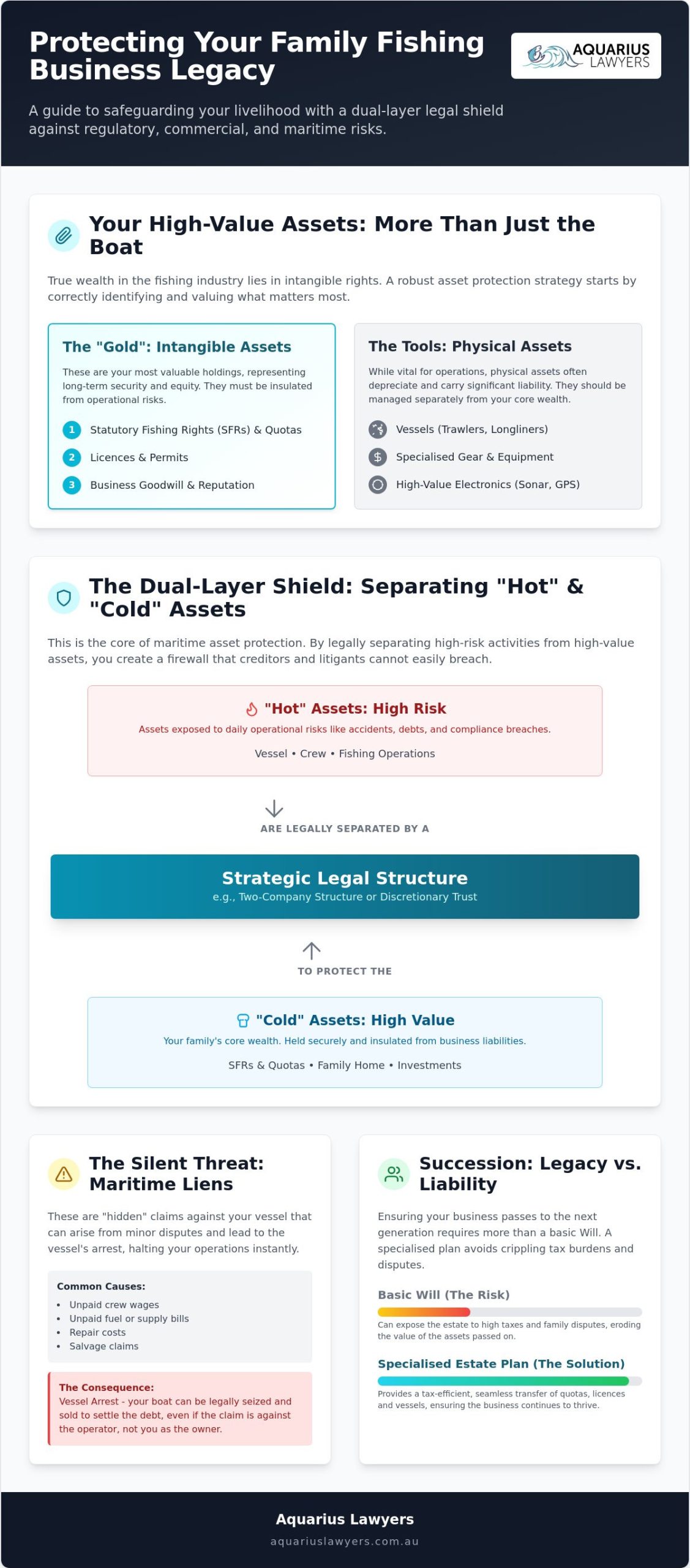
When most skippers think about their business, they picture the vessel cutting through the swell or the specialised gear on deck. While these are vital, they aren’t your only high-value holdings. In fact, the physical boat is often the most depreciating part of your portfolio. True wealth in this industry lies in the intangible. Statutory Fishing Rights (SFRs) and quotas are the “gold” of your enterprise. They represent your equity and your long-term security. Protecting family fishing business assets starts with recognising that your right to fish is often worth more than the vessel itself.
Beyond the boat, you must consider your licences and permits. These are your “permission to play” in the Australian market. Without them, your physical assets are just expensive scrap metal. There’s also the matter of goodwill. If your family name has been associated with quality catch for three generations, that reputation has a tangible market value. Guarding these assets requires a sophisticated understanding of fisheries law to ensure they remain within your control, even if the vessel encounters trouble.
Physical assets still require smart management. With the permanent $20,000 instant asset write-off for small businesses effective from July 2026, many families are upgrading gear. However, high-value vessels come with unique depreciation and liability risks. Every piece of equipment, from sonar systems to processing gear, needs to be accounted for in your protection strategy. The goal is to ensure that your equipment serves the business without becoming a liability trap.
Separating the “Hot” Assets from “Cold” Assets
A fundamental rule of maritime asset protection is the separation of “hot” and “cold” assets. Hot assets are those that carry inherent risk. Your operating vessel, the crew, and the daily fishing activities are high-risk elements. If an accident occurs at sea, any asset owned by that same legal entity is “on the table” for creditors. Cold assets, like your quotas, entitlements, or land-based sheds, are passive. They don’t cause accidents. You should never hold your quota in the same company that operates the boat. By keeping them separate, you ensure that a lawsuit against the vessel doesn’t sink your entire quota holding.
The Value of Intangible Fishing Rights
Legally valuing and shielding NSW fisheries entitlements requires precision. These aren’t just pieces of paper; they’re statutory rights that can be impacted by shifting government policy. In 2026, we’ve seen how quickly regulatory changes can devalue a licence. There is also the constant risk of “administrative” loss. A simple failure to comply with reporting standards or a missed renewal can lead to the forfeiture of rights. Guarding these assets involves more than just good bookkeeping. It requires a structure that anticipates policy volatility and protects your entitlements from being used as collateral for operational debts.
Strategic Structuring: Choosing the Right Legal Framework
If you’re operating as a sole trader, you’re effectively gambling your family home every time the boat leaves the wharf. It’s a ticking time bomb. In the commercial fishing industry, personal liability is a shadow that follows you from the deck to your front door. If an accident occurs or a contract is breached, a sole trader’s personal assets are entirely exposed to creditors. Moving toward a sophisticated legal structure is the only way to ensure that a bad day at sea doesn’t result in a total loss on land.
The most robust method for protecting family fishing business assets involves the “Two-Company” model. This is where we separate ownership from operation. One company owns the “cold” assets, such as your vessel and those hard-earned quotas, while a separate operating company handles the “hot” risks, like hiring crew and signing supply contracts. By using a corporate trustee to oversee these entities, you add an extra layer of protection and anonymity. This isn’t about complexity for complexity’s sake; it’s about building a firewall between your wealth and your risks.
The Family Trust: Flexibility and Protection
A Discretionary Trust remains a favourite for Australian fishing families because of its unmatched flexibility. It allows you to distribute income to family members in a tax-efficient manner, which is particularly useful given the 25% tax rate for base rate entities in the 2026-27 financial year. However, the “Trust Deed” is where many fishers trip up. Your deed must be specifically drafted to allow for fisheries-related activities and the holding of statutory rights. A generic, off-the-shelf deed often lacks the precise language needed to satisfy AFMA or NSW DPI requirements. While some skippers worry that a trust is too complex, the reality is that the protection it offers far outweighs the administrative effort.
The Operating Company: Managing Liability
Your operating company acts as your shield. It’s the entity that interacts with the world, signs the fuel bills, and manages the employment of deckhands. If a maritime creditor comes knocking, their reach is generally limited to the assets held by the operating entity. Because this company doesn’t own the boat or the quota, there is very little for a litigant to seize. This brings us to a signature strategy we call the “Equation of Protection”:
Asset Separation + Corporate Shield = Peace of Mind.
By keeping your high-value entitlements in an asset-holding entity and your daily risks in an operating company, you create a structure that is legally resilient. This methodology ensures that even if the operating company faces a debt recovery action or litigation, your family’s core assets remain safely out of reach. It’s a pragmatic, no-nonsense approach that values long-term results over traditional, risky business habits.
Maritime Liens and Vessel Arrests: Threats You Might Not See Coming
Maritime law operates on a different set of rules to the law on land. One of the most misunderstood concepts is the maritime lien. Unlike a standard debt that follows a person, a maritime lien “attaches” to the vessel itself. It’s a silent, invisible claim that stays with the hull, even if the boat is sold to a new owner. If a crew member isn’t paid or a fuel supplier is left hanging, they don’t just sue you. They sue the boat. This unique legal quirk means your most expensive piece of equipment can become a liability trap overnight.
The Australian Federal Court holds significant power in these matters. If a creditor can prove a maritime claim, the Court can issue a warrant for vessel arrest. When the Sheriff boards your trawler and tapes an arrest notice to the mast, your operations stop instantly. You can’t fish, you can’t move, and the costs start mounting. It’s a blunt instrument used to force a resolution, and it’s remarkably effective. Protecting family fishing business assets requires you to see these threats before the Sheriff arrives at the wharf.
Defending Against Vessel Arrest
When a vessel is arrested in Australia, the protocol is swift and uncompromising. The boat is taken into the custody of the Court, and the owner must typically provide “security” (often a bank guarantee or cash) to have it released. This is where the structural separation we discussed earlier becomes your lifesaver. If your operating company is the one in a dispute, but your asset-holding company owns the boat, you have a much stronger hand to play in negotiations. An Action in Rem is a legal proceeding directed against the vessel itself as the defendant, allowing creditors to arrest the boat to satisfy a debt regardless of the owner’s personal liability. By isolating the vessel from your quotas and other boats, you ensure that a single lien doesn’t trigger a total fleet shutdown.
Contractual Protections for Fishery Operators
Prevention is always more efficient than a courtroom battle. You should include “limitation of liability” clauses in every commercial contract you sign, from maintenance agreements to supply deals. These clauses cap the amount a creditor can claim, providing a ceiling on your exposure. Additionally, Protection and Indemnity (P&I) insurance is a non-negotiable part of the asset protection mix. While standard hull insurance covers the physical boat, P&I covers your third-party liabilities, including crew injuries and environmental damage. If you are struggling with a supplier dispute or need help managing debt recovery without risking your licences, professional legal intervention is the smartest move you can make. It’s about resolving the issue before it escalates into a Federal Court warrant.
Succession Planning: Ensuring the Next Generation Inherits a Business, Not a Burden
Passing down a fishing legacy involves more than just handing over the keys to the wheelhouse. In Australia, an estimated $3.5 trillion in assets is expected to move between generations in the coming years. For a fishing family, this transfer is fraught with regulatory traps. A standard Will is often insufficient because it fails to account for the specific transfer requirements of AFMA or the NSW DPI. Protecting family fishing business assets during this transition requires a “Fisheries-Aware” Estate Plan that treats your quotas and licences as the specialised statutory rights they are, rather than just generic property.
One of the biggest hurdles in succession is the potential for a massive tax event. Fortunately, the turnover threshold for the 50% active asset Capital Gains Tax (CGT) reduction has increased to $10 million, making 98% of small businesses eligible for this concession. However, navigating these rules while managing family dynamics requires a clear strategy. If one child wants to continue the family tradition at sea while another prefers to sell their share, a Buy-Sell Agreement is essential. This document acts as a pre-negotiated roadmap, ensuring the fishing child can keep the vessel and quota while the other is fairly compensated, preventing a “family feud” from sinking the business.
Wills and Estates for the Modern Fisher
Your executor needs to be more than just a trusted friend; they need to be fisheries-savvy. Appointing someone who understands the difference between a Statutory Fishing Right and a seasonal permit ensures that your business doesn’t stall during probate. We frequently recommend using Testamentary Trusts. These are highly effective because income from these trusts is exempt from the new 30% minimum tax on discretionary trust income. A Testamentary Trust provides a robust shield, protecting an inheritance from an heir’s potential bankruptcy or a messy divorce. Linking your commercial lawyer’s advice directly with your estate plan ensures that the structures we built for today remain standing for the next generation.
The Exit Strategy: Selling or Retiring
Whether you are handing the reins to your children or preparing for a total sale, your exit strategy should begin years in advance. A clean, transparent asset structure significantly increases the market value of your business. Buyers and heirs alike want a “plug-and-play” operation, not a tangled web of informal family debts and unrecorded agreements. When retiring, you must also consider the new Division 296 superannuation rules, which add a tax on earnings if your balance exceeds $3 million. Following a professional checklist for the handover of NSW fisheries entitlements ensures that no administrative oversight devalues your life’s work. If you are ready to formalise your future, secure your family legacy with a consultation from Aquarius Lawyers.
Securing Your Legacy on the Water
Building a successful fishing operation takes decades of grit; losing it shouldn’t take a single legal dispute. We’ve explored how separating your “hot” operational risks from your “cold” statutory rights creates a firewall that protects your livelihood. By moving away from risky sole trader setups and embracing “fisheries-aware” estate planning, you ensure your hard-earned quotas stay where they belong: in the family. Protecting family fishing business assets is a continuous strategy that balances modern corporate law with the unique realities of the Australian maritime industry.
You don’t have to navigate these complex regulatory waters alone. Principal Katherine Hawes, known nationally as “The Fish Lawyer,” brings over 20 years of specialised experience in maritime and fisheries law to your side. Our team provides the specific expertise needed for AFMA and NSW DPI regulatory compliance, ensuring your business is both legally resilient and ready for the next generation. Book a consult with “The Fish Lawyer” to protect your assets and gain the confidence that comes with professional, no-nonsense legal guidance. It’s time to stop worrying about the “what-ifs” and start focusing on a secure future for your family fleet.
Common Questions About Fishing Business Asset Protection
Can I lose my fishing quota if my business gets sued?
Yes, you can lose your quota if it’s held by the same legal entity that faces the lawsuit. If your operating company owns the quota, that asset is “on the table” to satisfy any court judgment or debt. This is why we recommend separating your high-value entitlements into a dedicated asset-holding entity. This structural firewall ensures that a bad day at sea doesn’t result in the loss of your family’s core equity.
What is the best business structure for a small family fishing outfit in NSW?
A “Two-Company” model combined with a discretionary trust is generally the most robust framework for protecting family fishing business assets. This structure uses one company to own the “cold” assets, like vessels and quotas, while a separate company handles the “hot” risks of daily operations. This separation ensures that operational debts or crew disputes don’t automatically threaten the high-value licences that your family has spent years securing.
How does a maritime lien affect my asset protection strategy?
A maritime lien is a unique legal claim that attaches to the vessel itself, not just the owner. This means the debt follows the boat even if it changes hands. Creditors can use the Federal Court to arrest your vessel to settle unpaid fuel bills or crew wages. Your strategy must involve isolating each vessel in its own legal entity to prevent a lien on one boat from affecting your other assets or quotas.
Do I need a specialised fisheries lawyer, or can my local solicitor handle it?
You need a specialist because general solicitors often lack experience with the specific nuances of AFMA and NSW DPI regulations. Fisheries law involves complex statutory rights and maritime procedures, such as an “Action in Rem,” that local lawyers rarely encounter. A specialist ensures your business structure complies with both general commercial law and the specific management acts that govern your right to fish in Australian waters.
What happens to my fishing licences if I pass away without a specialised Will?
Your licences may become trapped in a lengthy probate process, potentially leading to administrative forfeiture if renewal deadlines are missed. A standard Will often fails to account for the specific transfer protocols required by fisheries authorities. A specialised Will ensures your executor has the immediate legal authority and industry knowledge to manage these assets, preventing a loss of value or fishing time during a difficult period.
Is my family home at risk if one of my crew members gets injured on the boat?
Your family home is at risk if you are operating as a sole trader or if you have provided personal guarantees for your business. In these scenarios, there is no legal separation between your personal wealth and your business liabilities. By implementing a corporate structure and maintaining proper P&I insurance, you create a vital shield that keeps your home and personal savings isolated from workplace health and safety claims.
How often should I review my fishing business structure?
You should review your structure every two years or whenever there is a major shift in fisheries policy. With the 2026-27 tax reforms and significant catch reductions in various bioregions, old business models may no longer provide adequate protection. Regular reviews allow you to adjust for new laws, such as the 2026 High Seas Biodiversity Bill, ensuring your protecting family fishing business assets strategy remains effective and tax-efficient.
Can I hold my fishing quota in a family trust?
Yes, holding your quota in a family trust is an excellent way to protect your assets while managing family wealth. It allows you to distribute income to family members in a tax-efficient manner while keeping the principal asset shielded from creditors. You must ensure your trust deed is specifically drafted to allow for fisheries-related activities, as generic deeds may not meet the strict requirements of state and federal regulators.
Disclaimer
Please note that legal rules change and this is not a substitute nor construed as legal advice. It is general information only.