
A standard spreadsheet is no longer a shield against a $44,000 fine or a “fit and proper person” test that could end a commercial career. You likely feel the weight of the Corporations Act every time you sit down to draft a report to board on fisheries compliance risk, knowing that personal liability for Directors is a very real shadow in 2026. It’s a high-stakes environment where overlapping State and Commonwealth regulations can make even the most seasoned operator feel exposed.
We understand that your goal isn’t just to stay afloat, but to build a business that’s legally bulletproof. This guide provides the blueprint to master the art of presenting a robust, defensible risk report that protects your Board, your licence, and your hard-earned reputation. We’ll examine the critical elements of a professional report structure, including how to address the latest AMSA priorities and the incoming NSW enforcement powers. By the end, you’ll have the tools to mitigate legal exposure and face AFMA or State-level regulators with absolute confidence.
Key Takeaways
- Understand the legal necessity of Board-level oversight to protect Directors from personal liability under the Corporations Act.
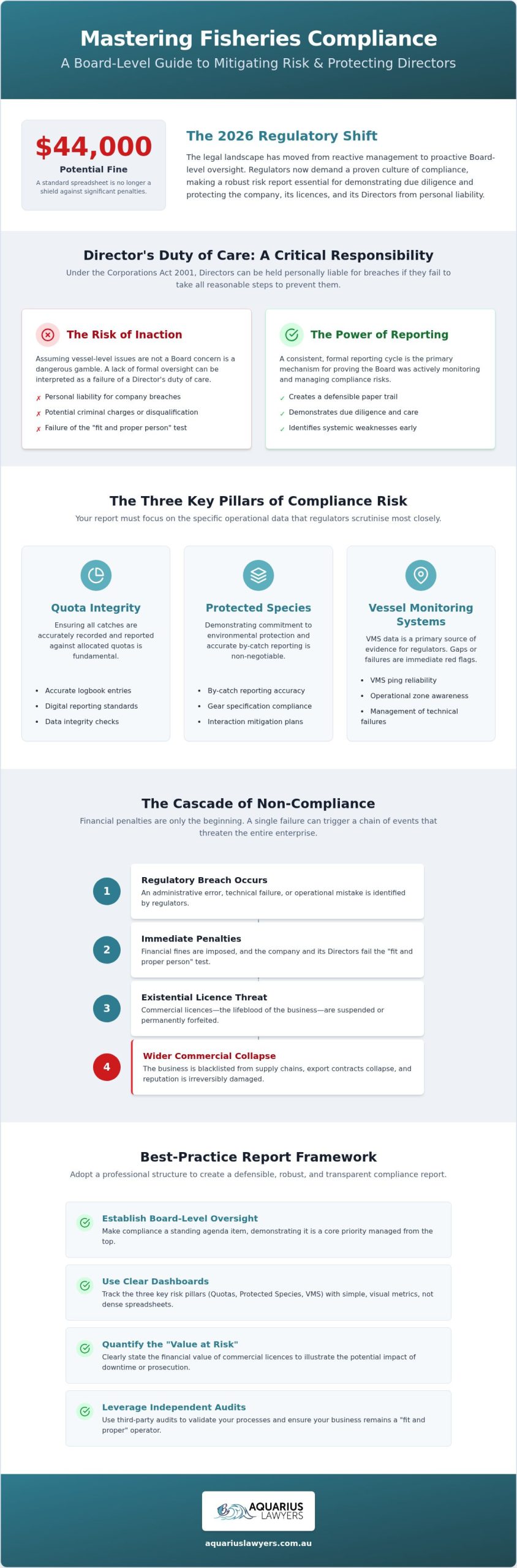
- Identify and monitor the three key risk pillars—quotas, protected species, and Vessel Monitoring Systems (VMS)—to avoid costly data gaps.
- Quantify the “Value at Risk” for your commercial licences to illustrate the potential impact of regulatory downtime or prosecution.
- Adopt a professional framework to report to board on fisheries compliance risk that uses clear dashboards to track operational accuracy and training.
- Leverage independent compliance audits to ensure your business remains a “fit and proper” operator in an increasingly strict regulatory landscape.
Why Fisheries Compliance Risk Reporting is a Board-Level Priority
In the Australian maritime sector, compliance risk represents the gap between your operational reality and the strict legal standards set by AFMA and state regulators. It encompasses everything from VMS pings and gear specifications to accurate logbook entries. For too long, many businesses viewed these as “vessel-level” issues handled by skippers. In 2026, that mindset is a significant liability. A robust report to board on fisheries compliance risk is now the primary mechanism for demonstrating that a company is managed with the necessary due diligence. Without it, the business is essentially flying blind in a storm of increasing regulatory scrutiny.
The 2026 regulatory landscape has shifted from reactive management to a model of proactive Board-level oversight. Regulators no longer accept “we didn’t know” as a valid response to a breach. Instead, they look for evidence of a culture of compliance that starts at the top. By implementing a consistent reporting cycle, your Board can identify systemic weaknesses before they trigger an investigation. This proactive stance is often the difference between a minor administrative correction and a full-scale prosecution that threatens the future of the enterprise.
Director Liability and the Duty of Care
Directors often assume that if they aren’t on the boat, they aren’t responsible for the catch. The law suggests otherwise. Under the Corporations Act 2001, Directors may be held personally liable for a company’s regulatory breaches if they fail to demonstrate that they took all reasonable steps to prevent the contravention. This “reasonable steps” threshold is what makes a formal reporting cycle so vital. It transforms vague intentions into a defensible paper trail that proves the Board was actively monitoring risks.
Wilful blindness to vessel activities or technical failures is a dangerous gamble. If a vessel is found to be operating in a closed zone or failing to report by-catch, the authorities will look directly at the Board’s oversight mechanisms. A lack of regular reporting can be interpreted as a failure of the Director’s duty of care, potentially leading to criminal charges or disqualification from managing corporations. High-quality data is your best defence.
The Cost of Non-Compliance: Beyond the Fines
Financial penalties are just the beginning of the trouble. The real danger lies in the “fit and proper person” test now being strictly enforced across various jurisdictions, including the 2026 NSW reforms. If a Director or the company fails this test, the result is often the suspension or permanent forfeiture of commercial licences. These licences are the lifeblood of the business; losing them is an existential threat that no amount of insurance can fully cover.
This risk extends to the global fight against Illegal, unreported and unregulated fishing (IUU), where even administrative errors can lead to a business being blacklisted by major supply chain partners. In an industry where reputation is currency, a single compliance failure can derail future aquaculture development approvals or cause the collapse of lucrative export contracts. Regularly reviewing a report to board on fisheries compliance risk ensures these high-level strategic threats are managed with the same rigour as financial performance.
Identifying Key Risk Pillars: Quotas, Protected Species, and VMS
Effective risk management requires moving beyond generalisations and focusing on the specific operational data that regulators scrutinise. A comprehensive report to board on fisheries compliance risk should be built on three core pillars: quota integrity, VMS reliability, and environmental protection. These aren’t just administrative hurdles. They are the metrics that define your standing as a “fit and proper” operator in an industry where the 2026 NSW reforms have raised the stakes for everyone involved.
Managing the boundary between Commonwealth and State waters adds another layer of jurisdictional complexity. A vessel might be compliant in NSW waters but find itself in breach of Commonwealth regulations the moment it crosses an invisible line. Your reporting must reflect how skippers manage these transitions, especially regarding different VMS and logbook requirements. If you’re unsure if your current reporting meets these standards, seeking advice on fisheries law can help you identify and close these gaps before they become liabilities.
Data Integrity and Digital Reporting
Quota management remains a high-stakes area. The temptation of high-grading, where lower-value fish are discarded to save quota for more lucrative catch, is a practice that AFMA and State agencies are increasingly targeting. Inaccurate catch reporting doesn’t just attract fines; it can trigger a total loss of trust. The Auditor General’s report on fishing regulation has previously highlighted that gaps in monitoring can lead to significant sustainability and compliance issues. Directors must ensure their data matches landing declarations every single time.
Vessel Monitoring Systems (VMS) are another critical pillar. Technical failures are common, but data gaps are often interpreted as intentional evasion. With VMS requirements becoming mandatory for all commercial vessels in or transiting through Australian Marine Parks by July 2028, the Board needs to know if current units are AFMA-approved and what the protocol is for technical downtime. Implementing internal data audits is the only way to catch these discrepancies before the regulator does.
Environmental and Species Protection
Interactions with Threatened, Endangered, and Protected Species (TEPS) carry heavy legal weight. Failing to use mandated mitigation equipment, like tori lines to prevent seabird interactions, can lead to immediate prosecution. Your report to board on fisheries compliance risk must include a summary of all protected species interactions and the effectiveness of current mitigation strategies. Beyond the legal risk, failing to manage these interactions threatens your social licence to operate and can derail future aquaculture development approvals or supply chain contracts.
Assessing the Financial and Reputational Impact of Non-Compliance
While a $44,000 fine is a significant hit to any balance sheet, it often represents just the tip of the iceberg. To accurately report to board on fisheries compliance risk, you must quantify the total Value at Risk (VaR) associated with your commercial licences. This calculation isn’t just about the face value of the permit. It’s about the total projected revenue those licences generate over their lifetime, coupled with the immediate loss if operations are suspended. When a regulator steps in, the financial fallout follows a multiplier effect. Legal fees and court costs are the obvious expenses, but the hidden costs of operational downtime and the need to replace key personnel during protracted legal battles can quickly dwarf the initial penalty.
Banks and insurers are increasingly sophisticated in how they assess maritime risk. A history of compliance notices or “near-misses” signals a lack of internal control. This leads directly to higher insurance premiums and significantly stricter finance terms. For those looking at future growth, the link between a clean compliance record and successful aquaculture investment projects is undeniable. Investors want certainty. A patchy record is a red flag that can kill a deal before it even reaches the due diligence stage.
Operational Downtime and Asset Seizure
The reality of vessel arrest is a nightmare scenario that can halt your entire fleet’s momentum. Under Australian maritime law, a vessel arrest serves as a powerful enforcement tool that immediately freezes a company’s primary income-generating asset, often resulting in daily losses that far exceed any potential fine. Beyond the physical ship, you lose precious time. While the lawyers argue, the season moves on. You may also find yourself needing to find and train replacement skippers if current personnel are caught up in criminal proceedings, adding further strain to an already tight maritime labour market.
Strategic Impact on Quota Value
A poor compliance history has a corrosive effect on the market value of your quotas. Quota is an asset, and like any asset, its value is tied to the security of the rights it provides. If those rights are perceived as being at risk due to systemic non-compliance, the resale value drops. Major Australian retailers are also under immense pressure to ensure their supply chains are ethical and legal. Losing “preferred supplier” status because of a compliance breach can lock you out of the most profitable markets. Long-term, this damages business saleability and complicates succession planning, as new owners are unlikely to pay a premium for a business with a tarnished regulatory record. Consistently reviewing your report to board on fisheries compliance risk is the only way to ensure these long-term assets remain protected.
A Best-Practice Framework for Your Board Compliance Report
A professional report to board on fisheries compliance risk is more than a formality; it’s a strategic tool for risk mitigation. Boards don’t need a 50-page logbook dump. They need a high-level synthesis that allows them to exercise their oversight duties effectively. Start your report with a punchy Executive Summary that flags critical risks and “near-misses” where a breach was narrowly avoided. This transparency builds trust and demonstrates that management is actively monitoring the front lines rather than just reacting to crises.
Visualising your data is the most efficient way to communicate complex operational trends. A Compliance Dashboard should track VMS uptime, catch reporting accuracy, and staff training levels at a glance. If VMS units show 99% uptime, that’s a strength to be documented. If uptime drops to 85%, that’s a clear signal for Board-level inquiry. Include a Remediation Updates section to track progress on previously identified gaps. Finally, a dedicated “Red Flag” section is mandatory for disclosing any active AFMA investigations or audits. Immediate disclosure is always better than a surprise prosecution notice.
Structuring the Report for Clarity and Action
- Step 1: Define the reporting period and scope. Clearly distinguish between Commonwealth and State jurisdictional activities. This prevents confusion regarding which set of regulations applies to specific incidents.
- Step 2: Detail the “Top 5” compliance risks. Rank these by potential financial impact and likelihood. This helps the Board prioritise resources where they’re needed most.
- Step 3: Provide evidence of internal controls. Show that skippers and crew have completed their 2026 refresher training on TEPS mitigation and VMS troubleshooting.
Managing Internal Disclosures
Reporting a breach to the Board is a delicate process. You must inform them of the facts without admitting liability prematurely. This is where the concept of legal privilege becomes vital. Compliance audits conducted under the guidance of a specialist can often be protected, allowing for an honest internal assessment without creating a roadmap for regulators. For your annual report, a concise “Statement of Compliance” should summarise your adherence to the 2026 National Compliance Plan, providing a public-facing assurance of your business integrity.
If you need a professional review of your reporting template to ensure it meets these high standards, you can book a consultation for fisheries law advice to ensure your framework is both practical and defensible.
Proactive Risk Management: Partnering with “The Fish Lawyer”
Managing a commercial fishing operation requires a unique blend of maritime grit and legal precision. Aquarius Lawyers acts as the bridge between your technical deck operations and high-level legal strategy. We translate complex state and commonwealth regulations into actionable insights for your leadership team. When you prepare a report to board on fisheries compliance risk, having the backing of a specialist ensures that the data isn’t just accurate, but legally defensible. It’s about moving from a position of “hope” to a position of “proof”.
An independent, third-party compliance audit is one of the most effective tools for protecting your Directors. It provides an objective “health check” that internal reviews might miss. By identifying data gaps in VMS reporting or quota discrepancies early, we help you resolve issues before they attract regulatory attention. Our retainer-based support ensures you have “The Fish Lawyer” on speed-dial. This means your Board can get immediate, expert answers to complex compliance queries, reducing the stress of uncertainty and the fear of personal liability.
Customised Compliance Manuals and Training
Generic advice doesn’t work in a niche industry like ours. We provide customised manuals tailored to your specific fishery and gear type, ensuring your operations align with current 2026 standards and the “fit and proper person” requirements. We also specialise in training masters and crew on their legal obligations and rights. This builds a “compliance culture” that flows from the deck to the boardroom, ensuring everyone knows their role in protecting the company’s commercial licences. Organise a compliance health check for your Board today.
Strategic Legal Representation
If a breach does occur, you need representation that understands the “why” behind the “what”. We defend fisheries prosecutions with a deep understanding of maritime law and the specific pressures of the Australian industry. We manage interactions with AFMA and State regulators on your behalf, ensuring your side of the story is told clearly and professionally. This strategic oversight is a vital component of any report to board on fisheries compliance risk, as it demonstrates a proactive approach to dispute resolution and reputation management. Contact Katherine Hawes, The Fish Lawyer, for expert advice.
Securing Your Licence and Legacy in 2026
The regulatory tides are shifting, and a “business as usual” approach to compliance is no longer a viable strategy for Australian maritime leaders. By implementing a rigorous report to board on fisheries compliance risk, you transform compliance from a source of anxiety into a competitive advantage. We’ve explored how identifying key pillars like VMS reliability and quota integrity protects your licence value. You also understand that quantifying the “Value at Risk” is essential for maintaining long-term financial stability and investor confidence.
Principal Katherine Hawes, Australia’s leading “Fish Lawyer”, brings specialised experience in Sydney and regional NSW maritime law to every engagement. With a proven track record in fisheries regulation and defence, Aquarius Lawyers provides the strategic oversight your Board needs to navigate complex State and Commonwealth waters safely. Don’t wait for a regulator to find a gap in your reporting.
Protect your business with a strategic fisheries compliance audit from Aquarius Lawyers.
Taking these proactive steps today ensures your business remains a “fit and proper” operator for years to come. Your reputation is your most valuable asset; let’s work together to keep it secure and prosperous.
Frequently Asked Questions
How often should a fisheries compliance report be presented to the Board?
Quarterly is the industry standard for established operations, though monthly is better for high-risk seasons or new ventures. Regularity ensures that the report to board on fisheries compliance risk stays relevant and identifies trends before they become systemic failures. If you only review compliance annually, you’re looking in the rearview mirror while heading toward a reef. Consistent reporting builds a defensible history of due diligence that protects every Director.
Does our Board need to report “near-misses” to the regulator?
No, you generally don’t have a legal obligation to report internal near-misses unless they involve mandatory reporting triggers like TEPS interactions. However, documenting them internally is vital for your own risk management strategy. It shows the Board is exercising due diligence by identifying where systems almost failed and fixing them. This proactive approach prevents a minor technical glitch from turning into a full-scale regulatory prosecution.
What is the difference between Commonwealth and State fisheries compliance risks?
Commonwealth risks usually centre on AFMA regulations, VMS requirements, and international treaty obligations in the Australian Fishing Zone. State risks focus on specific local management plans, gear restrictions, and the “fit and proper person” tests that vary between jurisdictions like NSW or WA. The primary difference is the governing legislation and the specific enforcement powers granted to the respective fisheries officers in those waters.
Can a Director be held personally liable for a crew member’s illegal catch?
Yes, Directors can face personal liability under the Corporations Act if the illegal catch resulted from a failure in corporate oversight. If the Board hasn’t implemented a robust report to board on fisheries compliance risk, regulators may argue the Director failed in their duty of care. Ignorance of what happens at sea is no longer a valid legal shield. You must prove active monitoring systems are in place.
What are the most common triggers for an AFMA compliance audit in 2026?
Discrepancies between VMS data and logbook entries are the most frequent triggers for an audit. AFMA also prioritises audits based on reports of high-grading or failing to use mandatory mitigation gear like tori lines. If your vessel’s data looks inconsistent compared to fleet averages, you’ll likely see an inspector on the wharf sooner rather than later. Technology makes it very easy for regulators to spot outliers.
How does a Vessel Monitoring System (VMS) failure impact our legal standing?
A VMS failure doesn’t automatically mean a prosecution, but failing to follow manual reporting protocols during downtime definitely does. If the unit stops pinging and the vessel continues fishing without notifying authorities, it’s viewed as a serious breach of licence conditions. Consistent technical failures suggest a lack of maintenance. This reflects poorly on the company’s overall compliance culture and can trigger more frequent inspections.
Should our compliance report be protected by Legal Professional Privilege?
Yes, it’s highly recommended to structure sensitive compliance audits under legal privilege where possible. This allows for a frank and honest internal assessment of risks without creating a discoverable document for regulators. By engaging a specialist to oversee the audit, you ensure the Board gets the truth while maintaining a layer of legal protection. It’s about fixing problems internally before they become public liabilities.
What is the first step a Board should take if they discover a serious compliance breach?
The first step is to seek immediate legal advice before making any admissions to the regulator. You need to secure all relevant data, including VMS logs and electronic logbooks, to establish the facts clearly. Once you’ve assessed the situation with a specialist, you can determine the best pathway for disclosure and remediation. This measured approach helps minimise potential penalties and protects the company’s long-term reputation.
Disclaimer
Please note that legal rules change and this is not a substitute nor construed as legal advice. It is general information only.