
A standard employment contract might suffice for a desk job, but when you are three hundred nautical miles offshore, a single vague clause can leave you stranded without pay or a way home. Your safety and livelihood shouldn’t depend on guesswork. A professional seafarer employment contract review is the only way to ensure your agreement actually holds water under the Navigation Act 2012 and the Maritime Labour Convention. You likely understand that life at sea is unpredictable, so it’s natural to feel uneasy about unclear repatriation terms or hidden salary deductions that could impact your take-home pay.
We’ve designed this guide to give you a clear understanding of your maritime rights and the strategic steps needed to secure a legally compliant agreement. You will discover the critical clauses to check in your maritime agreement to protect your rights at sea and guard against unfair dismissal. We’ll walk through the essential Australian checklist, covering everything from mandatory medical coverage in international waters to the 12% superannuation guarantee you’re entitled to. By the end, you’ll have the practical wisdom to sign your next contract with total confidence.
Key Takeaways
- Understand why a seafarer employment contract review acts as a vital legal audit to protect your rights before you leave the wharf.
- Learn to identify high-risk clauses regarding repatriation and medical coverage to ensure your agreement is legally compliant with Australian standards.
- Discover how flag state laws and the Maritime Labour Convention interact with domestic law to dictate your working conditions at sea.
- Get a practical plan for gathering vessel documentation so you can approach your maritime contract evaluation with all the necessary facts.
- Secure your career by aligning your employment terms with the Navigation Act 2012 to prevent unfair dismissal while in international waters.
Why a Seafarer Employment Contract Review Matters Before Going to Sea
Signing a maritime agreement without a professional legal assessment is a high-stakes gamble with your livelihood. A formal seafarer employment contract review operates as a protective legal audit. It isolates hidden liabilities before you leave the wharf. Land-based workers enjoy the constant protection of local state laws, but your working environment shifts the moment a vessel crosses territorial boundaries. Professional legal oversight creates a secure pathway for your career, ensuring that your rights remain intact even in international waters.
Failing to examine the fine print introduces severe financial risks. If your contract contains ambiguous terms, you might face unexpected costs that drain your earnings. Experienced maritime operators know that a clear contract equals peace of mind. Investing time in a thorough contract review ensures your agreement complies with Australian standards and protects you from predatory workplace practices.
The Unique Nature of Marine Law Employment
Employment at sea involves complex jurisdictional overlaps where domestic legislation intersects with global maritime frameworks. Your agreement does not just dictate your take-home pay; it governs your daily living conditions, onboard safety, and basic human rights. The international Maritime Labour Convention (MLC) sets the global baseline for modern seafaring standards, ensuring safe working environments across the globe. Because a vessel is a workplace, a hotel, and a hazardous operational environment all at once, marine law must account for scenarios that shore-based employment contracts never encounter.
Risks of Signing Unexamined Maritime Agreements
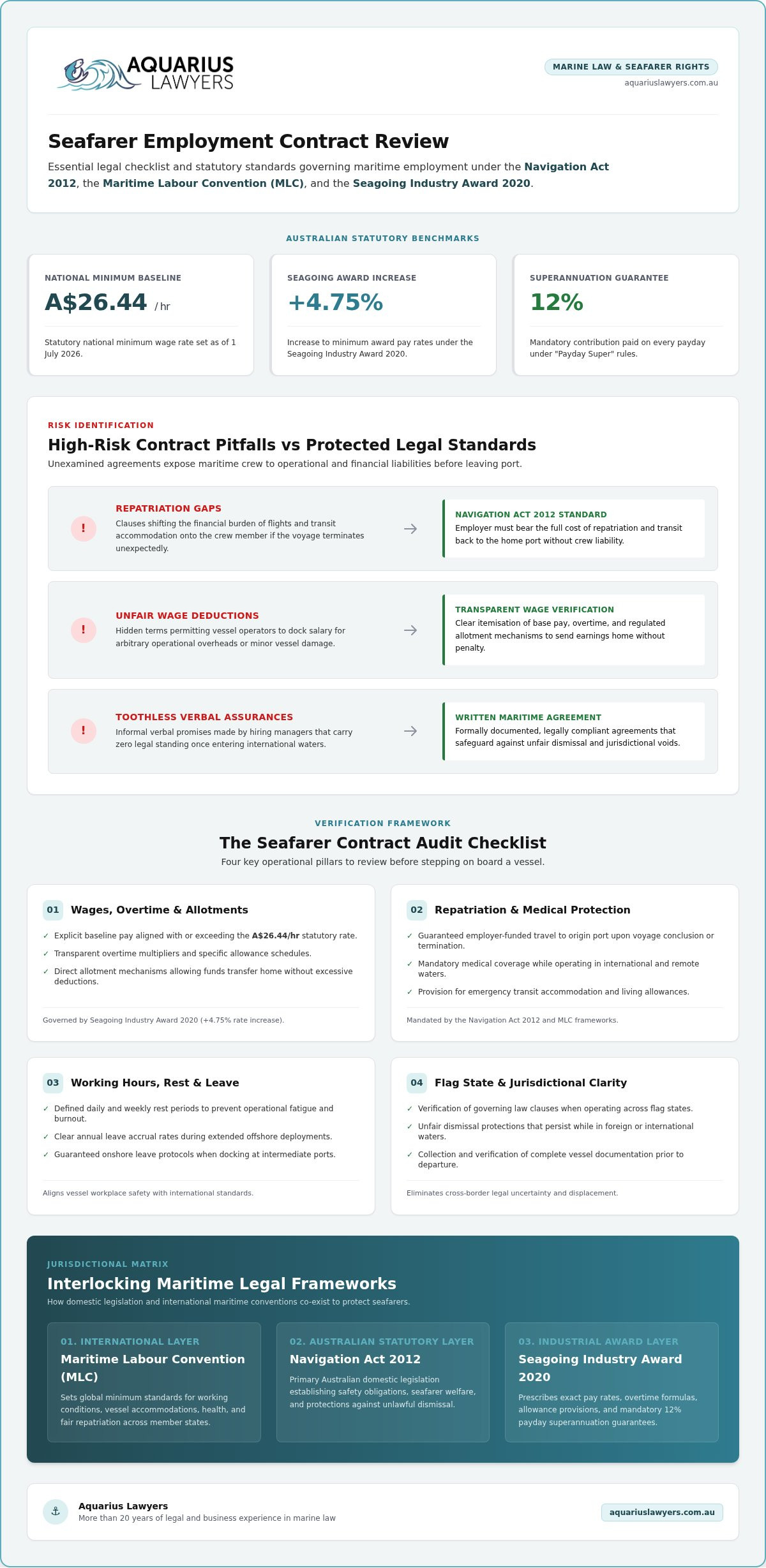
Accepting a maritime contract on blind trust leaves you highly vulnerable to operational exploitation. Unclear terms can leave you completely stranded in a foreign port without the repatriation support required under the Navigation Act 2012. Consider these common pitfalls found in unverified agreements:
- Repatriation gaps: Clauses that shift the financial burden of flights and transit accommodation onto the crew member if the voyage terminates unexpectedly.
- Unfair wage deductions: Hidden terms allowing vessel operators to dock your salary for arbitrary operational costs or minor vessel damage.
- Toothless verbal promises: Verbal assurances from a hiring manager hold zero weight once the vessel leaves port and international regulations take over.
Protecting your maritime career requires a proactive approach. Ensuring your agreement undergoes a professional seafarer employment contract review before you step on board is the most effective way to eliminate these risks and secure your professional future.
The Essential Seafarer Employment Contract Checklist: Crucial Clauses to Verify
A generic employment agreement is a liability when your workplace is a vessel moving through different jurisdictions. You need a structured framework to verify every operational expectation before you sign on the dotted line. A professional seafarer employment contract review ensures that your roles, duties, and safety protocols are defined with absolute precision. Relying on vague templates leads to disputes; a detailed checklist provides the certainty you need to focus on your work at sea.
Wages, Allowances, and Allotted Leave
Your wage structure must be transparent and compliant with current Australian regulations. As of 1 July 2026, the national minimum wage is A$26.44 per hour, but most Australian seafarers fall under the Seagoing Industry Award 2020, which saw a 4.75% increase in minimum rates this year. You should verify that your contract explicitly lists your basic pay, overtime rates, and specific allowances. Under the new “Payday Super” legislation, your employer must contribute 12% to your superannuation on every payday. Additionally, check the mechanism for allotments to ensure you can send money home to your family without excessive fees or delays. Ensure your annual leave and rest periods align with the Seagoing Industry Award to avoid burnout during long voyages.
Repatriation Rights and Medical Coverage
Never assume your transport home is guaranteed unless it is written in stone. Your contract must state that the employer bears the full cost of repatriation once you complete your service or if the voyage terminates unexpectedly. Under the MLC, the maximum continuous period you can serve before becoming entitled to leave and repatriation is 11 months. You also need explicit details regarding medical care. This includes full coverage for shipboard injury or sickness and access to shore-based specialists when required. The International Transport Workers’ Federation (ITF) provides critical oversight in these areas, advocating for agreements that prioritise worker health and safety above vessel schedule pressures.
Termination Notice and Dispute Resolution
Review the minimum notice periods to ensure they are fair and reciprocal. A contract that allows an employer to dismiss you instantly while requiring you to give months of notice is a red flag. You should also examine the formal grievance procedures available while at sea. It is vital to identify which legal body governs your contract; if a dispute arises, you need to know whether Australian law or flag state regulations apply. If you find these clauses confusing, seeking expert marine legal advice can clarify your position before you commit to a voyage.
Navigating International Regulations and Flag State Complexities
A ship is essentially a floating piece of territory belonging to its country of registration. This country, known as the flag state, dictates the fundamental legal framework governing your time on board. Whether the vessel flies the Australian Red Ensign or the flag of a foreign nation, those laws determine your minimum rights, safety standards, and disciplinary procedures. A seafarer employment contract review is essential because it bridges the gap between Australian expectations and the legal realities of foreign jurisdictions. Without this oversight, you might unknowingly sign away protections that you assume are universal.
Aligning your agreement with verified maritime frameworks ensures you aren’t left in a legal vacuum. International boundaries don’t just change the view from the bridge; they alter your options for legal recourse. If a dispute occurs while the vessel is in international waters, the importance of a seafarer employment contract review becomes even more apparent, as it clarifies which nation’s courts will actually hear your case.
Maritime Labour Convention Compliance
The Maritime Labour Convention (MLC) serves as the global “bill of rights” for seafarers. It establishes the baseline for everything from the quality of your food to your right to medical care. When reviewing your contract, you must ensure it explicitly references MLC compliance. This isn’t just a formality; it’s a binding promise that the vessel operator adheres to international safety and welfare standards. You should also verify that the vessel carries a valid Maritime Labour Certificate. This document proves that the ship has been inspected and meets the required standards for living and working conditions. If a contract attempts to bypass these global protections, it is a significant warning sign that your rights are at risk.
Jurisdiction Hurdles in International Waters
Understanding which country’s laws apply becomes complicated the moment you leave the Australian territorial sea. While the Fair Work Act 2009 protects seafarers on Australian-flagged vessels globally, its application to foreign-flagged ships is often limited to when they are operating within Australian waters or engaged in coastal trading. A professional contract review helps you identify these jurisdictional shifts before they become a problem. By consulting a Marine Law Specialist, you can gain a clearer understanding of how these complex regulations interact. This clarity is vital for determining where you would file a claim for unpaid wages or unfair dismissal. Knowing your standing under a foreign flag provides the strategic advantage needed to protect your livelihood in an industry that operates across multiple borders.
How to Prepare for Your Maritime Contract Evaluation
Preparation is the foundation of a successful legal assessment. Before you sit down for a formal consultation, you need to organise your thoughts and gather your paperwork. Arriving with a disorganised stack of papers slows down the process and can cause critical details to be missed. Taking a systematic approach to your preparation ensures that your seafarer employment contract review addresses every operational risk specific to your upcoming voyage.
Listing your personal requirements is an excellent starting point. You should write down your expectations regarding voyage duration, rest schedules, and accumulated leave entitlements. Having these benchmarks clearly defined makes it much easier to identify where the employer’s offer falls short. If you spot vague language or ambiguous definitions during your initial read-through, flag those sections immediately so your legal representative can target them for closer inspection.
Gathering Essential Voyage and Vessel Information
Your legal representative needs specific data to evaluate the jurisdictional framework of your agreement. You must collect the vessel’s unique IMO number, its official flag state registration, and the full corporate details of the registered owner. Additionally, you need to obtain copies of any collective bargaining agreements or modern awards that might apply to the vessel’s operations. To streamline your consultation, ensure you gather the draft contract, recent sea service records, relevant certifications, and copies of any correspondence regarding the job offer. This information allows your lawyer to verify compliance with both Australian maritime regulations and international safety standards quickly.
Documenting Special Conditions and Verbal Promises
Hiring managers often make attractive promises during interviews that somehow vanish when the written text arrives. Whether it is a promise of a specific cabin grade, a guaranteed flight home, or a flexible roster, you must document these verbal assurances. Written text always overrides verbal agreements once a dispute reaches a formal body. You need to ensure every single promise is integrated into the final document before you sign. If you need assistance with integrating these terms or translating complex maritime clauses, you can access our Seafood And Marine Legal Services to protect your career. Taking this proactive step ensures your contract reflects the actual deal you agreed to, providing total security before you step on board.
Protecting Your Maritime Career with Aquarius Lawyers
Life at sea is demanding enough without the added stress of deciphering dense legal text. You need a steady, common-sense guide who understands both the traditional rigours of maritime law and the contemporary tools needed to navigate it. Aquarius Lawyers acts as your dedicated advisor in this space. By conducting a tailored seafarer employment contract review, we identify hidden liabilities and turn them into manageable outcomes. We don’t just provide a service; we offer a protective pathway for your professional future.
Tailored legal advice reduces your long-term risks by ensuring your agreement isn’t just a piece of paper, but a robust shield. When you’re facing a complex maritime issue, you’re in excellent hands with our team. We focus on results over ceremony, providing you with the confidence to sign your next agreement knowing your rights are secure. Our down-to-earth pragmatism ensures that you receive advice that is as practical as it is legally sound.
Over 20 Years of Marine Law Experience
You benefit from a deep well of industry knowledge led by our principal, Katherine Hawes. With more than 20 years of legal and business experience, Katherine understands the unique pressures facing those who work on the water. We combine these traditional credentials with forward-thinking methodologies to provide solutions that are both strategically sound and practically efficient. Our methodology is simple: Expertise + Strategy = Reduced Risk. We remain focused on securing fair outcomes for maritime professionals nationwide, ensuring that your commercial assets and professional reputation are always prioritised.
Practical Legal Solutions for Modern Seafarers
We clear away confusing legal jargon to give you absolute clarity. Our role is to act as a facilitator, moving you from a state of uncertainty to a position of strength. A professional seafarer employment contract review ensures you aren’t caught off guard by jurisdictional hurdles or hidden salary deductions. We help you protect your career longevity by ensuring every clause is legally compliant and strategically sound. This proactive approach prevents small ambiguities from becoming expensive legal disputes later.
The Time is Now. Don’t leave your safety to chance or rely on outdated templates that don’t reflect current Australian standards. Contact Aquarius Lawyers today to organise your formal agreement evaluation. Whether you are a commercial fisher or a professional seafarer, we provide the seafood and marine legal services you need to secure your next voyage safely.
Secure Your Future Before You Set Sail
Stepping onto a vessel with an unverified agreement is a risk you shouldn’t take. You now understand that a professional seafarer employment contract review is the most effective way to lock in your repatriation rights and ensure your medical coverage is ironclad. By gathering your vessel’s IMO number and documenting every verbal promise, you’ve already taken the first step toward a safer voyage. Flag state complexities can shift your legal standing the moment you leave Australian waters, making expert oversight essential.
Aquarius Lawyers, led by Principal Solicitor Katherine Hawes, provides strategic, nationwide legal support based on more than 20 years of dedicated marine law experience. We clear away the confusion so you can focus on your career with absolute peace of mind. Our approach is practical and results-oriented, ensuring that every clause works in your favour. Protect your rights at sea and organise your contract review with Aquarius Lawyers today. Your livelihood is your most valuable asset; we’re here to help you defend it. Safe travels on your next voyage.
Frequently Asked Questions
What is a seafarer employment contract review?
A seafarer employment contract review is a specialised legal audit designed to identify risks before you step on board. It ensures your agreement meets the mandatory standards set by the Navigation Act 2012 and the Maritime Labour Convention. By examining the fine print, a lawyer can spot unfair clauses regarding wage deductions or repatriation gaps. This process transforms a generic document into a robust shield that protects your livelihood while you are operating in international waters.
Can an Australian seafarer negotiate terms in a standard maritime agreement?
You absolutely have the right to negotiate the terms of your maritime agreement. While many vessel operators present a standard form as non-negotiable, these documents often fail to address your specific needs for roster flexibility or higher allowances. You should flag any concerns during the recruitment phase and request written amendments. Securing these changes before you sign ensures your work-life balance and financial interests are protected throughout the duration of the voyage.
What happens if my contract violates the Maritime Labour Convention?
If your contract breaches the Maritime Labour Convention (MLC), the vessel risks detention by authorities like the Australian Maritime Safety Authority (AMSA). You have the right to use the on-board complaint procedure to raise grievances without fear of reprisal. When a violation is found, the employer is legally required to rectify the terms to align with global welfare and safety standards. Identifying these breaches early prevents operational delays and protects your fundamental rights at sea.
Who pays for my journey home if my shipboard contract is terminated?
The employer is legally obligated to cover the full cost of your repatriation under most circumstances. This includes your airfare, land transport, and reasonable accommodation during the journey back to your home port. These rights are triggered when your contract expires or if the vessel is involved in an incident that prevents the voyage from continuing. You must ensure these entitlements are explicitly stated in your written agreement to avoid being stranded in a foreign port.
How long does a professional seafarer employment contract review take?
A professional seafarer employment contract review usually takes between two and five business days. The exact timeframe depends on the complexity of the vessel’s flag state laws and whether there are existing collective bargaining agreements to consider. Getting an expert to review the text quickly provides the clarity you need to make an informed decision. It is a small investment of time that prevents long-term legal headaches and financial loss while you are at sea.
What should I do if my employer makes verbal promises not in the text?
You should never rely on verbal assurances from a hiring manager or skipper. If a promise regarding your cabin, bonus, or leave isn’t in the written text, it effectively doesn’t exist in the eyes of maritime law. You must ask the employer to integrate these verbal promises into the formal contract before you sign it. Documenting these conditions ensures you have legal recourse if the employer fails to honour the deal once you’ve left the wharf.
Does my contract protect me if I am injured in international waters?
Your agreement must include explicit provisions for medical care and financial compensation for shipboard injuries. Under the MLC, vessel owners are responsible for health protection and medical care for all seafarers working on board. This coverage applies whether you are in a local port or international waters. You should verify that your contract details the scope of this insurance and the process for claiming benefits if you become sick or injured during your service.
Disclaimer
Please note that legal rules change and this is not a substitute nor construed as legal advice. It is general information only.