
Could your next signature be the most expensive mistake your company ever makes? With Sydney CBD prime office rents reaching $1,100 per square metre in early 2026, the pressure to lock in a space is intense, but a rushed agreement is rarely a safe one. You probably already know that high overheads are only half the battle. The real risk lies in the fine print of “make-good” clauses and the confusing divide between retail and commercial protections.
To secure commercial lease for my business sydney, you need more than a floor plan; you need a strategic legal shield that balances traditional protection with modern business agility. We promise to help you master these complexities with expert legal strategies designed to protect your assets and future growth. This guide previews the essential 2026 legislative updates, provides a roadmap for negotiating predictable outgoings, and explains how to structure renewal options that actually favour your long-term success.
Key Takeaways
- Recognise why “standard” leases are often skewed towards landlords and how to navigate the high-stakes 2026 Sydney property market.
- Identify the critical legal differences between retail and commercial leases to ensure you capitalise on the specific statutory protections your business deserves.
- Master the practical strategies needed to secure commercial lease for my business sydney while locking in predictable outgoings and strong renewal options.
- Avoid the “make-good” trap by defining your end-of-lease obligations early, protecting your business from unexpected five-figure exit costs.
- Use a structured negotiation roadmap to neutralise deal-breakers in your Heads of Agreement before they become binding legal liabilities.
Understanding the Sydney Commercial Lease Landscape in 2026
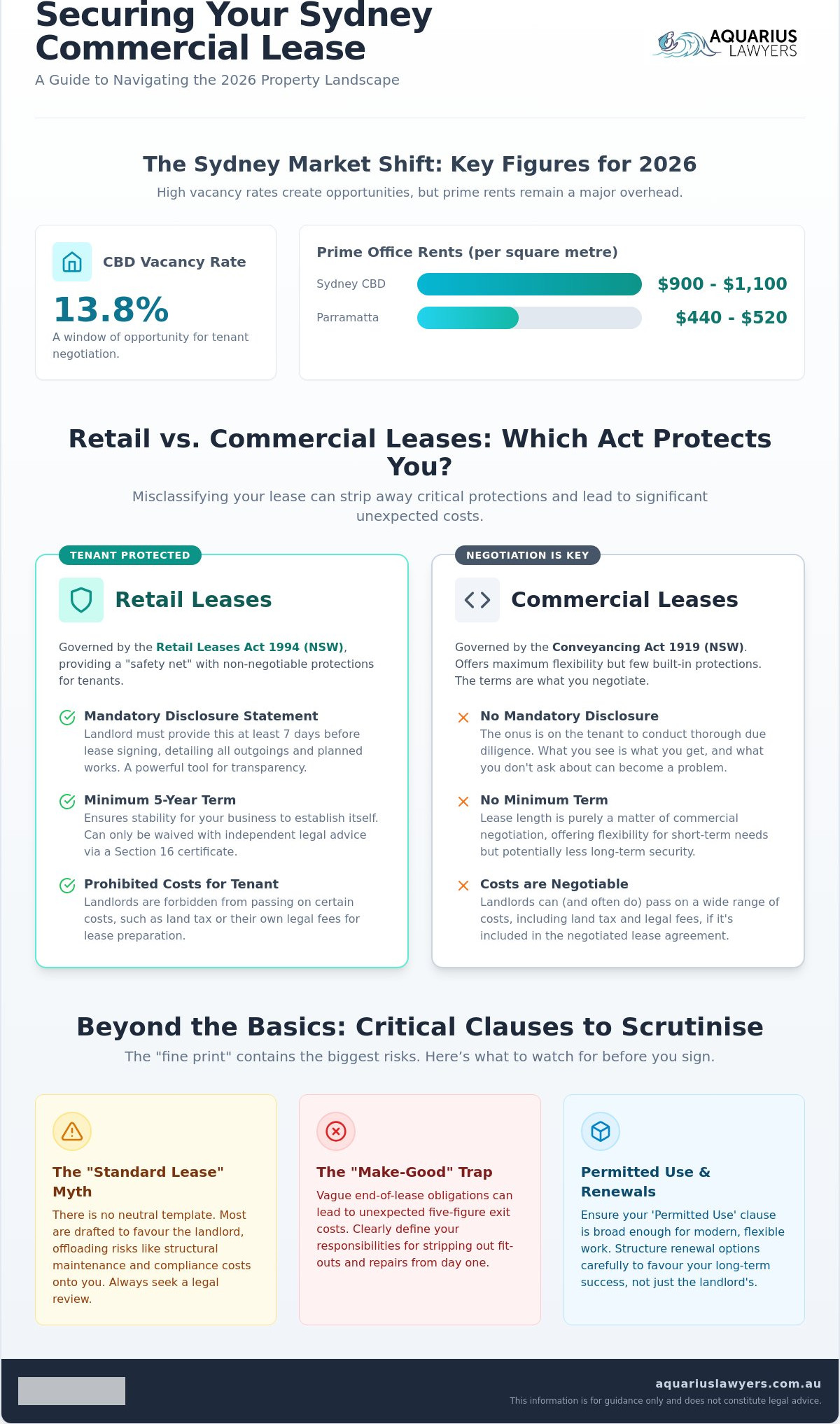
The Sydney commercial property market has undergone a significant transformation. It’s no longer just about finding a post code; it’s about navigating a landscape defined by high vacancy rates and a sharp “flight to quality.” As of early 2026, CBD office vacancy rates hover around 13.8%, creating a unique window of opportunity for tenants who know how to negotiate. While prime CBD rents remain high, ranging from $900 to $1,100 per square metre, the leverage has shifted. Landlords are increasingly willing to trade traditional long-term rigidity for high-calibre tenants who bring stability to their buildings.
The 2026 Sydney Market Shift
Hybrid work models have permanently altered how we use space. This shift has birthed the “mixed-use” precinct, where traditional office boundaries blur with retail and lifestyle amenities. If you’re looking to secure commercial lease for my business sydney, you must pay close attention to your permitted use clause. A clause that is too narrow might prevent you from adapting to these modern, multi-functional environments. We’re also seeing a surge in regional hubs. Parramatta and Shellharbour have become genuine contenders for businesses seeking to dodge CBD overheads, with Parramatta prime office rents sitting between $440 and $520 per square metre. These areas offer the same professional infrastructure at a fraction of the cost, provided the lease is structured to support long-term growth.
The Risk of the “Standard” Lease
The term “standard lease” is one of the most dangerous phrases in commercial law. There is no such thing as a neutral template. Most generic agreements are drafted by landlord associations to offload as much risk as possible onto the tenant. This includes everything from structural maintenance to complex compliance costs. In 2026, this risk is even more pronounced. New legislation, such as the Public Health (Tobacco) Amendment (Landlord Offences) Act 2026, holds landlords criminally liable for certain tenant activities. Consequently, many landlords are now inserting aggressive indemnity clauses into their “standard” documents to shield themselves. Understanding the fundamental differences between Retail vs Commercial Leases is vital for identifying which statutory protections you can actually rely on when these templates try to overreach. Your business sector dictates your security requirements; a maritime or aquaculture business needs vastly different protections regarding wharfage or environmental compliance than a tech startup in a Surry Hills terrace. True lease security is found in the balance between operational flexibility and ironclad legal protection.
Retail vs Commercial Leases: Which Act Protects You?
Classification is everything. Before you can secure commercial lease for my business sydney, you must identify which legal framework governs your agreement. In New South Wales, the divide is sharp. If your business is classified as “retail” under the Retail Leases Act 1994 (NSW), you enjoy a suite of statutory protections that are designed to level the playing field. If you fall outside this definition, you’re in the territory of a standard commercial lease. Here, the Conveyancing Act 1919 (NSW) and the Real Property Act 1900 (NSW) apply. These laws offer maximum flexibility but provide almost no “safety net” for the tenant. Misclassifying your lease isn’t just a clerical error; it’s a mistake that can strip away your rights to disclosure and cost you thousands in prohibited outgoings.
Retail Lease Protections in NSW
The Retail Leases Act is your primary shield. Its most powerful tool is the mandatory Disclosure Statement. A landlord must provide this document at least seven days before the lease is signed. It forces the landlord to be transparent about outgoings, planned works, and even the performance of the shopping centre. If they provide false or misleading information, you may have grounds to terminate the lease or claim compensation. Furthermore, retail tenants are protected by the “5-year rule,” which ensures a minimum lease term (including options) to give your business time to establish itself. While you can waive this right via a Section 16 certificate, doing so requires independent legal advice to ensure you aren’t being pressured into an unstable arrangement. In retail, landlords are also prohibited from passing on certain costs, such as land tax or their own legal fees for preparing the lease.
Commercial Lease Flexibility and Risks
Pure commercial leases are the “Wild West” of property law. They are common for office spaces, industrial units, and specialised waterfront sites. For maritime and fisheries businesses, these leases are standard because the activities involved—such as boat repairs or seafood processing—rarely fit the strict retail definition. The advantage here is bespoke negotiation. You can tailor every clause to suit a 24-hour operation or specific equipment installations. However, the risk is absolute. There is no mandatory disclosure, and outgoings are limited only by what you agree to in writing. If the contract says you pay for the landlord’s capital upgrades, you pay. This is why having commercial law experts review your contract is non-negotiable. Without a statutory safety net, your security depends entirely on the strength of your drafted terms. Every word matters, especially when dealing with relocation clauses that could force your workshop to move at the landlord’s whim.
Key Clauses That Secure Your Business Future
Signing a lease is a significant long-term commitment. To truly secure commercial lease for my business sydney, you must look past the monthly rent figure and scrutinise the “engine room” of the contract. The real cost of a lease is often hidden in standardised terms that many business owners skim over. These clauses dictate your ability to grow, your liability during a downturn, and your eventual exit strategy. In a market where CBD office rents can reach $1,100 per square metre, a single poorly drafted clause can drain your cash flow for years.
Rent review structures are your first major hurdle. You’ll typically choose between a fixed percentage increase, a CPI adjustment, or a market review. While fixed increases provide budget certainty, you must negotiate against “ratchet clauses.” These are aggressive terms that prevent the rent from ever decreasing, even if the Sydney market takes a dive. A fair lease allows for a true market adjustment in both directions. Equally critical is the “make-good” clause. This requires you to return the premises to its original state at the end of the term. Without a detailed condition report and clear limits on these works, you could face a $50,000 surprise bill for repairs or removals you didn’t expect.
Financial Security: Rent and Outgoings
Outgoings in Sydney can be volatile. You need a clause that grants you audit rights, ensuring you only pay your fair share of council rates, water, and insurance. Don’t let the landlord use outgoings as a hidden profit centre. When it comes to security, aim for a bank guarantee rather than a personal guarantee. A bank guarantee limits your liability to a specific cash amount, whereas a personal guarantee puts your family home and private assets on the line if the business faces a rough patch. It’s a simple equation: limited liability equals greater peace of mind.
Operational Agility: Assignments and Sub-letting
Your business won’t stay the same forever. You need the “Right to Assign” the lease if you decide to sell the company or move to a larger space. Ensure the landlord cannot “unreasonably withhold” consent for a new, qualified tenant. For those in the maritime or fisheries sectors, operational clauses are even more specific. You might need guaranteed wharfage access or specialised environmental compliance terms that a standard office lease won’t cover. If your permitted use clause is too narrow, you’ll be stuck. A broad permitted use clause allows you to pivot your services or sub-let a portion of your space to a complementary business, keeping your operations agile and resilient.
The Negotiation Roadmap: Securing Favourable Terms
Negotiation is where strategy meets reality. To secure commercial lease for my business sydney, you must treat the process as a structured sequence of protective steps. With CBD office vacancy rates sitting at 13.8% in early 2026, the power dynamic has shifted toward the tenant, but this leverage is only useful if you know how to deploy it. A successful negotiation isn’t just about lower rent; it’s about eliminating operational landmines that could cripple your business years down the track.
Your roadmap should follow these four critical phases:
- Step 1: Conduct a rigorous review of the Heads of Agreement (HoA) before any signature is applied.
- Step 2: Identify and neutralise deal-breakers, specifically relocation and demolition clauses that offer the landlord too much control.
- Step 3: Use current market data to secure significant rent-free periods or fit-out contributions.
- Step 4: Engage a solicitor to formalise the lease, ensuring every verbal promise is reflected in the final registered document.
The Heads of Agreement (HoA) Trap
Many Sydney business owners treat the HoA as a mere formality or a non-binding expression of interest. This is a dangerous misconception. While it may not be the final contract, the HoA locks in the core commercial terms. If you fail to exclude a demolition clause at this stage, it becomes incredibly difficult to remove it later during the formal lease drafting. You should never sign a HoA without legal oversight because it establishes the commercial blueprint that dictates your future financial obligations. Signing prematurely often leads to expensive disputes when the formal lease arrives with unexpected standard conditions that contradict your verbal agreement.
Tactical Negotiation for Sydney Tenants
In the 2026 market, demolition clauses are a major bargaining chip. If a landlord insists on a demolition clause in a secondary office building or a mixed-use precinct, use this to demand a lower base rent or a longer rent-free period. You’re effectively accepting a higher risk of displacement, and the price should reflect that. Similarly, be precise about fit-out incentives. Clarify who owns the partitions, cabling, and lighting at the end of the term. A well-negotiated fit-out can save you six figures in capital expenditure, but only if the make-good obligations are clearly capped. Always insist on a comprehensive Condition Report with high-resolution photos. This document is your primary defence against inflated repair claims when your lease eventually concludes.
If you need help reviewing your current proposal, our commercial law team can provide a proactive review to ensure your interests are protected from day one.
Why Aquarius Lawyers is Your Commercial Lease Partner
Securing a commercial property in Sydney is a complex equation where legal precision plus market pragmatism equals long-term business stability. At Aquarius Lawyers, we don’t just review contracts; we build strategic pathways for your success. As an “innovative veteran” firm, we blend decades of traditional legal credentials with the latest digital tools to ensure your agreement is robust. If you want to secure commercial lease for my business sydney, you need a partner who values results over ceremony and provides clarity when you face high-stakes decisions.
Expertise Beyond the Standard Office
Not every business fits into a tidy CBD office block. Katherine Hawes, known globally as “The Fish Lawyer,” brings world-class expertise to sectors that other firms often overlook. Whether you are organising complex waterfront commercial leases, managing aquaculture sites, or securing fisheries infrastructure, we understand the specific regulatory hurdles you face. Our presence across Sydney and regional NSW hubs ensures we have the local market insights to spot red flags in a contract before they become liabilities. We have fully integrated e-conveyancing and digital review technology into our workflow. This modern methodology allows for fast, efficient, and accurate contract analysis. It cuts through the noise of dense legal jargon and gets you to the signing stage with total confidence in your protections.
Proactive Protection for Your Business
Adopting a “no-nonsense” approach to legal counsel is our standard. This means moving away from the detached formality of traditional law firms and stepping into the role of a trusted advisor. Our goal is to prevent litigation before it starts by identifying the common commercial contract mistakes that lead to expensive court battles. We offer fixed-fee options for lease reviews because we believe Sydney small business owners deserve cost certainty. This transparency allows you to budget for expert advice without the fear of hidden billable hours. It’s a pragmatic way to protect your growth. We provide the steady, common-sense guide you need to navigate the 2026 landscape. Don’t leave your business assets to chance by relying on a generic template or a rushed negotiation.
Secure your Sydney business future with a professional lease review from Aquarius Lawyers
Secure Your Sydney Business Assets Today
A commercial lease is the foundation upon which you build your company’s future. We’ve explored how the 2026 Sydney market shift provides unique leverage for tenants, provided you know how to identify the “standard” lease traps. By mastering the Heads of Agreement and scrutinising make-good clauses, you move from a position of risk to one of strategic advantage. To secure commercial lease for my business sydney, you need a legal partner who understands the synergy between traditional experience and modern business agility.
Principal Katherine Hawes is a renowned expert in niche commercial and marine law, offering the specialised insights required for complex Sydney sites. With multiple office locations across Sydney and regional NSW, Aquarius Lawyers provides strategic, cost-effective legal solutions tailored specifically for SMEs. Don’t leave your long-term growth to chance or poorly drafted templates. We’re here to offer the common-sense guidance and authoritative protection your business deserves.
Book a Commercial Lease Consultation with Aquarius Lawyers
Take the proactive step to protect your assets and ensure your business has the space it needs to scale with confidence.
Frequently Asked Questions
Is a Heads of Agreement (HoA) legally binding in NSW?
A Heads of Agreement is generally not legally binding in NSW unless the document explicitly states that the parties intend to be bound immediately. It usually serves as a commercial roadmap for the formal lease that follows. However, if the HoA contains all essential terms and the parties act as though a contract exists, a court might find it enforceable. You should always treat the HoA as the final opportunity to lock in your deal-breakers before the formal drafting begins.
What is the difference between a gross lease and a net lease in Sydney?
In a gross lease, your rent is an all-inclusive figure that covers the base rent and all outgoings like rates, taxes, and insurance. Conversely, a net lease requires you to pay a base rent plus your proportional share of the building’s operating costs. In the 2026 Sydney market, net leases are more common for industrial sites and larger office blocks; while gross leases are often preferred by smaller tenants seeking total budget certainty.
Can my landlord increase the rent by any amount they want?
Your landlord can only increase the rent according to the specific review mechanisms outlined in your signed agreement. Most Sydney leases use fixed percentage increases, CPI adjustments, or market reviews at set intervals. If your contract is a retail lease, “ratchet clauses” that prevent rent from falling during a market review are legally prohibited. For other commercial spaces, you must negotiate these caps during the HoA stage to ensure you can secure commercial lease for my business sydney without facing uncapped financial hikes.
Do I need to register my commercial lease with the NSW Land Registry Services?
You must register your lease with the NSW Land Registry Services if the total term, including any options to renew, exceeds three years. Registration provides you with “indefeasibility of title,” which protects your right to occupy the premises if the landlord sells the building. As of July 2026, standard registration fees are approximately $350. Failing to register a long-term lease leaves your business vulnerable to new owners who might not recognise your unregistered interest.
What happens if I need to break my Sydney commercial lease early?
Breaking a lease early usually triggers a “surrender of lease” or a “default” scenario where you remain liable for the rent until a new tenant is secured. You’ll also likely be responsible for the landlord’s re-letting costs, including legal fees and marketing. To mitigate this risk, ensure your contract includes a right to assign or sub-let. This allows you to transfer the lease to another qualified business owner rather than paying out the remaining term of the contract.
Who is responsible for repairs and maintenance in a commercial building?
Responsibility is split between the parties and must be clearly defined in your contract to avoid disputes. Generally, the tenant handles internal repairs, such as light globes, air conditioning servicing, and floor coverings; while the landlord manages structural elements like the roof and external walls. Many “standard” commercial templates try to push structural maintenance costs onto the tenant. You should always insist on a clause that excludes “fair wear and tear” and inherent defects from your obligations.
What is a “make-good” provision and how can I negotiate it?
A “make-good” provision requires you to remove your fit-out and return the premises to its original condition at the end of the lease. You can negotiate this by agreeing to a “cash-out” figure instead of performing the physical works or by limiting the scope to “broom clean” only. It’s vital to attach a detailed condition report to your lease at the start. This ensures you aren’t forced to repair damage that existed before you moved in.
How much should I expect to pay for a commercial lease review in Sydney?
Legal fees for a commercial lease review vary depending on the complexity of the document and the level of negotiation required. Rather than accepting an hourly rate that can lead to bill shock, look for a firm that offers fixed-fee options for initial reviews. This provides your business with cost certainty from the outset. Getting professional advice early is a strategic investment that helps you secure commercial lease for my business sydney by avoiding expensive “make-good” traps or hidden outgoings later.
Disclaimer
Please note that legal rules change and this is not a substitute nor construed as legal advice. It is general information only.