
If a vessel carrying your unpaid debt clears the Heads of Sydney Harbour tonight, your legal leverage might vanish with the horizon. You’re likely feeling the intense pressure of a ticking clock, knowing that once a ship leaves Australian waters, your maritime claim becomes significantly harder to enforce. It’s a high-stakes environment where the fear of “wrongful arrest” damages often clashes with the urgent need to secure a settlement. You need a strategy that balances speed with absolute procedural accuracy.
This article provides the clarity you need to navigate the Federal Court of Australia’s complex Admiralty rules. By partnering with an experienced ship arrest lawyer sydney, you can secure your interests through a proven legal formula that combines traditional maritime expertise with modern, cost-effective tactics. We’ll break down the 1 July 2026 Federal Court fee updates, including the $5,255 commencement fee for corporations, and explain how new AMSA regulations under the Navigation Act 2012 impact your case. From filing the initial writ to managing Marshal’s custody costs, you will learn how to turn a maritime lien into a tangible result.
Key Takeaways
- Understand how the Admiralty Act 1988 (Cth) provides the essential legal framework to secure your maritime claims through the Federal Court of Australia.
- Identify the specific grounds for vessel detention in New South Wales, ranging from unpaid bunker bills at Port Botany to international crew wage disputes.
- Learn why the 24-hour window is critical and how a specialised ship arrest lawyer sydney manages the urgent filing of your Writ and Arrest Warrant.
- Discover how to navigate “Caveats Against Arrest” to protect your commercial interests and avoid the significant risks of wrongful arrest damages.
- Gain insights into how partnering with a maritime litigation expert like Katherine Hawes combines traditional experience with modern legal efficiency.
Understanding Ship Arrest in Sydney: The Legal Framework
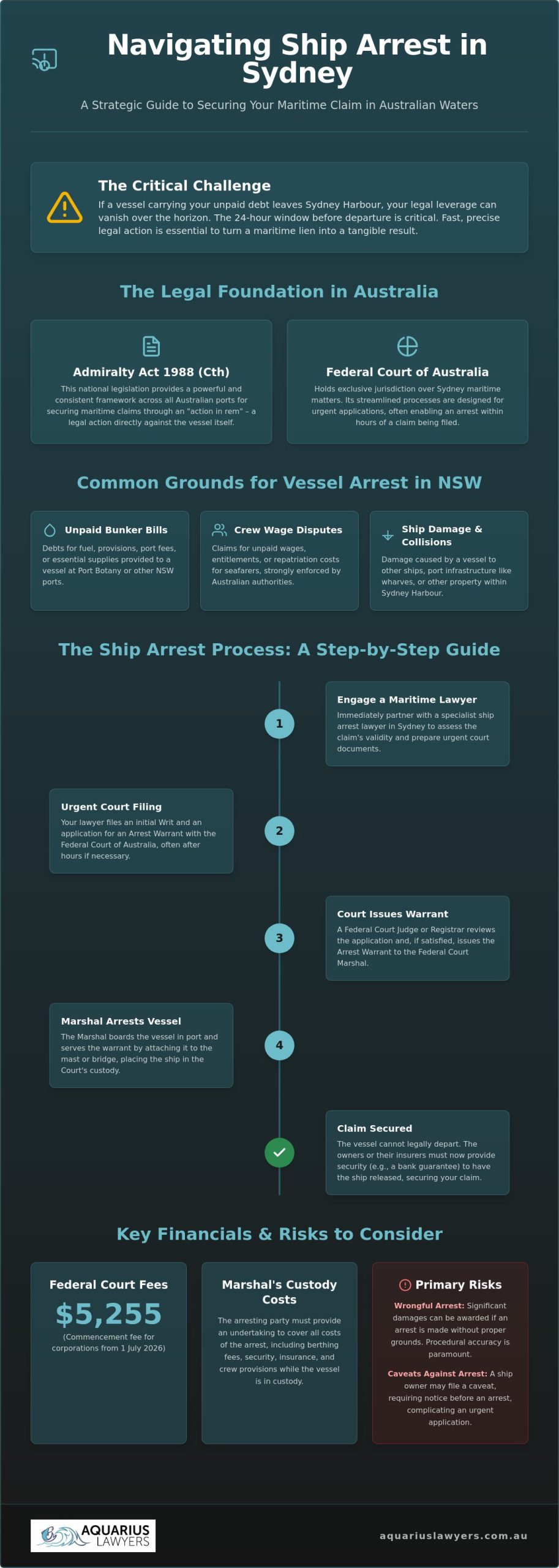
When you’re dealing with a vessel that’s about to weigh anchor at Port Botany, the legal machinery must move faster than the tide. In Australia, ship arrest isn’t just a maritime tradition; it’s a high-precision legal procedure governed by the Admiralty Act 1988 (Cth). This Commonwealth legislation grants the Federal Court of Australia exclusive jurisdiction over Sydney maritime matters, providing a robust mechanism to secure unpaid debts or damages. Unlike standard litigation, an arrest is often an “action in rem.” This means the legal proceeding is directed against the ship itself, treating the vessel as the defendant rather than just the owner. This distinction is vital. It allows a ship arrest lawyer sydney to freeze the asset where it sits, forcing the owners or insurers to provide security before the ship can leave NSW waters.
Sydney Harbour and Port Botany serve as the primary gateways for Australian trade, making them critical hubs for maritime law enforcement. Because these ports are so active, the Federal Court maintains a streamlined process to handle urgent applications. While the process follows international ship arrest protocols, the Australian application is uniquely efficient, often allowing an arrest to occur within hours of an application being filed. This speed is the ultimate equaliser for creditors facing international debtors who have no other assets in the country.
The Admiralty Act 1988: Your Legal Foundation
This Act provides the national framework that ensures consistency across all Australian ports. It distinguishes between “maritime liens,” which can follow a ship even after a change in ownership, and “statutory rights in rem,” which cover broader commercial claims like unpaid bunker bills or repair costs. For a ship arrest lawyer sydney, the priority is identifying which category your claim falls into. This determines your priority in the queue of creditors. The Act applies equally to local vessels and international ships, ensuring that whether the ship is a coastal trader or a foreign-flagged container vessel, your rights remain enforceable under Australian law.
The Role of the Federal Court Marshal
Once the Court issues an arrest warrant, the Federal Court Marshal steps in. The Marshal isn’t just a figurehead; they are an officer of the Court tasked with the physical and legal custody of the vessel. In Sydney, this means the Marshal will formally serve the warrant on the ship, often by attaching it to the mast or the bridge. From that moment, the ship is in the custody of the Court. You should be aware of the financial commitment involved. The party seeking the arrest must give an undertaking to pay the Marshal’s costs. These expenses include berthing fees, security, and even crew provisions during the arrest period. It’s a strategic investment: the cost of the arrest is the price of ensuring the vessel doesn’t vanish before your debt is settled.
Grounds for Arrest: When Can You Detain a Vessel in NSW?
Not every unpaid invoice grants you the right to stop a ship. To trigger an arrest in New South Wales, your grievance must qualify as a “maritime claim” under the Admiralty Act 1988 (Cth). Common triggers include unpaid bunker bills or supply chain debts incurred by vessels visiting Port Botany. If a shipowner fails to pay for fuel, provisions, or necessary repairs, the law allows you to move from a simple debt recovery action to a tactical arrest. This is particularly effective when dealing with foreign entities that lack a physical presence in Sydney. It’s about securing an asset before it disappears beyond the horizon.
Crew wage claims are another high-priority ground. As seen in the April 2026 case of the BBG Wuzhou, where the Australian Maritime Safety Authority (AMSA) banned a vessel for underpaying crew over $68,000, Australian authorities take seafarer welfare seriously. Beyond wages, you can detain a vessel if it causes physical damage to Sydney Harbour infrastructure or other ships. If you’re unsure if your specific situation qualifies, consulting a ship arrest lawyer sydney can help clarify your standing before you commit to court fees. We focus on the practical reality of your claim to ensure the arrest is both legal and effective.
Commercial Fishing and Aquaculture Vessel Arrests
Commercial fishing and aquaculture present unique legal challenges that standard maritime firms often overlook. Disputes over fishing quotas, breaches of supply contracts for specialised marine equipment, or disagreements regarding aquaculture support vessels are all valid grounds for arrest. Leveraging “The Fish Lawyer” perspective ensures that niche industry nuances, like the seasonal urgency of a catch or the specific mechanics of offshore pens, are factored into your legal strategy. We understand the synergy between traditional maritime law and the specific regulatory hurdles of the fisheries sector.
Cargo Claims and Charterparty Disputes
Ship arrest also serves as vital security for cargo claims and charterparty disputes. If cargo is lost or damaged during transit, or if a charterer faces a breach of agreement, arresting the vessel ensures there is an asset available to satisfy a future judgment. A maritime lien is a privileged claim upon maritime property that attaches to the vessel for service done to it or damage caused by it, recognised under Section 15 of the Admiralty Act 1988 (Cth). This powerful legal tool ensures your claim remains “stuck” to the hull, even if the vessel’s ownership changes hands. It provides the ultimate peace of mind for creditors in a volatile global market.
The Arrest Process: Navigating the Federal Court of Australia
Time isn’t just money in maritime law; it’s the difference between a secured claim and a total loss. Once a vessel clears the Sydney Heads, your window for legal action effectively closes. A seasoned ship arrest lawyer sydney understands that the first 24 hours after discovering a ship’s arrival at Port Botany are the most critical. The process begins with the preparation of two vital documents: the “Writ” and the “Application for Warrant.” The Writ initiates the legal action against the ship, while the Warrant serves as the instrument that physically detains it. These must be filed with the Federal Court Registry with absolute precision. Any error in the vessel’s name or the specific nature of the claim can lead to delays that allow the ship to slip away.
Executing the arrest is a coordinated effort between your solicitor and the Federal Court Marshal. Once the warrant is issued, the Marshal travels to the vessel to serve the papers on the ship’s master. This often involves physically attaching the warrant to the mast or bridge. Crucially, the court requires an “Undertaking” from the person seeking the arrest. This is a formal promise to pay the Marshal’s costs and expenses, which include everything from berthing fees to the Marshal’s hourly salary plus a 20% loading for overheads. It’s a pragmatic “pay-to-play” system that ensures the Court is not left out of pocket while protecting your commercial interests.
Emergency Filing Procedures in Sydney
Ships don’t always arrive during business hours. The Sydney Federal Court Registry has established emergency procedures to handle after-hours and weekend filings. Through the eLodgment system, we can often initiate the process digitally, though a physical presence is still required for the Marshal to execute the warrant. To move within the first hour, your solicitor will need:
- Evidence of the debt or damage (contracts, invoices, or logs).
- The vessel’s current location and estimated time of departure.
- The ship’s IMO number and country of registry.
- A signed authority to provide the Marshal’s undertaking.
Having these ready transforms an urgent crisis into a manageable legal procedure.
Security for Costs and the Undertaking
Initiating an arrest involves a significant financial commitment. Beyond the court filing fees, which as of 1 July 2026 are $5,255 for a corporation to commence a proceeding, you must be prepared for the Marshal’s ongoing custody costs. We manage the risk of “wrongful arrest” through a meticulous pre-filing evidence review. If you arrest a vessel without a valid maritime claim, you could be liable for the shipowner’s lost profits. Our strategy focuses on verifying the “statutory right in rem” before the first document is filed, which minimises your liability and ensures the arrest remains a tool for resolution rather than a source of further litigation.
Avoiding the Pitfalls: Caveats Against Arrest and Release
Before you commit to the court filing fees mentioned earlier, you must check the Register of Caveats. A “Caveat Against Arrest” is a proactive shield used by shipowners to prevent their vessels from being detained. By filing this document, the owner formally undertakes to provide security for any claim that may be brought against the ship. If you proceed with an arrest while a valid caveat is in place, you risk being ordered to pay the shipowner’s costs and damages for the delay. A ship arrest lawyer sydney will always conduct this search first to ensure your tactical strike doesn’t backfire into a costly legal blunder. It is a simple step that separates professional precision from amateur risk.
If the debt remains unpaid and the owner cannot provide security, the court may eventually order a judicial sale. This is the “nuclear option” of maritime law. The vessel is sold at auction, and the proceeds are distributed to creditors based on the priority of their claims. However, most cases are resolved much sooner through the provision of alternative security. This usually takes the form of a Letter of Undertaking (LOU) from a Protection and Indemnity (P&I) Club or a bank guarantee. These documents replace the physical ship as security for your claim, allowing the vessel to return to its commercial schedule while your legal battle continues in the Federal Court. This synergy between legal pressure and commercial reality is what makes ship arrest such a powerful tool.
Wrongful Arrest: Protecting Your Reputation
In Australia, the threshold for “wrongful arrest” damages is high. You aren’t liable just because you lose the case; the owner must prove “gross negligence” or “malice.” This means you acted with a reckless disregard for the truth or a deliberate intent to cause harm. We protect our clients by building a robust evidentiary foundation before the first warrant is issued. If you are a shipowner whose vessel has been arrested without proper grounds, we can move quickly to challenge the warrant and seek the ship’s immediate release. If you find yourself facing an unjustified detention, contact our maritime solicitors to discuss your defence strategy.
Negotiating the Release of a Vessel
Speed is just as important during the release phase as it is during the arrest. Every hour a ship sits idle at Port Botany costs the owner thousands in charter hire and port fees. We facilitate speedy resolutions by negotiating directly with P&I Clubs and insurers to secure acceptable guarantees. Once the security is in place, we draft the “Consent to Release” and coordinate with the Marshal to settle final expenses. This methodical approach ensures the ship returns to sea as quickly as possible, minimising the financial fallout for all parties involved and ensuring the dispute moves into a manageable litigation phase.
Why Partner with a Sydney Maritime Specialist?
Choosing a ship arrest lawyer sydney is a decision that balances legal tradition with modern tactical speed. At Aquarius Lawyers, we combine deep-seated maritime grit with an efficient, tech-forward methodology. Our principal, Katherine Hawes, widely known as “The Fish Lawyer,” brings a unique perspective to the table. She understands that maritime law isn’t just about statutes; it’s about the practical reality of the water. Whether you’re dealing with a large-scale container ship at Port Botany or a commercial fishing vessel in regional NSW, we offer the intellectual versatility to protect your interests without the bloated overheads of big-tier firms. Our “no-nonsense” approach prioritises your commercial outcome over billable hours, ensuring that every legal move is a strategic step toward settlement or security.
Our strategic office locations in Sydney and regional NSW allow us to respond rapidly to any port in the state. Maritime disputes don’t wait for business hours, and neither do we. We operate with a “boots on the ground” philosophy, moving quickly to assess claims and file the necessary paperwork before a vessel can clear the Heads. This combination of local presence and specialised knowledge creates a powerful advantage for our clients. We don’t just provide advice; we provide a pathway to resolution that respects both the law and your bottom line.
Innovation Meets Experience
We’ve moved beyond the era of dusty law books and slow-moving litigation. By leveraging modern legal tech, we streamline the Admiralty filing process, ensuring that your “Writ” and “Application for Warrant” are lodged with the Federal Court Registry with maximum speed and accuracy. This efficiency directly reduces client costs and increases the likelihood of a successful arrest. You get the benefit of a down-to-earth advisor who speaks the language of the maritime industry, whether you’re a crew member seeking unpaid wages or a commercial supplier dealing with a breach of contract. Our track record spans the full spectrum of marine law, from complex international shipping disputes to niche fisheries matters that generalist firms often struggle to navigate.
Next Steps: Securing Your Claim Today
If a vessel is currently in port or approaching Sydney, immediate consultation is your most effective tool. A delay of even a few hours can be the difference between a secured maritime lien and a total loss of leverage. We can provide a rapid assessment of your claim, verifying your “statutory right in rem” and calculating the potential Marshal’s expenses before you commit to the process. This proactive strategy ensures you move forward with clarity and confidence. Don’t leave your maritime interests to chance when you can secure them with precision legal action. Contact Aquarius Lawyers for urgent maritime advice and let us help you take command of your legal situation today.
Take Command of Your Maritime Interests
When a vessel is on the move, your ability to secure a debt depends entirely on the speed and precision of your legal response. You now understand that a successful ship arrest in Sydney requires a deep grasp of the Admiralty Act 1988 (Cth), a clear-eyed assessment of Marshal costs, and the tactical agility to navigate the Federal Court Registry before the ship clears the Heads. It’s a high-stakes environment where the right strategy turns a fleeting maritime claim into a tangible resolution. Every hour matters when a ship is at berth; waiting too long often means losing your leverage entirely.
Our Sydney CBD office is strategically positioned near the Federal Court of Australia to ensure we can act within the critical 24-hour window. Led by Principal Katherine Hawes, a recognised expert known as “The Fish Lawyer,” Aquarius Lawyers provides the specialised niche expertise in Fisheries and Aquaculture law that generalist firms simply can’t match. When you partner with an experienced ship arrest lawyer sydney, you’re choosing a no-nonsense advocate who values results over ceremony. We focus on the pragmatic steps needed to secure your interests and force a settlement.
Don’t let your leverage sail away. Secure your maritime claim with Aquarius Lawyers — Contact us for urgent assistance. We’re ready to help you navigate the complexities of the law and protect your commercial future with confidence.
Frequently Asked Questions
How much does it cost to arrest a ship in Sydney?
Arresting a vessel involves three primary costs: the Federal Court filing fee, the Marshal’s expenses, and your legal costs. As of 1 July 2026, a corporation must pay $5,255 to commence proceedings, while an individual pays $1,805. You’ll also need to provide an undertaking for the Marshal’s custody costs. These include the officer’s hourly salary, a 20% overhead loading, and actual expenses like berthing fees or security while the ship is detained.
Can I arrest a ship for a debt that occurred outside of Australia?
Yes, you can arrest a ship in Sydney for a debt incurred overseas, provided it qualifies as a maritime claim under the Admiralty Act 1988. This is a powerful tool for global creditors. If the vessel is currently in Australian waters, the Federal Court has jurisdiction to hear the matter. Your ship arrest lawyer sydney will verify if the claim is a maritime lien or a statutory right in rem before filing.
How long does a ship stay arrested in the Federal Court?
A ship remains under arrest until the Court orders its release or it is sold to satisfy the debt. Release typically happens when the shipowner provides alternative security, such as a P&I Club Letter of Undertaking or a bank guarantee. In many Sydney cases, this security is arranged within days. If no security is provided, the vessel stays in the Marshal’s custody until a judicial sale is finalised through the Court.
What is the difference between a maritime lien and a statutory claim?
A maritime lien is a high-priority claim that sticks to the hull, even if the ship’s owner changes. It covers specific issues like crew wages, salvage, and damage caused by a ship. A statutory claim, such as unpaid fuel bills or repair costs, is broader but generally requires the person liable for the debt to be the owner or charterer at the time the legal action starts. Liens usually take priority over mortgages.
Can a foreign crew arrest a ship in Sydney for unpaid wages?
Foreign crew members have a clear legal right to arrest a vessel in Sydney for unpaid wages. This is classified as a maritime lien, giving it high priority in the Federal Court. Recent 2026 enforcement trends by AMSA show a zero-tolerance approach to wage underpayment. Crew can seek an arrest warrant to secure their earnings before the vessel departs, which often forces a swift settlement from the shipowner or their insurer.
What happens to the cargo on an arrested ship?
Arresting a ship doesn’t automatically arrest the cargo on board unless the claim specifically involves those goods. However, the cargo’s movement is physically restricted because the vessel cannot sail. Cargo owners may need to apply to the Court to have their goods discharged. This often involves negotiating with the Marshal and the arresting party to ensure berthing and stevedoring costs are covered without compromising the legal status of the arrest.
Is it possible to arrest a sister ship in Australia?
Australia’s Admiralty Act 1988 allows for “surrogate ship” or sister ship arrest. This means you can arrest a different vessel owned by the same entity responsible for the original debt. It’s a vital strategy when the offending ship is elsewhere but another vessel from the same fleet is visiting Port Botany. It ensures that owners can’t avoid their liabilities simply by keeping one specific vessel out of Australian jurisdictions.
How do I search for a Caveat Against Arrest in the Federal Court?
Your ship arrest lawyer sydney will search the Register of Caveats through the Federal Court of Australia’s electronic filing system. This search confirms if an owner has already undertaken to provide security for claims. Checking this register is a mandatory first step. Proceeding with an arrest despite a valid caveat can lead to your claim being set aside and potentially make you liable for the shipowner’s delay damages.
Disclaimer
Please note that legal rules change and this is not a substitute nor construed as legal advice. It is general information only.