
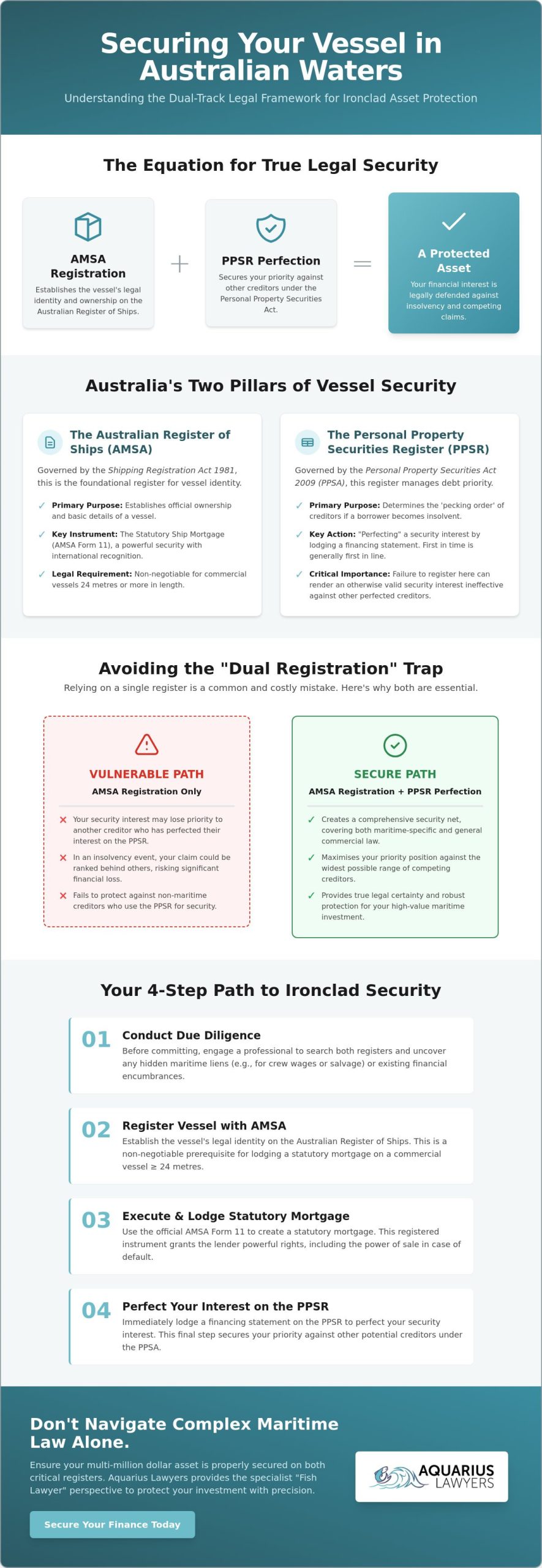
Securing a multi-million dollar vessel in Australian waters isn’t as simple as signing a mortgage and sailing away. Most owners assume that an entry on the Australian Shipping Register is the final word on ownership. However, true legal safety is a specific equation: AMSA registration plus PPSR perfection equals a protected asset. If you are searching for a ship financing lawyer australia experts rely on, you’ve likely realised that missing a single filing on the Personal Property Securities Register can render your security interest ineffective against other creditors.
It’s understandable to feel overwhelmed by the technical overlap between traditional maritime liens and modern digital registries. You want a seamless acquisition without the fear of hidden liabilities surfacing months later. This article provides the clarity you need to master Australian ship financing, from managing the $2,664 AMSA registration fee for large commercial vessels to ensuring your PPSR filings are accurate. We’ll preview the essential steps for a legally secure vessel purchase and explain your rights as a mortgagor so you can move forward with absolute confidence.
Key Takeaways
- Understand the dual-track legal framework of the Shipping Registration Act 1981 and the PPSA to ensure your vessel security is ironclad.
- Avoid the common “Dual Registration” trap by learning when you must lodge interests on both the Australian Register of Ships and the PPSR.
- Engage a specialist ship financing lawyer australia to navigate the unique legal hurdles of securing commercial fishing vessels and their associated quotas.
- Utilise a professional due diligence checklist to uncover hidden encumbrances and maritime liens before you commit to a vessel acquisition.
- Bridge the gap between complex maritime law and practical business outcomes with a strategy designed for the modern Australian shipping industry.
What is Ship Financing Law in the Australian Context?
Ship financing provides the essential legal architecture used to fund vessel acquisition, construction, or refitting. It isn’t just a loan agreement; it’s a sophisticated framework designed to manage risk in a mobile and high-value environment. In Australia, this process is anchored by two primary pieces of legislation: the Shipping Registration Act 1981 and the Personal Property Securities Act 2009 (PPSA). While many business owners are familiar with standard equipment finance, maritime assets require a different level of precision.
A standard chattel mortgage, frequently used for land-based machinery, is often insufficient for high-value maritime assets. These assets operate in international waters and are subject to unique risks like maritime liens. The gold standard for securing a lender’s interest in this jurisdiction is the statutory Ship mortgage. This instrument provides a level of security and international recognition that a simple contract cannot match. Choosing a ship financing lawyer australia trusts ensures that your asset is protected by more than just a standard bank document; it’s protected by a registered interest that carries weight across global jurisdictions.
The Role of the Australian Maritime Safety Authority (AMSA)
AMSA maintains the Australian Register of Ships, a critical database for any vessel transaction. The register is divided into the General Register and the International Register. For commercial vessels 24 metres or more in length, registration on the General Register is a legal requirement. This registration is a non-negotiable prerequisite for a statutory mortgage. You cannot lodge a statutory mortgage against a vessel that hasn’t first been properly registered with AMSA. It’s a foundational step that establishes the legal “identity” of the vessel before any finance can be secured.
Why General Commercial Lawyers Often Miss Maritime Nuances
Generalist commercial lawyers often rely on “equitable mortgages” or standard PPSR filings. While these have their place, they can be disastrous in the maritime world. Maritime liens for crew wages, salvage, or damage caused by a collision can take priority over even the most carefully drafted bank contracts. Without the “Fish Lawyer” perspective, you might miss these hidden liabilities. We focus on the practical reality of vessel operations, ensuring that your security interest is perfected on both the AMSA register and the PPSR to prevent other creditors from jumping the queue. This dual-track approach is the only way to achieve true legal certainty for your maritime investment.
The Legal Instruments: Statutory Mortgages vs. PPSR
Understanding the distinction between the Australian Register of Ships (ARS) and the Personal Property Securities Register (PPSR) is the first step toward securing your capital. While the ARS tracks ownership and high-level encumbrances, the PPSR is the modern engine room for debt priority in Australia. Many lenders fall into the “Dual Registration” trap by assuming one register covers all bases. If a vessel is over 24 metres, it must be on the General Shipping Register managed by the Australian Maritime Safety Authority (AMSA). However, failing to also register that interest on the PPSR can leave a lender vulnerable if the borrower enters insolvency.
Priority rules in Australia generally follow a “first in time” principle, but the PPSA introduced complexities that can override traditional maritime logic. If a business hits rough weather, the creditor with a “perfected” security interest on the PPSR usually stands at the front of the queue. For high-value assets, the interaction between these two registers creates a safety net. Engaging a ship financing lawyer australia trusts ensures that your security is lodged correctly on both systems, preventing other creditors from gaining a legal advantage through a technicality.
The Statutory Ship Mortgage (Form 11)
The AMSA Form 11 is the primary document used to create a statutory mortgage under the Shipping Registration Act. This form requires precise details, including the vessel’s official number and name, to be legally valid. A statutory mortgage is a registered security interest that grants the lender a power of sale over the vessel. Beyond the power of sale, this instrument allows a mortgagee to take possession of the ship or appoint a receiver if the mortgagor defaults. These specific protections are far more robust than those found in a standard commercial loan agreement.
PPSA and Small Craft Financing
For recreational vessels and commercial craft under 24 metres, the PPSR is the primary tool for securing finance. In these transactions, the Purchase Money Security Interest (PMSI) is a powerful feature. A PMSI gives a lender “super-priority” over other creditors, provided it is registered within strict timeframes. Common mistakes often involve entering the wrong Hull Identification Number (HIN) or Serial Number (SRN) on the registry. An incorrect digit can render the entire security interest invalid, which is why having an experienced marine lawyer review your filings is a vital protective step. We ensure your descriptions are bulletproof, protecting your investment from day one.
Specialist Financing: Commercial Fishing Vessels and Quotas
Financing a commercial fishing vessel involves more than just the physical asset; it’s an investment in access. In this sector, the value of a deal is frequently tied to fishing quotas rather than the hull itself. Securing a loan against Statutory Fishing Rights (SFRs) requires a deep understanding of how intangible assets are treated under Australian law. While the vessel is registered with AMSA, the quota interests must be meticulously recorded on the Personal Property Securities Register (PPSR) to ensure the lender’s priority. As a specialized ship financing lawyer australia, we recognise that the hull and engines are often secondary to the value held in these rights.
Navigating the interaction between state-based bodies like NSW Fisheries and Commonwealth regulators such as the Australian Fisheries Management Authority (AFMA) is a core task for any maritime transaction. Each jurisdiction has its own rules for how security interests are noted and transferred. We also focus heavily on the vessel’s compliance history. If a previous owner has a record of serious fisheries offences, the risk of vessel forfeiture is a genuine threat to your security. Thorough due diligence into logbooks and infringement notices is just as important as checking the engines to ensure your capital isn’t at risk from past regulatory breaches.
Financing Vessel Construction and Refits
During the “build” phase, legal protections must be robust to manage the high risk of shipyard default. We ensure lenders have “step-in rights,” allowing them to take control of the project and complete the build if a shipyard faces insolvency. This transition from a builder’s certificate to full registration on the Australian Register of Ships is a delicate period. If the legal paperwork isn’t synchronised, there’s a window where security can lapse, leaving the lender as an unsecured creditor during the most capital-intensive part of the project.
Chartering and Lease-to-Own Structures
Choosing between a Bareboat Charter and a Hire Purchase agreement involves more than just tax preferences; it’s about “beneficial ownership” and title security. In Australian law, the distinction between who operates the boat and who holds the ultimate title can become blurred if the contract isn’t precise. We draft agreements that protect the owner’s title against a charterer’s potential creditors. This ensures that if the operator hits financial trouble, your asset doesn’t end up in their liquidation pool, providing a clear pathway for repossession and debt recovery.
Due Diligence Checklist for Vessel Acquisition
A successful vessel acquisition is the result of a precise equation: thorough register searches plus physical compliance audits plus robust contractual indemnities. When you move to purchase a commercial craft, you aren’t just buying a hull; you’re inheriting its legal history. If you don’t have a ship financing lawyer australia experts trust on your side, you risk taking on debt that isn’t yours. A methodical due diligence process is your only protection against becoming liable for the previous owner’s mistakes.
Your investigation must start with a search of the Australian Register of Ships (ARS) to identify any registered statutory mortgages. However, relying solely on the ARS is a common error. You must also perform comprehensive PPSR searches against the current owner and, crucially, any previous owners. Security interests can remain attached to a vessel through multiple changes of hands if they weren’t properly discharged. Beyond the registers, you must verify the vessel’s survey status and AMSA Certificate of Operation. A ship that cannot legally work is a ship that cannot service its debt. Finally, ensure the Bill of Sale meets the strict formal requirements of the Shipping Registration Act, or you’ll find yourself unable to register your ownership.
Searching for “Secret” Liens
The most dangerous threats in maritime law are the “secret” liens that never appear on any digital registry. Maritime liens for unpaid crew wages, salvage services, or damage caused by a collision are valid without registration. Maritime liens follow the ship, regardless of a change in ownership. This means a lender could see their security seized to pay for a collision that happened years before they were involved. We mitigate this risk by drafting specific warranties and indemnities into the Sale and Purchase (S&P) agreement, ensuring the seller remains legally responsible for any “invisible” liabilities that surface after the closing date.
Insurance and Valuation
Lenders require absolute certainty that their capital is protected if the vessel is lost at sea. We ensure this by negotiating “Loss Payee” clauses in the marine insurance policy, which direct payments to the lender first in the event of a total loss. Unlike land-based assets, a standard valuation won’t suffice for ship financing. We liaise with accredited marine surveyors to obtain a “Condition and Value” report. This provides a realistic assessment of the vessel’s market value and its ability to continue operating safely. If you are preparing for a purchase, our team can organise your vessel due diligence to ensure your title is clear before the first payment is made.
How Aquarius Lawyers Organises Your Ship Finance
Aquarius Lawyers serves as the vital bridge between complex maritime law and practical business outcomes. We don’t just quote legislation; we provide the pragmatic strategy needed to get your vessel on the water and your finance secured. By choosing a ship financing lawyer australia relies on, you gain access to a technology-integrated approach that fast-tracks your AMSA and PPSR filings. Our team understands that in the shipping industry, delays are measured in lost revenue. We prioritise direct communication and efficient filing systems to ensure your settlement occurs without a hitch.
We believe in transparency and predictability in an industry often clouded by archaic jargon. That’s why we offer fixed-fee options for vessel conveyancing and comprehensive contract review. This allows you to budget for your acquisition with absolute certainty, knowing that high-level maritime expertise doesn’t have to come with an open-ended bill. Our “Fish Lawyer” perspective ensures that whether you’re dealing with a commercial trawler or a transport ship, every regulatory nuance is addressed before it becomes a problem.
A Pathway to Secure Ownership
Our process starts with a robust Letter of Intent (LOI) and continues through to the final entry on the Australian Register of Ships. We manage the entire lifecycle of the deal, ensuring that your interests are protected during negotiations, shipyard inspections, and the final settlement. With deep roots in both Sydney maritime hubs and regional NSW ports, we understand the local challenges facing Australian operators. You can contact Katherine Hawes, the “Fish Lawyer”, for a strategic consultation to discuss your specific fleet requirements and the most secure financial structures for your business.
Cost-Effective Solutions for Ship Owners
You don’t need to endure “Big Firm” overheads to receive top-tier maritime expertise. Aquarius Lawyers provides a no-nonsense alternative that focuses on results over ceremony. Our proactive risk management strategies are designed to identify potential maritime liens and regulatory breaches before you sign on the dotted line, effectively preventing future litigation. We combine traditional maritime experience with modern methodology to ensure your vessel remains a protected asset throughout its operational life. Book a consultation today with our maritime specialists to secure your next maritime investment with confidence.
Charting a Clear Path to Maritime Security
Navigating the Australian shipping register isn’t just about paperwork; it’s about building a legal fortress around your investment. You now understand that a statutory mortgage on the AMSA register must be paired with PPSR perfection to be truly secure. We’ve also highlighted why standard due diligence often fails to catch the “invisible” maritime liens that can sink a deal after settlement. These complexities require a ship financing lawyer australia trusts for both technical precision and industry-specific insight.
Led by Principal Katherine Hawes, known across the sector as “The Fish Lawyer”, our firm brings specialist expertise in Fisheries and Marine Law to every transaction. We provide fixed-fee options for maritime conveyancing, giving you the certainty of professional guidance without the stress of unpredictable costs. Your next vessel acquisition should be a milestone of growth, not a source of legal risk. We’re here to ensure you sail forward with absolute confidence.
Secure your maritime investment—Contact Aquarius Lawyers for expert ship financing advice today. Let’s get your finance organised properly so you can focus on what matters most: your operations at sea.
Frequently Asked Questions
Do I need a specialised lawyer for ship financing in Australia?
Yes, engaging a specialised ship financing lawyer australia trusts is essential because maritime law operates on unique priority rules. General commercial lawyers often overlook maritime liens for crew wages or salvage, which can take priority over your loan even if they aren’t registered. A specialist ensures your security is perfected across both the AMSA and PPSR systems to protect your capital from these “invisible” claims.
What is the difference between the PPSR and the Australian Shipping Register?
The Australian Register of Ships, managed by AMSA, records legal title and statutory mortgages for vessels, particularly those over 24 metres. The PPSR is a digital registry used to record security interests in personal property, including smaller boats and intangible assets like fishing quotas. For commercial transactions, you often need to lodge interests on both registers to ensure your debt has absolute priority over other creditors.
Can I finance a vessel that is currently under a foreign flag?
You can finance a foreign-flagged vessel, but the process usually involves “flagging in” the ship to the Australian General Shipping Register to secure the lender’s interest locally. If the vessel remains under a foreign flag, the mortgage must be registered in that country’s jurisdiction. This adds significant complexity to debt recovery and requires a deep understanding of international maritime treaties and local enforcement protocols.
How much does it cost to register a mortgage with AMSA?
While specific mortgage lodgement fees vary, the prerequisite registration for a commercial vessel 24 metres or more costs $2,664 as of October 2025. For ships permitted but not required to be registered, the fee is $1,554. You should also factor in PPSR registration fees, which range from $6.00 for short-term interests to $115.00 for interests with no set end date, depending on your finance structure.
What happens to my financing if the vessel is involved in a pollution incident?
A pollution incident can trigger massive statutory fines and cleanup costs that may take priority over your mortgage. Under Australian law, the vessel itself can be arrested to secure these debts, potentially devaluing your collateral overnight. We draft specific insurance requirements and “loss payee” clauses into the finance documents to shield the lender’s interest from these significant environmental liabilities.
Is a “Bill of Sale” enough to transfer ownership of a commercial ship?
A Bill of Sale is the necessary contract for transfer, but it isn’t enough to secure legal title against third parties on its own. You must lodge the Bill of Sale with AMSA to update the Australian Register of Ships. Without this formal registration, the previous owner remains the legal owner on the register, which can lead to complications if they face insolvency or attempt further transactions.
Can fishing quotas be used as collateral for a vessel loan?
Yes, Statutory Fishing Rights (SFRs) and quotas are frequently used as collateral, though they are treated as intangible property. Because these rights aren’t physical ships, they cannot be secured via a traditional statutory mortgage. Instead, your lawyer will register a security interest on the PPSR. This ensures your claim to the quota is legally enforceable and has priority over other lenders who might target the same rights.
What are the risks of buying a second-hand vessel with an unregistered mortgage?
Buying a vessel with an unregistered mortgage exposes you to “equitable interests” that can lead to costly litigation. While a registered statutory mortgage usually takes priority, an unregistered interest can still cloud your title and complicate future financing or resale. Thorough searches of both the AMSA register and the PPSR are the only way to verify that a hull is truly clear of encumbrances.
Disclaimer
Please note that legal rules change and this is not a substitute nor construed as legal advice. It is general information only.