
Is your commercial lease a platform for growth or a ticking financial time bomb? With the RBA holding the cash rate at 4.35 per cent and Sydney CBD office vacancy rates sitting at 13.9 per cent, the 2026 market offers a rare window of leverage for tenants who know where to look. Most business owners understandably feel outmatched when facing institutional landlords, especially when trying to apply practical commercial lease negotiation tips while managing their daily operations.
We agree that the power dynamic often feels one-sided, but a lease should be a risk-management tool rather than just a monthly overhead. This guide provides the expert legal strategies you need to master the art of the deal, ensuring you secure a space that protects your bottom line and your business future. We will explore how to strip away hidden costs in outgoings, neutralise restrictive ‘make good’ clauses, and negotiate the high incentives, currently averaging 36.8 per cent for A-grade assets, that your business deserves. By the end of this guide, you will have a clear pathway to lower rent and flexible exit strategies that keep you in control.
Key Takeaways
- Understand how the 2026 Sydney market vacancy rates provide unique leverage and why starting your search 12 months early is non-negotiable for success.
- Learn essential commercial lease negotiation tips to neutralise ‘Make Good’ traps and hidden outgoings that often cripple small business cash flow.
- Discover how to identify a landlord’s hidden motivators, like loan covenants, to turn a standard rental agreement into a strategic partnership.
- Master the ‘Package Deal’ approach to secure better incentives or lower rent by trading lease length for immediate financial stability.
- Find out how a no-nonsense legal review can identify red flags fast, protecting your business future with clear, pragmatic advice.
Understanding the Sydney Commercial Lease Landscape in 2026
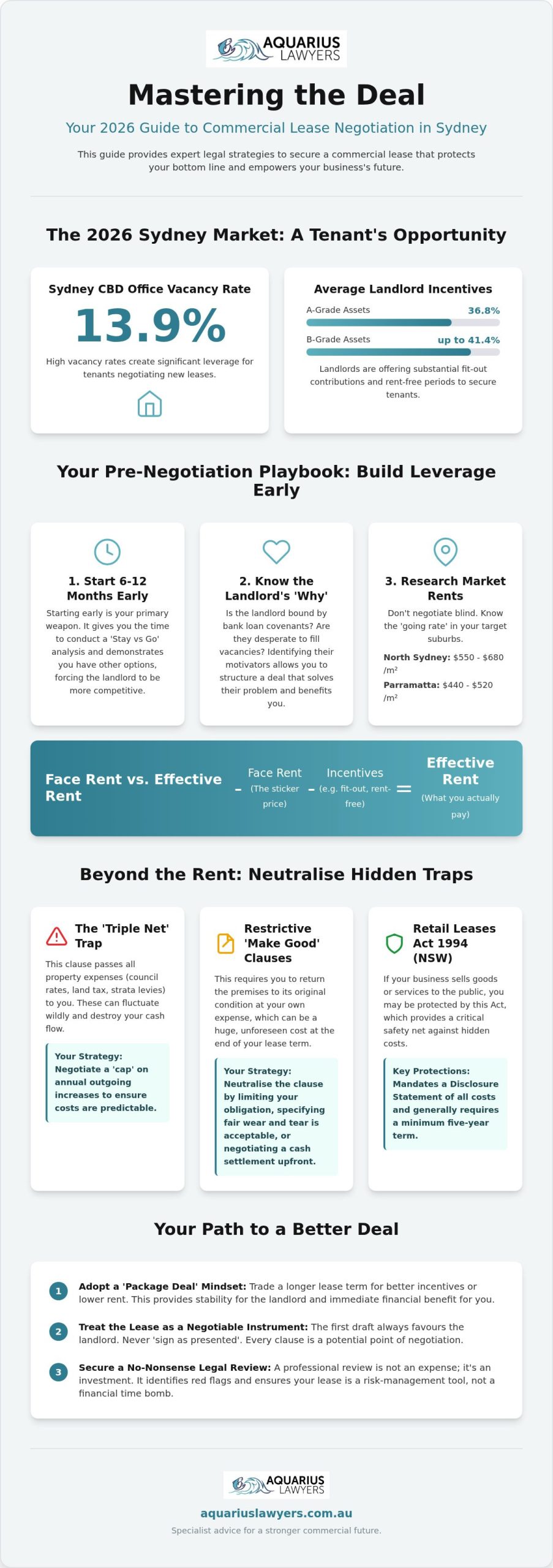
A commercial lease is far more than a simple handshake over a monthly rent figure; it’s a legally binding contract that dictates your business’s financial health for years. When understanding lease agreements, you must view the document as a strategic allocation of risk. In Sydney’s 2026 market, the landscape is heavily split. While industrial spaces remain incredibly tight with a 3.7 per cent vacancy rate, the CBD office market tells a different story. With vacancy rates at 13.9 per cent, tenants currently hold significant leverage. Landlords are offering incentives as high as 41.4 per cent for B-grade properties just to secure stable tenants.
Despite these favourable conditions, many business owners make the mistake of ‘signing as presented’. They treat the lease as a standard form rather than a negotiable instrument. This is where professional commercial lease negotiation tips become vital. Accepting the first draft often means inheriting every hidden cost and restrictive clause the landlord’s lawyers could dream up. You aren’t just renting a space; you’re signing onto a set of obligations that could make or break your business future.
Retail Leases Act 1994 (NSW): Are You Protected?
The Retail Leases Act 1994 (NSW) provides a safety net that standard commercial leases do not. If your business sells goods or services to the public, you likely fall under this Act. It mandates a Disclosure Statement, which is a transparent breakdown of costs, and generally requires a minimum five-year term. These protections are designed to prevent landlords from hiding costs or forcing you out before you’ve recouped your fit-out investment. The 2025/26 amendments have further streamlined this, allowing legally represented parties to waive certain periods to speed up the process, provided the protections remain clear.
The ‘Triple Net’ Trap: Understanding Outgoings
The ‘Triple Net’ trap is where many Sydney businesses stumble. This structure passes all property expenses directly to the tenant, including council rates, strata levies, and land tax. In 2026, with annual inflation at 3.8 per cent, these outgoings can fluctuate wildly and impact your business cash flow. You must negotiate a ‘cap’ on annual outgoing increases. Without a cap, a sudden spike in land tax or a major building repair could consume your entire profit margin. Applying smart commercial lease negotiation tips early in the discussion ensures these costs are predictable and manageable.
Building Your Leverage: Preparation Before the Handshake
Leverage is built in the months before you ever sit down at the negotiating table. In the Sydney property market, the ‘Time is Money’ rule is absolute. If you begin discussions only three months before your current lease expires, you have already lost your primary weapon: the ability to walk away. You should start the process six to twelve months early. This window allows you to conduct a proper ‘Stay vs Go’ analysis, which involves inspecting alternative premises and obtaining formal quotes. When a landlord knows you are actively looking at other options, their willingness to offer competitive commercial lease negotiation tips and better incentives increases significantly.
Understanding what drives your landlord is just as vital as knowing your own budget. Many Sydney landlords are bound by strict loan covenants with their banks, which often require them to maintain specific occupancy levels or ‘face rents’ to keep their financing secure. If a building has several vacancies, the landlord might be desperate to sign a tenant to satisfy a bank requirement, even if it means offering a larger fit-out contribution. By identifying these motivators, you can structure a deal that solves their problem while protecting your bottom line. Having a trusted advisor review these initial landlord motivations can prevent you from overpaying in a tenant-friendly market.
Market Research: Know the ‘Going Rate’ in your Suburb
You cannot negotiate effectively without concrete data. In early 2026, we see a massive variance across the Sydney basin. While North Sydney prime office rents sit between $550 and $680 per square metre, Parramatta offers a more accessible range of $440 to $520. You must also distinguish between ‘Face Rent’ and ‘Effective Rent’. Face rent is the sticker price on the contract, but effective rent is what you actually pay after factoring in incentives. With CBD A-grade incentives currently averaging 36.8 per cent, the gap between these two figures is often substantial.
Documenting Everything: From HoA to Final Lease
Oral promises from leasing agents are effectively worthless in a court of law. If an agent promises a rent-free period or a contribution to your kitchen fit-out, it must be captured in the Heads of Agreement (HoA). While the HoA is generally non-binding, it sets the stage for the final legal document. The Heads of Agreement serves as a strategic roadmap that translates your commercial goals into a clear set of instructions for your solicitor. Ensure every incentive and agreed outgoing cap is written down before the formal lease preparation begins. This disciplined approach to commercial lease negotiation tips ensures that the final contract actually reflects the deal you thought you made.
Beyond the Rent: Negotiating Critical Clauses for Protection
While the monthly rent figure dominates the headlines, the clauses buried in the back of the contract often carry the highest price tags. These hidden obligations can potentially bankrupt a business at the end of its term if not handled correctly. One of the most effective commercial lease negotiation tips is to focus heavily on the ‘Make Good’ clause. Landlords typically demand you return the premises to ‘original condition’, which means stripping out every partition, light fixture, and floor covering. Given that Sydney fit-out costs averaged approximately $2,665 per square metre in 2025, the expense of removing that same fit-out can be staggering. You must negotiate to return the space in its current condition, subject to fair wear and tear only.
Protecting your personal assets is equally vital. Most commercial landlords require personal guarantees from company directors. Without careful wording, you are personally liable for every cent of the lease until the final day. You should aim to limit this exposure by proposing a bank guarantee instead, or by negotiating a ‘sunset clause’ where the personal guarantee expires after two or three years of consistent payment. This ensures that if the business faces a downturn, your family home isn’t the collateral for the landlord’s rent.
Flexibility is your best defence against an uncertain future. You must ensure the lease allows for assignment and sub-letting without the landlord being able to ‘unreasonably’ withhold consent. This is critical if you ever plan to sell your business. A buyer won’t touch a company if they cannot legally take over the premises. Ensuring these transfer rights are clear and cost-effective is a cornerstone of smart commercial lease negotiation tips.
Incentive Clawbacks: The Sting in the Tail
Landlords in 2026 are offering significant incentives, often exceeding 35 per cent for premium office space. However, these usually come with a ‘clawback’ clause. If you exit the lease early, the landlord will demand you pay back the unamortised portion of that incentive. We recommend negotiating a pro-rata reduction. This ensures that if you leave in the final year of a five-year term, you only owe a small fraction of the original incentive rather than the full amount. This protection prevents a necessary business move from becoming a financial disaster.
Options to Renew: Securing Your Business Future
An ‘Option to Renew’ is a powerful right, but it’s easily lost. Missing a notice period by even one day can give the landlord the right to evict you or hike the rent to whatever the market will bear. We often see businesses lose their premises because they forgot to trigger their option six months in advance. Additionally, ensure your rent reviews are tied to a fair mechanism. With inflation sitting at 3.8 per cent as of June 2026, a fixed 4 or 5 per cent increase might actually outpace the market. Insist on a market rent review that allows for an independent valuer to resolve any disputes and keep the landlord honest.
Strategic Negotiation Tactics for Australian Business Owners
Successful negotiation in Sydney requires a shift in mindset. Instead of an adversarial approach, adopt a ‘problem-solver’ persona. Landlords in 2026 value certainty above all else. If you can show them that your business is stable and well-managed, you become a lower risk. This is where the ‘Package Deal’ approach becomes a powerful tool. By offering a longer lease term, say seven years instead of five, you provide the landlord with long-term security. In exchange, you can demand significantly lower rent or higher fit-out contributions. This creates a win-win scenario where the landlord satisfies their bank’s occupancy requirements while you lower your overheads.
One of the most overlooked commercial lease negotiation tips involves the ‘Permitted Use’ clause. Many tenants accept a narrow definition, such as ‘accounting firm’. If you want to pivot into financial planning or legal services later, you might be in breach of your agreement. Request a broad definition like ‘professional office’ to allow for future growth and flexibility. Similarly, you should negotiate for ‘Exclusivity’ within the building or shopping centre. If you are running a boutique gym, you don’t want the landlord leasing the space directly above you to a national fitness franchise. Securing these rights early prevents your landlord from cannibalising your customer base.
The Art of the Counter-Offer
Never accept the first Disclosure Statement without a redline. This document is the starting point, not the final word. We often suggest including ‘Break Clauses’ in your counter-offer to manage long-term risk. A ‘Break Clause’ is a vital insurance policy for startups. It allows you to terminate the lease at a specific point, such as the three-year mark, if the business hasn’t hit its growth targets. This gives you a clear exit strategy without the crippling costs of a full lease tail.
Dealing with Commercial Real Estate Agents
It’s vital to remember that the leasing agent works for the landlord, not you. Their commission is tied to the lease value, so their job is to maximise the rent and minimise the incentives. You must learn to filter ‘agent-speak’ regarding market demand. If they claim there are ‘multiple interested parties’, remain firm on your numbers and don’t be rushed. If your business is mobile or tech-focused, consider leveraging regional NSW incentives. Locations like Shellharbour often offer more competitive terms than the Sydney CBD while still providing excellent connectivity and lifestyle benefits.
Before you sign any counter-offer, ensure your legal strategy is sound. Our team provides a no-nonsense lease review to ensure your business interests are fully protected. Using these commercial lease negotiation tips will help you level the playing field against professional landlords and their agents.
How Aquarius Lawyers Secures Your Commercial Future
Securing a commercial space in Sydney requires more than just a keen eye for property; it demands a legal partner who views your lease through the lens of long-term business survival. Aquarius Lawyers, led by Principal Katherine Hawes, acts as a trusted advisor for business owners across NSW. We don’t just read the fine print. We translate complex legal jargon into practical strategy. As an innovative veteran in commercial law, Katherine Hawes blends traditional credentials with a tech-savvy approach to ensure your lease remains a foundation for growth rather than a liability.
Our no-nonsense lease review process is designed to identify red flags before they become expensive disputes. We bring a unique perspective by combining property law expertise with a deep understanding of commercial litigation. This dual focus is vital because we don’t just look at the contract as it stands today; we look at how those clauses might play out in a courtroom three years from now. By anticipating potential conflicts, we provide commercial lease negotiation tips that are grounded in real-world risk management. This proactive methodology ensures that every protective step we take serves a clear, commercial purpose, reinforcing your position as a tenant who values results over ceremony.
Our Fixed-Fee Lease Review Service
We believe in transparency, which is why we offer fixed-fee options for our lease reviews. You won’t face any ‘billable hour’ surprises or hidden costs when you work with our team. Our comprehensive review covers the critical elements discussed in this guide, including ‘Make Good’ obligations, personal guarantees, and incentive clawbacks. We also ensure your agreement fully complies with the latest updates to the Retail Leases Act 1994 (NSW), including the 2026 amendments regarding landlord offences and termination rights. Navigating these regulations can be complex, but our grounded approach provides the clarity and confidence you need to move forward without fear of the unknown.
Your Next Steps: Don’t Sign Until You’re Sure
The biggest mistake any business owner can make is rushing into a binding agreement without a professional second opinion. A 30-minute preliminary consultation can often reveal risks you hadn’t considered, saving you thousands in the long run. Whether you are based in the heart of the Sydney CBD or require local expertise from our Shellharbour office, we are ready to help you organise a deal that works for you. We move easily between different areas of focus to ensure your lease supports your wider business goals. Take a proactive step toward protecting your business future today.
Book a Commercial Lease Review with Aquarius Lawyers
Secure Your Commercial Footprint in Sydney
Your lease is the foundation upon which your business is built. In the 2026 Sydney market, the difference between a thriving enterprise and a struggling one often comes down to the terms agreed upon months before the doors open. By starting your search early and applying the commercial lease negotiation tips we’ve discussed, you turn a standard rental agreement into a powerful risk-management tool. It’s vital to look beyond the face rent and focus on the hidden traps like ‘make good’ obligations and incentive clawbacks that can impact your future exit strategy.
Katherine Hawes, renowned as ‘The Fish Lawyer’, and the team at Aquarius Lawyers bring deep local knowledge from our Sydney and Shellharbour offices to every contract. We provide a no-nonsense approach through fixed-fee commercial reviews and conveyancing, ensuring you have total cost certainty from the outset. Don’t leave your business future to chance or rely on the verbal promises of a landlord’s agent. It’s time to take control of your negotiations with a trusted advisor by your side.
Secure your business with a professional lease review by Aquarius Lawyers
We look forward to helping you build a resilient and successful commercial future.
Frequently Asked Questions
What is the difference between a commercial lease and a retail lease in NSW?
A retail lease is governed by the Retail Leases Act 1994 (NSW) and applies to businesses selling goods or services to the public. These leases offer stronger statutory protections, such as a mandatory Disclosure Statement and a minimum five-year term. Standard commercial leases are used for offices or industrial spaces and are more flexible, but they lack the specific legal safeguards provided by the Act.
Can I negotiate a commercial lease after I have signed the Heads of Agreement?
Yes, you can usually continue to negotiate. Most Heads of Agreement are non-binding and include a ‘subject to contract’ clause. However, it is much harder to change core commercial terms like rent or incentives once they are recorded. Using your primary commercial lease negotiation tips during the HoA stage ensures a smoother transition to the final legal drafting.
What is a ‘Make Good’ clause and how much will it cost me?
A ‘Make Good’ clause requires you to return the premises to a specific state, often the original shell, at the end of your term. This involves removing partitions, floor coverings, and signage. Costs vary depending on the floor area and complexity of your fit-out, but failing to negotiate ‘fair wear and tear’ provisions can lead to significant unexpected expenses when you vacate.
Do I really need a lawyer to review my commercial lease?
Yes. Commercial landlords use professional legal teams to draft documents that protect their own interests and maximise their returns. A specialized lawyer identifies hidden risks, such as unfair termination rights or personal guarantee exposure, that you might miss. Having a trusted advisor ensures you understand every obligation before you commit your business to a long-term financial burden.
How long does it take to negotiate a commercial lease in Sydney?
The formal legal process in Sydney typically takes eight to twelve weeks from the initial offer to the final exchange of contracts. However, the most successful tenants start their preparation twelve months in advance. This lead time allows you to apply effective commercial lease negotiation tips and maintain the leverage needed to walk away if the terms are not favourable.
What happens if I need to break my commercial lease early?
Breaking a lease early usually triggers a ‘surrender’ or ‘default’ scenario where you remain liable for the rent until a new tenant is found. You will typically be required to pay the landlord’s re-letting costs, including agent fees and legal expenses. Most Sydney leases also contain clawback clauses that require you to repay a pro-rata portion of any rent-free periods or fit-out incentives.
Can the landlord increase my rent every year?
Yes, almost all commercial leases include an annual rent review mechanism. This is usually a fixed percentage increase, often between 3 and 5 per cent, or an adjustment tied to the Consumer Price Index (CPI). When an option to renew is exercised, the rent is typically reset to the current market rate, which is determined by comparing similar properties in the local area.
What are ‘outgoings’ in a commercial lease?
Outgoings are the operational costs of the building that the landlord passes on to the tenant. These include council rates, land tax, building insurance, and strata levies. It is vital to confirm whether your rent is ‘gross’, meaning outgoings are included, or ‘net’, where you pay them as an additional cost. We always recommend negotiating a cap on annual outgoing increases to maintain predictable cash flow.
Disclaimer
Please note that legal rules change and this is not a substitute nor construed as legal advice. It is general information only.