In 2026, aquaculture compliance is no longer a simple “tick-box” exercise; it’s the strategic commercial armour that protects your farm’s market value and operational longevity. Whether you’re navigating the new “Aquaculture Authority” requirements in Queensland or managing the 2026 National Biosecurity Strategy updates, the regulatory burden can feel like a maze of red tape. Staying ahead of these shifts isn’t just about avoiding heavy penalties; it’s about building a resilient business that thrives under scrutiny. This aquaculture compliance checklist australia provides the clarity you need to move from uncertainty to total operational control.
We understand that keeping up with shifting state laws and federal frameworks is a full-time job in itself. You want to focus on production, not paperwork. That’s why we’ve developed this comprehensive, lawyer-vetted roadmap to help you streamline your reporting and secure your commercial investment. We’ll break down the essential “to-do” list for legal safety, covering everything from the latest NSW fee schedules to South Australian biosecurity protocols. Think of it as a simple formula: effective oversight + proactive reporting = audit-ready confidence. By the end of this guide, you’ll have a clear pathway to navigate government audits with absolute certainty and protect your bottom line.
Key Takeaways
- Grasp the “dual-layer” regulatory system to ensure your business plan is built on a solid foundation of Commonwealth and State-level legal requirements.
- Utilise our five-pillar aquaculture compliance checklist australia to systematically audit your licensing, environmental, and labour obligations.
- Navigate state-specific nuances with ease, particularly the stringent NSW Department of Primary Industries (DPI) standards for site allocation and reporting.
- Future-proof your farm by aligning with the 2026 National Biosecurity Strategy and adopting tech-driven monitoring to streamline government audits.
- Protect your commercial investment by merging maritime legal expertise with practical, “down-to-earth” strategies for long-term operational success.
Navigating the Australian Aquaculture Regulatory Landscape
Australia’s regulatory framework isn’t a single straight line; it’s a complex web. You have the Commonwealth looking at the big picture while the States handle the day-to-day operational grit. This “dual-layer” system can feel like double the trouble, but it’s actually the reason our products command a premium globally. When you examine an Australian aquaculture industry overview, it becomes clear that our reputation for high-quality, safe seafood is built directly on this rigorous oversight. Compliance isn’t a hurdle to jump over. It’s the foundation of a sustainable business plan.
The core governing bodies you’ll deal with include the federal Department of Agriculture, Fisheries and Forestry (DAFF), your relevant State Fisheries department, and the Environmental Protection Authority (EPA). For an operator, the “Cost of Non-Compliance” is staggering. It includes heavy fines, potential criminal charges, and the total loss of your social licence to operate. Conversely, the “Value of Certainty” is what attracts serious investors. They want to know your farm is legally sound and future-proofed against shifting rules. A robust aquaculture compliance checklist australia is your primary tool for securing that certainty.
The Interplay of Commonwealth and State Laws
The Environment Protection and Biodiversity Conservation Act 1999 (EPBC Act) is the federal heavy hitter. It triggers whenever a project might impact “Matters of National Environmental Significance,” such as migratory whales or protected wetlands. Most of your daily rules, however, are dictated by State-based Fisheries Acts. These cover everything from stocking densities to gear specifications. Don’t overlook local government either. If you’re running a land-based facility, local councils often control the zoning and waste-water discharge permits that can make or break your site’s viability.
Defining “Compliance” in 2026
By 2026, the definition of compliance has shifted significantly. It has moved beyond basic licensing into the realm of integrated Environmental, Social, and Governance (ESG) standards. Buyers and banks now expect you to prove your sustainability through data, not just promises. Our “Fish Lawyer” methodology focuses on proactive risk management rather than reactive damage control. We help you build systems that anticipate regulatory changes before they happen. Aquaculture compliance is a multifaceted legal shield for primary producers, safeguarding your commercial investment against both environmental volatility and government scrutiny.
The 5-Pillar Aquaculture Compliance Checklist
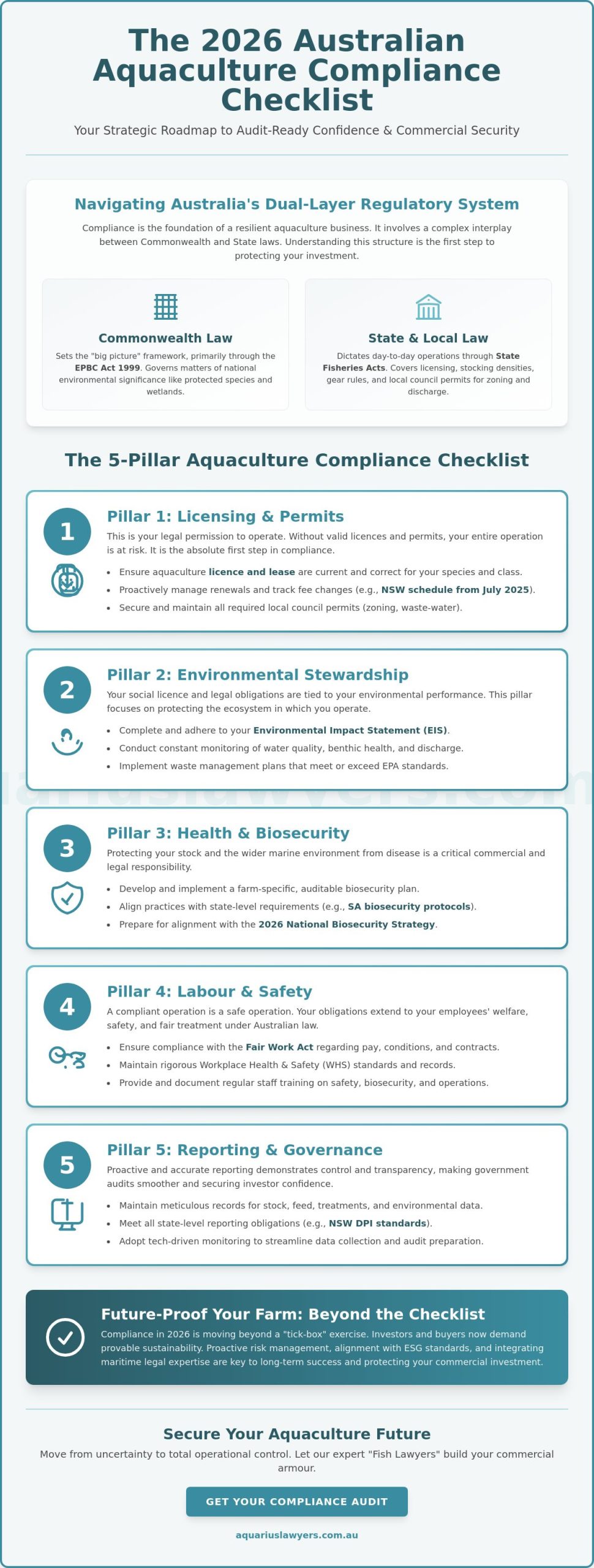
Successful aquaculture depends on more than just healthy stock and clean water; it requires a robust legal structure that supports every operational decision. We view this through a five-pillar framework: Licensing, Environment, Health, Labour, and Reporting. Think of these pillars as the hull of your vessel. If one section fails, the entire operation is at risk of taking on water. This aquaculture compliance checklist australia is designed to be a living document for farm managers, evolving alongside your business and the shifting regulatory tides of 2026.
In this industry, “near enough” is never good enough. A single oversight in a biosecurity protocol or a lapsed permit can lead to immediate stop-work orders or significant financial penalties. By treating compliance as a core business function rather than a yearly chore, you create a culture of excellence that protects your investment. High standards + consistent verification = commercial resilience. If you are operating in local waters, securing and maintaining a valid aquaculture licence NSW is your first and most critical hurdle.
Pillar 1 & 2: Licensing and Environmental Stewardship
Licensing is your permission to exist. Without a valid lease and the correct class of permit, your equipment is just expensive scrap metal sitting in public water. You must proactively manage your renewals and stay ahead of fee updates, such as the NSW schedule effective from July 2025. Beyond the paperwork, your environmental obligations are ongoing. This includes the initial Environmental Impact Statement (EIS) and the constant monitoring of water quality and benthic health. Within the broader Australian aquaculture regulatory framework, waste management and discharge permits are non-negotiable. You need clear systems to handle everything from bio-fouling removal to nutrient levels in your runoff.
Pillar 3, 4 & 5: Health, Labour, and Reporting
The final three pillars focus on the “soft” assets of your farm: your stock, your people, and your data. Biosecurity is perhaps the most significant risk in 2026. You must have a site-specific biosecurity plan that aligns with the National Aquatic Biosecurity Plan updates released in April 2026. On the labour front, Workplace Health and Safety (WHS) in marine environments requires specialised protocols that standard land-based rules don’t cover. Finally, mandatory reporting is your proof of compliance. Maintaining accurate harvest logbooks and real-time data reporting isn’t just about satisfying a department; it’s about building a defensible record of your farm’s integrity. If you’re feeling overwhelmed by these requirements, a quick consultation regarding Aquaculture Law can help you identify any gaps in your current strategy.
State-Specific Nuances: Focus on New South Wales
While federal guidelines provide a broad framework, the real operational heavy lifting happens at the state level. New South Wales is widely regarded as having some of the most stringent aquaculture regulations in the world. This isn’t by accident. With a high population density and iconic coastlines, the NSW government balances industry growth with intense environmental protection. The NSW Department of Primary Industries (DPI) acts as the central coordinator for site allocation; they ensure your farm doesn’t clash with existing marine parks, shipping lanes, or recreational zones. When building your aquaculture compliance checklist australia, the NSW-specific section will likely be your most detailed, requiring a deep dive into the state’s unique Sustainable Aquaculture Strategy.
The state’s goal is ambitious: doubling farmgate production to AUD 300 million by 2030. However, reaching that target requires navigating a complex approval process that can catch the unprepared off guard. Common pitfalls in aquaculture development approval within the Sydney region often involve underestimating the time required for environmental assessments in sensitive catchments. Rules change. Markets shift. Your legal foundation shouldn’t. We focus on providing a clear pathway through these state-based hurdles so you can focus on the water.
NSW Licensing vs. National Standards
NSW differentiates itself through a highly categorised permit system. Whether you are farming Sydney Rock Oysters or venturing into offshore finfish, your obligations vary wildly. The Fisheries Management (Aquaculture) Regulation 2024 is the primary engine behind the NSW aquaculture regulations, dictating everything from lease renewals to biosecurity obligations. NSW utilises permit classes ranging from Class A to H, each with specific criteria for land-based versus marine-based operations. The NSW Land-Based Aquaculture Policy is particularly critical for those using Recirculating Aquaculture Systems (RAS), as it streamlines the planning process by providing pre-approved “best practice” standards for indoor facilities.
Local Council and Planning Approvals
Land-based facilities often face an extra layer of scrutiny: the local council. In the Sydney basin, dealing with councils requires a blend of technical accuracy and community diplomacy. Community objections are a reality in high-density areas; neighbours often worry about noise, odour, or visual impacts. Managing these objections during the approval phase is just as important as the engineering itself. Seeking aquaculture investment legal help during the early planning stages allows you to address these concerns proactively. A well-structured proposal that anticipates council questions is the difference between a project that gets off the ground and one that stays bogged down in committee meetings for years.
Future-Proofing: Audits and Biosecurity in 2026
As we move through 2026, the gap between traditional farming and tech-integrated compliance is widening. It’s no longer enough to rely on a dusty folder in the farm office. Modern regulators are looking for real-time data and proactive risk management. The adoption of IoT sensors and AI-driven health monitoring has transformed the aquaculture compliance checklist australia into a digital asset. These tools don’t just satisfy the department; they provide a level of operational oversight that was impossible a decade ago. High-tech monitoring + legal oversight = audit immunity. This is the new standard for an industry that values both efficiency and transparency.
Many operators hesitate at the cost of these upgrades, viewing compliance as a drain on resources. However, the return on investment is tangible. Beyond avoiding fines, a proven track record of compliance significantly reduces your insurance premiums. Insurers are increasingly looking for “gold standard” operators who can demonstrate a lower risk profile through rigorous auditing. By investing in your legal safety now, you’re protecting your margins for the long term. If you’re ready to secure your operation against future regulatory shifts, it’s time to speak with a specialist in Aquaculture Law to review your current standing.
Biosecurity as a Legal Requirement
Biosecurity is no longer just a best-practice suggestion; it’s a hard legal mandate. The National Biosecurity Strategy Monitoring, Evaluation, Reporting and Improvement Framework (NBS MERI Framework), released on April 30, 2026, has tightened the screws on reporting obligations. You now face mandatory notification periods for “notifiable diseases” that are strictly enforced. The legal implications of a “failure to report” can be catastrophic, potentially leading to the permanent cancellation of your leases. Drafting a biosecurity plan that satisfies both state fisheries and federal biosecurity regulators requires a precise understanding of these 2026 updates. It must be a practical, working document that your staff actually follow every single day.
Modern Auditing Techniques
The days of scrambling when a regulator pulls up at the gate should be over. We advocate for a “mock-audit” strategy where you stress-test your own systems before the government does. Transitioning from paper logbooks to digital compliance dashboards allows you to spot gaps in real-time. Crucially, when these audits are conducted or overseen by legal professionals, they often fall under “Professional Privilege” protection. This means you can identify and rectify internal issues without those findings being automatically discoverable by regulators. Creating a culture of compliance among your farm staff is the final piece of the puzzle. When every deckhand understands that biosecurity is their responsibility, your personal liability as a director is significantly reduced.
How Aquarius Lawyers Secures Your Aquaculture Future
Navigating the complex waters of Australian maritime law requires more than just a general legal background; it demands a deep, practical understanding of the industry. Katherine Hawes, widely known as “The Fish Lawyer,” brings this exact niche expertise to every client engagement. At Aquarius Lawyers, we don’t just cite statutes. We merge decades of maritime law experience with a “down-to-earth” commercial pragmatism. This ensures that your aquaculture compliance checklist australia isn’t just a piece of paper, but a robust strategy that protects your livelihood. We act as your trusted advisor, moving effortlessly between high-level strategy and the everyday realities of farm management.
High-value investments in the blue economy are too significant to leave to chance. Whether you’re a startup looking to secure your first lease or an established operator facing a complex regulatory hurdle, having a specialist fisheries lawyer Australia on your side is essential. We understand that in aquaculture, time is money and delay is risk. Our approach is simple: specialised knowledge + proactive management = commercial security. We provide the clarity you need to operate with confidence, ensuring your business remains resilient against both environmental challenges and shifting government policies.
Our Specialist Aquaculture Services
We’ve designed our service suite to address the specific pain points identified in this guide. From the initial application phase to long-term operational auditing, we provide a clear pathway to success. Our services include:
- Fixed-fee compliance reviews: We offer transparent pricing for comprehensive audits, helping both startups and established farms identify and bridge regulatory gaps before they become liabilities.
- Regulatory representation: If you’re facing a dispute with a state department or a fisheries prosecution, we provide rigorous litigation defence and mediation services to protect your interests.
- Strategic business planning: We offer legal advice on investment structures and business plans that align with the Sustainable Aquaculture Strategies of various Australian states.
The “Innovative Veteran” Advantage
What sets us apart is our “innovative veteran” persona. We respect the traditional credentials of the industry while actively embracing the tools of the future. We use the latest technology to streamline your legal compliance, making it easier for you to manage biosecurity plans and mandatory reporting. Beyond basic licensing, we specialise in protecting your commercial assets, including fishing quotas and intellectual property. This forward-thinking methodology ensures that your operation isn’t just compliant for today, but is ready for whatever the 2030s may bring. Don’t leave your farm’s future to the mercy of the next audit. Organise a consultation with Aquarius Lawyers today and let us help you build a legal shield for your commercial investment.
Securing Your Operational Future in the Blue Economy
The regulatory landscape in 2026 demands more than just basic awareness; it requires a proactive, tech-savvy approach to risk management. By integrating the five pillars of this aquaculture compliance checklist australia into your daily operations, you transform legal red tape into a strategic commercial advantage. Whether you’re mastering the nuances of NSW Fisheries Law or aligning with the latest National Biosecurity Strategy, the goal is clear: absolute operational certainty. Compliance is the foundation upon which sustainable growth is built.
Katherine Hawes, known across the industry as “The Fish Lawyer,” provides the specialised expertise needed to navigate these complex waters. Aquarius Lawyers combines deep traditional credentials with technology-integrated legal solutions to protect your high-value investments. We don’t just help you survive an audit; we help you build a resilient, future-proofed business that thrives under scrutiny. Contact Aquarius Lawyers to secure your aquaculture compliance roadmap. With the right legal shield in place, you can focus on what you do best: growing a sustainable future for Australian seafood.
Frequently Asked Questions
Do I need a separate licence for land-based vs. marine-based aquaculture?
Yes, you definitely need the correct permit class for your specific environment. In states like New South Wales, aquaculture is categorised into different classes; for example, land-based facilities often fall under Class D or E, while marine leases have their own distinct requirements. Each environment triggers different regulatory bodies, with land-based farms focusing more on local council zoning and marine farms dealing with state fisheries and maritime safety authorities.
What happens if I accidentally breach an environmental condition on my licence?
Immediate notification and remediation are your best defences. While many environmental breaches carry strict liability, meaning the department doesn’t need to prove intent, being proactive can significantly mitigate your penalties. You should document the incident, report it to the EPA or relevant fisheries department straight away, and seek legal advice to manage the regulatory response. Prompt action + transparent reporting = reduced legal exposure.
How often should I conduct a legal compliance audit on my farm?
We recommend a comprehensive legal audit at least once a year or whenever significant regulatory shifts occur. With the introduction of the new “Aquaculture Authority” in Queensland and the 2026 biosecurity updates, staying current is vital. An annual review ensures your aquaculture compliance checklist australia is up to date, allowing you to catch minor administrative gaps before they turn into major departmental headaches during a surprise government inspection.
Does a Commonwealth permit override a State aquaculture licence?
No, they operate as a dual-layer system where you must satisfy both. If your project impacts “Matters of National Environmental Significance,” you’ll need approval under the Commonwealth EPBC Act in addition to your state-issued fisheries licence. Think of it as a logical equation: State Compliance + Federal Approval = Operational Certainty. Neither replaces the other; they function together to ensure total environmental oversight.
Are there specific WHS requirements for workers on aquaculture sea cages?
Yes, marine environments require specialised safety protocols that go far beyond standard land-based WHS rules. Working on sea cages involves unique risks such as drowning, vessel-to-cage transfers, and heavy lifting in unpredictable sea states. You’re legally required to have a safety management system that addresses these specific maritime risks, ensuring all staff are trained in water safety and emergency response procedures tailored to an offshore setting.
How can a fisheries lawyer help with a rejected development application?
A specialist lawyer identifies the specific legal grounds for appeal or renegotiation. We often find that applications are rejected due to technical misunderstandings or unaddressed community concerns that can be resolved through strategic amendments. By acting as a facilitator between you and the department, we help turn a “no” into a compliant “yes” by aligning your business plan with the relevant state’s Sustainable Aquaculture Strategy.
What are the reporting requirements for aquatic animal mortalities in 2026?
You must report mortalities to your state authority within 24 hours if they exceed your licence’s specific threshold or if you suspect a “notifiable disease.” Under the NBS MERI Framework released in April 2026, these notification windows are strictly enforced. Failure to report unusual mortality events can lead to immediate licence suspension, as these events are often the first sign of a broader biosecurity threat to the industry.
Can I transfer my aquaculture licence to a new owner if I sell the business?
Yes, licences can be transferred, but the process is not automatic and requires departmental approval. The incoming owner must usually pass a “fit and proper person” test, and all existing environmental bonds or outstanding fees must be settled. It’s a formal legal process that involves a deed of assignment; ensuring this is handled correctly during the sale is essential to protect both the buyer and the seller from future liability.
Disclaimer
Please note that legal rules change and this is not a substitute nor construed as legal advice. It is general information only.