
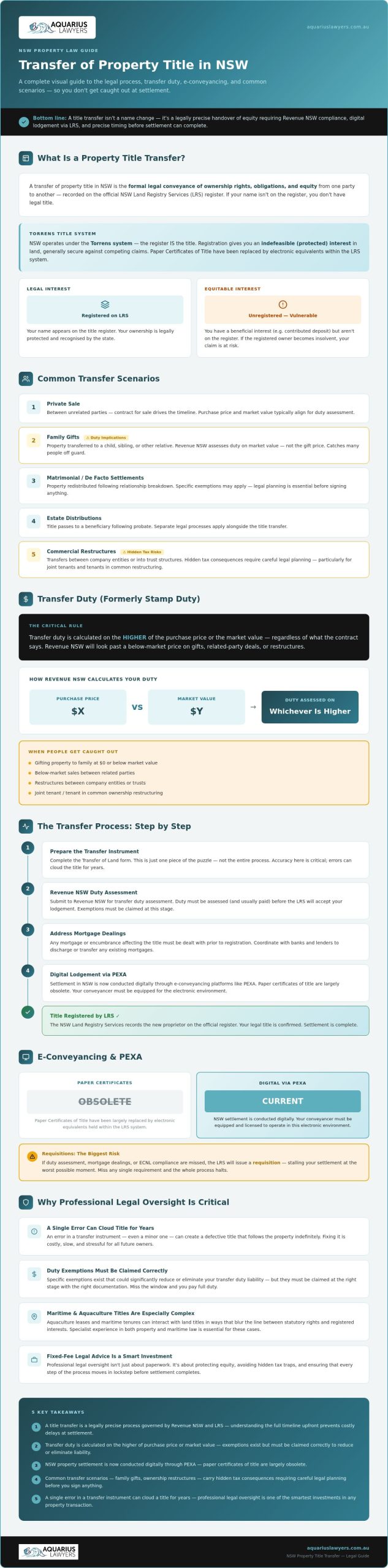
Changing the name on a property title sounds straightforward enough. But a transfer of property title in NSW is far less like a name change and far more like a legal handover of equity, one that requires Revenue NSW compliance, digital lodgement through the Land Registry Services, and precise timing, all moving in lockstep before settlement can complete.
If you’re already feeling the pressure of potential stamp duty bills, confused by PEXA’s digital workspace, or quietly worried that a paperwork error could derail your settlement at the worst possible moment, you’re not alone. These are the exact sticking points that catch buyers, sellers, and even well-intentioned DIY conveyancers off guard.
This guide cuts through the complexity. You’ll come away with a clear picture of the full transfer timeline, a solid understanding of which duty exemptions you may be eligible to claim, and the practical knowledge to get your title registered without requisitions slowing things down. Whether you’re dealing with a standard residential sale, a primary production holding in regional NSW, or something with a maritime twist, the pathway forward starts here.
Key Takeaways
- A transfer of property title NSW is a legally precise process governed by Revenue NSW and the Land Registry Services — understanding the full timeline upfront prevents costly delays at settlement.
- Transfer duty (formerly stamp duty) is calculated on the higher of the purchase price or market value, but specific exemptions exist that could significantly reduce or eliminate your liability depending on your circumstances.
- Property settlement in NSW is now conducted digitally through platforms like PEXA, meaning paper certificates of title are largely obsolete and your conveyancer must be equipped to operate in this electronic environment.
- Common transfer scenarios — including gifting property to family members or restructuring ownership between joint tenants and tenants in common — carry hidden tax consequences that require careful legal planning before you sign anything.
- Getting professional legal oversight isn’t just about paperwork; a single error in a transfer instrument can cloud a title for years, making fixed-fee legal advice one of the smartest investments in any property transaction.
Understanding Property Title Transfers in New South Wales
At its core, a transfer of property title NSW is the legal mechanism by which ownership interest in land moves from one party to another. It’s not a clerical update or a simple name swap. It’s a formal conveyance of rights, obligations, and equity, recognised and recorded by the state. The NSW Land Registry Services (LRS) sits at the centre of this process, maintaining the official register of all land holdings across the state. Every registered transfer ultimately flows through the LRS, making accurate lodgement non-negotiable.
The triggers for a transfer are more varied than most people expect. Common scenarios include:
- Private sales between unrelated parties, where a contract for sale drives the timeline
- Family gifts, where property is transferred to a child, sibling, or other relative, often with duty implications that catch people off guard
- Matrimonial or de facto settlements, where property is redistributed following the breakdown of a relationship
- Estate distributions, where title passes to a beneficiary following probate
- Commercial restructures, including transfers between company entities or into a trust structure
Here’s where many people trip up: the Transfer of Land form is just one piece of the puzzle. Before registration can occur, you’ll also need to address duty assessment by Revenue NSW, any mortgage dealings affecting the title, and compliance with the Electronic Conveyancing National Law if lodging through PEXA. Miss any one of these, and the LRS will issue a requisition, stalling your settlement.
Torrens Title and the Indefeasibility of Interest
NSW operates under the Torrens system of land title, introduced in the 19th century and still the bedrock of modern property law. Under Torrens, the register is the title. Having your name recorded on the LRS register as the registered proprietor gives you a protected, indefeasible interest in that land, meaning your ownership is generally secure against competing claims, with limited exceptions. The old paper Certificate of Title has been largely replaced by an electronic equivalent held within the LRS system, but its legal significance hasn’t diminished one bit. If your name isn’t on the register, you don’t have legal title, full stop.
The Distinction Between Legal and Equitable Interest
This is where things get genuinely complex. It’s entirely possible to be the registered owner of a property while someone else holds a beneficial, or equitable, interest in it. Think of a parent who contributes the deposit but whose name doesn’t appear on title; their interest exists in equity but not at law. The risk? If the registered owner becomes insolvent or disputes the arrangement, the unregistered party’s claim becomes vulnerable. Prompt registration of any transfer is the clearest way to protect legal rights.
This distinction also surfaces in less obvious contexts. Aquaculture leases and certain maritime tenures in NSW can interact with land titles in ways that blur the line between statutory rights and registered interests. A lease over aquaculture water lots, for instance, may not appear on a standard title search but can significantly affect the value and use of adjoining land. It’s precisely this kind of complexity that makes specialist legal advice, particularly from practitioners with genuine experience in both property and maritime law, worth every cent.
Navigating the Revenue NSW Maze: Transfer Duty and Exemptions
Transfer duty is a state tax levied on the acquisition of property in NSW, and it applies to the vast majority of transfers regardless of whether money changes hands. The rate is calculated on the higher of the purchase price or the market value of the property, and that second criterion is where people consistently come unstuck.
When a transfer of property title NSW occurs at arm’s length between unrelated parties, the purchase price and market value usually align. But the moment you’re dealing with a gift, a below-market sale, or a restructure between related entities, Revenue NSW will look past the contract price entirely. They’ll assess duty on what the property is actually worth, not what you agreed to pay for it.
The Ad Valorem Trap in Non-Market Transfers
Ad valorem simply means “according to value.” If you’re transferring property to a family member for nominal consideration, or restructuring ownership between related companies, you cannot simply declare a low purchase price and expect a low duty bill. Revenue NSW requires a formal valuation, and if they disagree with the figure you submit, they’ll substitute their own. Getting an independent market valuation before lodgement isn’t optional in these situations; it’s essential protection against an amended assessment with interest penalties attached.
On the deadline front, transfer duty must generally be paid within three months of the liability date (typically the date of the contract or transfer instrument). Miss that window and Revenue NSW will apply interest charges that compound quickly. Prompt assessment and payment isn’t just good practice; it’s how you avoid an avoidable cost.
Matrimonial and De Facto Relationship Exemptions
Spouses and de facto partners can transfer property between themselves without paying transfer duty in certain circumstances, but the exemption isn’t automatic. For transfers made pursuant to a financial agreement or court order under the Family Law Act 1975 (Cth), the exemption pathway is well-established. For voluntary “love and affection” transfers between partners outside of a formal separation, the requirements are more specific and the documentation more demanding. You’ll need to demonstrate the genuine nature of the relationship and the basis for the transfer, and Revenue NSW will scrutinise the application carefully.
Deceased Estates and Concessional Duty
Transfers from a deceased estate to a beneficiary who is entitled under a will or on intestacy attract concessional duty rather than full ad valorem rates. The nominal duty rate for these transfers has historically been a fraction of standard duty, though you should confirm the current applicable rate with a solicitor given that thresholds are subject to legislative change. The key distinction here is between a transfer to a beneficiary as part of a proper estate administration versus an inter vivos (lifetime) gift dressed up as an estate matter. Revenue NSW draws that line firmly, and attempting to use estate mechanisms to avoid duty on a lifetime gift can trigger penalties, not just a reassessment.
The strategic reality is that exemptions exist, but claiming them correctly requires precise documentation, accurate valuations, and an understanding of how Revenue NSW interprets each category. A property law solicitor familiar with both the legislative framework and Revenue NSW’s current assessment practices can identify which pathway applies to your situation before you lodge anything. If you’re unsure where your transfer sits, speaking with an experienced property lawyer before signing any documents is the most cost-effective step you can take.
The Modern Pathway: How E-Conveyancing and PEXA Work
Paper certificates of title are, for all practical purposes, a relic. Since NSW mandated electronic conveyancing for the vast majority of property transactions, the physical document that once represented your ownership interest has been replaced by an electronic record held within the Land Registry Services system. If you’re approaching a transfer of property title NSW in 2026 expecting a paper-based process, you’ll need to reset your expectations quickly.
PEXA, the Property Exchange Australia platform, is the digital workspace where NSW property settlements now happen. Think of it as a secure, real-time environment where your solicitor, the other party’s solicitor, and the relevant financial institutions all connect to prepare, verify, and execute the transfer simultaneously. Documents are lodged electronically, funds move through a verified digital channel, and registration with the LRS happens in near real-time once settlement completes. The old model of physically exchanging bank cheques and paper documents at a settlement table has been replaced by a far more efficient, and considerably more secure, digital exchange.
One of the most tangible benefits for clients is the reduction in requisitions. A requisition is essentially a correction notice issued by the LRS when a lodged document contains an error or omission. In the paper era, these were frustratingly common and could stall settlement by days or even weeks. PEXA’s built-in validation tools flag many common errors before lodgement, meaning a well-prepared digital workspace reaches the LRS in a condition far less likely to attract a requisition. That said, the platform doesn’t replace legal expertise; it amplifies it. A solicitor who understands both the technical requirements of the LRS and the mechanics of PEXA is the difference between a smooth settlement and a last-minute scramble.
Verification of Identity (VOI) Requirements
Digital conveyancing comes with strict anti-fraud safeguards. Before any transfer instrument can be lodged through PEXA, every party to the transaction must complete a Verification of Identity process. This isn’t a formality. VOI requirements under the Electronic Conveyancing National Law mean your solicitor must verify your identity against approved documentary evidence and certify that verification before proceeding. For clients based interstate or overseas, this adds a logistical layer that needs to be planned for well in advance of settlement. Aquarius Lawyers has established processes to facilitate VOI for both local and international clients, ensuring this step doesn’t become a bottleneck when the settlement clock is running.
The Settlement Timeline in a Digital World
From contract exchange to registration, a standard residential transfer in NSW typically follows this sequence:
- Contract exchange: The formal start of the conveyancing process; your solicitor begins preparing the PEXA workspace
- Duty assessment: Transfer duty is assessed and paid through Revenue NSW before settlement can proceed
- Pre-settlement checks: Title searches, mortgage discharges, and adjustments are finalised within the workspace
- Settlement day: All parties sign digitally within PEXA, funds transfer electronically, and the transfer instrument is lodged with the LRS
- Registration: The LRS processes the lodgement and updates the register, often within hours of settlement completing
That last step is where the digital system genuinely shines. Registration that once took days now happens the same day in most cases. You can track the progress of your title change through the LRS portal, and your solicitor will confirm registration as soon as it’s confirmed. For a transfer of property title NSW, that registered confirmation is the moment your legal interest is fully protected. Don’t consider the job done until you have it.
Common Transfer Scenarios: From Family Gifts to Primary Production
Not all transfers of property title in NSW follow the same path. The legal and tax mechanics shift considerably depending on who’s involved, what the land is used for, and what’s sitting on the title already. Getting the scenario wrong at the planning stage doesn’t just cost money; it can create title complications that take years to unwind.
Gifting property to a child is probably the most common scenario where people walk in expecting simplicity and walk out needing a stiff drink. The transfer duty question we covered earlier is only half the story. Capital Gains Tax is the other half, and it catches parents off guard regularly. When you gift a property, the ATO treats it as a disposal at market value on the date of transfer. If the property has appreciated since you acquired it, you’ve crystallised a CGT event, even though no money changed hands. The main residence exemption may apply if it’s been your home throughout your ownership, but the moment there’s any period of rental or commercial use in that history, the calculation becomes considerably more involved.
Changing a title from joint tenants to tenants in common is another scenario that looks administrative but carries genuine estate planning weight. Joint tenancy includes a right of survivorship; if one owner dies, their share passes automatically to the surviving owner, bypassing the will entirely. Converting to tenants in common severs that automatic right, allowing each owner to direct their share through their estate. For blended families, business partners, or anyone with a more complex inheritance intention, this distinction is critical. It’s also a dutiable transaction in certain circumstances, so it needs proper assessment before you lodge anything.
Transferring property that carries an existing mortgage adds another layer. The mortgagee’s consent is required before any transfer can be registered, and in practice this means coordinating with the lender well ahead of settlement. In a PEXA workspace, the mortgage discharge and the new transfer instrument must be sequenced correctly or the LRS will reject the lodgement.
Primary Production Land Exemptions in NSW
This is where most guides fall silent, and it’s where the stakes are highest. Under the Duties Act 1997 (NSW), transfers of primary production land between certain family members can attract a full exemption from transfer duty. The criteria are specific: the land must be used for primary production at the time of transfer, the transferee must be a “family member” as defined by the Act (which includes spouses, children, grandchildren, siblings, and their spouses), and the transfer must not form part of a scheme to avoid duty. The land use test is applied strictly; Revenue NSW will look at actual use, not intended use, at the date of transfer.
For a transfer of property title NSW involving a working farm, aquaculture operation, or rural holding, this exemption can represent a substantial saving. But claiming it incorrectly, or failing to document the land use adequately, invites an amended assessment with interest. Aquarius Lawyers has direct experience in regional NSW property matters and understands the evidentiary requirements Revenue NSW expects when these exemptions are claimed.
Intergenerational Transfers and Strategic Planning
Using a property transfer to manage future inheritance isn’t inherently problematic, but it requires the kind of integrated thinking that combines property law, wills and estates, and an understanding of how Revenue NSW and the ATO interact. A parent who transfers the family farm to an adult child today may be solving one problem while inadvertently creating another: a CGT liability, a duty assessment, or a future family provision claim from another beneficiary who was left out. The solution isn’t to avoid the transfer; it’s to structure it correctly from the outset, with a clear legal framework that anticipates those downstream consequences.
Aquaculture and maritime-adjacent land adds a further dimension. Properties that adjoin or incorporate water lots, aquaculture leases, or other coastal tenures can carry statutory interests that don’t appear on a standard title search but directly affect value and transferability. Specialist advice isn’t a luxury in these situations; it’s the only way to ensure the transfer reflects the full picture of what’s actually being conveyed.
If your transfer involves primary production land, a family restructure, or any property with a maritime or coastal dimension, speak with Aquarius Lawyers before you sign anything to ensure the right exemptions are claimed and the right risks are managed from day one.
Securing Your Interest: Why Professional Legal Oversight is Critical
There’s a persistent myth that a transfer of property title NSW is something you can manage with a downloaded form and a bit of patience. The reality is considerably less forgiving. An incorrectly prepared transfer instrument doesn’t just get sent back for correction; it can cloud a title for years, create competing claims on equity, and in serious cases, expose you to liability you never anticipated. The LRS won’t fix your paperwork. That’s your problem, and the longer it sits unresolved, the more expensive it becomes.
Professional legal oversight isn’t about hand-holding through an administrative process. It’s about having someone in your corner who understands exactly what the LRS requires, what Revenue NSW will scrutinise, and what downstream consequences a poorly structured transfer can trigger. Those three things rarely align without specialist guidance.
Avoiding the “Requisition” Trap
A requisition from the LRS is essentially a formal rejection of your lodged documents. Common triggers include inconsistent party names, incorrect property descriptions, missing duty endorsements, or a failure to discharge an existing mortgage in the correct sequence. Each requisition halts the registration process and restarts the clock. In a time-sensitive settlement, that delay can have cascading consequences: finance approvals lapse, occupancy arrangements fall through, and penalties accumulate.
Aquarius Lawyers uses professional-grade conveyancing software integrated with PEXA’s validation tools to identify these errors before anything reaches the LRS. The combination of technical platform checks and experienced legal review means the workspace arriving at the LRS is correct the first time. That’s not a minor efficiency gain; it’s the difference between settlement completing on the day it’s supposed to and a frantic scramble to salvage a transaction under pressure.
The hidden costs of fixing an incorrect registration extend beyond the obvious. You may need a fresh duty assessment, updated title searches, additional legal fees, and in some cases a court application to rectify a title defect. None of that is cheap, and none of it was necessary with proper preparation upfront.
Strategic Advice for Complex Titles
Not every title arrives clean. Caveats lodged by a previous purchaser, easements that weren’t properly disclosed, or an unresolved mortgage from a deceased estate can all block a transfer from completing. Identifying and resolving these encumbrances before settlement requires more than a standard title search; it requires a solicitor who knows how to read what they find and act on it decisively.
Property transfers also don’t exist in isolation from your broader legal position. Transferring a property without updating your Will to reflect the changed asset structure is a surprisingly common oversight, and it can create exactly the kind of family provision dispute you were trying to avoid. Aquarius Lawyers’ practice spans both property law and wills and estates, which means your transfer can be integrated into a coherent legal strategy rather than treated as a standalone transaction.
Fixed-fee arrangements remove the uncertainty that often makes people hesitant to seek legal advice early enough. Knowing your costs upfront means you can make informed decisions at every stage, not just when a problem has already developed.
Whether you’re dealing with a straightforward residential transfer or a complex title with caveats, encumbrances, or primary production considerations, the right time to get expert advice is before you sign anything. Organise a fixed-fee consultation with Aquarius Lawyers today and get the clarity you need to move forward with confidence.
Your Next Step Towards a Clean, Confident Property Transfer
A transfer of property title NSW is never just paperwork. It’s a legal handover with real financial consequences, tight deadlines, and zero tolerance for errors at the LRS. Get the duty assessment right, navigate PEXA correctly, and protect your registered interest from day one; those three things together are what a smooth settlement actually looks like in practice.
Aquarius Lawyers brings fixed-fee transparency to every property transaction, so you know your costs upfront and can plan accordingly. Principal Katherine Hawes brings deep expertise in NSW property and commercial law, including the primary production and maritime-adjacent matters that most generalist firms simply aren’t equipped to handle. With offices in both Sydney and Shellharbour, the firm is genuinely accessible to clients across metropolitan and regional NSW.
Don’t wait until a requisition stalls your settlement or a duty assessment catches you off guard. Secure your property transfer with Aquarius Lawyers’ fixed-fee conveyancing services and move forward with the confidence that every detail has been handled correctly.
Frequently Asked Questions About Property Title Transfers in NSW
How much does it cost to transfer a property title in NSW?
The total cost of a transfer of property title in NSW has several components: transfer duty (calculated on the higher of the purchase price or market value), Land Registry Services lodgement fees, and your solicitor or conveyancer’s professional fees. Transfer duty is typically the largest component and scales with property value, so the overall cost varies considerably depending on your specific transaction. LRS lodgement fees are set by the NSW government and subject to periodic revision, so confirm the current figures before settlement.
Fixed-fee legal arrangements, like those offered by Aquarius Lawyers, remove the uncertainty from the professional fees component. Knowing your legal costs upfront means you can budget accurately for the entire transaction rather than discovering additional charges after the fact.
Can I transfer property to my spouse for free in NSW?
In certain circumstances, yes. Transfers between spouses or de facto partners made pursuant to a court order or financial agreement under the Family Law Act 1975 (Cth) can attract a transfer duty exemption. Voluntary transfers between partners outside of a formal separation arrangement are assessed differently and require specific documentation to support an exemption claim. The exemption isn’t automatic; you need to satisfy Revenue NSW’s requirements precisely.
Don’t assume “love and affection” transfers between partners are duty-free without getting proper advice first. Revenue NSW scrutinises these applications carefully, and a failed exemption claim means a duty assessment you weren’t budgeting for, potentially with interest attached.
Do I need a lawyer to transfer a property title?
You’re not legally required to engage a solicitor, but the practical reality is that the consequences of getting it wrong are severe. An incorrectly prepared transfer instrument can cloud a title for years, attract LRS requisitions that stall settlement, and trigger amended duty assessments with interest penalties. The electronic conveyancing environment through PEXA also requires a qualified practitioner to operate the workspace on your behalf in most standard transactions.
For anything beyond the most straightforward residential sale, professional legal oversight isn’t a luxury; it’s genuine risk protection. Complex scenarios involving primary production land, family restructures, or titles carrying caveats or encumbrances demand specialist knowledge that a downloaded form simply can’t replace.
How long does a title transfer take through PEXA?
From contract exchange to registration, a standard residential transfer in NSW typically takes four to six weeks, though this varies depending on the length of the settlement period agreed between the parties. The PEXA platform itself is highly efficient once the workspace is properly prepared; lodgement with the Land Registry Services happens at settlement, and registration is often confirmed within hours of the transaction completing.
Delays most commonly arise before settlement, not during it. Unresolved encumbrances, outstanding duty assessments, or mortgage discharge complications can all push the timeline out. Getting your solicitor across the full picture of your title early in the process is the most reliable way to keep the settlement date intact.
What is the difference between Joint Tenants and Tenants in Common?
Joint tenancy includes a right of survivorship: if one owner dies, their share passes automatically to the surviving owner, regardless of what the deceased’s will says. Tenants in common each hold a defined share of the property that they can direct through their estate independently. The distinction is critical for estate planning, particularly in blended families or where co-owners have different inheritance intentions.
Changing from joint tenancy to tenants in common severs the survivorship right and is a dutiable transaction in certain circumstances. It’s a decision that should sit within a broader estate planning conversation, not be treated as a simple administrative update. Getting that sequencing right protects everyone involved.
Will I have to pay Capital Gains Tax on a property gift?
Almost certainly, yes, unless a specific exemption applies. The ATO treats a gift of property as a disposal at market value on the date of transfer, which means any capital growth since you acquired the property is a taxable gain, even though no money changed hands. The main residence exemption may offset the liability if the property has been your home throughout your ownership, but any period of rental or commercial use complicates that calculation significantly.
CGT and transfer duty are separate obligations assessed by different authorities, and both need to be factored in before you commit to gifting a property. Integrated advice that covers both the NSW duty position and the federal tax consequences is essential; treating them in isolation risks an expensive surprise from one direction or the other.
Can I transfer property if there is still a mortgage on it?
Yes, but the mortgagee’s consent is required before the transfer can be registered. In practice, this means coordinating directly with the lender well ahead of settlement to arrange either a formal consent to the transfer or a discharge of the mortgage. Within a PEXA workspace, the mortgage discharge and the transfer instrument must be sequenced correctly; if they’re not, the Land Registry Services will reject the lodgement.
This coordination adds a logistical layer that needs to be planned for early. Lenders have their own processing timeframes, and last-minute requests rarely end well. Your solicitor should be engaging with the relevant financial institutions as soon as a settlement date is confirmed, not in the final days before completion.
What is a Verification of Identity (VOI) and why is it required?
VOI is a mandatory identity verification process required under the Electronic Conveyancing National Law before any transfer instrument can be lodged through PEXA. Your solicitor must verify your identity against approved documentary evidence and certify that verification as part of their obligations as a subscriber to the platform. It’s an anti-fraud safeguard designed to protect against unauthorised property transfers, which have become an increasing concern as conveyancing has moved online.
For clients based interstate or overseas, completing VOI can require additional planning, since the verification process typically needs to occur in person or through an approved remote process. If you’re managing a transfer of property title in NSW from outside the state, raise this with your solicitor early so the right arrangements are in place before the settlement clock starts running.
Disclaimer
Please note that legal rules change and this is not a substitute nor construed as legal advice. It is general information only.