A vessel arrest is a surgical legal strike, not a blunt instrument. What happens when the only asset capable of settling your debt is weighing anchor and steaming toward international waters? If you are facing unpaid crew wages, collision damage, or outstanding service fees, the fear of a ship fleeing Australian jurisdiction is a heavy burden. Engaging an experienced vessel arrest lawyer australia is the first step in turning a complex maritime crisis into a manageable legal process.
We understand that the prospect of high litigation costs and the technicalities of “Action in rem” procedures can feel overwhelming. It’s a high-stakes environment where precision matters more than ceremony. This guide offers a comprehensive pathway to help you secure payment or organise the rapid release of a vessel under the Admiralty Act 1988. By blending traditional legal expertise with modern digital efficiencies like eLodgment, we provide the clarity you need to move forward. We will preview the specific filing fees for 2026, the essential grounds for arrest, and the pragmatic strategies used to mitigate risks and secure your commercial future.
Key Takeaways
- Learn how the “Action in rem” procedure allows you to target the vessel itself as the defendant, securing your claim even when owners are based overseas.
- Navigate the step-by-step process of drafting Writs and Affidavits, and see why a vessel arrest lawyer australia is essential for managing Federal Court requirements.
- Identify whether your specific grievance qualifies as a maritime claim under Section 4 of the Admiralty Act 1988 to ensure your legal strike is valid.
- Understand the mechanisms for releasing an arrested vessel, including the provision of bank guarantees or cash security to get your operations moving again.
- Discover how integrating modern technology with traditional maritime expertise creates a more efficient pathway to resolving complex debt recovery and litigation matters.
Understanding Vessel Arrest under the Admiralty Act 1988
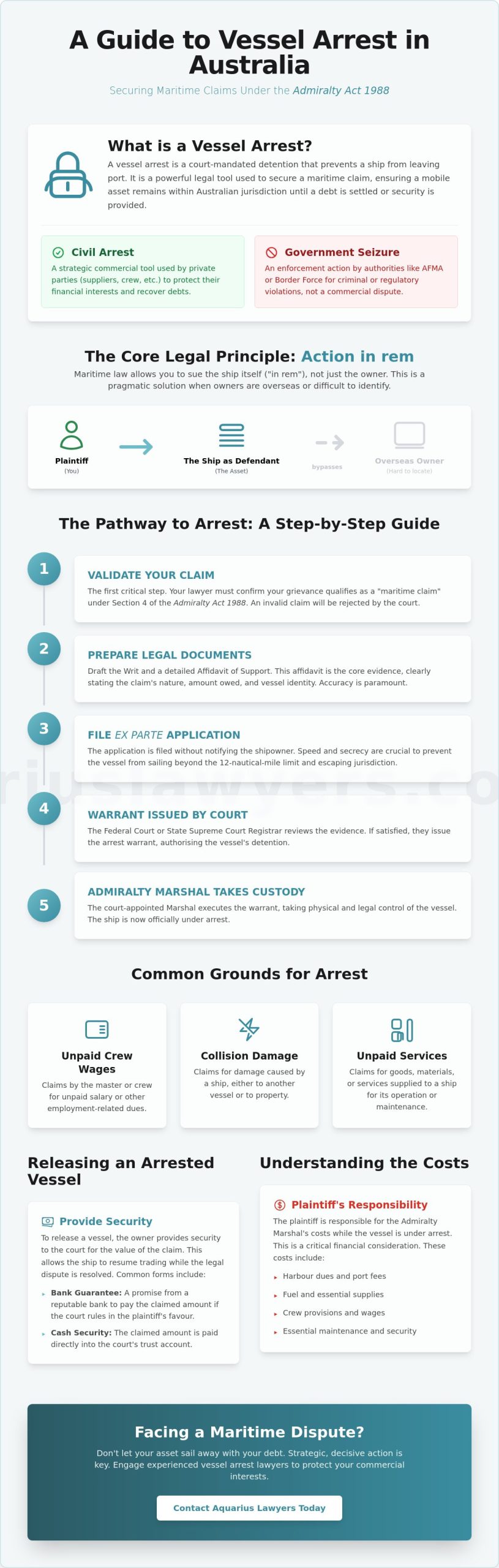
A vessel arrest is a court-mandated detention used to secure a maritime claim. It’s a surgical legal move that prevents a ship from leaving port until a debt is paid or sufficient security is provided. In Australia, this process is governed strictly by the Admiralty Act 1988. While the Federal Court of Australia handles the lion’s share of these cases, State Supreme Courts also possess the authority to hear admiralty matters. This dual-jurisdiction system ensures that maritime claimants have access to the courts regardless of where the vessel is berthed along our vast coastline.
Don’t confuse a civil arrest with a government seizure. If the Australian Fisheries Management Authority (AFMA) or Border Force detains a boat, they’re usually enforcing criminal or regulatory laws. A civil arrest, managed by a vessel arrest lawyer australia, is a strategic commercial tool used by suppliers, crew, or damaged parties to ensure their financial interests are protected. Understanding Vessel Arrest is about knowing how to freeze a mobile asset before it escapes your grasp. It’s a high-stakes procedure where timing is everything.
The Legal Logic of an Action in Rem
Maritime law relies on the “Action in rem” concept, which allows a plaintiff to sue the ship itself rather than the shipowner. This is a pragmatic solution to a common industry problem: shipowners are often hard to find, located overseas, or hidden behind complex corporate structures. By making the vessel the defendant, the law ensures the asset remains within the court’s reach. This legal fiction provides a direct pathway to resolution.
- Ownership Changes: An “in rem” claim often survives a change in ownership, meaning a new owner might inherit the ship’s debts if they weren’t cleared prior to sale.
- Direct Leverage: You don’t need to serve papers to a CEO in London or Singapore if the ship is sitting in Port Botany or Fremantle.
- Terminology: In these proceedings, the claimant is known as the “Plaintiff” and the vessel is formally named as “The Ship as Defendant.”
The Role of the Admiralty Marshal
When a warrant is executed, the Admiralty Marshal steps in. They are the court-appointed officer responsible for the vessel’s custody. Their authority is absolute within the port, and they must ensure the ship is safe, secure, and maintained while under arrest. However, this service is not free. The plaintiff is responsible for the “Marshal’s Costs,” which cover everything from harbour dues and fuel to essential repairs and crew provisions. Understanding these costs is vital for any vessel arrest lawyer australia when advising a client on the commercial viability of an arrest. It’s a simple equation: the cost of the arrest must be weighed against the total value of the claim and the likelihood of recovery.
How to Arrest a Vessel in Australia: A Step-by-Step Pathway
The process begins with a cold, hard look at the facts. Before filing any paperwork, your vessel arrest lawyer australia must confirm that your grievance fits neatly into the categories defined by Section 4 of the Admiralty Act 1988. If the claim isn’t a “maritime claim” by law, the court won’t grant the warrant. This assessment is the foundation of your entire strategy. It’s about ensuring the legal “equation” of your claim equals a valid warrant before you spend a cent on filing fees.
Speed and secrecy are your greatest allies. The application for an arrest warrant is made ex parte, meaning you don’t notify the shipowner or the captain. If they get wind of the legal action, they might simply sail beyond the 12-nautical-mile limit, leaving you with an empty dock and a mounting debt. Once the court is satisfied with the evidence, the warrant is issued, and the Admiralty Marshal is mobilised. This transition from paperwork to physical detention happens quickly, often within hours of the initial filing.
Preparing the Affidavit of Support
The Affidavit of Support is the critical evidence the Registrar reviews. It must clearly state the nature of the claim, the amount owed, and the identity of the vessel. Vague statements or missing documents are the fastest way to get a warrant rejected. Accuracy is paramount here. The solicitor must also provide an undertaking to the court to pay the Marshal’s fees and expenses. This is a personal guarantee from the law firm, ensuring the court isn’t left holding the bill for the ship’s upkeep. If you are unsure about the strength of your evidence, speaking with a specialist in marine law can help clarify your position before you commit to the process.
Execution: What Happens at the Wharf
When the Marshal arrives at the wharf, the arrest becomes physical. The warrant is typically attached to the mast or taped to the windows of the wheelhouse. At this moment, the ship is officially in the custody of the Federal Court. The Marshal immediately notifies the Australian Maritime Safety Authority (AMSA) and Border Force to ensure the vessel’s AIS (Automatic Identification System) is monitored and port clearances are revoked. If the ship is already attempting to sail, a “hot” arrest, the Marshal has the authority to use police or tugboat assistance to stop the vessel. Once the boat is secured, the focus shifts to management, including crew welfare and ensuring that the vessel’s P&I insurance remains valid while under court detention.
Grounds for Arrest: Identifying Your Maritime Claim
Section 4 of the Admiralty Act 1988 acts as a definitive treasure map for any vessel arrest lawyer australia. Before a warrant is even considered, your claim must fit into one of the specific categories listed in this legislation. If your grievance falls outside these boundaries, the court simply has no jurisdiction to arrest the ship. We categorise these into two main groups: proprietary maritime claims and general maritime claims. Understanding the distinction is vital because it dictates who you can sue and how the “Action in rem” proceeds.
Proprietary maritime claims are the heavyweights of the Act. These involve disputes over the actual possession or ownership of a vessel, or disagreements between co-owners regarding profits and employment. If a bank is looking to enforce a mortgage, they are exercising a proprietary claim. On the other hand, general maritime claims cover the day-to-day friction of the shipping industry. This includes damage done by a ship, loss of life or personal injury, and salvage operations. The Federal Circuit and Family Court of Australia’s admiralty jurisdiction provides the framework for these actions, ensuring that even smaller commercial disputes have a clear legal pathway to resolution.
While the legal right to arrest might be clear, the commercial decision depends on the Marshal’s costs. These expenses accumulate daily, covering berthage, security, and essential maintenance. A pragmatic advisor ensures the value of your claim justifies these mounting expenses. If the debt is smaller than the projected upkeep costs, mediation might be a more efficient solution than a full-scale arrest. Beyond financial claims, vessel operators must also be aware that environmental incidents occurring during port stays or coastal operations can trigger significant regulatory exposure; understanding how to approach defending marine pollution fines in NSW is an increasingly important part of any comprehensive maritime legal strategy.
Common Scenarios for Vessel Arrest
The most frequent trigger for an arrest in Australian waters is unpaid crew wages. Our courts take these claims very seriously, often granting them high priority during the distribution of sale proceeds. Unpaid bunker bills or repairer’s fees are also classic scenarios. When a ship leaves a port without settling its accounts for fuel or essential maintenance, an arrest is often the only way to ensure the local supplier isn’t left out of pocket. We also see frequent claims regarding damage to cargo or personal injury occurring on the vessel, where the ship itself becomes the security for the eventual judgment.
Fisheries and Aquaculture Specifics
In the specialised world of fisheries law, the grounds for arrest often involve quota disputes or commercial fishing license disagreements. If a vessel is operating in breach of a shared fishing agreement, an arrest can be used to protect the interests of other quota holders. We also handle cases involving aquaculture infrastructure. If a passing vessel damages a lease or a sea-cage, the owner of that infrastructure can seek an arrest to secure damages. Katherine Hawes, often referred to as the “Fish Lawyer,” brings a unique perspective to these cases, blending deep maritime knowledge with a no-nonsense approach to protecting aquaculture assets.
Counter-Measures: How to Release an Arrested Vessel
When a ship is arrested, the commercial clock starts ticking. Every hour spent idle at the wharf translates into lost charter hire, mounting port fees, and disrupted supply chains. For a ship owner or charterer, the immediate priority is to get the vessel moving again. Engaging a vessel arrest lawyer australia allows you to quickly assess the warrant’s validity and determine the fastest route to release. This is a high-stakes environment where a “no-nonsense” approach to legal strategy is the only way to protect your bottom line.
The most common pathway to release is providing “security” to the court. This process effectively swaps the physical vessel for a financial guarantee. Crucially, providing security is not an admission of liability. It is a pragmatic commercial lever that allows the ship to return to sea while the underlying legal dispute is resolved through litigation or mediation. If you anticipate a claim, filing a “Caveat Against Arrest” is a proactive shield. This document notifies the court that you are ready to provide security, often preventing the physical arrest from ever taking place.
There are also consequences for plaintiffs who act recklessly. If a party arrests a vessel with “crass negligence” or malice, the owner may be entitled to sue for wrongful arrest. This can lead to significant damages, covering the massive financial losses incurred while the vessel was out of service. If your vessel has been detained, you must contact a maritime litigation specialist immediately to organise a defence and minimise your operational exposure.
Security and P&I Club Letters
Security can take several forms, including cash bonds, bank guarantees, or Letters of Undertaking (LOU) from a Protection and Indemnity (P&I) Club. While cash is the simplest, it ties up vital liquidity. Most commercial releases involve negotiating an LOU, which the plaintiff must agree to accept. The amount of security is usually capped at the value of the claim plus interest and costs, or the value of the ship itself, whichever is lower. The court holds this security until a final judgement is delivered or a settlement is reached.
Challenging the Arrest Warrant
Not every warrant is legally sound. You can apply to the court to set aside a warrant if there was a lack of jurisdiction or if the plaintiff failed to disclose material facts during their ex parte application. Identifying “material non-disclosure” is a powerful tool. If a plaintiff hid vital information from the Registrar to secure the arrest, the court may release the vessel and order the plaintiff to pay costs. For owners facing a meritless arrest, claiming damages for the loss of charter hire is the “nuclear option” that holds the arresting party accountable for their tactical errors.
Strategic Maritime Representation with Aquarius Lawyers
Admiralty Court is no place for generalists. Successfully navigating the Admiralty Act 1988 requires more than a basic understanding of the law; it demands a vessel arrest lawyer australia who understands the intricate commercial machinery of the shipping industry. We don’t just file paperwork. We build tactical solutions that protect your financial interests. Whether you are a supplier chasing a debt or an owner facing a wrongful detention, the legal “equation” must always result in a commercial win.
Katherine Hawes brings a unique hybrid of expertise to every case. Known widely as the “Fish Lawyer,” she combines deep roots in fisheries law and aquaculture law with sophisticated commercial law experience. This dual perspective is a significant advantage. We understand both the biological constraints of a fishing fleet and the cold realities of debt recovery and litigation. Our role is to act as a trusted advisor, offering a blend of high-level strategic thinking and relatable, everyday wisdom to resolve your maritime crisis.
Cost-effectiveness is our baseline. While an arrest is a powerful tool, it isn’t always the most efficient pathway. Sometimes, the mere threat of a warrant, backed by a solid legal argument, is enough to trigger a settlement through mediation. We help you calculate the risks and rewards, ensuring the potential recovery justifies the Marshal’s daily upkeep costs and court fees. By integrating modern technology with traditional maritime expertise, we provide a streamlined service that values results over ceremony.
The “Innovative Veteran” Advantage
We blend traditional credentials with contemporary tools to stay ahead of the curve. Our team uses advanced vessel tracking technology to monitor AIS data in real-time. This ensures we know exactly where a ship is located before we move for an arrest. With a presence in regional NSW and Sydney, we offer accessible local counsel for ports across the state. Our “no-nonsense” attitude ensures that maritime debts are addressed with speed and precision. We move easily between different areas of focus, providing the intellectual versatility required for complex international law disputes.
Contact a Vessel Arrest Specialist Today
In maritime law, time is your most precious resource. Waiting even 24 hours can be the difference between a successful arrest and a vessel disappearing into international waters. If you need to secure a claim or release a ship, urgency is paramount. You can Contact Aquarius Lawyers for immediate assistance. Our Sydney team is ready to organise an initial consultation and map out your legal pathway. Don’t leave your maritime assets to chance; take a proactive step to secure your commercial future today.
Take Command of Your Maritime Legal Strategy
Securing a maritime claim is about more than just filing papers. It’s about executing a precise legal strategy before the asset disappears over the horizon. We’ve explored how the Admiralty Act 1988 serves as a powerful tool for debt recovery and why the “Action in rem” procedure remains the gold standard for maritime litigation. Whether you’re navigating the complexities of Section 4 grounds or organising a rapid release through security, the right guidance ensures your commercial interests remain protected.
Success in the Federal Court requires a blend of traditional expertise and modern tactical precision. With over 20 years of experience across Sydney and Regional NSW, our team understands the unique pressures of the shipping and fisheries industries. Principal Katherine Hawes, widely known as “The Fish Lawyer,” provides the niche authority needed to handle even the most complex maritime disputes. Engaging a qualified vessel arrest lawyer australia early in the process is the most effective way to mitigate risk and ensure a favourable outcome.
Secure your maritime claim with a specialist vessel arrest lawyer
Don’t let your claims drift away. Take control of your maritime assets today and move forward with clarity and confidence.
Frequently Asked Questions
How much does it cost to arrest a ship in Australia?
The filing fee for commencing a proceeding in the Federal Court of Australia is $5,050 for a corporation and $1,735 for other entities as of 1 July 2025. Beyond these court fees, you must budget for the Admiralty Marshal’s costs. These cover the vessel’s maintenance, fuel, and security while it remains in the court’s custody. A vessel arrest lawyer australia will help you estimate these daily expenses to ensure the arrest is a commercially sound decision.
Can I arrest a foreign-flagged vessel in an Australian port?
Yes, you can arrest any ship regardless of its flag or place of registration once it enters Australian territorial waters. The Admiralty Act 1988 grants our courts jurisdiction over foreign vessels to ensure that local creditors can secure their claims. This “Action in rem” procedure is a vital tool for dealing with international owners who don’t have a physical business presence in Australia.
What happens to the crew while the vessel is under arrest?
The crew usually stays on board the vessel to maintain its safety and operational integrity. The Admiralty Marshal takes responsibility for their welfare, ensuring they have access to essential provisions like food, water, and medical care. These costs are initially funded by the plaintiff’s undertaking to the court. If the arrest lasts for an extended period, the Marshal may make specific arrangements for crew repatriation or shore leave.
How long does a vessel arrest warrant remain valid?
A vessel arrest warrant is valid for six months from the date the court issues it. If the ship doesn’t enter an Australian port within this window, the warrant expires. You can apply for a renewal if you can show the court that the vessel hasn’t yet entered the jurisdiction. Because ships move quickly, it’s essential to have your legal team ready to execute the warrant the moment the vessel berths.
Is a vessel arrest the same as a maritime lien?
No, they are different legal concepts. A maritime lien is a specific type of high-priority claim that “sticks” to the ship, such as a claim for salvage or crew wages. A vessel arrest is the physical legal action used to enforce that lien or any other maritime claim. Think of the lien as the right to the debt and the arrest as the procedural strike that secures the asset to pay it.
Can I arrest a ship for a debt that isn’t related to that specific ship?
Generally, you can only arrest the ship that is directly connected to the maritime claim. However, Australia allows for “surrogate ship” arrests under specific conditions. If the person who would be liable for the debt owns other vessels, you may be able to arrest one of those “sister ships” instead. This requires a vessel arrest lawyer australia to prove a clear link in ownership and control between the two vessels.
What is a ‘Sister Ship’ arrest and is it legal in Australia?
A “Sister Ship” arrest, formally known as a surrogate ship arrest, is legal under Section 19 of the Admiralty Act 1988. It allows a plaintiff to arrest a vessel owned by the same party who was the owner or charterer of the original ship when the claim arose. This is a strategic move often used when the vessel that caused the damage or incurred the debt has already fled Australian jurisdiction.
How quickly can a vessel be released after security is provided?
The release can happen very quickly, often within a few hours of the court accepting the security. Once a bank guarantee or cash deposit is lodged and the Marshal is satisfied, the court issues a release order. The AIS system is updated, and port authorities are notified that the ship is free to sail. The speed usually depends on how quickly the parties can agree on the form and amount of the security.
Disclaimer
Please note that legal rules change and this is not a substitute nor construed as legal advice. It is general information only.