
Buying a Sydney home with a private jetty isn’t just a real estate transaction; it’s a high-stakes maritime acquisition where the land ends and the legal headaches often begin. You’ve likely spent years dreaming of that perfect sunset over the harbour, but the reality of seawall maintenance and complex Crown Land licences can quickly turn a dream purchase into a financial sinkhole. We understand that the fear of losing water access rights after settlement is a genuine concern for any savvy investor in 2026. Security of title is the foundation of peace of mind, and getting the paperwork wrong isn’t an option when millions are on the line.
This guide provides the expert legal clarity you need to secure your slice of the coast while navigating the mandatory 2026 Contract for Sale and new AML compliance measures. By mastering waterfront property conveyancing Sydney, you can turn modern regulatory complexity into a strategic advantage. We will explore how specialised legal guidance on riparian rights, jetty licences, and the latest WaterNSW regulations creates a smooth pathway to settlement. From validating the contract of sale to uncovering hidden infrastructure costs, we ensure your investment remains a sanctuary rather than a legal liability.
Key Takeaways
- Understand why waterfront property conveyancing sydney requires a maritime lens to manage complex aquatic boundaries and harbour-specific regulations.
- Master the distinction between riparian rights and land ownership to ensure your water access is legally protected after settlement.
- Identify hidden liabilities like seawall maintenance and unauthorised Crown Land encroachments before they become costly post-purchase disputes.
- Learn the essential specialised searches, including NSW Maritime and Crown Lands, required to validate your contract of sale in the 2026 market.
- Discover how combining traditional property law with niche maritime expertise provides a secure pathway for high-value Sydney coastal investments.
What Makes Waterfront Property Conveyancing in Sydney Unique?
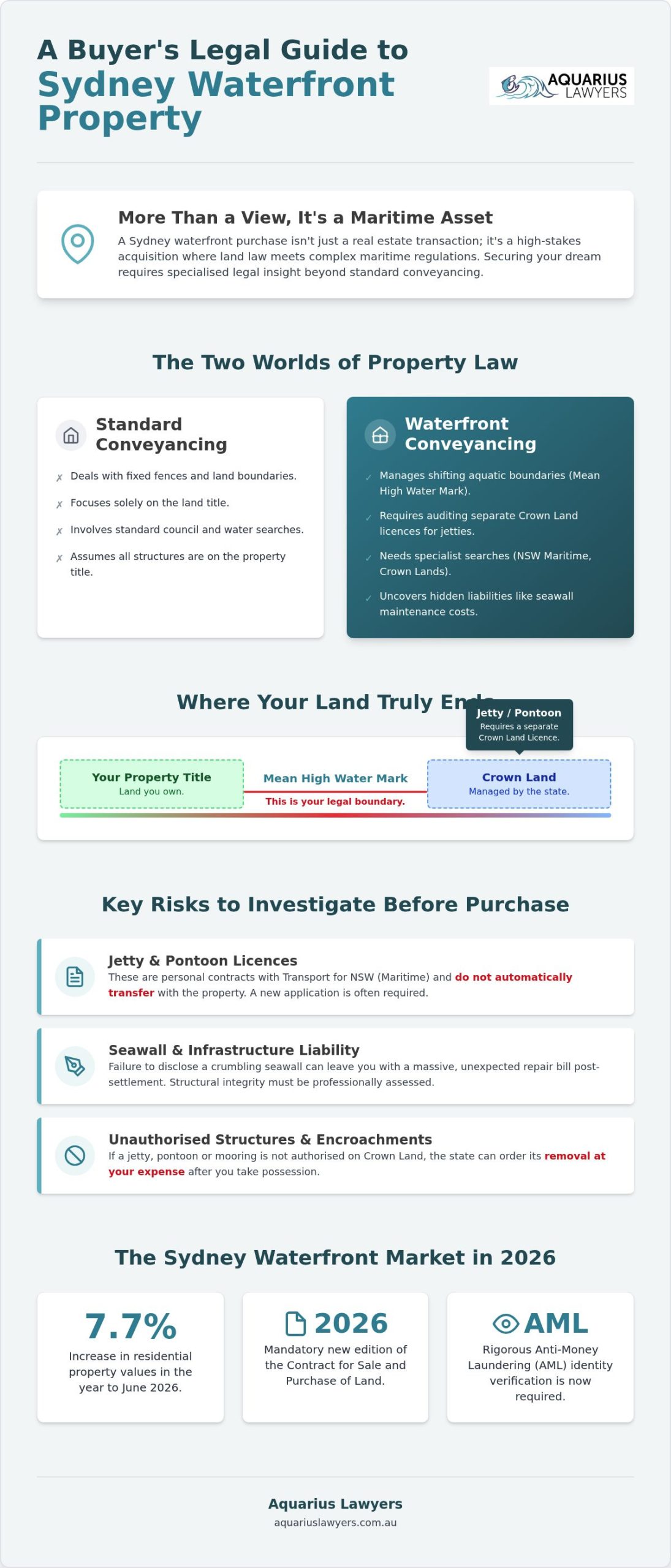
Standard property transactions usually deal with fixed fences and clearly defined easements. However, waterfront property conveyancing sydney involves shifting boundaries and complex Crown Land leases that sit outside the typical land title. If you are looking for a foundational definition, what is conveyancing? refers to the legal transfer of property title between parties. While that definition holds true for a suburban villa, it barely scratches the surface of a harbour-front estate. When land meets the water, the legal “tide” adds layers of complexity that a standard suburban solicitor often misses.
The primary difference lies in the distinction between “dry land” conveyancing and “wet” property law. A standard practitioner treats a waterfront home as a traditional house with a nice view. They might overlook the fact that a private jetty isn’t actually part of the land title. Instead, it is often held under a separate licence from the Crown. Failing to identify these nuances can result in a purchaser losing their water access rights or inheriting a massive repair bill for a crumbling seawall that wasn’t properly disclosed during the due diligence phase.
The Sydney Waterfront Market in 2026
Sydney’s prestige market remains resilient, with residential property values seeing a 7.7% increase in the year leading to June 2026. From the iconic inlets of Sydney Harbour to the rugged cliffs of the Northern Beaches and the tidal reaches of the Shire, the demand for coastal living is high. However, the market in 2026 is defined by stricter environmental compliance and new regulatory hurdles. New buyers must navigate the mandatory 2026 Edition Contract for Sale and Purchase of Land, which includes updated cooling-off notices and rigorous Anti-Money Laundering (AML) identity verification. Valuations now hinge not just on the floor plan, but on the legal integrity of the structures providing water access.
Property Law vs. Maritime Law: The Intersection
The real risk for buyers lies in the gap between the NSW Conveyancing Act and Maritime regulations. Most property lawyers understand land titles, but they stumble when a boundary is defined by the mean high-water mark. This is where an “innovative veteran” approach becomes essential. You need a solicitor who understands how fisheries law impacts your pontoon or how aquaculture regulations might affect your water usage rights. Principal Katherine Hawes, widely known as “The Fish Lawyer,” provides this protective guide. By mastering waterfront property conveyancing sydney through a maritime lens, we ensure that your purchase isn’t just a house on the coast, but a legally sound maritime asset.
Navigating Riparian Rights and Water Licences
A common mistake in the Sydney market is assuming that “waterfront” ownership extends into the water itself. In reality, most residential titles stop abruptly at the Mean High Water Mark. Everything beyond that line is typically Crown Land managed by the state. This is where riparian rights come into play. These rights grant landholders certain privileges regarding water access and usage, but they are far from absolute. Navigating these nuances is a critical pillar of waterfront property conveyancing sydney, as failing to verify where your land ends and public property begins—often with the expert assistance of Hill & Blume—can lead to significant legal disputes post-settlement.
Standard title searches aren’t enough. You must conduct specific maritime authority enquiries to ensure structures like jetties or pylons are actually authorised. Without a valid licence, you are essentially trespassing on Crown Land, regardless of what the real estate agent’s brochure might suggest. If a structure is unauthorised, the state can order its removal at your expense after you have already taken possession.
Jetty, Pontoon, and Mooring Licences
Most private water infrastructure in Sydney Harbour or the Georges River is held under a Domestic Waterfront Licence. These aren’t permanent property rights; they are personal contracts with Transport for NSW (Maritime). During a property transfer, these licences do not automatically “follow” the land. They must be formally transferred, often requiring a fresh application and the payment of specific administrative fees. As of July 1, 2026, new regulated fees for the Water Access Licence Register have come into effect, making it even more important to audit these costs during the cooling-off period. If you are unsure about the status of a specific structure, consulting a specialist in marine and property law can prevent you from inheriting an illegal pontoon.
Access Rights and Public Easements
Your “private” beach might not be as private as you think. Many Sydney waterfronts are subject to public access easements or “foreshore building lines” that restrict how close you can build to the water. Additionally, the Mean High Water Mark is a dynamic boundary. If the shoreline shifts significantly due to erosion, your legal boundary might move with it. We also look for maritime maintenance easements. These allow government bodies to access your land to service navigation markers or environmental monitoring equipment. Understanding these encumbrances ensures you aren’t surprised by a utility crew walking through your garden six months after settlement. Accurate boundary identification is the only way to guarantee the privacy you are paying for.
Seawalls, Encroachments, and Environmental Due Diligence
A luxury deck or manicured lawn might look perfect, but if it crosses the boundary onto Crown Land, it is a legal landmine. This is where waterfront property conveyancing sydney shifts from standard paperwork to forensic detective work. Encroachments are remarkably common in older Sydney harbour suburbs where boundaries have blurred over many decades. If you buy a property with an unauthorised structure on public land, you aren’t just buying a home; you’re buying a potential demolition order from the state. Environmental audits are now just as vital as a building inspection, especially with the 2026 emphasis on the Sustainable Buildings SEPP and the proposed Climate Change and Natural Hazards SEPP.
Crown Land Encroachment and Permissive Occupancy
Many Sydney residents are surprised to find their stone stairs or boat shed actually sit on reclaimed land or Crown territory. Historically, some owners were granted “permissive occupancy,” which is a temporary right that lacks the security of a freehold title. We investigate historical land use and maritime records to identify these hidden boundary slips before they become your problem. If a deck extends past the high-water mark without a proper lease, the NSW Government can demand its immediate removal or charge significant back-rent. We validate every structure against historical data to ensure your outdoor living space is legally protected.
Seawall Maintenance and Liability
Seawalls are the unsung heroes of coastal property, yet they represent a massive financial liability for the unwary. Under the Coastal Management Act 2016, owners are usually responsible for the structural integrity of the barriers protecting their land. A crumbling seawall can cost hundreds of thousands of dollars to repair, and local councils in 2026 are increasingly strict about reporting and maintenance standards. We treat seawall integrity as a core part of waterfront property conveyancing sydney, often recommending specialist engineering reports before the cooling-off period ends. Negotiating repairs within the contract of sale is a protective step that can save you from inheriting a failing asset. If the wall is structurally unsound, we work to ensure the vendor addresses the issue or provides a price adjustment before settlement.
The Specialist Conveyancing Process: Step-by-Step
Standard conveyancing follows a predictable path from contract exchange to settlement. However, waterfront property conveyancing sydney requires a specialised maritime detour to account for the unique infrastructure and boundary issues that define coastal living. We don’t just look at the house; we look at the water that surrounds it. This process ensures that every structure, from the pontoon to the seawall, is legally accounted for before you commit your capital. Precision is the antidote to risk in high-value transactions.
- Initial Maritime Review: We examine the contract for clauses regarding riparian rights and infrastructure ownership.
- Specialised Searches: We conduct enquiries with Crown Lands, Transport for NSW (Maritime), and local councils to verify the authorisation of all aquatic structures.
- Lender Coordination: We work with your bank to ensure they understand the boundary complexities, as some lenders are hesitant about tidal markers and encroaching structures.
- Licence Transfer: We manage the formal transfer of Domestic Waterfront Licences to ensure you have legal access from day one.
Pre-Purchase Contract Reviews
A “free review” from a high-volume conveyancer might miss the specialised maritime clauses that protect your water access. We specifically look for “Subject to Licence Transfer” clauses that prevent you from being locked into a purchase if the maritime authority refuses to transfer a jetty licence. Performing a comprehensive legal audit before you sign ensures that your lifestyle expectations align with the legal reality of the title. This is particularly vital in 2026, as the mandatory 2026 Edition Contract for Sale includes updated cooling-off notices that demand immediate attention from your legal team.
Fixed-Fee Transparency in Sydney
Transparency is the cornerstone of a smooth settlement. Our fixed-fee waterfront conveyancing quotes cover the essential legal work while clearly outlining necessary disbursements, such as maritime enquiry fees and title search costs. We believe in an “innovative veteran” approach where traditional expertise meets no-nonsense pricing. If you want to secure your investment without hidden legal costs, you can book our property law services to gain a clear financial and legal pathway. We also handle the identity verification and AML compliance reporting required under the July 2026 laws, ensuring your settlement remains on track and fully compliant with new federal regulations.
Why Choose Aquarius Lawyers for Your Sydney Waterfront Purchase?
Choosing a legal partner for a harbour-front acquisition requires more than just a standard property solicitor. It demands a specialist who understands where the land ends and the maritime world begins. At Aquarius Lawyers, led by Principal Katherine Hawes, we provide that exact synergy. Known across the industry as “The Fish Lawyer,” Katherine combines deep expertise in marine, fisheries, and aquaculture law with a pragmatic approach to property transactions. This dual-lens perspective is the ultimate safeguard for your investment. When you engage us for waterfront property conveyancing sydney, you aren’t handed off to a junior clerk. You get direct access to a senior legal mind who has spent over 20 years navigating the intersection of land and water.
Complex negotiations involving multiple government departments, such as Transport for NSW and the Department of Planning, Housing and Infrastructure, require a steady hand. We act as your advocate, managing the bureaucratic “red tape” so you can focus on your move. Our methodology is built on a simple equation: traditional legal rigour plus modern digital efficiency equals a faster, more secure settlement. We utilise 2026-standard paperless technology to streamline the process, ensuring your AML compliance and identity verification are handled with surgical precision. This approach is essential for navigating the 7.7% growth in Sydney’s property market while maintaining absolute title certainty.
A Down-to-Earth Approach to High-End Real Estate
High-stakes real estate doesn’t have to be high-stress. We pride ourselves on a down-to-earth communication style that replaces legal jargon with actionable clarity. As an “innovative veteran” firm, we value results over ceremony. Our proactive risk management strategy involves stopping problems before they start. We identify the potential for seawall disputes or unauthorised encroachments during the initial contract review, allowing you to walk into a deal with your eyes wide open. This grounded approach provides the confidence you need to secure a high-value asset in Sydney’s competitive coastal market without the fear of post-purchase litigation.
Beyond Conveyancing: Long-Term Maritime Legal Support
Our relationship with our clients often extends far beyond the final settlement. Waterfront ownership is an ongoing journey that requires regular legal maintenance. We provide continuous support for jetty licence renewals, seawall structural disputes, and even commercial maritime advice for property developers. Whether you are dealing with updated WaterNSW regulations or negotiating a new mooring arrangement, we remain your trusted advisor on the coast. It’s about building a legal foundation that protects your lifestyle for decades, not just days. If you are ready to move forward, secure your Sydney waterfront investment with Aquarius Lawyers and ensure your purchase stands on solid ground and secure water.
Beyond legal protection, managing your new maritime lifestyle is the next priority; Neptune Oceanic provides premium yacht share and vessel management services for Sydney residents who want to enjoy the water without the complexity of sole ownership.
Secure Your Slice of the Sydney Coast
Owning a home on the water is the ultimate Sydney achievement, but it shouldn’t come with a tide of legal uncertainty. We’ve explored how riparian rights, Crown Land encroachments, and seawall maintenance can redefine the value of your asset. Success in the 2026 market depends on seeing the property through a maritime lens. Standard conveyancing isn’t enough when your boundary is defined by the high-water mark; you need a specialist who understands the “wet” side of the law.
By choosing a legal partner who specialises in both marine and property law, you eliminate the guesswork. Principal Katherine Hawes, widely known as “The Fish Lawyer,” brings an “innovative veteran” perspective to every transaction. We provide fixed-fee waterfront property conveyancing sydney with no hidden surprises, ensuring your settlement is as smooth as a harbour breeze. We’re here to provide the clarity and confidence you deserve throughout the entire process.
Contact Aquarius Lawyers for a Specialised Waterfront Contract Review and move forward with absolute certainty. Your coastal dream is within reach; let’s make sure it’s built on a rock-solid legal foundation.
Frequently Asked Questions
Do I automatically own the water access if I buy a waterfront property in Sydney?
Ownership usually ends at the Mean High Water Mark. Everything beyond this line is typically Crown Land. While you have riparian rights to access the water, you don’t own the seabed or the water itself. This distinction is vital for waterfront property conveyancing sydney because it dictates what you can build or fence off. We verify these boundaries to ensure you aren’t paying for land that belongs to the public.
What is a Domestic Waterfront Licence and how do I transfer it?
This is a legal agreement with Transport for NSW that allows you to have structures like jetties or pontoons on Crown Land. These licences are personal and don’t automatically transfer with the land title. During settlement, we lodge a formal application to transfer the licence into your name. Failing to do this correctly means you’ll have no legal right to use the jetty once you move into your new home.
Are seawall repairs the responsibility of the homeowner or the Council?
Homeowners are almost always responsible for maintaining and repairing seawalls on their property boundary. Under the Coastal Management Act 2016, you must ensure the structure is sound to prevent erosion. Repairs are often expensive, sometimes reaching six figures for major works. We recommend structural inspections during the due diligence phase to identify any crumbling infrastructure before you are legally committed to the purchase and the associated financial burden.
Can I build a private jetty if the property doesn’t currently have one?
There is no guarantee you can build a new jetty. Approval depends on local council zoning, environmental impact assessments, and consent from Crown Lands. Many areas in Sydney Harbour have strict limits on new private infrastructure to protect the marine environment and public access. We investigate the specific planning controls for your zone to determine if your plans for a new pontoon or jetty are actually feasible before you sign a contract.
What is the difference between a licensed conveyancer and a property lawyer for waterfront sales?
A property lawyer provides broader legal protection, especially when dealing with the complex maritime regulations found in Sydney. While conveyancers handle the administrative transfer of title, a lawyer can advise on litigation risks, boundary disputes, and the intersection of maritime law. For high-value waterfront assets, having a solicitor who understands both the NSW Conveyancing Act and fisheries regulations provides a much higher level of risk management than a standard transaction-focused service.
How much does waterfront property conveyancing cost in Sydney?
Costs vary depending on the complexity of the aquatic structures and the number of specialised maritime searches required. At Aquarius Lawyers, we offer a fixed-fee model for our legal work to ensure transparency. You will also need to account for disbursements, such as maritime enquiry fees and Crown Land search costs. We provide a detailed breakdown of these expenses upfront so there are no hidden surprises at settlement or unexpected invoices later.
What happens if a pre-purchase search reveals an encroachment on Crown Land?
An encroachment can lead to a demolition order or significant back-rent claims from the NSW Government. If your garden or deck extends onto Crown Land without a valid lease, it represents a major legal liability. We usually negotiate with the vendor to rectify the issue or seek a price reduction to cover the costs of legalising the structure. Identifying these slips early is a core part of our protective strategy for coastal buyers.
Why do I need a maritime lawyer for a residential property purchase?
Waterfront property is a unique hybrid of land and sea law that standard solicitors rarely encounter. A maritime lawyer understands riparian rights, aquaculture impacts, and the specific regulations governing Sydney’s waterways. This niche expertise ensures that your water access rights are secure and that you aren’t inheriting illegal infrastructure. It’s about protecting your lifestyle and your capital through specialised knowledge that goes beyond simple land transfer in a waterfront property conveyancing sydney context.
Disclaimer
Please note that legal rules change and this is not a substitute nor construed as legal advice. It is general information only.