
Would you still sign that contract if you knew the pristine sea wall fronting your new home could land you with a six-figure repair bill the moment the tide turns? Buying by the harbour is the ultimate Sydney dream, but the legal reality is often far murkier than the water itself. Specialist waterfront property conveyancing sydney requires more than just a standard title search. It demands a deep dive into the intersection of land law and maritime regulations. We understand that securing a home on the water’s edge feels like a triumph, but without the right strategy, you’re often inheriting complex liabilities along with that view.
In this guide, we’ll help you master the legal complexities of the 2026 market, from navigating riparian rights to understanding the implications of the Water Management Amendment (Easements for Inundation) Bill 2026. You’ll learn how to manage mooring licence transfers and Crown land leases without the usual headaches. Our goal is simple: to provide the clarity you need to secure a clean title transfer and ensure your water usage rights are protected. By combining traditional property expertise with modern maritime law integration, we’ll show you how to avoid post-settlement disputes and protect your investment for the long term.
Key Takeaways
- Identify why the “Mean High Water Mark” is the most critical boundary in your contract and how it dictates exactly what you own.
- Master the legal nuances of waterfront property conveyancing sydney to ensure riparian rights and water usage permissions are fully secured before exchange.
- Uncover the hidden financial risks of sea wall maintenance and private maritime infrastructure that standard residential searches often overlook.
- Streamline the transfer of mooring licences and Crown land leases by integrating maritime law expertise into your property strategy.
- Use a comprehensive due diligence checklist to audit jetties and boundaries, preventing costly maritime disputes after you move in.
Why Waterfront Property Conveyancing in Sydney Requires Specialist Expertise
Waterfront property conveyancing sydney is the legal process of transferring land where private ownership meets tidal or navigable waterways. Unlike a standard residential block in the suburbs, these properties exist at a complex legal junction. The boundary of your land isn’t just a line on a map; it’s often defined by the “Mean High Water Mark” (MHWM). This boundary is dynamic, shifting with the tides and the natural movement of the shore. If you don’t understand where the Crown’s land ends and yours begins, you might find yourself paying for a view you don’t actually own.
Navigating this market requires managing a multi-agency regulatory environment. You aren’t just dealing with the local council. You’re answering to Transport for NSW for maritime structures and the Department of Planning and Environment for Crown land leases. A standard conveyancer might tick the boxes for a land title search, but they often miss maritime-specific encumbrances like public access ways or heritage-listed sea walls. Expertise + Precision = A Secure Waterfront Investment.
The Sydney Waterfront Landscape in 2026
In 2026, we’re seeing a significant shift in how Sydney Harbour, Pittwater, and the Georges River properties are traded. Buyers are now prioritising climate resilience, as new NSW policies require properties to account for rising sea levels in their title structures. The NSW Land Registry Services has fully embraced digital-first settlements via the PEXA platform. This makes the administrative side faster but increases the need for accurate data entry and verification. If your legal team isn’t tech-savvy, they risk missing the nuanced digital encumbrances that now appear on modern electronic titles.
Identifying the Legal Hybrid: Land vs. Marine Law
A waterfront contract is a hybrid of “wet” and “dry” components. The house sits under the Conveyancing Act 1919, but your jetty or pontoon is governed by maritime regulations. Understanding Riparian Rights is essential here, as these rights dictate your access to the water and what you can build on the shore. The land-water interface represents a unique legal junction where terrestrial property rights meet public maritime jurisdiction, creating a hybrid regulatory space that requires dual-domain expertise. You need to know if you’re buying a freehold title or a complex Crown land lease, as the difference impacts your long-term costs and usage rights significantly.
Understanding Riparian Rights and Maritime Encumbrances
Most buyers assume that owning a waterfront home means they own the water or have an absolute right to build right up to the waves. In reality, riparian rights are far more restrictive. Under the Water Management Act 2000 (NSW), these rights generally grant you the privilege of accessing the water and using it for domestic purposes, but they don’t give you ownership of the riverbed or the harbour floor. If your contract doesn’t clearly define these permissions, you’re essentially buying a house with a view you can’t legally interact with. Waterfront property conveyancing sydney must distinguish between “freehold to the water” and properties separated from the shore by a thin strip of Crown land.
Your s10.7 planning certificate is the first place to look for maritime encumbrances. These documents now include critical updates following the Water Management Amendment (Easements for Inundation) Bill 2026, which passed in May 2026. This legislation allows authorities to create easements for temporary flooding on private land. If you aren’t looking for these specific 2026 regulatory changes, you might buy into a property that the government has the right to flood for storage or mitigation purposes. Securing your rights requires specialist property law guidance that understands both the shore and the sea.
Water Access and Accretion: Who Owns the Sand?
Boundaries at the water’s edge are rarely static. The legal principle of “accretion and erosion” means that if the shoreline moves gradually over time, your property boundary moves with it. If the tide leaves behind new land through slow, natural processes, you might gain territory. If the water encroaches, you lose it. This creates significant risk during waterfront property conveyancing sydney, as a survey from five years ago might not reflect the current reality. We always recommend a fresh boundary audit to ensure you aren’t paying for land that has already been claimed by the harbour.
Crown Land Licences and Leases
It’s a common shock for Sydney buyers to discover their manicured lawn or boat ramp actually sits on Crown land. Many waterfront properties rely on long-term licences or leases from the NSW government to maintain structures like jetties or even simple garden beds. These aren’t permanent rights. They come with annual fees and strict maintenance responsibilities. When a lease expires, the government isn’t always obligated to renew it on the same terms. You must verify the remaining term and the transferability of these licences before you commit to the purchase, as a failed renewal could strip your property of its most valuable maritime features.
Beyond the Contract: Mooring Licences, Jetties, and Sea Wall Liabilities
A standard land title search tells you who owns the dirt, but it says almost nothing about the structures keeping that dirt from washing into the harbour. In waterfront property conveyancing sydney, the most significant financial risks often sit just beyond the boundary line. We take a different approach by integrating marine engineering insights directly into our legal due diligence. This “Fish Lawyer” methodology ensures that your contract doesn’t just cover the house, but also the complex maritime infrastructure attached to it. Specialist Insight + Engineering Context = Liability Mitigation.
Before you commit to a settlement, you must audit the legal and physical status of every maritime asset. A failure to do so can lead to unexpected repair orders or the loss of water access. These assets include:
- Jetties and Pontoons: Verify they are authorised and built to current maritime standards.
- Mooring Poles: Check for structural decay and compliance with Transport for NSW safety rules.
- Boat Ramps: Ensure they don’t encroach on neighbouring access corridors or public land.
- Sea Walls: Confirm the integrity of the masonry and the legality of the original construction.
Transferring Mooring Licences and Jetty Rights
Don’t assume a mooring out the front is yours to keep. Private mooring licences are issued by Transport for NSW (Maritime) to individuals, not properties. They don’t automatically transfer with the house. You must apply for a transfer, and in high-demand areas like East Sydney Harbour, you’ll need to account for specific vessel size restrictions and annual fees. For example, as of June 2026, a 12-month renewal for a vessel up to 10 metres in East Sydney costs $1,298. You need to verify that existing jetties or boat ramps have the correct permits; if a structure was built without approval, you might be legally required to remove it at your own expense after settlement.
The Sea Wall Trap: Managing Repair Liabilities
The most expensive “hidden” trap for Sydney buyers is the sea wall. Under NSW regulations, the responsibility for the design, construction, and maintenance of any sea wall fronting private property rests entirely with the landowners who benefit from it. These works must be fully funded by the private owner. If a sea wall is crumbling, you could be looking at a repair bill worth hundreds of thousands of dollars. We help you identify these failures early, allowing you to negotiate price reductions or require repairs as a condition of the sale. The Coastal Management Act 2016 also dictates strict permissions for repairs, meaning you can’t simply patch a wall without formal approval from the relevant authorities.
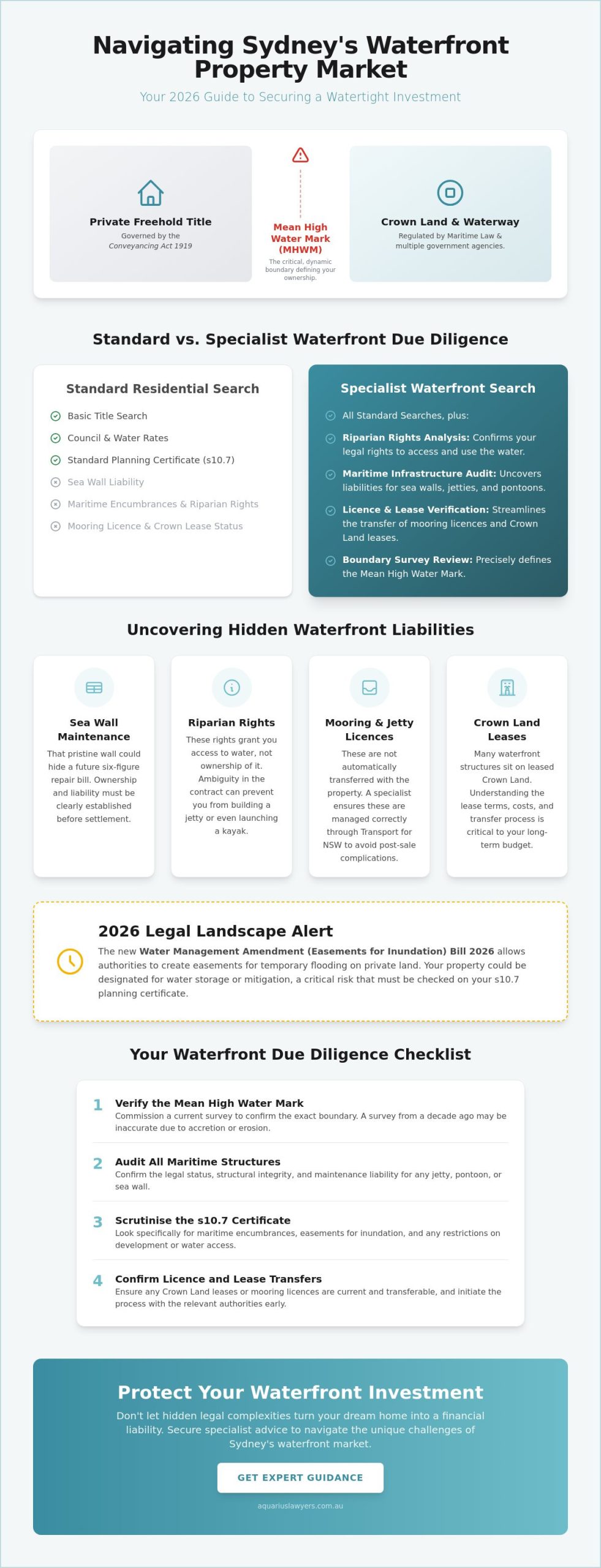
The Waterfront Due Diligence Checklist: Protecting Your Investment
A standard property checklist is a recipe for financial disaster on the Sydney shoreline. You need a strategy that accounts for both the soil and the swell. Waterfront property conveyancing sydney requires a layered approach to due diligence that goes far beyond a simple pest and building report. Rigorous Audit + Specialist Search = Asset Security. Don’t settle for a generic process when your boundary is defined by the tide.
- Step 1: Boundary Audit: Verify the Mean High Water Mark via a specialist survey. Don’t rely on historical plans; the water moves, and so does your legal title.
- Step 2: Maritime Infrastructure Audit: Is that jetty legal? Is the pontoon decaying? Check for unauthorised additions that could lead to council demolition orders.
- Step 3: Crown Land Search: Much of Sydney’s “private” waterfront is actually leased from the government. Identify any non-freehold portions before you commit.
- Step 4: Environmental Compliance: Sydney Harbour and Pittwater have strict protection zones. Review Marine Park restrictions that might limit your ability to renovate or moor.
- Step 5: Specialist Contract Review: Standard contracts are too thin for these assets. You must insert custom clauses to cover maritime infrastructure and permit transfers.
Essential Searches for Sydney Waterfront Buyers
If you’re buying on the harbour, a basic council search is just the tip of the iceberg. You must dig into Transport for NSW (Maritime) records to find hidden encumbrances or expired licences that don’t appear on a standard land title. A current “Identification Survey” is non-negotiable. It’s the only way to prove the house or sea wall hasn’t “crept” onto public land over the decades. We also recommend Fisheries and Marine Park searches to ensure your water access isn’t restricted by habitat protection zones or upcoming environmental regulations. You can book our waterfront due diligence services to ensure every maritime box is ticked before the cooling-off period ends.
Drafting Special Conditions for Marine Assets
Most REINSW contracts are designed for suburban blocks, not multi-million dollar maritime assets. They often fail to address the complexities of a boat ramp or a private mooring. Your “chattels” list must be expanded to include mooring equipment, boat winches, and the formal transfer of maritime permits. We draft specific clauses that allow for infrastructure repairs identified during the 5-business-day cooling-off period. If a sea wall inspection reveals structural failure, your contract should allow you to hold back funds at settlement or require the vendor to rectify the issue. This proactive drafting ensures you aren’t left with a sinking asset and a rising repair bill.
Strategic Property Transfers: The Aquarius Lawyers Advantage
Katherine Hawes, widely recognised as “The Fish Lawyer,” offers a rare hybrid of marine and property law expertise that generalist firms simply cannot match. Most conveyancers treat a harbour-side sale as a standard residential transaction. We don’t. We understand that the legal boundary of a Sydney waterfront home is as fluid as the tide itself. By combining deep traditional credentials with a modern, tech-savvy methodology, we provide a clear pathway to settlement for buyers who value precision over ceremony. Marine Law Expertise + Fixed-Fee Conveyancing = Secure Investment.
Our role is to act as your trusted advisor, moving easily between the technicalities of the Conveyancing Act and the complexities of maritime regulations. We use digital tools to ensure efficiency, but we never sacrifice the rigorous due diligence that waterfront assets demand. Choosing the right partner for waterfront property conveyancing sydney means ensuring that your sea wall, jetty, and mooring rights are as well-protected as the roof over your head. We focus on results, providing the grounded, common-sense guidance you need to navigate these high-stakes transactions.
The Innovative Veteran Approach to Conveyancing
We blend traditional legal rigour with the latest digital settlement tools provided by PEXA and the NSW Land Registry Services. This synergy allows us to process transactions quickly while maintaining a “no-nonsense” focus on risk mitigation. Our niche focus on Marine Law is particularly vital for buyers in Sydney Harbour, Pittwater, and the Georges River. In a recent Pittwater settlement, our team resolved a complex boundary dispute by identifying an unauthorised encroachment of a boat ramp onto Crown land. By rectifying this before exchange, we ensured the client didn’t inherit a demolition order along with their new home. This is the difference that specialised maritime knowledge brings to a property transfer.
Start Your Waterfront Journey with Confidence
We believe in transparency and efficiency, which is why we offer fixed-fee arrangements for our property transactions. This provides you with cost certainty from the outset, allowing you to focus on the excitement of your new acquisition rather than worrying about billable hours. Before you head to auction or sign a contract, it’s a protective step to have a specialist review the maritime encumbrances and riparian rights associated with the title. We offer strategic consultations designed to give you a competitive edge in Sydney’s fast-moving waterfront market.
Organise a waterfront contract review with Aquarius Lawyers to secure your investment with the expertise of an innovative veteran in maritime and property law.
Secure Your Future at the Water’s Edge
Owning a home on Sydney Harbour or the Parramatta River is more than a property purchase; it’s the acquisition of a complex maritime asset. You’ve seen how boundary audits and infrastructure checks prevent the sea wall trap from draining your finances. By identifying Crown land leases and securing mooring licences early, you ensure your lifestyle matches your legal entitlements. Specialist insight protects your capital. Technical Precision + Practical Strategy = Absolute Confidence.
Successful waterfront property conveyancing sydney requires a partner who understands the movement of the tide as well as the nuances of land title. Led by Katherine Hawes, “The Fish Lawyer,” our team brings a unique blend of Marine and Property Law expertise to every settlement. We provide fixed-fee conveyancing to ensure your pricing remains transparent and predictable throughout the process. Don’t leave your investment to chance with a generalist who lacks maritime depth.
Secure your Sydney waterfront investment with Aquarius Lawyers. Your dream home deserves a legal foundation built on expert strategy and technical precision. Let’s make your transition to the water’s edge a seamless success.
Frequently Asked Questions
Do I automatically own the beach or water in front of my Sydney property?
No, you rarely own the sand or the water. Most Sydney titles end at the Mean High Water Mark; this means the area below that line is public Crown land. While you might have riparian rights for access, the actual beach is typically not part of your freehold land. Waterfront property conveyancing sydney involves verifying these boundaries so you don’t accidentally trespass on government land while thinking it’s your own backyard.
How do I transfer a private mooring licence when buying a waterfront home?
You must submit a formal application to Transport for NSW (Maritime) because these licences are personal and don’t automatically transfer with the property title. The vendor needs to cancel or transfer their interest, and you must meet specific vessel and residency requirements. It’s a common trap to assume the mooring is “included” in the sale price. Without a successful transfer, you’ll have no legal right to keep your boat there after settlement.
What is the “Mean High Water Mark” and why does it matter for my title?
The Mean High Water Mark is the legal boundary where the average high tide meets the shore. It is the dividing line between your private property and the state-owned seabed. This matters because any structures built beyond this mark, such as jetties or pontoons, require separate licences or leases. If the shoreline moves naturally over time, your boundary shifts with it, potentially changing the total area of land you legally own.
Am I responsible for repairing the sea wall if I buy a waterfront property?
Yes, the responsibility for the design, construction, and maintenance of any sea wall fronting private property rests entirely with the landowner. These works must be fully funded by you, not the local council or the state government. Because repairs can cost hundreds of thousands of dollars, we recommend a structural engineering audit before you commit to the purchase. Neglecting this infrastructure can lead to significant liability and even the loss of land to the harbour.
Can I build a new jetty on a Sydney Harbour property after I buy it?
Building a new jetty is a complex process that requires development consent from your local council and a lease or licence from Crown Lands and Transport for NSW. It isn’t a guaranteed right just because you own the land. Environmental regulations, such as the protection of seagrasses or navigation channels, often lead to the refusal of new structures. You should always check the feasibility of new maritime infrastructure during the due diligence period.
Why is a standard conveyancer not enough for a waterfront purchase?
A standard conveyancer usually lacks the specialised knowledge required to navigate maritime law and Crown land lease structures. They might miss critical encumbrances like public access rights or heritage-listed sea walls that don’t appear on a standard land title search. Waterfront property conveyancing sydney requires a hybrid approach that integrates marine engineering insights and maritime regulations. This ensures you aren’t blindsided by hidden liabilities or restricted water usage rights after you’ve already settled.
What happens if my property boundary changes due to erosion?
Under the legal doctrine of accretion and erosion, your boundary shifts with the natural, gradual movement of the water. If the harbour slowly encroaches on your lawn, that land is legally lost from your title. Conversely, if land is added through slow natural processes, you may gain territory. This highlights why a current identification survey is vital. It confirms exactly what you are paying for in the current 2026 environment rather than relying on outdated plans.
Are there extra stamp duty or tax implications for waterfront land?
While there is no specific “waterfront tax,” the high value of these properties often triggers premium thresholds. For the 2025-2026 financial year, the premium property duty threshold in NSW is $3,721,000. Additionally, if the land value exceeds the 2026 land tax threshold of $1,075,000, you will be liable for annual land tax. Foreign buyers must also account for the 8% surcharge purchaser duty that applies to residential-related property in NSW as of early 2026.
Disclaimer
Please note that legal rules change and this is not a substitute nor construed as legal advice. It is general information only.