
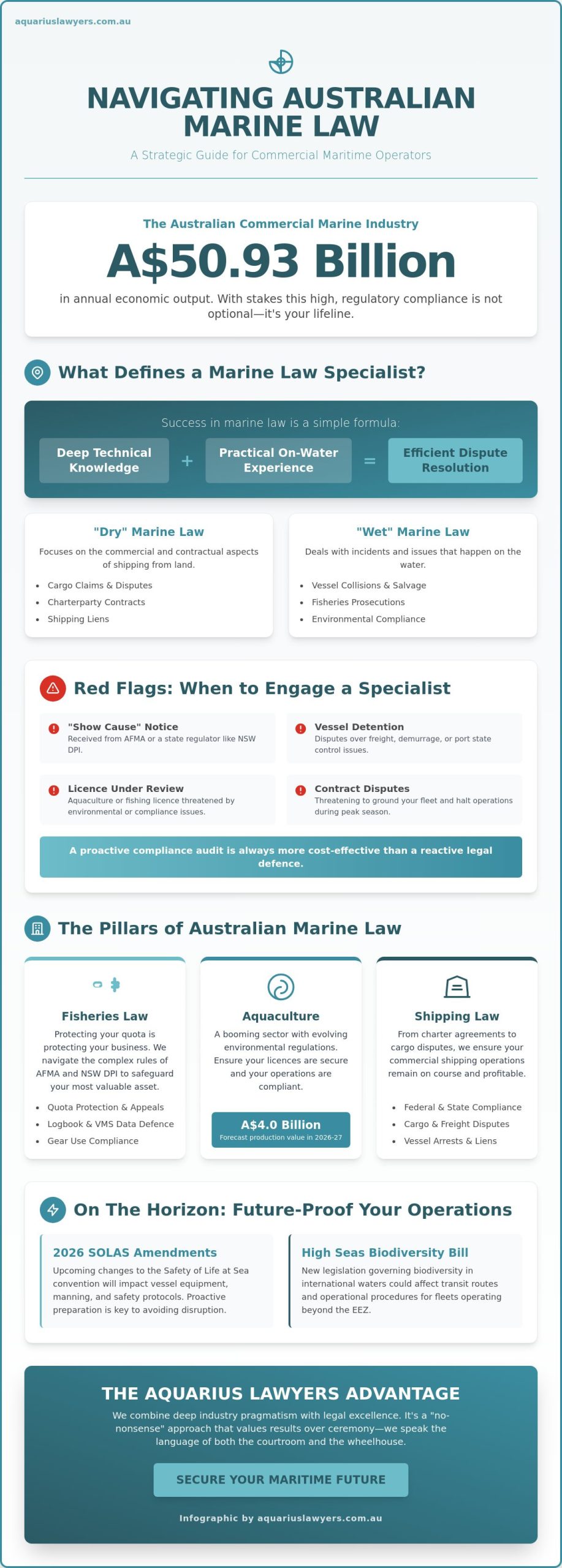
With the Australian commercial marine industry now generating A$50.93 billion in annual output, the margin for regulatory error has never been thinner. A single compliance oversight with AFMA or the NSW DPI can lead to heavy fines or a suspended licence that grounds your fleet indefinitely. You understand that the maritime environment is inherently volatile, and the legal framework governing it is becoming just as unpredictable. Engaging a dedicated marine law specialist is the formula for turning these complex regulatory hurdles into a streamlined pathway for commercial growth.
You’ve worked hard to build your maritime interests, and you deserve a legal partner who values results over ceremony. This article explores how expert legal strategy protects your commercial fishing quotas and resolves shipping disputes with the speed required in a 24/7 industry. We will preview the critical 2026 SOLAS amendments, the implications of the new High Seas Biodiversity Bill, and the proactive steps you can take today to ensure total compliance and operational continuity in Australian waters.
Key Takeaways
- Understand the unique intersection of commercial, environmental, and administrative law that defines a modern marine law specialist in the Australian context.
- Identify the specific regulatory requirements for commercial fishing and aquaculture to protect your quotas from heavy fines or licence suspensions.
- Evaluate the cost-benefit ratio of proactive compliance audits against the significant expense and operational downtime of maritime litigation.
- Use our expert checklist to ensure your legal counsel possesses the right blend of “on-water” experience and clear, plain-English communication skills.
- Learn how to future-proof your maritime operations against the 2026 SOLAS amendments and the newly passed High Seas Biodiversity Bill.
What defines a marine law specialist in Australia?
Marine law isn’t a single legal pillar. It’s a complex intersection where commercial strategy, environmental protection, and administrative compliance meet on the water. To understand What is Maritime Law?, one must look beyond global admiralty rules and focus on the specific Australian statutes that govern our 2026 maritime economy. A marine law specialist acts as a facilitator of outcomes in an environment where a single mistake can halt a multi-million dollar operation. They bridge the gap between “dry” shipping law, which involves cargo claims and charterparty contracts, and “wet” marine matters, such as collisions, salvage, and fisheries prosecutions.
In the Australian context, this role requires a “no-nonsense” attitude that values practical solutions over academic ceremony. Success in this field is a simple equation: Deep Technical Knowledge + Practical On-Water Experience = Efficient Dispute Resolution. Whether you’re managing a commercial fleet or a family-owned fishing business, you need a guide who speaks the language of both the courtroom and the wheelhouse.
The unique landscape of Australian maritime law
The Navigation Act 2012 remains the bedrock of vessel operations, but the regulatory burden has shifted significantly as we move through 2026. The Australian Maritime Safety Authority (AMSA) now employs advanced targeting algorithms for port state control inspections, focusing heavily on shipboard maintenance and seafarer welfare. For NSW-based businesses, the challenge is doubled. You must balance federal AMSA standards with strict regional compliance from NSW DPI and Transport for NSW. This dual-layered oversight creates unique regional hurdles that generalist firms often overlook. Professional expertise is the only way to ensure these regulatory layers don’t become a barrier to your business.
When to engage a specialist over a generalist
General commercial lawyers are excellent for land-based disputes, but they often lack the specific industry vocabulary to handle a fisheries quota dispute or a complex shipping lien. Using a generalist for a maritime contract is a high-risk strategy that can lead to costly delays. At Aquarius Lawyers, “The Fish Lawyer” approach provides a distinct advantage because it combines traditional legal credentials with deep industry pragmatism. You should seek a marine law specialist immediately if you encounter any of these red flags:
- You’ve received a “show cause” notice from AFMA or a state regulator.
- A vessel is being detained due to a dispute over freight or demurrage.
- Your aquaculture licence is under review for environmental non-compliance under the June 2026 standards.
- A contract dispute threatens to ground your fleet during peak season.
Don’t wait for a formal summons to protect your interests. A proactive audit of your compliance framework is always more cost-effective than a reactive defence in court.
The pillars of marine law: Fisheries, Aquaculture, and Shipping
Australian waters represent a high-value commercial grid rather than just a natural resource. With the value of fisheries and aquaculture production forecast to increase to A$4.0 billion in 2026-27, the stakes for operators have never been higher. To thrive in this “blue economy,” your business needs a legal framework that treats your vessels, permits, and quotas as the sophisticated assets they are. A marine law specialist ensures these pillars remain stable by aligning your commercial goals with the latest Australian maritime regulations.
Success in this sector follows a clear logic: Regulatory Precision + Operational Readiness = Sustainable Profit. Whether you are negotiating a charter agreement or defending a fishing licence, the goal is to keep your business moving. This requires a “no-nonsense” approach to the law that prioritises your bottom line over unnecessary ceremony.
Fisheries law and quota protection
Commercial fishing in NSW is a high-stakes environment where compliance is the only path to longevity. Between the NSW Department of Primary Industries (DPI) and the Australian Fisheries Management Authority (AFMA), the rules for catch limits and gear use are under constant revision. If you’re facing a licence appeal or a prosecution, you need a defence that understands the technicalities of logbook entries and VMS data. Quota management constitutes a proprietary interest in Australian law, and it requires rigorous legal protection to maintain its market value. Protecting these interests is a core capability for any serious marine law specialist.
Aquaculture: From licensing to investment
The aquaculture sector is on a steep growth trajectory, with production volumes projected to reach 453 thousand tons by 2034. However, the introduction of updated National Environmental Standards for Marine Aquaculture on 4 June 2026 means the barrier to entry is higher than ever. Managing biosecurity and environmental impact statements shouldn’t mean halting your production. If you’re looking to scale, consulting a specialist marine lawyer can prevent regulatory bottlenecks from sinking your expansion. For startups, this level of due diligence is what transforms a risky venture into a secure, bankable investment.
Beyond the nets and cages, the commercial shipping pillar covers the lifecycle of your fleet. Whether it’s a vessel purchase, a complex bareboat charter agreement, or navigating the January 2026 SOLAS amendments regarding onboard lifting appliances, every contract must be airtight. We focus on ensuring that seafarer certification and new alcohol limit amendments are integrated into your standard operating procedures without operational drama. This proactive strategy keeps your fleet compliant and your interests protected in an increasingly regulated ocean.
Compliance vs. Litigation: A proactive maritime strategy
Reacting to a legal crisis is always more expensive than preventing one. In the maritime sector, the cost of being reactive is measured in thousands of dollars per day of vessel downtime and potential loss of market access. While some operators view legal fees as a sunk cost, a marine law specialist views legal counsel as a strategic investment in risk mitigation. Think of it as a logical equation: Proactive Audit + Robust Documentation = Reduced Liability. By identifying regulatory gaps before an inspector boards your vessel, you aren’t just avoiding a fine; you’re securing your operational future.
Addressing the common objection that lawyers are too expensive requires a shift in perspective. The real expense isn’t the solicitor’s hourly rate; it’s the cost of a vessel being detained or a commercial fishing quota being frozen during a peak run. We use modern methodologies and tech-driven systems to streamline the review of Australian maritime regulations. This ensures your business stays ahead of the 2,400 inspections AMSA has planned for the 2025-26 period, focusing on shipboard maintenance and seafarer welfare.
The cost of non-compliance in Australian waters
Non-compliance isn’t just about the immediate penalty. While fines for marine pollution or safety breaches can reach significant levels, the hidden damage lies in your regulatory record. A criminal conviction or a history of safety breaches can lead to the permanent suspension of your commercial fishing licences or aquaculture permits. A specialist identifies these blind spots in your vessel management plan. We ensure you meet the new SOLAS requirements for danger messaging regarding lost freight containers and the updated alcohol limits for seafarers entering into force on 1 January 2026. Crew-related obligations are equally critical; a failure to comply with maritime employment law can result in your vessel being banned from Australian ports, as demonstrated by AMSA’s six-month ban on the BBG Wuzhou in April 2026.
Strategic dispute resolution and mediation
When conflicts arise, traditional litigation should be the last resort. It’s slow, adversarial, and keeps your focus on the past rather than the horizon. Mediation offers a faster, more confidential pathway to resolution that often preserves vital commercial relationships. Our “innovative veteran” approach prioritises mediation because it allows you to maintain control over the outcome. By organising your documentation and contracts before a dispute reaches a tribunal, you create a position of strength. This proactive preparation often resolves issues before they ever need a courtroom, keeping your vessels moving and your business profitable.
A marine law specialist provides the clarity needed to navigate these choices. We move easily between high-level strategic thinking and the relatable, everyday wisdom of the industry. This ensures your legal strategy is as practical as it is powerful.
Choosing the right marine law specialist: A checklist
Selecting legal counsel for your maritime operations isn’t just about finding a name on a door. It’s about finding a partner who understands that in your industry, time spent at the dock is money lost. A qualified marine law specialist should offer more than just a list of credentials; they must provide a strategic pathway that respects your commercial timelines. The right choice follows a simple formula: Industry Pragmatism + Legal Precision = Operational Security. If your lawyer can’t explain a complex salvage lien or a quota dispute in plain English, they aren’t the right fit for a fast-moving commercial environment.
Modern maritime law in 2026 demands a tech-savvy approach. You should look for firms that utilise digital tools to streamline compliance audits and offer transparent, fixed-fee arrangements where possible. This “no-nonsense” attitude ensures that your legal budget is spent on achieving results rather than funding unnecessary ceremony. When evaluating a potential firm, ask about their specific track record in your niche. A lawyer who excels in superyacht sales might not have the depth of experience required to defend a commercial fisheries prosecution or negotiate an aquaculture biosecurity agreement. For operators based in NSW, understanding how to evaluate maritime law firms in Sydney against the specific demands of local waterway regulations is an essential first step in protecting your commercial interests.
Essential credentials and experience
Mastery of the law requires a deep understanding of the friction between State and Commonwealth jurisdictions. Your advisor must be equally comfortable discussing NSW DPI fisheries management rules as they are with the Commonwealth Navigation Act 2012. Seek out specialists who are active participants in industry bodies and regulatory discussions. This involvement means they don’t just react to changes in the law; they anticipate them. A trusted advisor should understand the day-to-day reality of your operations, from the engine room to the boardroom, ensuring their advice is always grounded in practicality. This extends to crew management, where a thorough understanding of seafarer rights and maritime employment obligations under the Fair Work Act 2009 and the Maritime Labour Convention is essential for any operator managing a crew in Australian waters.
The “The Fish Lawyer” difference
Niche expertise in fisheries and aquaculture is a rare asset in the Australian legal landscape. While many firms can handle a standard commercial contract, few possess the intellectual versatility to manage the unique biological and regulatory hurdles of the seafood industry. Aquarius Lawyers, led by Katherine Hawes (widely known as “The Fish Lawyer”), provides this exact blend of high-level strategy and relatable, everyday wisdom. We don’t believe in cold, detached formality. Instead, we offer regional support through multiple NSW offices, ensuring we’re available where your business actually operates. Connect with a marine law specialist at our firm to ensure your legal strategy is as robust as your fleet.
By choosing a specialist who prioritises efficiency and clear communication, you turn a potential regulatory burden into a competitive advantage. Don’t settle for a generalist when your livelihood depends on the specific nuances of the sea.
Securing your maritime future with Aquarius Lawyers
Aquarius Lawyers has established itself as a leader in the Australian maritime sector by providing a specific type of intellectual versatility that generalist firms cannot match. As a marine law specialist, we don’t just interpret statutes; we facilitate commercial outcomes. Our firm operates on a foundational belief: Traditional Expertise + Modern Efficiency = Seamless Compliance. This synergy allows us to protect your interests without the cold, detached formality often found in the legal industry. Whether you’re a commercial fisher in NSW or managing an international shipping fleet, our goal is to provide a steady, common-sense guide through the complexities of 2026 maritime regulations.
We remain committed to cost-effective, tech-driven legal solutions that respect your bottom line. We understand that every hour your vessel is inactive is an hour of lost revenue. By using contemporary tools to manage documentation and risk assessments, we move with the speed of the industry. This no-nonsense attitude ensures you receive high-level strategic thinking without unnecessary ceremony. You deserve a legal partner who values results over process, ensuring your business stays profitable and compliant in a changing regulatory landscape.
Our specialised approach to marine law
Katherine Hawes, widely known as “The Fish Lawyer,” has built a reputation based on niche authority and a genuine understanding of the water. Our specialised approach isn’t limited to a single area. We manage the synergy between commercial, criminal, and property law as they apply to the unique maritime environment. This means we can handle everything from a debt recovery issue for a marine business to a criminal defence against a fisheries prosecution with equal precision. Aquarius Lawyers protects the pathway to your maritime success by proactively managing the friction between regulatory compliance and commercial growth.
Next steps: Protect your interests today
Securing your future in the Australian maritime industry begins with a proactive strategy. You can book a consultation at our Sydney or Shellharbour offices to discuss your specific needs with a marine law specialist. To get the most out of your first meeting, we recommend preparing any relevant permits, recent correspondence from regulators like AMSA or NSW DPI, and copies of current commercial contracts. This allows us to get to the heart of the matter quickly and start building your resolution pathway immediately.
Don’t let regulatory uncertainty ground your operations. Contact Aquarius Lawyers to discuss your maritime compliance or dispute and experience the difference that genuine specialist expertise provides.
Charting Your Course for 2026 and Beyond
Navigating the Australian maritime landscape in 2026 requires more than just keeping a steady hand on the wheel. It demands a proactive legal strategy that anticipates regulatory shifts before they impact your fleet. You’ve seen that the equation for long-term success is simple: Early Compliance + Specialist Expertise = Operational Continuity. Whether you’re adapting to new SOLAS amendments or protecting your commercial fishing quotas, the right legal partner ensures your business remains resilient against the tide of evolving standards.
Aquarius Lawyers, led by Katherine Hawes, known as “The Fish Lawyer,” provides the niche authority your maritime interests deserve. With convenient offices in Sydney and Shellharbour, we specialise in the practical application of fisheries, aquaculture, and commercial maritime law. Don’t leave your livelihood to chance or wait for a regulatory hurdle to ground your operations. Book a consultation with Australia’s leading marine law specialist today to secure your pathway to success. We’re here to provide the clarity and confidence you need to stay moving in Australian waters.
Frequently Asked Questions
What is the difference between maritime law and marine law?
Maritime law, often called admiralty law, traditionally focuses on commercial shipping, cargo claims, and vessel navigation. Marine law is a broader ecosystem that encompasses these elements while also covering fisheries management, aquaculture regulations, and environmental protection. While the terms are sometimes used interchangeably, a marine law specialist usually handles a wider variety of “wet” and “dry” matters across the entire blue economy.
Do I need a specialist lawyer for a commercial fishing licence appeal in NSW?
Engaging a specialist is vital because commercial fishing licence appeals involve highly technical data and complex administrative laws. Generalist lawyers often lack the specific industry vocabulary needed to challenge NSW DPI or AFMA decisions effectively. A marine law specialist understands the nuances of logbook requirements and quota management, which can be the difference between a successful appeal and losing your livelihood.
Can a marine law specialist help with international shipping disputes?
Yes, we provide strategic advice on disputes involving international conventions like SOLAS and MARPOL. With new amendments entering into force on 1 January 2026 regarding alcohol limits and freight container messaging, international compliance is more complex than ever. We help resolve charterparty conflicts and cargo claims by applying both Australian law and international maritime standards to keep your global operations moving.
What are the most common marine pollution laws I need to follow in Australia?
The primary framework is MARPOL, which is implemented in Australia through the Protection of the Sea (Prevention of Pollution from Ships) Act 1983. You must also comply with state-specific legislation like the Marine Pollution Act 2012 in NSW. These laws cover everything from oil and sewage discharge to garbage disposal. Failing to follow these standards can lead to severe fines and vessel detention by AMSA.
How much does it cost to hire a maritime lawyer in Sydney?
Costs depend entirely on the complexity of your matter and whether you require litigation or proactive compliance advice. Instead of focusing on hourly rates, consider the return on investment through risk mitigation. We prioritise efficient, results-oriented strategies to ensure your legal spend is a facilitator of outcomes rather than an open-ended expense. We’re happy to discuss specific fee structures after an initial consultation.
What happens if my vessel is arrested in an Australian port?
A vessel arrest is a powerful legal tool used to secure a maritime claim, often involving unpaid debts or damage. Once arrested by the Admiralty Marshal, the vessel cannot leave the port until the claim is resolved or security is provided. You need immediate legal counsel to negotiate the vessel’s release and prevent crippling operational downtime. We act quickly to protect your commercial interests during these high-pressure situations.
How can I ensure my aquaculture business is fully compliant with environmental laws?
Total compliance requires a proactive approach to the updated National Environmental Standards for Marine Aquaculture effective 4 June 2026. Regular compliance audits are the most effective way to identify biosecurity and environmental gaps before they trigger a regulatory investigation. We help you build a robust management plan that balances sustainable farming practices with the practical needs of your daily production.
Does Aquarius Lawyers offer fixed-fee services for maritime matters?
We offer fixed-fee arrangements for specific maritime matters to provide our clients with cost certainty and transparency. This “no-nonsense” approach allows you to budget for legal expenses without worrying about hidden costs. Whether it’s a contract review or a compliance audit, we believe in providing value through clear, predictable pricing models that align with your business goals.
Disclaimer
Please note that legal rules change and this is not a substitute nor construed as legal advice. It is general information only.