Your commercial fishing licence is far more than a regulatory requirement. It’s the multi-generational foundation of your livelihood that currently faces unprecedented pressure from every coastline. You likely feel that the gap between a successful haul and a crippling administrative penalty has never been narrower, especially as mandatory electronic monitoring begins its phase-in across Commonwealth sectors from July 2026. It’s a high-stakes environment where a simple oversight can jeopardise everything you’ve built, even as the industry’s production value is forecast to climb to $4 billion this year. This article delivers the specialised legal advice for fishers you need to protect your commercial interests, manage complex state and federal compliance, and defend your operations against prosecution. We’ll break down the 2026 regulatory landscape, including Western Australia’s demersal scalefish bans and Queensland’s new bycatch mandates, to provide a clear strategy for securing your quota and your future.
Key Takeaways
- Learn the specific legal mechanics of managing your commercial fishing quota and navigating the jurisdictional divide between AFMA and state authorities.
- Understand your fundamental legal rights when boarded by fisheries officers, including the crucial distinction between cooperation and self-incrimination.
- Discover why specialised legal advice for fishers is essential for interpreting complex gear specifications and maritime evidence that generalist firms often overlook.
- Avoid the “DIY trap” by learning when representing yourself to the department creates more risk than resolution for your licence.
- Identify how a tech-integrated, industry-first legal strategy can streamline your compliance and provide a clear pathway for commercial growth.
Why Specialised Legal Advice for Fishers is Your Best Defence Against Regulatory Overreach
Fisheries law is a unique legal hybrid. It sits at the intersection of commercial contracts, administrative compliance, and high-stakes criminal law. For most operators, the legal system feels like a maze of overlapping state and federal rules that can change with a single departmental memo. This is why specialised legal advice for fishers is a necessity rather than a luxury. A generalist lawyer might understand the basics of a contract, but they often lack the technical depth to argue about gear specifications, mesh sizes, or the nuances of maritime evidence. If your solicitor doesn’t know the difference between a trawl net and a gillnet, they cannot effectively defend your livelihood in court.
Katherine Hawes, known across the industry as “The Fish Lawyer,” bridges this gap by translating deck-side reality into courtroom procedure. She ensures that judges and departments understand the practicalities of life at sea. Without this niche expertise, a minor administrative oversight or a simple logbook error can quickly escalate into a catastrophic licence cancellation or a permanent loss of quota. We focus on stopping that escalation before it starts.
The High Stakes of the Australian Fisheries Landscape
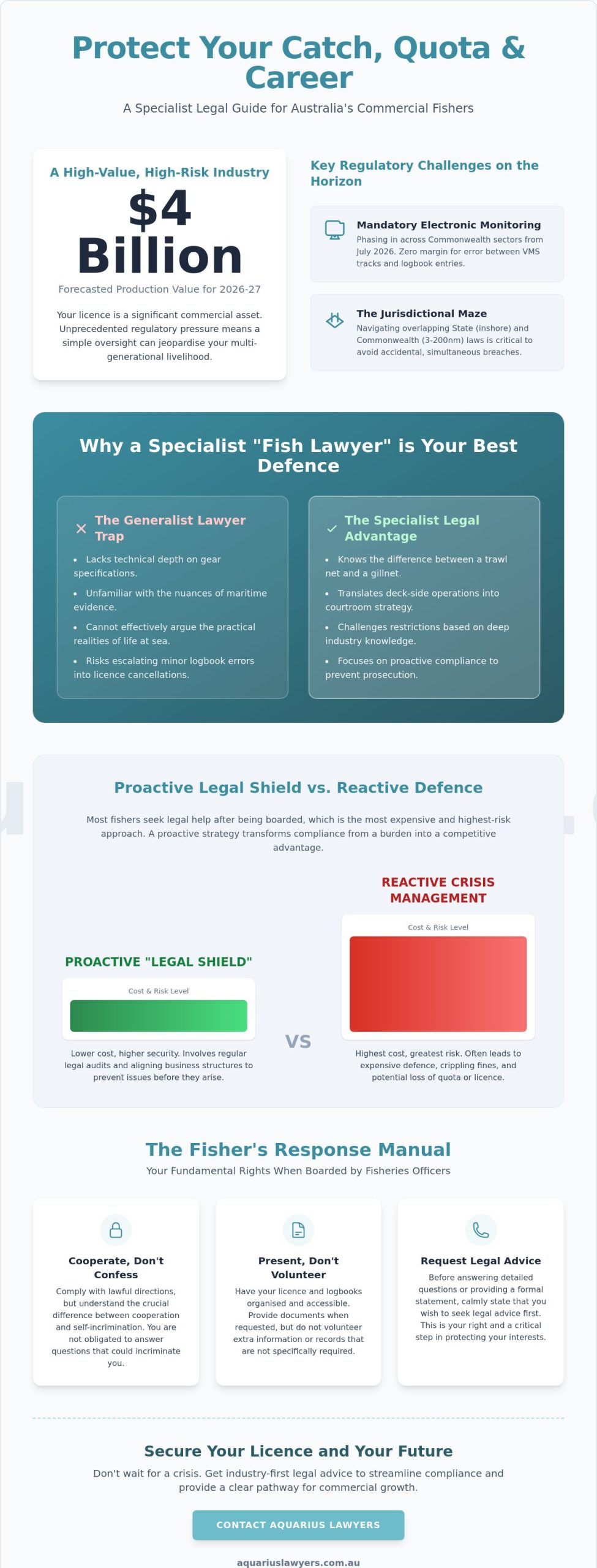
The economic value of your licence has never been higher. With ABARES forecasting fisheries and aquaculture production to reach $4 billion in 2026-27, your quota is a significant commercial asset that requires sophisticated protection. However, the “precautionary principle” in environmental law often leaves fishers on the back foot. This legal concept allows authorities to restrict fishing even when scientific data is uncertain, often prioritising environmental caution over your commercial viability. You need a solicitor who understands the seasonal nature of the industry and can challenge these restrictions before they cripple your cash flow or your family’s future.
Proactive Compliance vs. Reactive Defence
Most fishers only call a lawyer after they’ve been boarded or served with a notice. This reactive approach is often the most expensive way to manage a business. By conducting regular legal audits, you can identify compliance gaps in your operations before the Australian Fisheries Management Authority (AFMA) or state inspectors find them. Building a “legal shield” around your assets involves more than just tick-box compliance; it requires a strategic alignment of your corporate structure, employment law obligations, and operational habits. Effective fisheries legal strategy is the primary method to ensure long-term operational continuity in a volatile regulatory environment.
Don’t wait for a crisis to secure your future. Professional legal advice for fishers transforms compliance from a burden into a competitive advantage. It ensures that when regulations change, such as the 2026 amendments to the Queensland Fisheries Act regarding bycatch reduction, your business is already ahead of the curve and protected from unnecessary prosecution. Understanding the full scope of fisheries regulation changes taking effect in 2026 is essential to building that proactive compliance strategy.
Licensing, Quotas, and Compliance: Navigating the Legal Framework of Australian Fisheries
Understanding who governs your water is the first step in protecting your deck. Jurisdiction in Australia follows a strict hierarchy. The Commonwealth manages fisheries from three nautical miles out to the 200-mile limit. State authorities, such as the NSW Department of Primary Industries (DPI), govern everything closer to shore. Misunderstanding this boundary can lead to jurisdictional “double-dipping” where you inadvertently breach two sets of laws simultaneously. Getting the right legal advice for fishers ensures you know exactly which rulebook applies to your current GPS coordinates.
Compliance isn’t just about what you catch; it’s about how you record it. Vessel Monitoring Systems (VMS) and electronic logbooks are now non-negotiable tools for enforcement. With mandatory electronic monitoring expanding across Commonwealth sectors between July 2026 and April 2027, the margin for error is effectively zero. A single discrepancy between your VMS track and your logbook entries can trigger an investigation. If a department makes a decision that threatens your livelihood, such as a licence suspension, the Administrative Appeals Tribunal (AAT) offers a pathway for independent review. It’s a formal process where technical evidence often outweighs departmental opinion.
State-Specific Nuances: Focus on New South Wales
The Fisheries Management Act 1994 (NSW) remains the cornerstone of local operations. Many fishers miss subtle provisions regarding share-holding requirements or the specific triggers for “fit and proper person” tests. In 2026, local management plans continue to evolve, often shifting the value of specific share classes based on updated sustainability data. Staying informed via the Fisheries Research and Development Corporation helps you understand the scientific trends driving these regulatory changes. Proactive share management is the difference between a thriving business and one stalled by red tape.
Quota Management and Asset Protection
Your quota is a commercial asset, not just a permission slip. Smart operators use robust legal structures, like discretionary trusts or specialised companies, to hold these assets. This creates a barrier between your personal liability and your multi-generational “heritage” licences. When passing a licence down to the next generation, a clear succession plan is vital to avoid tax traps or regulatory hurdles. If you’re looking to expand, performing due diligence on a vessel’s compliance history is just as important as checking the engines. Operators navigating the latest fisheries regulation changes in 2026, including bioregion-specific closures and quota cuts, should seek expert guidance before making any acquisition decisions. You can consult with a fisheries law expert to ensure your next acquisition is a secure investment rather than a legal liability.
Evaluating Your Legal Options: When to Seek Professional Counsel vs Internal Management
Most fishers are fiercely independent. You’re used to fixing your own gear and navigating your own path. However, applying that same “do-it-yourself” mentality to complex regulatory disputes often leads to the “DIY Trap.” This happens when an operator attempts to resolve a compliance issue by simply “having a chat” with the department. In the eyes of the law, there is no such thing as an off-the-record conversation with a fisheries officer. Every statement you make can be used as evidence in a future prosecution. Professional legal advice for fishers ensures that your side of the story is told without inadvertently admitting to a strict liability offence.
Choosing the right solicitor is a strategic business decision. You don’t need a generalist; you need an innovative veteran who understands the synergy between traditional maritime experience and modern tech-driven enforcement. Look for a firm with a reputation for “no-nonsense” pragmatism and a deep understanding of how electronic monitoring data is actually used in court. While industry bodies are excellent for broad lobbying and policy shifts, they cannot provide the specific, privileged legal protection required during a personal licensing dispute or a criminal investigation. Private counsel offers a dedicated shield for your individual interests.
The Threshold for Professional Legal Intervention
Knowing when to call for backup is as vital as knowing when to head back to port. If a fisheries officer moves from asking for your logbook to asking “why” a certain entry was made, the “informal chat” has likely become a formal investigation. This is the moment to stop talking and start calling a lawyer. Similarly, when negotiating quota leases or vessel acquisitions, the cost of a legal review is far lower than the cost of a contract that leaves your assets exposed. A second opinion on a departmental decision can often uncover administrative errors that, if left unchallenged, could result in an unjust licence suspension.
Cost-Effective Solutions for Commercial Fishers
Legal support shouldn’t be a cost of crisis; it should be a tool for efficiency. For larger fleets, retainer-based support provides a predictable way to manage ongoing compliance without the sting of unexpected hourly bills. We prioritise transparent pricing and direct pathways to resolution. By integrating technology into our legal documentation processes, we ensure that your compliance reporting is streamlined and robust. Proactive legal management + tech-savvy strategy = long-term operational security. This approach reduces your overall legal spend by preventing minor administrative hiccups from turning into expensive, multi-year litigation battles.
The Fisher’s Response Manual: Managing DPI Inspections and Fisheries Prosecutions
Boarding by fisheries officers or police is a high-pressure scenario where your first reaction often dictates the legal outcome. You have specific rights under both state and federal law that must be balanced against your obligations to co-operate. While you’re required to allow authorised officers to inspect your catch, gear, and vessel, you aren’t required to provide a verbal narrative of your operations on the spot. Obtaining immediate legal advice for fishers during or immediately after a boarding can prevent a routine inspection from spiralling into a full-scale prosecution. The “Right to Silence” in a fisheries context is often misunderstood; while you must produce required documentation like logbooks or VMS data, you don’t have to answer questions about alleged discrepancies without a lawyer present.
If officers decide to seize your vessel, gear, or catch, the impact on your cash flow is immediate and severe. You must act quickly to challenge the seizure or negotiate the release of assets to prevent your business from grinding to a halt. Preparing for a Local Court or District Court hearing requires a methodical approach to evidence. We focus on standardising your version of events and ensuring that every technical detail of your operation is accurately represented to the magistrate. In 2026, with fines in Western Australia reaching up to $10,000 for corporate first offences and mandatory penalties of 10 times the fish value, the financial risk of an undefended charge is simply too high. Understanding the full scope of your options for fisheries prosecution defence is essential before you face a magistrate unprepared.
Immediate Actions During an Inspection or Search
Document the inspection process as it happens. Use your phone to take photos of your gear and catch as the officers see it, provided you don’t obstruct their work. Always ask for the specific legislative power they’re using to board or search, and if they have a warrant, insist on a copy. Professional co-operation does not mean waiving your right to legal advice.
Defending Prosecution and Mitigating Penalties
A summons isn’t a conviction. Successful defences often hinge on an “honest and reasonable mistake of fact” or proving that technical malfunctions, such as a VMS failure, were beyond your control. We frequently engage expert witnesses, including marine biologists and gear specialists, to provide the technical evidence that departments often overlook. Negotiating with the prosecution to withdraw charges or reduce penalties is a strategic pathway we use to protect your record. If you’re facing a compliance notice or court attendance, contact Aquarius Lawyers for a strategic defence plan.
Aquarius Lawyers: Strategic Legal Pathways for the Australian Marine and Fishing Industry
Katherine Hawes isn’t just a solicitor; she’s “The Fish Lawyer.” This title reflects a career dedicated to the specific needs of those who work on the water. Providing legal advice for fishers requires more than just a law degree. It demands a deep, practical understanding of how a commercial vessel operates and how a quota is managed as a business asset. At Aquarius Lawyers, we move beyond the standard legal service. We offer a comprehensive suite of solutions spanning marine law, fisheries law, and aquaculture law, while also addressing the commercial, criminal, and property law issues that inevitably arise in this industry.
We serve the heart of the industry from our offices in Sydney and Shellharbour. This presence allows us to offer accessible counsel to regional NSW fishers who often feel overlooked by city-based generalists. Whether you’re dealing with a debt recovery matter, an employment law dispute, or the complex litigation of a fisheries prosecution, we provide a steady, common-sense guide through the legal storm. Our commitment to cost-effective, tech-integrated solutions means you get high-level expertise without the unnecessary overheads of traditional firms.
Why We Are Known as the “Innovative Veterans”
Our team represents the synergy between traditional credentials and forward-thinking methodology. We value results over ceremony. This “no-nonsense” attitude means we get to the heart of your fisheries issue quickly, saving you time and reducing stress. We’ve built a track record of facilitating outcomes for everyone from aquaculture startups to multi-generational commercial veterans. By integrating modern technology into our legal practice, we ensure our services are efficient and our documentation is robust enough to withstand departmental scrutiny. We don’t just react to problems; we build the strategic pathways that allow your business to grow.
Next Steps: Securing Your Livelihood
The most effective way to protect your operation is to be proactive. A strategic consultation allows us to review your current compliance status and identify potential risks before they become legal crises. If you’ve received correspondence from a department, don’t wait for a deadline to pass. An initial expert review can determine the best pathway forward, whether that involves mediation or a formal defence. Your livelihood is too valuable to leave to chance. Contact Aquarius Lawyers today to protect your future on the water.
Securing Your Legacy on the Australian Coastline
The landscape of Australian fisheries is shifting toward more rigorous oversight and mandatory electronic monitoring. Protecting your commercial interests requires more than just hard work; it demands a strategic legal shield. We’ve explored how understanding jurisdictional boundaries and maintaining logbook accuracy can prevent minor errors from becoming major prosecutions. Specialised legal advice for fishers is the most effective tool for managing these risks and ensuring your quota remains a secure asset. Principal Katherine Hawes, known as “The Fish Lawyer,” brings authoritative representation to the AAT and Local Courts, specialising in both NSW and international fisheries law. Her innovative approach combines deep industry knowledge with modern legal strategies to deliver practical results. Don’t leave your operations to chance in an increasingly complex environment. Secure your fishing future with a consultation from The Fish Lawyer. Your expertise belongs on the water; let us handle the complexities of the law so you can focus on a successful and compliant future.
Frequently Asked Questions
Do I really need a specialised fisheries lawyer, or can my family solicitor help?
Specialised knowledge is vital because fisheries law combines criminal, administrative, and commercial elements that a family solicitor rarely encounters. A generalist may struggle with technical gear specifications or the specific evidentiary requirements of maritime law. Getting niche legal advice for fishers ensures your representative understands the difference between a minor logbook error and a systemic compliance failure that could end your career.
What should I do if a fisheries officer asks to interview me on the wharf?
You must produce your required identification and documentation, but you should politely decline to answer questions about any alleged incident until you have legal representation. Anything you say on the wharf is considered evidence and can be used against you in a future prosecution. It’s safer to defer the conversation until you’ve consulted with a lawyer who understands the nuances of fisheries inspections.
Can I appeal a decision made by the DPI regarding my fishing licence?
Yes, you can generally appeal a DPI decision through a merits review process. If the department has suspended your licence or refused a transfer, the Administrative Appeals Tribunal (AAT) or a state equivalent provides a pathway for an independent assessment. These appeals often focus on whether the department followed correct legal procedures and applied the law fairly to your specific circumstances.
How much does it typically cost to defend a fisheries prosecution in NSW?
The cost of a defence depends on the complexity of the charges and whether the matter is heard in the Local or District Court. Factors such as the duration of the hearing and the need for expert witnesses, like marine biologists, will influence the total legal spend. We recommend an initial review of your summons to determine the most efficient strategy for your case.
Is it possible to lease my fishing quota without a formal legal agreement?
While you can technically lease quota on a handshake, it’s a significant risk to your commercial assets. Without a formal legal agreement, you have very little protection if the other party fails to pay or breaches regulations while using your quota. A written contract ensures that responsibilities for compliance and payment are clearly defined and enforceable in court.
What happens to my commercial licence if I am charged with a fisheries offence?
A charge can trigger an immediate review of your status as a “fit and proper person” to hold a commercial licence. In some jurisdictions, the department has the power to suspend your licence before the court reached a verdict. This is why a proactive fisheries prosecution defence is essential to protect your right to continue operating while the legal process unfolds.
Can Aquarius Lawyers help with aquaculture development approvals in Sydney?
Yes, we provide aquaculture law services to help businesses navigate the complex development approval process. Securing approvals in Sydney or regional NSW requires coordinating with multiple departments and meeting strict environmental requirements. We assist with the legal framework needed to get your aquaculture project off the ground while ensuring long-term operational compliance.
Do you provide fixed-fee services for buying or selling fishing vessels?
We provide clear and transparent pricing structures for all commercial transactions involving fishing vessels and assets. Whether you’re buying your first boat or expanding a fleet, we handle the due diligence, contract drafting, and settlement process. We recommend contacting our team for a tailored quote based on the specific requirements of your vessel transaction.
Disclaimer
Please note that legal rules change and this is not a substitute nor construed as legal advice. It is general information only.