
What if the most effective way to recover an unpaid invoice wasn’t through aggressive phone calls, but through the precise, surgical application of the Civil Procedure Act? Many business owners feel stuck when debtors ignore standard follow-ups, fearing that the cost of hiring a debt recovery lawyer nsw will eventually outweigh the debt itself. It’s a valid concern; cash flow is the lifeblood of your operations, and you can’t afford to waste it on inefficient processes. We believe that professional leverage + procedural expertise = the fastest path to recovered capital.
In this article, you’ll learn how to navigate the NSW legal system to recover outstanding debts efficiently while protecting your commercial relationships. We provide a clear roadmap for everything from issuing a statutory demand for debts over A$4,000 to understanding the 7.60% pre-judgment interest rate you may be entitled to claim. We’ll preview the different court jurisdictions and show you how a strategic legal framework creates the leverage needed to get you paid without the stress of hidden costs or unnecessary friction.
Key Takeaways
- Understand why a formal solicitor’s letterhead provides greater psychological leverage than a standard collection agency when dealing with recalcitrant debtors.
- Identify the correct NSW court jurisdiction for your matter, ranging from the Small Claims Division for debts under A$20,000 to the District or Supreme Courts for larger commercial disputes.
- Discover how a debt recovery lawyer nsw utilizes high-pressure tools like Statutory Demands for corporate debts over A$4,000 to create immediate payment urgency.
- Learn the critical documentation needed to satisfy NSW regulations and why you must generally initiate action within the six-year limitation period.
- See how combining traditional legal expertise with modern recovery technology can secure outstanding funds while maintaining your professional reputation.
The Debt Recovery Landscape in NSW: Why Hire a Specialist Lawyer?
Unpaid invoices are more than just a line item on a balance sheet; they represent a breach of trust that stalls your business momentum. While many companies start with internal reminders, there comes a point where the “softly, softly” approach hits a wall. This is where a debt recovery lawyer nsw steps in, moving the conversation from a request for payment to a formal legal requirement. Our primary tool is the Civil Procedure Act 2005 (NSW), which provides a structured, predictable framework for enforcing your rights. Unlike the scattergun approach of a collection agency, legal intervention focuses on creating maximum leverage while protecting your professional standing.
Lawyer vs. Agency: The Authority Factor
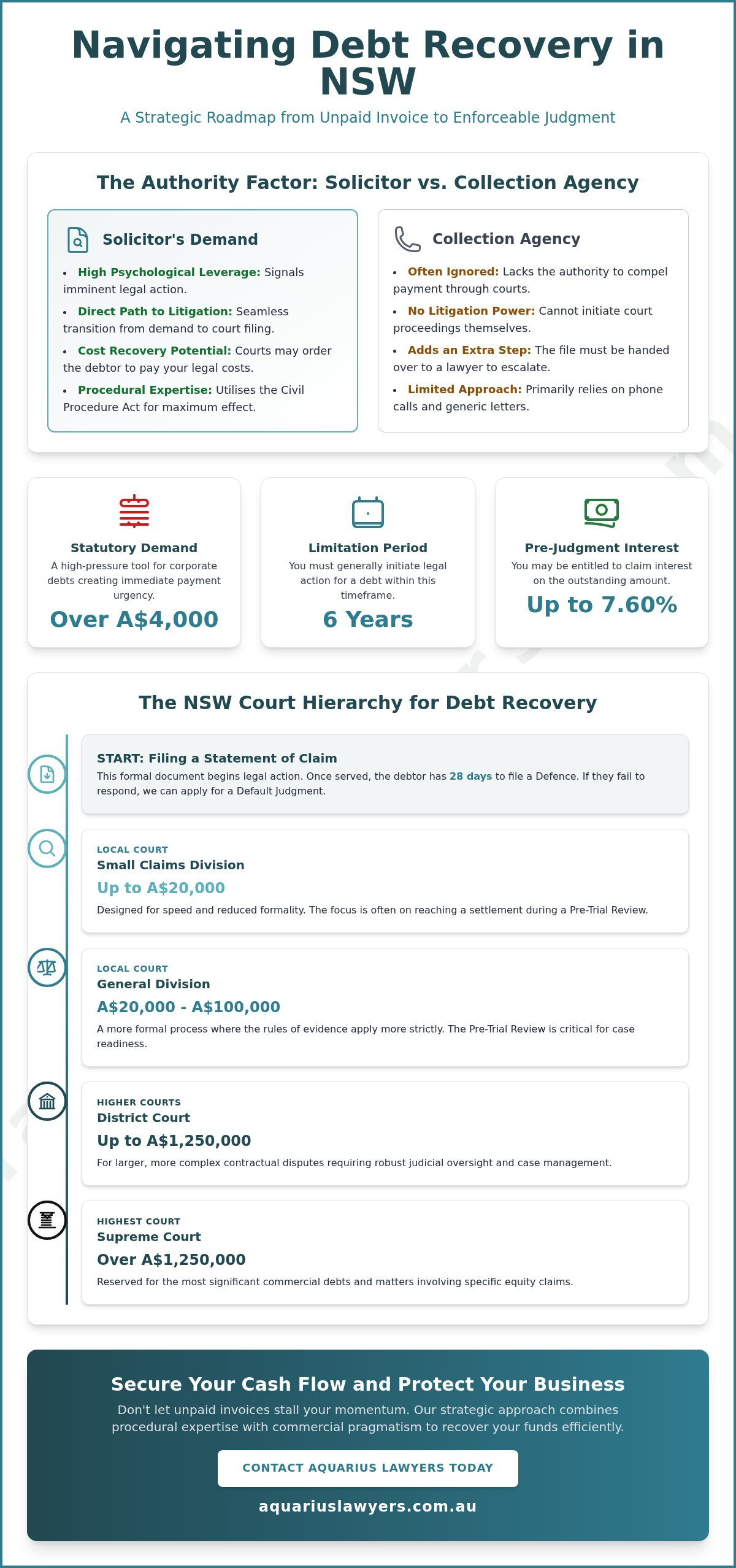
Agencies call; lawyers litigate. “Professional debtors” often ignore collection agencies because they know these firms lack the power to actually initiate court proceedings. They’re used to the letters and the automated calls. However, a solicitor’s letterhead signals a fundamental shift in intent. It shows you’re prepared to file a Statement of Claim, the formal document that begins legal action in NSW. Because we’re a law firm, we move seamlessly from a final demand to litigation without handing the file off to a third party. This continuity is vital for maintaining pressure. Additionally, the NSW legal system allows for the recovery of certain “party and party” costs. If you’re successful, the debtor may be ordered to pay a portion of your legal fees, significantly reducing the financial burden on your business.
The Strategic Advantage of Commercial Pragmatism
Winning a court case is pointless if the debtor has no assets to seize. Before we recommend litigation, we perform a “fruitfulness” assessment to ensure the debt is actually recoverable. This involves looking at the debtor’s position through the lens of Australian insolvency law to determine if they’re solvent enough to pay. We value results over ceremony. Sometimes, a strategic mediation session is more effective than a year in court. It’s about finding the shortest path to your funds. If a debtor is simply facing a temporary cash flow crunch, a professionally negotiated payment plan can recover your money while keeping a long-term commercial relationship intact. A debt recovery lawyer nsw doesn’t just chase debts; we engineer solutions that make financial sense. We balance the cost of recovery against the likelihood of payment to ensure you aren’t throwing good money after bad.
Navigating the NSW Court Hierarchy for Debt Recovery
Initiating legal action is a strategic decision that begins with a Statement of Claim. This formal document outlines exactly what’s owed, the basis of the debt, and any interest claimed. Once served, the debtor has exactly 28 days to file a Defence. If they fail to do so, a debt recovery lawyer nsw can apply for a Default Judgment. In many uncontested matters, the Court Registrar manages this process, allowing for a faster resolution without the need for a full hearing before a Magistrate or Judge. This procedural efficiency is a core strength of the NSW system, turning a stalled invoice into a legally enforceable debt with minimal friction.
The Local Court: Small Claims and General Divisions
Most commercial debt matters begin in the Local Court, but the specific division depends entirely on the quantum of the debt. The Small Claims Division handles matters up to A$20,000. It’s designed for speed and reduced formality, often focusing on reaching a settlement during a Pre-Trial Review. If the debt sits between A$20,000 and A$100,000, it moves into the General Division. Here, the rules of evidence apply more strictly, and the process becomes more formal. Navigating the Pre-Trial Review is critical; it’s the point where a Magistrate ensures all evidence is ready and often pushes parties toward a resolution. If you’re unsure which division fits your specific claim, speaking with a commercial law specialist can prevent costly procedural delays.
District and Supreme Court Jurisdictions
When the stakes are higher, the venue changes. The District Court of NSW has the jurisdiction to hear debt recovery matters up to A$1,250,000. These cases often involve complex contractual disputes or multi-party litigation that requires a more robust judicial oversight. For debts exceeding A$1,250,000, or matters involving specific equity claims and large-scale corporate insolvency, the Supreme Court is the appropriate forum. Choosing the correct jurisdiction is not just about following the rules; it’s about cost protection. If you commence proceedings in the Supreme Court for a debt that could have been handled in the Local Court, the court may penalise you by limiting the legal costs you can recover from the debtor. Correct jurisdiction + precise documentation = protected profit margins. A debt recovery lawyer nsw ensures your claim is filed in the most cost-effective court to maximise your net recovery.
Strategic Pressure Points: Statutory Demands and Enforcement
Winning a case in court is a significant milestone, but a judgment alone doesn’t put money back into your bank account. It’s a piece of paper that grants you the legal right to collect. The real work begins with enforcement. A debt recovery lawyer nsw focuses on identifying the debtor’s vulnerabilities to apply maximum pressure. We move beyond simple requests to high-leverage legal mechanisms that compel payment. Strategy + execution = recovered capital. Whether your debtor is a stubborn corporation or an evasive individual, the NSW legal system provides several “pressure points” to ensure they cannot simply walk away from their obligations.
The Power of the 21-Day Statutory Demand
If your debtor is a company and the debt exceeds A$4,000, a Statutory Demand is often the most potent tool in your arsenal. This isn’t just a letter; it’s a formal notice under the Corporations Act. Once served, the company has exactly 21 days to pay the debt or apply to the court to have the demand set aside. Failure to act within this strict window results in a legal presumption of insolvency. This allows you to apply to the Supreme Court to wind up the company. It’s a high-stakes move that often forces even the most recalcitrant directors to find the funds. However, precision is vital. If there’s a “genuine dispute” over the debt, the court may set the demand aside and order you to pay the debtor’s legal costs. We ensure your documentation is bulletproof before pulling this trigger.
Enforcing a Judgment Debt in NSW
When a debtor ignores a Statement of Claim, we move quickly to obtain a Default Judgment. This bypasses a full trial and gives us immediate access to enforcement orders. We then select the tool that best fits the debtor’s asset profile. A debt recovery lawyer nsw typically utilises one or more of the following pathways:
- Garnishee Orders: We can apply to the court to have funds diverted directly from the debtor’s bank account or their wages. As of early 2026, the weekly protected amount for wage garnishees is A$612.60, ensuring the debtor retains basic living costs while you recover the balance.
- Writs for the Levy of Property: This involves the Office of the Sheriff of NSW. The Sheriff can enter the debtor’s premises to seize and sell professional or personal assets to satisfy the debt.
- Examination Notices and Orders: If the debtor’s financial position is unclear, we can force them to attend court and disclose their assets, income, and bank details under oath.
- Charging Orders: For larger debts, we can register the judgment as a charge over the debtor’s real estate, preventing them from selling or refinancing the property without paying you first.
In cases where an individual debtor remains defiant, bankruptcy proceedings serve as the final resort. This process involves a high degree of technical complexity but remains a powerful deterrent for those attempting to shield assets from legitimate creditors.
Preparing Your Case: Evidence and NSW Regulations
Success in the courtroom is built long before the first hearing. It starts with a meticulous assembly of evidence that leaves no room for a “genuine dispute.” When you engage a debt recovery lawyer nsw, our first task is to audit your paper trail to ensure every link in the chain is secure. In NSW, the Limitation Act 1969 generally gives you six years to commence proceedings for a simple contract debt. However, this clock can restart if the debtor makes a partial payment or provides a written acknowledgement of the debt. While six years sounds generous, fading memories and lost records make early intervention a strategic necessity. Accuracy + speed = higher recovery rates.
Before filing any documents, we verify the exact legal entity of your debtor. An ABN or ACN search is a non-negotiable step; serving a Statement of Claim on a business name rather than the underlying Pty Ltd company can lead to your case being struck out. We also shield your negotiations by using “Without Prejudice” communications. This allows us to discuss potential settlements freely without those concessions being used against you if the matter proceeds to a hearing. If you are ready to secure your cash flow, you can consult with a debt recovery lawyer nsw to review your current documentation.
The Debt Recovery Checklist for NSW Businesses
To build a robust case, follow this three-step verification process:
- Step 1: Confirm the debt is due. Review your contract terms to ensure any required notice periods have passed and the debt is officially “payable.”
- Step 2: Issue a formal Letter of Demand. This must comply with court rules, providing a clear timeframe (typically 7 to 21 days) and outlining the specific consequences of continued non-payment.
- Step 3: Gather proof of performance. Compile all signed delivery dockets, service reports, and email chains where the debtor accepted the goods or services without complaint.
Common Pitfalls and How to Avoid Them
Even a valid claim can be derailed by procedural errors. One common mistake is inaccurate interest calculations. Under the Uniform Civil Procedure Rules, you are entitled to claim pre-judgment interest, which as of early 2026 is set at 7.60%. Failing to calculate this correctly, or neglecting to account for GST in the Statement of Claim, can lead to delays or reduced judgments. Furthermore, you must ensure your follow-up remains firm but professional. Crossing the line into harassment can violate ACCC and ASIC guidelines, potentially exposing your business to counterclaims or regulatory fines. We manage this balance by maintaining a “no-nonsense” professional distance that demands payment without compromising your commercial reputation. Many of these disputes also stem from commercial contract mistakes that leave Australian businesses exposed before a debt even arises, making proactive contract review an essential part of your risk management strategy.
Why Aquarius Lawyers is Your Strategic Debt Recovery Partner
Aquarius Lawyers operates as an “innovative veteran” in the legal space. We blend decades of traditional legal credentials with modern, tech-forward recovery methodologies. When you hire a debt recovery lawyer nsw from our team, you’re getting more than just a legal representative; you’re getting a strategic partner who values results over ceremony. We understand that every day an invoice remains unpaid is a day your capital isn’t working for you. Our approach is built on a simple equation: Niche Authority + Proactive Technology = Maximum Recovery. We don’t just send letters. We engineer the most efficient pathway to get your funds back into your business.
Niche Expertise: The Fish Lawyer Advantage
Our firm possesses a unique edge in the Australian market through our deep specialisation in maritime and fisheries law. Recovering debt in these industries requires more than general commercial knowledge. It requires an understanding of complex maritime liens and the specific regulations governing vessel-related debt. Whether it’s pursuing unpaid levies, commercial fishing quota fees, or managing international debt recovery for aquaculture and shipping clients, we know the terrain. We understand the high-stakes nature of the seafood and maritime sectors, where seasonal cash flow is critical. This industry-specific insight allows us to move faster and with more precision than generalist firms that might struggle with the technicalities of maritime jurisdictions.
A Direct Pathway to Resolution
Transparency and cost certainty are at the heart of our service. We offer fixed-fee options for standard recovery steps, ensuring you know exactly where you stand before we take action. This removes the fear of spiralling legal costs that often prevents businesses from pursuing what they’re rightfully owed. Our process integrates tech-driven searches to locate hidden assets and verify debtor solvency, providing you with a clear picture of the “fruitfulness” of any potential action. We’re committed to proactive communication and transparent reporting. You’ll receive regular updates at every stage, so you’re never left wondering about the status of your capital. We move easily between high-level strategic thinking and relatable, everyday wisdom to ensure you feel confident in every decision. To further protect your business from disputes before they escalate to debt recovery, understanding common commercial contract mistakes that put Australian businesses at risk is a critical first step.
If you’re tired of being ignored and ready to take a firm, professional stand, it’s time to change your strategy. Contact Aquarius Lawyers to start your recovery today and let us help you secure the funds your business has already earned. Our no-nonsense approach to commercial litigation and dispute resolution is designed to deliver the outcome you need with the efficiency you deserve.
Reclaiming Your Business Momentum
Recovering what you’re owed is about more than just persistence; it’s about the strategic application of the law to protect your bottom line. By understanding court thresholds and preparing a bulletproof evidentiary trail, you move from a position of frustration to one of absolute leverage. Accuracy creates results. Working with a debt recovery lawyer nsw ensures that your approach is both professional and procedurally sound, minimising the friction that often stalls commercial settlements. You’ve done the work, and you deserve to be paid for it.
At Aquarius Lawyers, Principal Katherine Hawes brings her recognised expertise in commercial and maritime law to every matter. With decades of experience navigating the NSW Local and District Courts, our firm provides the steady, common-sense guidance needed to resolve even the most complex disputes. We offer fixed-fee options for various commercial services to provide you with the cost certainty your business requires. Don’t let unpaid invoices dictate your operational capacity. It’s time to put your capital back to work.
Secure your cash flow with strategic debt recovery – Book a consultation. Take the first proactive step toward a debt-free ledger today.
Frequently Asked Questions
How long does the debt recovery process take in NSW?
Standard undefended debt recovery proceedings in NSW typically take between 10 to 16 weeks from the initial filing to obtaining a judgment. If the debtor chooses to file a Defence, the timeframe often extends to 12 months or longer depending on the complexity of the dispute and court availability. Your debt recovery lawyer nsw will always aim for the most efficient resolution to minimise these delays.
Can I recover my legal costs from the debtor?
You can generally recover a portion of your legal fees, known as “party and party” costs, if you are successful in obtaining a court judgment. While these scale-based costs rarely cover 100% of your legal spend, they serve to significantly offset the expense of taking formal action. Additionally, you can often recover the A$117 Local Court filing fee and other out-of-pocket expenses directly from the debtor.
What is the minimum debt amount worth pursuing legally?
While the Small Claims Division hears matters starting from any amount, A$4,000 is a critical strategic threshold for corporate debts. This is the minimum amount required to issue a Statutory Demand under Australian law. For debts below this, we perform a cost-benefit analysis to ensure that court fees and professional time don’t outweigh the value of the funds we’re recovering for you.
What happens if the debtor disputes the invoice?
If a debtor disputes your claim, they must file a formal Defence within 28 days of being served with the Statement of Claim. The matter then moves to a Pre-Trial Review where a Magistrate explores settlement options. If a resolution isn’t reached, the case proceeds to a hearing where both parties must present their evidence for a final judicial decision.
Can I still recover a debt if there is no written contract?
Yes, you can recover a debt based on a verbal agreement or the conduct of the parties, though the evidentiary burden is higher. We look for a “paper trail” of emails, text messages, and delivery dockets that prove you provided the services and the debtor accepted them. A debt recovery lawyer nsw can help piece this evidence together to establish a clear legal right to payment.
What is a Garnishee Order and how does it work in NSW?
A Garnishee Order is a powerful enforcement tool that allows you to divert funds directly from a debtor’s bank account or their wages. Once the court grants the order, the bank or employer is legally required to pay the funds to you. In NSW, a protected weekly amount of A$612.60 is currently indexed for wage garnishees to ensure the debtor maintains a basic standard of living while your debt is satisfied.
Is a Statutory Demand different from a Letter of Demand?
A Letter of Demand is a final professional warning, whereas a Statutory Demand is a formal notice issued under the Corporations Act for debts over A$4,000. The Statutory Demand is a high-leverage tool; if the company fails to pay or apply to set it aside within 21 days, they are legally presumed insolvent. This opens the door for you to apply to the Supreme Court to wind up the company.
How do I find out if a debtor has assets before suing them?
We use a combination of ASIC company searches, property title searches, and tech-driven asset location tools to assess a debtor’s solvency. If you have already obtained a judgment, we can also apply for an Examination Order. This forces the debtor to attend court and disclose their bank details, income, and property holdings under oath, providing a clear map for enforcement action.
Disclaimer
Please note that legal rules change and this is not a substitute nor construed as legal advice. It is general information only.