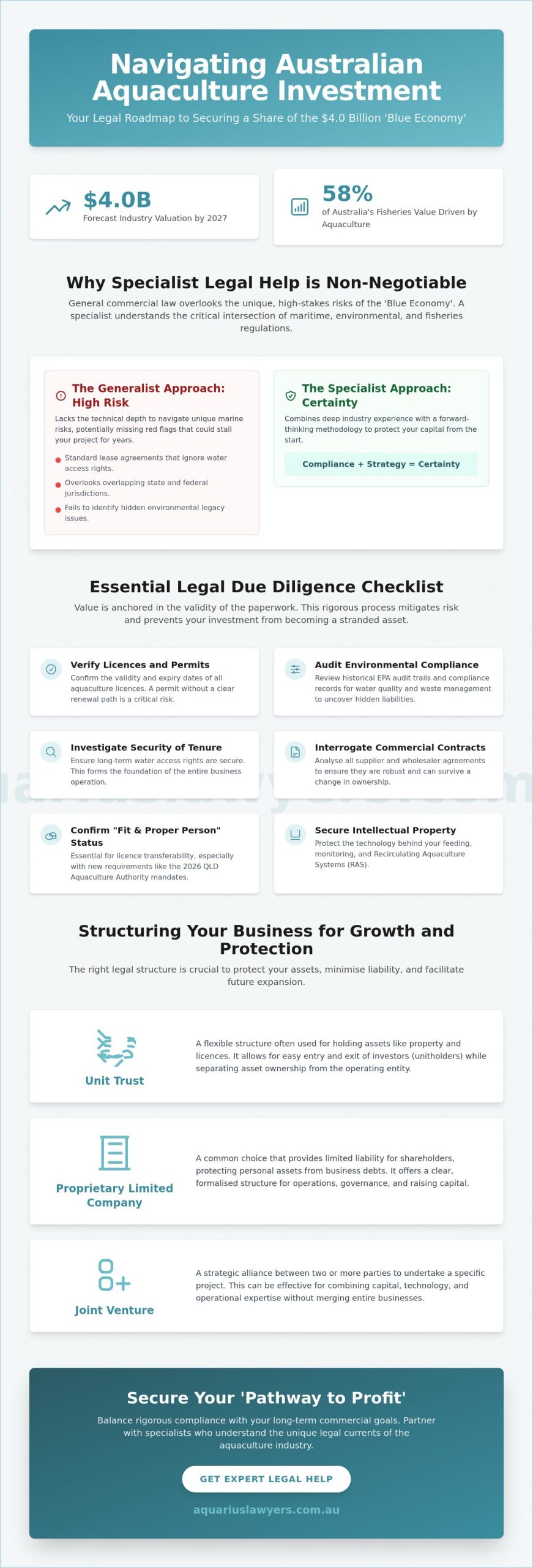
Did you know that aquaculture now drives 58% of the total value of Australia’s fisheries, with the industry forecast to reach a $4.0 billion valuation by 2027? Securing your share of this growth requires more than just technical expertise; it demands specialised aquaculture investment legal help to navigate a landscape where regulations can feel as unpredictable as the tides. It is a reality that high capital risks and opaque, multi-jurisdictional rules can stall even the most promising projects for years.
We understand that the complexity of state and federal compliance can be a significant barrier to entry. This guide provides a clear, pragmatic roadmap for your legal due diligence and strategic structuring. We’ll walk you through the essential steps to protect your capital, from navigating the new 2026 Queensland Aquaculture Authority mandates to choosing a business structure that minimises your liability. You will gain the confidence to move forward with a framework that is as resilient as the operations you intend to build. Our approach combines deep industry experience with a forward-thinking methodology to ensure your investment is protected from the start.
Key Takeaways
- Understand why general commercial law fails to address the unique risk profile of the “Blue Economy” and why specialised marine expertise is vital.
- Master the legal due diligence process by learning how to verify licence validity and audit historical environmental compliance records.
- Determine whether a unit trust, proprietary limited company, or joint venture is the best structure to protect your assets and facilitate expansion.
- Navigate the approval maze with confidence by learning how to identify lead agencies and streamline development applications across state borders.
- Access a strategic “Pathway to Profit” through expert aquaculture investment legal help that balances rigorous compliance with your long-term commercial goals.
Why Specialist Legal Help is Non-Negotiable for Aquaculture Investment
Investing in the Australian “Blue Economy” is far more complex than a standard commercial property play. While a traditional lawyer understands leases and liability, they often lack the technical depth to navigate the intersection of maritime, environmental, and fisheries law. To truly understand what is aquaculture? in a commercial context, you must view it as a high-stakes synergy between biological variables and rigid regulatory frameworks. This is why seeking specialised aquaculture investment legal help is the first step toward securing your capital.
General commercial law doesn’t account for the unique risk profile of marine farming. In this industry, a standard lease agreement is only the tip of the iceberg. A specialist “Fish Lawyer” identifies red flags that an all-rounder would miss, such as overlapping jurisdictional claims between state and federal waters or hidden environmental legacy issues. We look at your investment through a prism of pragmatism: Compliance + Strategy = Certainty. Without this specific lens, you risk sinking capital into a project that may never clear the first hurdle of environmental litigation or regulatory shifts.
The High Stakes of Marine and Fisheries Compliance
The Environment Protection and Biodiversity Conservation Act 1999 (EPBC Act) remains a formidable barrier for the unprepared. A single oversight regarding protected migratory species or seagrass habitats can trigger a federal intervention, stalling your project for years. Beyond environmental law, biosecurity obligations are non-negotiable. You have a strict legal duty to manage disease and report outbreaks immediately. In Australia, the cost of non-compliance is steep. It isn’t just about the fines; it’s about the permanent loss of your social licence to operate and the risk of total licence cancellation.
Bridging the Gap Between Ag-Tech and Maritime Law
Modern aquaculture is as much about technology as it is about biology. Whether you are funding an offshore cage system or a land-based Recirculating Aquaculture System (RAS), you must secure the intellectual property behind your feeding and monitoring systems. As we approach 2026, new climate risk disclosure requirements will force investors to be even more transparent about their environmental footprint. Securing aquaculture investment legal help ensures your operation is future-proofed against these evolving standards. We help you navigate the legalities of innovative farming methods, ensuring your tech-driven “Pathway to Profit” remains unencumbered by outdated legal structures.
Essential Legal Due Diligence Checklist for Investors
Moving from the theoretical potential of a project to a signed contract requires a rigorous, “no-nonsense” evaluation of the target asset. In the marine sector, value isn’t just found in the biomass or the technology; it’s anchored in the validity of the paperwork. If you are acquiring an existing operation, your first step is a granular verification of all aquaculture licences and permit expiry dates. A permit that expires shortly without a clear pathway for renewal can turn a “blue-chip” investment into a stranded asset overnight. This is where professional aquaculture investment legal help becomes your most valuable tool for risk mitigation.
Due diligence must extend beyond the surface. You need to review historical environmental compliance and EPA audit trails to ensure there are no “skeletons in the closet” regarding water quality or waste management. Undisclosed liabilities often hide in property titles or maritime liens on vessel assets. We also look closely at the security of tenure. Without long-term water access rights, your business has no foundation. Every commercial contract with suppliers and wholesalers must be interrogated to ensure they are robust enough to survive a change in ownership.
Licensing and Regulatory Vetting
State-specific laws dictate the rules of engagement. For instance, in Queensland, the new “Aquaculture Authority” requirements that commenced on 27 April 2026 have changed the compliance landscape for all assessable operations. You must confirm the “fit and proper person” status for all licence holders, as this directly impacts the transferability of permits. It’s also vital to check for any pending fisheries prosecutions. A deep understanding of Australia’s aquaculture legal framework is essential to ensure that the permits you are buying are actually worth the paper they are printed on.
Environmental and Social Governance (ESG) Audit
A project’s “social licence” is as critical as its environmental impact statement (EIS). If a project lacks community support or has a history of poor engagement, your expansion plans will likely face stiff opposition. In regional Australia, you must also consider the legal implications of Indigenous Land Use Agreements (ILUAs). These agreements are not just a formality; they are a fundamental part of the legal landscape that ensures traditional owners are respected and involved. Ignoring these factors can lead to costly delays and reputational damage that no amount of marketing can fix. If you need a hand assessing a potential site, we can help you build a comprehensive due diligence framework to protect your interests.
Structuring Your Aquaculture Business for Growth and Protection
Choosing the right business structure is a foundational decision that dictates your tax obligations and your level of personal risk. In the context of aquaculture investment legal help, we often see investors overlook the importance of asset separation. A common mistake is holding the aquaculture licence within the same entity that manages daily operations. If a biosecurity breach or environmental incident occurs, that licence becomes vulnerable to the company’s liabilities. By separating the “licence holder” from the “operator”, you create a legal firewall that protects your most critical asset. Structure equals security.
Most Australian ventures choose between three main frameworks: sole traders, unit trusts, and proprietary limited companies. While a sole trader structure is simple, it offers zero protection for your personal assets in a high-risk marine environment. Unit trusts are popular for their tax flexibility and ability to flow through income to beneficiaries. However, for most commercial-scale operations, a proprietary limited (Pty Ltd) company remains the gold standard. It provides a clear legal personality and limited liability for shareholders. It’s also the preferred vehicle for accessing primary producer tax concessions and R&D tax incentives, which are vital for those investing in Recirculating Aquaculture Systems (RAS) or innovative feeding technologies. Ensuring your aquaculture business plan legal requirements are embedded into your chosen structure from the outset is essential to avoid costly restructuring down the line.
Joint Ventures and Strategic Partnerships
Large-scale projects, such as the $110 million expansion at Whale Point in Tasmania, often rely on Joint Ventures (JVs). A robust JV agreement must do more than just split profits; it must clearly define operational control and biosecurity responsibilities. We advocate for drafting “living documents” that include clear exit strategies and buy-sell provisions. If a partnership sours, you need a legal pathway to wind down or sell your stake without destroying the business. We always prioritise mediation over costly litigation to resolve disputes, keeping your capital focused on production rather than court fees.
Foreign Investment Review Board (FIRB) Compliance
International capital is a major driver of the Australian aquaculture sector, but it comes with strict oversight. If you are an international investor, you must determine if your acquisition requires FIRB approval. Most aquaculture sites fall under the “sensitive land” definition because they are located in maritime or coastal zones. This means lower monetary thresholds for mandatory notification often apply. Beyond the initial approval, foreign-owned primary production assets have ongoing reporting obligations. Getting this right from day one prevents federal intervention and ensures your “Pathway to Profit” remains clear and compliant.
Navigating the Multi-Jurisdictional Approval Maze
The Australian aquaculture sector is governed by a patchwork of state and federal authorities. For many investors, the sheer volume of “red tape” is the single greatest deterrent to entry. However, complexity shouldn’t be a deal breaker; it simply requires a methodical approach. Securing professional aquaculture investment legal help ensures you don’t miss a critical agency in the sequence. Efficiency in this phase is a direct result of proper sequencing. We follow a proven five-step roadmap to bring projects from concept to operational reality.
The process begins with identifying your lead agency, such as Fisheries Queensland or the NSW Department of Primary Industries (DPI). From there, you must secure development approval (DA) from local and state planning bodies, a process that often requires detailed environmental impact statements. The third step involves negotiating lease terms with Crown Lands or Port Authorities to secure your physical footprint. Once the land or water is secured, you must obtain environmental protection licences and biosecurity clearances. Finally, you’ll need to finalise operational permits and vessel registrations through the Australian Maritime Safety Authority (AMSA). Missing any one of these links can stall your production cycle indefinitely.
State vs. Commonwealth Jurisdictions
The three-nautical-mile limit is the primary legal boundary in Australian waters. State and territory governments generally manage coastal waters up to this line, while the Commonwealth manages the zone from three to 200 nautical miles. Navigating the Offshore Constitutional Settlement (OCS) is vital if your operation spans both jurisdictions. With the updated National Environmental Standards for Marine Aquaculture coming into effect on 4 June 2026, it’s now easier for operators to reconsent and undertake research in Commonwealth waters. Understanding these boundaries prevents jurisdictional overlaps that can lead to double-handling of compliance data.
Common Roadblocks in the Approval Process
Native title claims and coastal management plans are frequent hurdles that can extend approval timeframes if not addressed early. You must also manage competing interests from recreational fishers and the tourism sector. We specialise in “shovel-ready” legal preparation, which involves addressing potential objections before they reach the public notification stage. By proactively engaging with stakeholders and aligning your waste management plans with the latest EPA standards, you significantly reduce the risk of litigation. If you want to avoid these common pitfalls and fast-track your project, we can help you streamline your approval strategy with a pragmatic legal framework.
How Aquarius Lawyers Secures Your Aquaculture Future
Katherine Hawes, widely recognised as “The Fish Lawyer,” brings a unique blend of academic rigour and practical sea-legs to the table. Most legal firms treat marine ventures as a side interest; at Aquarius Lawyers, it’s our core focus. We’ve developed a “Pathway to Profit” methodology that ensures your compliance obligations aren’t just a box-ticking exercise; they are integrated into your commercial goals. This approach provides the specialised aquaculture investment legal help needed to turn high-risk variables into manageable business milestones. We value results over ceremony.
We prioritise transparency in our partnership. This means offering fixed-fee options for initial due diligence and project feasibility reviews. You shouldn’t have to guess your legal costs while you’re still assessing water quality or biomass potential. For established operations, our ongoing retainer support provides a safety net for corporate compliance and risk management. We act as a steady, common-sense guide through the choppy waters of primary industry regulation, ensuring your structure remains resilient as you scale.
A Modern Approach to Traditional Marine Law
We bridge the gap between traditional maritime law and the fast-paced world of ag-tech. By leveraging modern legal technology, we ensure document reviews and reporting are handled with clinical efficiency. You also gain direct access to our hand-picked network of maritime experts, biologists, and planners. This synergy allows us to solve problems that others haven’t even identified. We don’t just react to the law; we monitor it proactively. Whether it’s a shift in state fisheries policy or a new federal environmental standard, we tell you about regulation changes before they impact your bottom line.
Get Started with a Strategic Consultation
Your first session with us is designed to be a practical “stress test” for your business plan. We don’t do detached formality. Instead, we dive straight into the mechanics of your project to identify potential legal bottlenecks. Come prepared to discuss your structure, your site, and your long-term expansion goals. Our job is to provide the clarity and confidence you need to move forward. If you’re ready to secure your position in Australia’s growing aquaculture industry, organise a consultation with Aquarius Lawyers today.
Securing Your Position in Australia’s Blue Economy
Australia’s aquaculture sector is on a clear trajectory toward a $4.0 billion valuation by 2027. To capitalise on this growth, your legal framework must be as robust as your operational technology. We’ve explored how separating your licence from your operating entity provides a vital layer of asset protection. We also highlighted the importance of a meticulous due diligence process to uncover hidden liabilities before they sink your capital. In this high-stakes environment, success is simply a result of thorough preparation meeting market opportunity.
Accessing specialised aquaculture investment legal help is no longer just a recommendation; it’s a strategic necessity for any serious investor. Principal Katherine Hawes, widely known as “The Fish Lawyer,” brings deep expertise in NSW and International Marine Law to every project. With a proven track record in fisheries compliance and commercial litigation, Aquarius Lawyers provides the grounded pragmatism you need to navigate complex state and federal waters. It’s about building a business that is compliant, resilient, and ready for expansion.
Secure your aquaculture investment with expert legal help. The future of sustainable seafood in Australia is bright, and with the right legal partner, your venture can thrive in this innovative landscape.
Frequently Asked Questions
Do I need a specific lawyer for aquaculture or will a commercial lawyer do?
A specialist lawyer is essential because aquaculture involves a unique risk equation that standard commercial practitioners rarely encounter. While a general commercial lawyer handles contracts, they often lack the technical depth to manage biosecurity obligations or the complexities of the Offshore Constitutional Settlement. Specialised aquaculture investment legal help ensures your counsel understands the biological and regulatory variables specific to both marine and land-based farming operations.
What are the main legal risks when investing in Australian fish farms?
The primary legal risks include biosecurity failures, environmental litigation, and insecure water access rights. A single disease outbreak or waste-management breach can trigger heavy fines or the permanent cancellation of your operating licence. You must also manage the risk of overlapping jurisdictions, where state and federal laws might impose conflicting requirements on your site, potentially stalling your production for years.
How long does the legal approval process take for a new aquaculture site?
Approval timeframes generally range from 12 to 24 months, depending on the complexity of the environmental impact statement and the specific state jurisdiction. Projects located in designated “shovel-ready” zones may move through the system faster. Conversely, offshore ventures often face longer delays due to federal assessments under the EPBC Act. Proactive legal preparation is the best way to avoid common roadblocks that stretch these timelines.
Can international investors own 100% of an Australian aquaculture business?
International investors can own 100% of an Australian aquaculture business, provided they comply with Foreign Investment Review Board (FIRB) requirements. Because most sites are located on “sensitive land” within coastal or maritime zones, lower monetary thresholds for mandatory notification often apply. You must ensure all reporting obligations are met to avoid federal intervention and to maintain the long-term security of your investment.
What is the difference between an aquaculture licence and a sea lease?
An aquaculture licence grants you the legal right to farm specific species, while a sea lease provides the right to occupy a particular area of Crown land or water. You need both to operate legally. Think of the licence as your “permission to produce” and the lease as your “right to the site.” Managing the different expiry dates and conditions of each document is a critical part of your compliance strategy.
What happens if environmental regulations change after I have invested?
You are typically required to adapt to new environmental standards as they are introduced, such as the updated National Environmental Standards for Marine Aquaculture. While some existing permits may have limited protections, most modern licences include conditions that allow regulators to update environmental requirements. This reality makes ongoing risk monitoring essential to protect your capital from sudden and significant compliance costs.
How does Aquarius Lawyers help with government grant applications?
We assist by ensuring your business structure and compliance history meet the rigorous eligibility criteria of state and federal grant programs. Programs like the NSW Aquaculture Industry Development Program require detailed evidence of your legal standing and operational viability. We help you provide aquaculture investment legal help by packaging this information to demonstrate that your project is a low-risk, high-value candidate for public funding.
Do I need FIRB approval for land-based aquaculture projects?
FIRB approval is often required for land-based projects because they involve the acquisition of “agricultural land” by a foreign person. The specific thresholds depend on your country of origin and the classification of the land you intend to purchase. Even land-based Recirculating Aquaculture Systems (RAS) must be vetted to ensure the investment aligns with Australia’s national interest and foreign ownership regulations.
Disclaimer
Please note that legal rules change and this is not a substitute nor construed as legal advice. It is general information only.