
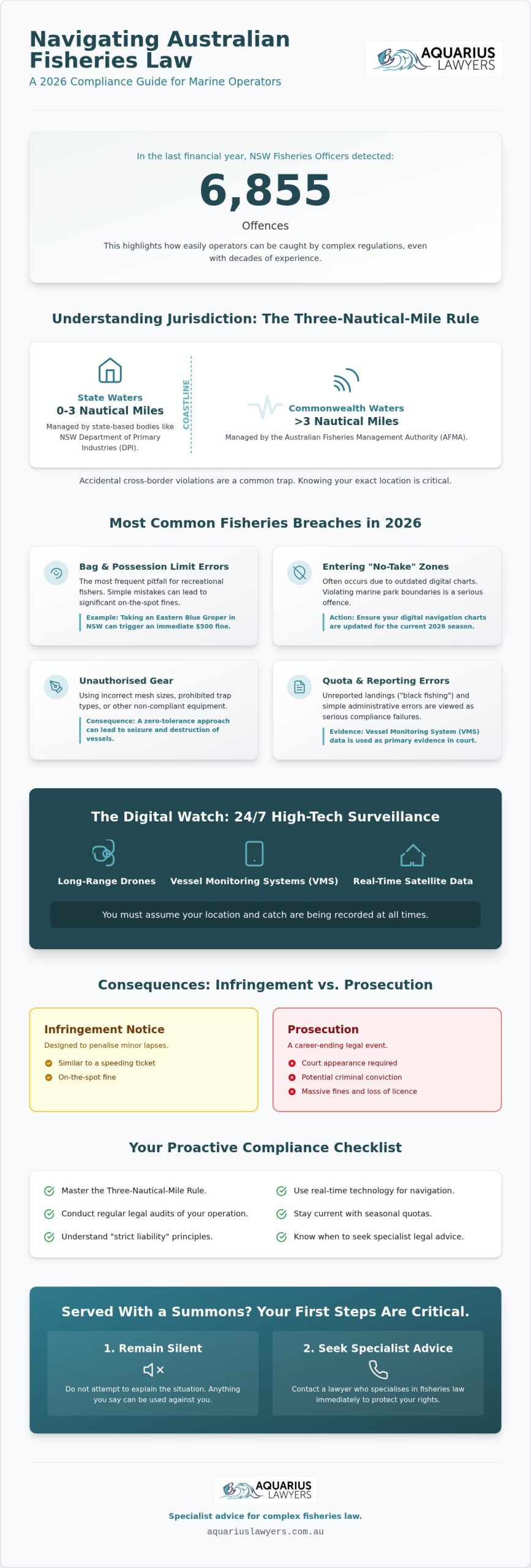
Did you know that NSW Fisheries Officers detected 6,855 offences in the last financial year? It is a confronting figure that highlights just how easy it is to get caught up in common fisheries law breaches australia operators often encounter, even when you have been in the industry for decades. You likely feel the pressure of juggling different state and federal rules while trying to keep up with changing seasonal quotas. It is exhausting to stay on top of everything when the goalposts move every season.
This 2026 guide provides the clarity you need to move from confusion to confidence. We will examine the current $330 Commonwealth penalty units, the strict liability traps that lead to “accidental” offences, and the latest demersal closures in Western Australia. You will learn how to build a compliance strategy that protects your commercial licence. By combining deep industry knowledge with practical safeguards, you can stop worrying about inspections and know exactly when to call in a specialist to safeguard your business.
Key Takeaways
- Master the “Three-Nautical-Mile Rule” to distinguish between state and Commonwealth jurisdictions and prevent accidental cross-border violations.
- Identify the most frequent common fisheries law breaches australia faces in 2026, including bag limit errors and entering “no-take” marine zones.
- Shift to a proactive compliance strategy by using real-time technology and legal audits to safeguard your livelihood and commercial assets.
- Learn the essential steps to take when served with a summons, including the strategic importance of remaining silent until you speak with a specialist.
- Stay ahead of the game by understanding how seasonal quotas and strict liability principles apply to your specific operations this year.
Understanding Fisheries Compliance in Australian Waters
Fisheries law in Australia is not a single rulebook. It is a sophisticated intersection of environmental conservation, commercial management, and criminal statutes. Because our marine biodiversity is so high, the regulations are among the strictest on the planet. When you look at common fisheries law breaches australia operators face, they often arise from a misunderstanding of how these different legal layers overlap. You might be following commercial quota rules but accidentally violate a marine park “no-take” zone, leading to immediate legal trouble.
The difference between a minor infringement notice and a full prosecution is massive. An infringement is essentially an on-the-spot fine, similar to a speeding ticket, designed to penalise minor lapses. A prosecution, however, involves a court appearance and can lead to criminal convictions, massive fines, or the loss of your commercial licence. Katherine Hawes, known internationally as The Fish Lawyer, acts as a translator in this space. She takes these dense legal frameworks and turns them into common-sense business strategies, ensuring you stay on the right side of the law without sacrificing your efficiency.
The Purpose of Strict Fisheries Enforcement
Australia’s rigid enforcement isn’t about being difficult; it’s about protection. Authorities focus on three main pillars:
- Sustainability: Ensuring fish stocks remain viable for future generations so the industry doesn’t collapse.
- Economic Value: Protecting the massive financial investment commercial fishers make in their quotas and licences.
- Biosecurity: Preventing the spread of marine pests and diseases that could wipe out entire aquaculture sectors.
Key Authorities: Who Monitors Australian Waters?
Monitoring is split between state and federal jurisdictions. The Australian Fisheries Management Authority (AFMA) manages Commonwealth waters, which generally start three nautical miles offshore. Closer to the coast, state-based bodies like the NSW Department of Primary Industries (DPI) take the lead. By 2026, enforcement has become incredibly high-tech. Authorities now use real-time satellite Vessel Monitoring Systems (VMS) and long-range drones to monitor activity 24/7. This tech-heavy approach has led to a surge in detections, including the prosecution of over 200 foreign fishers in Darwin since mid-2025. If you’re operating on the water today, you should assume your location and catch are being recorded.
The Most Common Commercial and Recreational Breaches
While high-level illegal activity often makes the news, the majority of common fisheries law breaches australia records involve everyday operators facing complex rules. According to an Australian Institute of Criminology report on fishing industry crime, while some breaches are deliberate, many stem from the inherent difficulty of managing high-value species in a strict regulatory environment. For recreational fishers, exceeding bag or possession limits is the most frequent pitfall. For example, taking an Eastern Blue Groper in NSW can trigger an immediate $500 fine. Similarly, fishing in “no-take” marine parks or protected zones often happens because an operator hasn’t updated their digital charts for the 2026 season.
Unauthorised gear remains a significant focus for enforcement officers. This includes everything from using the wrong mesh size in nets to deploying prohibited trap types in specific bioregions. In Queensland, the zero-tolerance approach to gear breaches recently led to the seizure and destruction of three boats in September 2026. These aren’t just minor slap-on-the-wrist offences; they are life-changing legal events that can end a career overnight.
Commercial Quota and Reporting Errors
Commercial operators face a heavy administrative burden. “Black fishing” or unreported landings are treated with extreme severity because they undermine the entire quota system. Today, the Australian Fisheries Management Authority (AFMA) uses Vessel Monitoring System (VMS) data as primary evidence in court. If your location data doesn’t match your logbook entries, you face an uphill battle. Simple administrative errors, such as expired licences or inaccurate catch data, are no longer viewed as minor paperwork issues but as serious compliance failures. If you’re unsure about your current paperwork status, seeking advice on fisheries law can prevent a costly audit.
Protected Species and Bycatch Issues
The legal obligation of “due diligence” is your primary defence against bycatch charges. Accidental capture of protected species, like certain sharks or turtles, must be reported immediately. Failure to use mandated mitigation tools, such as Turtle Excluder Devices, is a strict liability offence. This means the court doesn’t care if you didn’t mean to catch the animal; they only care that the required gear wasn’t in place. In 2026, the focus has shifted toward ensuring every boat has a documented bycatch strategy to prove they’ve taken all reasonable steps to avoid breaches.
Jurisdiction Jargon: State vs. Commonwealth Regulations
The Three-Nautical-Mile Rule is the invisible line that dictates which set of laws applies to your vessel. In Australia, state governments manage fisheries from the shoreline out to 3 nautical miles. Beyond that point, you enter Commonwealth waters. The Australian Fishing Zone (AFZ) is the expansive maritime region extending from that 3-nautical-mile mark out to a 200-nautical-mile reach. Many common fisheries law breaches australia fishers encounter happen because they cross this boundary without adjusting their practices. You might be legally catching a specific species in state waters, but find yourself in breach the moment you drift past that 3-mile marker into federal territory.
This “cross-border” movement often creates legal confusion. In some cases, it can lead to a form of double jeopardy where an operator faces scrutiny from both state and federal agencies for a single trip. Knowing exactly which specific Act applies to your catch is not just a matter of administration; it’s a matter of business survival. Operating without this knowledge is like driving across state lines without knowing the speed limit has changed; ignorance is rarely an acceptable defence in court.
NSW-Specific Regulations for Local Fishers
Local operators must comply with the Fisheries Management Act 1994 (NSW). This legislation governs everything from bag limits to seasonal closures in Sydney Harbour and regional NSW coastal waters. For instance, the spawning closure for Australian Bass and Estuary Perch from May to August 2026 is a critical date for NSW fishers to remember. Aquarius Lawyers frequently assists Sydney-based commercial fleets in reviewing their internal compliance manuals to ensure they align with these state-specific mandates. We focus on turning complex statutory requirements into clear, actionable operational steps that protect your licence.
The Commonwealth Context: AFMA Enforcement
Once you move into federal waters, the Fisheries Management Act 1991 (Cth) takes precedence. The penalties here are significantly higher, with Commonwealth penalty units currently sitting at $330 each. Enforcement is managed through AFMA’s Domestic Compliance Program, which utilises high-tech surveillance to monitor activity. If you are targeted in a Commonwealth investigation, you will likely face a formal interview process that is far more intense than a standard state-based inspection. Because federal charges carry such weight, it is vital to engage a marine law specialist who understands the nuances of AFMA’s investigative powers. We provide the strategic guidance needed to manage these high-stakes interactions effectively.
How to Organise Your Compliance Strategy and Avoid Fines
Building a robust compliance strategy isn’t just about following rules; it’s about protecting your commercial assets. A proactive approach is always cheaper than a reactive court case. By conducting a regular legal audit, you can identify the common fisheries law breaches australia operators often face before they trigger an inspection. In 2026, the margin for error is slim. You need a system that works as hard as your crew does to keep your licence secure.
Modern technology is your best ally on the water. AI-driven apps now provide real-time alerts for bioregion closures, such as the total cessation of demersal fishing in the West Coast Bioregion starting 1 January 2026. These tools remove the guesswork. Every commercial voyage should begin with a “no-nonsense” checklist to ensure total readiness:
- Zone Verification: Confirm the exact GPS boundaries and current seasonal closures for your target species.
- Gear Audit: Double-check mesh sizes and the presence of mandated mitigation devices like Turtle Excluder Devices.
- VMS Check: Ensure your Vessel Monitoring System is active and transmitting correctly to avoid “dark vessel” suspicions.
- Crew Briefing: Verify that every staff member understands the 2026 bag limits and reporting requirements.
Maintaining Accurate Records and Logbooks
The shift toward mandatory digital reporting in 2026 has changed the enforcement landscape. Paper logs are largely a thing of the past. If you notice an entry error in your digital logbook, correct it immediately. Authorities often provide legal protections for “self-reporting” mistakes if they are caught and rectified before an officer boards your vessel. Honesty and transparency in your digital records create a “paper trail” of compliance that is invaluable if you ever face a formal audit.
Engaging a Specialist for a Compliance Review
Generic commercial lawyers often miss the specific nuances of strict liability that define marine law. They might understand contracts, but they don’t always grasp the complexities of state versus federal jurisdiction or the specific powers of a fisheries officer. Engaging a fisheries lawyer australia ensures your business is reviewed by someone who speaks the industry’s language. A fixed-fee legal strategy session can provide a clear roadmap for your operations, helping you avoid the stress of unexpected billable hours. If you want to secure your fleet’s future, it’s time to organise a professional compliance review to identify and close any gaps in your current strategy.
Expert Legal Defence for Fisheries Prosecutions
Being served with a summons or a notice of prosecution is a high-stress moment that requires an immediate, calculated response. If you find yourself in this situation, the most important action you can take is to stop talking. While fisheries officers are often approachable, their job is to gather evidence that could lead to a conviction. In the context of common fisheries law breaches australia prosecutors pursue, your initial statements on the boat or at the wharf are frequently the strongest evidence against you. Silence isn’t an admission of guilt; it’s a strategic protection of your legal rights.
Building a defence starts with a meticulous review of the facts. We look for technical flaws in the prosecution’s case, such as incorrectly calibrated surveillance equipment or errors in species identification. A common pathway is the “honest and reasonable mistake of fact” defence. This applies when you genuinely believed a set of facts that, if true, would have made your actions legal. For example, if you relied on a government-issued map that contained a verified error, your mistake might be deemed reasonable by the court.
Navigating the Court Process in NSW
Most fisheries matters begin in the Local Court with a “mention.” This is a preliminary hearing where the court checks the progress of the case. It’s also a critical window for negotiation. We work directly with prosecutors to highlight mitigating factors, often resulting in reduced charges or lower penalties. A conviction for a serious breach can lead to a “show cause” notice for your commercial licence, which effectively puts your livelihood at risk. Managing the court process with precision is the only way to avoid these long-term consequences.
Why Katherine Hawes is Your Best Ally
Katherine Hawes, known globally as The Fish Lawyer, offers a unique combination of criminal defence expertise and deep marine industry knowledge. She doesn’t just understand the law; she understands the practicalities of life on the water. This “no-nonsense” approach means you get a strategy based on reality, not just theory. By using modern methodology and traditional legal credentials, Aquarius Lawyers provides a steady guide through the most complex prosecutions. To protect your future and secure your assets, Book a Legal Strategy Session with Aquarius Lawyers today.
Securing Your Future on the Australian Water
Operational success in 2026 requires more than just a good catch; it demands a bulletproof compliance strategy. We have explored how the three-nautical-mile jurisdictional split and the shift toward mandatory digital reporting have redefined the industry. By identifying the common fisheries law breaches australia operators often face, you can transform legal risks into manageable business protocols. Whether you are navigating NSW DPI bag limits or a complex AFMA investigation, the right preparation ensures your commercial licence remains your most valuable asset.
Expertise is the ultimate safeguard against “accidental” breaches. Principal Katherine Hawes, known globally as The Fish Lawyer, brings specialised authority in both commercial and criminal law to every case. With deep experience in AFMA and NSW DPI regulations, Aquarius Lawyers provides the steady, down-to-earth guidance you need to resolve disputes and protect your legacy. Don’t leave your livelihood to chance. Protect your livelihood—Contact Aquarius Lawyers for a Fisheries Strategy Session and move forward with absolute confidence.
Frequently Asked Questions
What is the most common fisheries breach for recreational fishers in NSW?
Exceeding bag or possession limits remains the most frequent offence for recreational fishers in New South Wales. In the 2023-24 financial year, NSW Fisheries Officers detected 6,855 offences, many of which involved taking more than the permitted number of a specific species. These errors often occur when fishers fail to check the latest seasonal limits or use outdated fishing apps. Staying updated with current NSW DPI bag limits is essential to avoid on-the-spot fines.
Can my boat be seized for a fisheries law breach in Australia?
Yes, authorities have the power to seize and even destroy vessels involved in serious offences. In September 2026, three boats were seized and destroyed in Queensland following investigations into illegal seafood sales. This zero-tolerance approach is designed to deter repeat offenders and protect the integrity of the industry. Forfeiture of equipment, including your boat and fishing gear, is a real risk for major common fisheries law breaches australia regulators investigate.
What should I do if a fisheries officer boards my vessel?
You should remain calm, follow all safety instructions, and provide the required identification or licences. While you must assist with the inspection of your catch and gear, you have the right to remain silent regarding any potential admissions of guilt. Anything you say can be used as evidence in a prosecution. It is often best to provide the necessary paperwork and then contact a legal specialist before making a formal statement.
Is an “honest mistake” a valid legal defence for exceeding a bag limit?
Generally, an “honest mistake” is not a valid defence because many fisheries offences are “strict liability.” This means the prosecution does not need to prove you intended to break the law; they only need to prove the breach occurred. However, a specific legal defence known as an “honest and reasonable mistake of fact” may apply in very narrow circumstances. This usually requires proving that you genuinely believed a fact that would have made your actions legal.
How much are the fines for commercial fisheries breaches in 2026?
Fines vary significantly depending on the jurisdiction and the severity of the offence. In 2026, a single Commonwealth penalty unit is valued at $330. For serious corporate breaches, such as driftnet offences, fines can reach up to 2,500 penalty units, totalling $825,000. In New South Wales, court-imposed penalties for serious breaches can reach $22,000. These financial penalties are often accompanied by the loss of commercial quotas or licence suspension.
Can I appeal a decision to cancel my commercial fishing licence?
Yes, you can appeal a decision to suspend or cancel your commercial licence. In jurisdictions like New South Wales, the demerit point system triggers a “show cause” notice before a licence is cancelled. This provides a formal opportunity to present your case and explain why you should retain your livelihood. Navigating this administrative process requires a strategic legal response to ensure your arguments are heard by the relevant fisheries authority or tribunal.
Do I need a specialised lawyer for a fisheries prosecution?
While any lawyer can represent you, a specialised fisheries lawyer understands the unique intersection of marine science, strict liability, and industry regulations. General criminal lawyers may overlook technical defences related to Vessel Monitoring Systems or bioregion boundaries. Having a representative like Katherine Hawes, known as “The Fish Lawyer,” ensures your defence is built on deep industry expertise. This specialised knowledge is often the difference between losing your licence and reaching a favourable settlement.
What happens if I accidentally catch a protected species?
You have a legal obligation to report the accidental capture of any protected species immediately to the relevant authority. Failure to report bycatch can lead to severe penalties, even if the capture was unintentional. You must also demonstrate that you were using required mitigation devices, such as Turtle Excluder Devices, where mandated. Keeping accurate, real-time records of these incidents in your digital logbook is a critical part of proving your “due diligence” on the water.