
Acquiring commercial real estate in New South Wales requires strict legal due diligence, structured risk management, and transparent financial planning. Engaging an experienced commercial property purchase lawyer nsw ensures you identify hidden liabilities, verify zoning permissions, and execute contracts efficiently.
Key Takeaways: A commercial property purchase lawyer nsw manages contract reviews, zoning verification, and lease audits to prevent you from inheriting undisclosed liabilities or planning breaches.
- Standard legal reviews typically take 3 to 5 business days under fixed fee structures.
- Unless you perform due diligence, you inherit all historical council orders and tax debts.
- Instruct a lawyer to audit existing leases before exchange to verify your future yield.
- The article highlights how unapproved building works transfer to your balance sheet at settlement.
Match Your Buyer Type to the Right First Legal Move
Your commercial property purchase strategy depends on whether you occupy the premises, hold them for yield, or buy from offshore. Buyers often sign before planning constraints are tested, and that habit feeds zoning disputes and delayed settlements.
At the start of the file, map yourself to one of these paths:
- Owner-occupier: Confirm the zoning already permits your exact operations, then instruct a contract review before you pay a deposit.
- Commercial investor: Audit every registered lease for term, default triggers, and incentive clawbacks so cash flow is intact from day one.
- Foreign buyer: Diary FIRB dates first; a missed compliance deadline attracts statutory penalties that dwarf legal fees.
A missed lease clause works like a tear in a safety net: you only feel the drop after exchange. Prioritise contract review early. Aquarius Lawyers can structure the file so title, planning, and finance move together. Early structuring is the practical form of protecting my stuff (asset protection strategies) on a commercial buy.
5 Steps That Keep Commercial Conveyancing in NSW on Track
Commercial property purchase files follow a fixed legal sequence. Treat each step as a gate, not a formality.
- Review contract terms: Examine vendor disclosures and title conditions.
- Perform due diligence: Investigate zoning limits, lease agreements, and structural reports.
- Exchange contracts: Sign agreements and pay the deposit to secure the property.
- Prepare settlement: Confirm tax obligations and arrange funds transfer.
- Finalise transfer: Complete legal settlement and register your title.
Under basic principles of property law (Wikipedia, 2026), ownership transfers carry binding statutory conditions that dictate land usage. Skipping due diligence is the commercial equivalent of sailing without radar: you discover the hazard after you are already committed. Statutory duties that attach once you hold title need a plan from the moment settlement is booked, not after the keys change hands. Read how the firm’s Property work supports commercial files, then speak with the legal team before you lock the sequence in.
Tip: Always confirm planning certificates under Section 10.7 before exchanging contracts to avoid restricted land use issues.
Fixed Fees or Hourly Rates: What Review Timelines Really Cost You
Transparent billing removes a layer of uncertainty when you buy commercial real estate across Sydney. Fixed fee models give you a known figure for standard transactions; hourly billing suits files where negotiations may expand without warning. An open hourly rate can inflate quickly if a contract dispute appears mid-stream, so many buyers prefer fixed legal fees when they need budget control.
Unindexed review delays also feed contract default penalties that catch people off guard.
| Fee Structure | Typical Timeline | Primary Risk |
|---|---|---|
| Fixed Fee | 3–5 Business Days | Scope creep exclusions |
| Hourly Rate | 5–10 Business Days | Uncapped cost inflation |
Through PROPERTY LEGAL SERVICES, scoped representation keeps exposure tied to the work you actually need. Agree the scope in writing, then use a rapid contract review to lock transfer terms before the timetable slips. Clear billing is part of risk control, not an afterthought. Ask for a scoped fee proposal on your next acquisition.
Which Sale and Disclosure Documents You Must Read Before Exchange
Commercial files stall when environmental impact reports or planning certificates omit council approvals. That pattern shows up often enough in practitioner observations that document gaps should sit on your critical path from day one.
On a commercial property purchase you need to work through title searches, registered leases, and zoning certificates in full. Those checks are what stop inherited statutory duties attaching to you without warning.
Where the asset has marine or primary industry use, environmental licences need the same scrutiny as the title. The firm’s note on commercial fishing compliance shows why operational rights depend on that paper trail. Treat every schedule as live risk, including data and records obligations that sit beside the land itself. Aquarius Lawyers walks buyers through this pack so gaps surface before exchange, not after. Book a document review before you diary exchange.
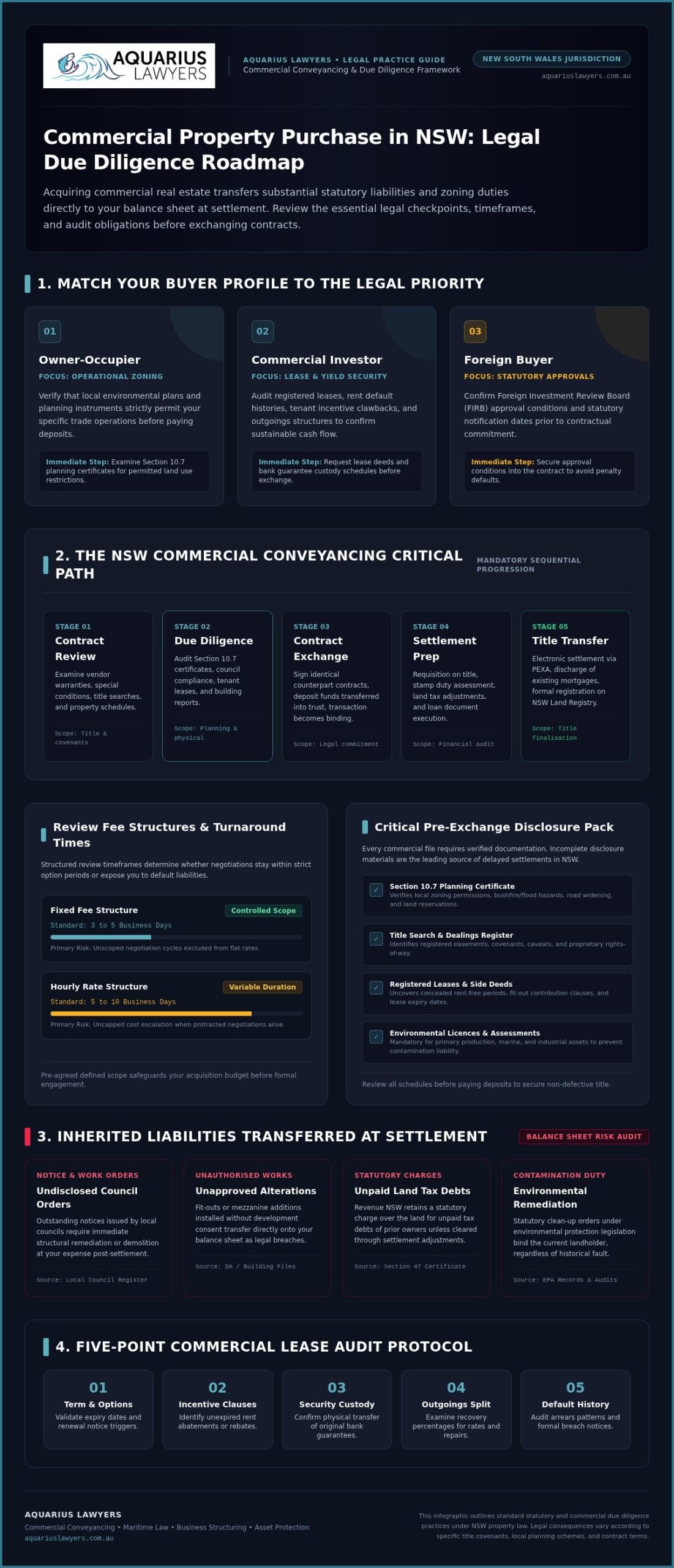
How Inherited Liabilities and Zoning Gaps Transfer at Settlement
A commercial property purchase in NSW can import the previous owner’s environmental or planning breaches straight onto your balance sheet.
Undisclosed council orders, unpaid land tax debts, and unauthorised building works transfer to you at settlement. In one recurring client pattern, a buyer completed on a site that looked clean on the vendor statement, then faced an immediate council enforcement notice for historical zoning non-compliance; the planned fit-out stopped until the planning breach was regularised. Local planning schemes dictate lawful use, so a past illegal use can close your intended operations overnight.
Property owner liability (post-settlement statutory duties) covers ongoing environmental stewardship and local development consents. Do not rely on vendor disclosures alone. Aquarius Lawyers reviews planning certificates, searches historical land uses, and flags contaminated land issues before you exchange. Those checks are what separate a usable asset from a remediation file. Instruct that search pack before you commit to exchange dates.
Audit Tenant Leases Before You Rely on the Yield
If you buy with tenants in place, the leases are the yield. Audit them before settlement or you inherit shortfalls you did not price.
Lease review surfaces default risk, option mechanics, incentive clawbacks, and maintenance covenants while you can still renegotiate or walk. Retail and industrial assets amplify this: a weak covenant becomes your problem the day title passes. Tenant incentives, in particular, can leave a financial tail that lands on the incoming owner at completion.
Aquarius Lawyers tests existing lease structures for enforceability and continuity so your income line matches the contract you think you bought. Written leases override informal promises tenants may have made to the vendor; if it is not on the page, do not bank it. Request a lease audit alongside the title review.
Stop Contract and Commercial Loan Disputes Before Default
Disputes on a commercial property purchase or its finance line need early legal intervention. An unresolved lender conflict can stop a transaction in a single notice cycle. Small businesses may take commercial loan disputes to the Australian Financial Complaints Authority where the complaint falls within that scheme’s rules.
Contract breaches, delayed settlements, and valuation disagreements create sharp downside for buyers. Aquarius Lawyers represents clients in those transactional standoffs so capital and timetable stay protected.
Act before default notices issue. Failure to enforce contract conditions or manage lender obligations leaves you open to penalties and to duties that run with ownership after settlement. Dispute management is part of acquisition hygiene, not a separate later file. Contact the team as soon as a lender or vendor position turns adversarial.
When Outright Purchase Ties Up Capital You Still Need
Buying the freehold outright can lock capital your business still needs for growth or a cash reserve. Outright acquisition anchors the position, yet it also reduces flexibility if trading conditions shift. Leasing, or holding through a trust, often suits enterprises that need agility and a cleaner split between operating risk and property risk. Direct ownership brings statutory duties onto the same balance sheet as the trading entity, including sudden environmental or structural remediation calls.
Aquarius Lawyers will pressure-test capital commitments before you sign a binding contract. Retaining liquidity keeps operational options open. If you assume freehold is the only way to secure premises, weigh a commercial lease or a trust structure first: both can deliver control without committing equity you may need elsewhere. Arrange a structure review before the heads of agreement harden.
What a Commercial Property Purchase Lawyer NSW Checks Before You Commit
Counsel choice decides whether you take clean title or inherit someone else’s breach. Waterfront and other specialised commercial assets need oversight beyond a standard residential-style conveyancing checklist.
Purchasers still overlook inherited environmental liabilities with surprising frequency. A lawyer who works those files for a living is the person who finds latent compliance breaches while you can still withdraw or reprice.
Marine and regulatory experience matters where operational permits sit beside the land title: unaddressed breaches pass with the title and arrive as enforcement risk after settlement. Engage Aquarius Lawyers early to audit operational permits and environmental exposure, and build asset protection into the structure before exchange rather than after a notice lands. You can request a personalised quote for advice scoped to your transaction.
Frequently asked questions
What services do commercial property law firms provide?
Legal firms guide buyers through contract reviews, due diligence, lease negotiations, title searches, and settlement execution so the file meets statutory requirements. A commercial property purchase in Sydney needs that planning discipline if you want operational and financial risk contained. Aquarius Lawyers focuses on hidden liabilities inside complex agreements before you sign.
What documentation is required for commercial property transactions?
Transactions require the contract for sale, title certificates, zoning receipts, lease agreements, building records, and tax clearance certificates. Missing documents drive delay. Accurate files are what lenders and the transfer process both expect.
Can issues from a previous sale affect my purchase?
Unresolved structural defects, unpaid council rates, or unapproved building works from former owners can crystallise as your problem on completion. Review historical encumbrances on title so those defects are priced or cleared before you take ownership.
When should you instruct a commercial property lawyer in NSW?
Instruct counsel before you sign or exchange, ideally as soon as the draft contract and disclosure pack arrive. Early review is what surfaces zoning limits, lease tails, and finance conditions while you still have room to renegotiate or exit. Waiting until the deposit is paid compresses every remedy.
What documents should buyers review?
Review council zoning certificates, existing commercial leases, the sale contract, registered plan diagrams, and land title encumbrances in full. A skipped schedule is how operational restrictions arrive as a surprise. Request an expert contract assessment when you want that pack stress-tested before exchange.
Strategic Legal Oversight for Your Property Investments in 2026
Completing a commercial property purchase turns on contract analysis that keeps post-settlement statutory duties from ambushing the business. Risks surface fast once a file is live, so safeguards belong at the front of the process. Under the guidance of Principal Solicitor Katherine Hawes, the team at Aquarius Lawyers applies over 20 years of legal and business experience to NSW transactions of this type. Protect the asset and lock in long-term structure before any binding agreement is signed. Set your commercial property purchase lawyer nsw plan in motion by requesting a direct consultation through the Aquarius Lawyers Contact page.