
Securing an oyster farming licence NSW operators can rely on means obtaining commercial lease approvals, maintaining biosecurity compliance, and following spatial planning rules under strict Department of Primary Industries oversight. You must understand land tenure rules, security bond structures, and mandatory vocational training before submitting your application. The decisions that shape your outcome are which permit class fits your scale, whether you pursue a lease transfer or a new tenure, and when contract growing beats direct Crown water exposure.
Match Class A or Class B to your oyster farming licence NSW goals
Choosing your oyster farming (aquaculture) entry point sets your regulatory duties and your room to expand across NSW. Three situations come up often in practice:
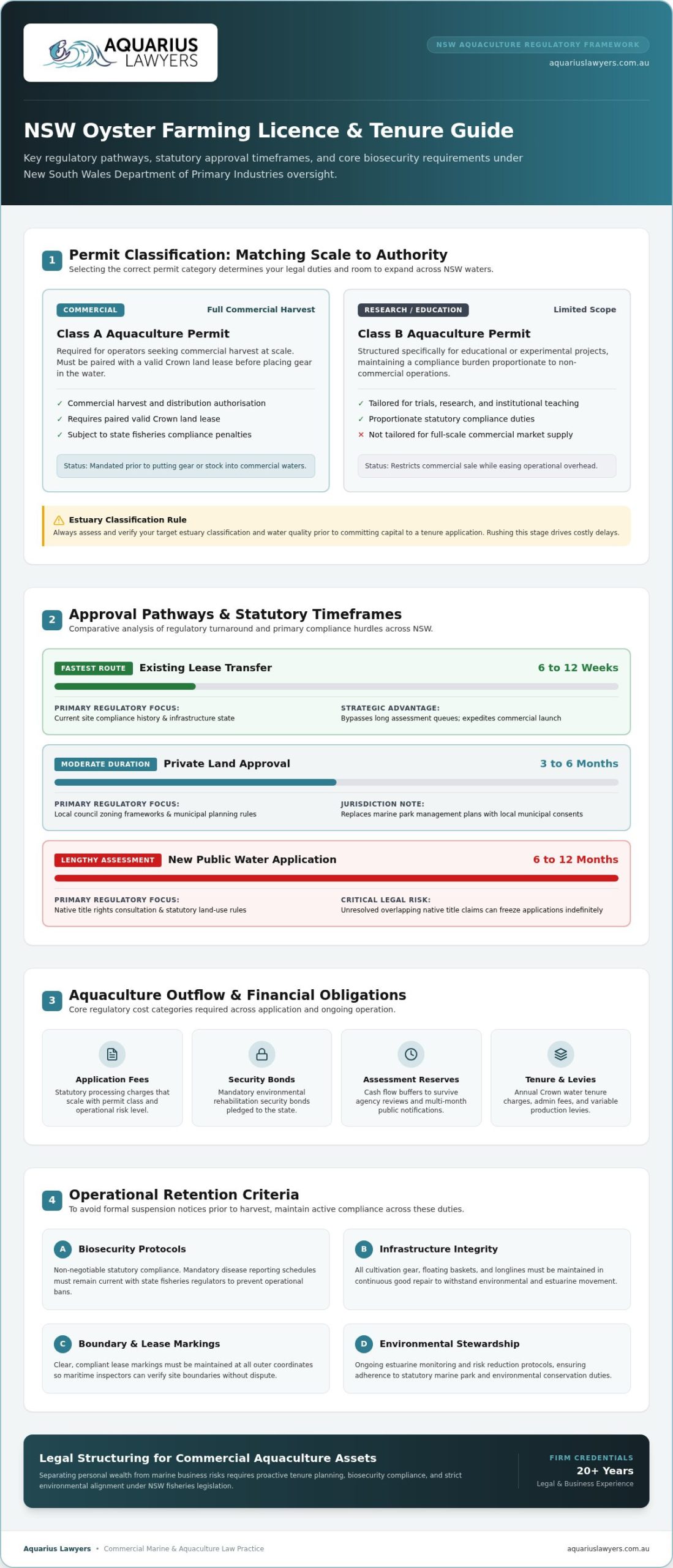
- You want full commercial harvest at scale: hold a Class A commercial permit and pair it with a valid Crown land lease before you commit gear to the water.
- You are running an educational or experimental project: a Class B permit matches that scope and keeps your compliance burden proportionate.
- You have not verified water quality or estuary classification yet: pause the tenure application; rushing here is what drives costly delays for clients we advise.
Your choice dictates your regulatory burden. Securing a marine site means gaining an oyster growing licence (aquaculture permit) alongside a valid Crown land lease. Selecting the wrong category exposes your business to statutory compliance penalties under state fisheries legislation.
A clear legal framework matters if you intend to harvest seafood commercially. Consulting Aquarius Lawyers on maritime structure helps you secure aquatic assets while meeting environmental stewardship duties. Careful category selection protects capital you would otherwise burn on rework.
Tip: Assess your target estuary’s classification before committing capital to a tenure application.
Budget the full 2026 aquaculture permit cost before you apply
Securing an oyster farming permit involves several regulatory steps that change with your operational scale and location. Your initial cash outflow covers government processing fees, environmental assessments, and ongoing annual administration charges.
Agency reviews and public notification periods often run across several months before approval, so you need a cash plan that survives that wait. Statutory application fees vary with permit class and environmental risk level. Beyond government charges, you must secure mandatory operational bonds. If those legal compliance line items are missing from your model, project delays follow quickly.
If you plan to trade internationally, review these export compliance case studies so export costs do not land as a surprise.
Environmental stewardship remains a core statutory duty. Smaller estuarine lease setups suit boutique producers, while extensive offshore operations need larger capital reserves for continuous monitoring. A suitable business framework from the start separates personal wealth from business risk.
Reach out to Aquarius Lawyers for a tailored price estimate for your enterprise.
Tip: Factor mandatory environmental rehabilitation security bonds into your initial cash flow projections.
Cut months off approval by choosing transfer, public water or private land
Securing approval for an oyster farming lease takes six to twelve months depending on location complexity. You must secure an oyster growing licence alongside your lease allocation before placing stock in the water. Pursuing an existing lease transfer rather than a fresh application is the practical route when you need to bypass lengthy assessment queues: transferred rights shorten regulatory delay and bring the commercial launch forward.
| Option | Processing Timeframe | Primary Regulatory Consideration |
|---|---|---|
| Existing Lease Transfer | 6 to 12 weeks | Current compliance history |
| New Public Water Application | 6 to 12 months | Native title rights and land-use rules |
| Private Land Approval | 3 to 6 months | Local council zoning frameworks |
Statutory land-use restrictions and overlapping native title claims can freeze public water applications for an indefinite period. Unresolved claims require extensive consultation with traditional owners, whereas private land operations follow distinct municipal planning rules.
Operating on public waters incurs annual tenure charges, administration fees, and variable production levies. Operating on private water means navigating local council zoning permits instead of marine park management plans. You can dig further into regulatory requirements through FishFarming resources. Critical legal risks left unchecked during lease negotiations put your initial investment in jeopardy. Ask Aquarius Lawyers for a personalised quote when you want the tenure path stress-tested before you sign.
Hold your permit by meeting biosecurity and infrastructure duties
You must meet strict operational criteria to keep your oyster farming authority valid in New South Wales.
From legal practice the pattern is consistent: a grower treats a minor compliance lapse as paperwork noise, the lapse stacks, and a suspension notice arrives before the next harvest window. Situation: infrastructure markings slip and disease reporting lags. Action: rebuild monitoring schedules and close reporting gaps before the inspector arrives. Outcome: you keep the oyster growing licence active and avoid the financial hit that follows a formal suspension.
Maintaining that permit requires continuous adherence to environmental and biosecurity protocols. Keep infrastructure in good repair and maintain clear lease markings so inspectors can verify the site without dispute.
Biosecurity management is a non-negotiable legal requirement. Permit conditions and operational details must stay current with the NSW DPI aquaculture management process; regulators issue heavy fines and permit revocations when operators ignore mandatory disease reporting or stock movement rules.
Prevent marine debris and contain waste properly so environmental stewardship duties are met on the water, not only on paper. Incorporating SmartFarming software helps you track monitoring schedules and compliance deadlines without relying on memory alone.
Aquarius Lawyers helps marine businesses build practical systems that reduce regulatory exposure. You protect licence, revenue, and commercial reputation when compliance gaps close before formal inspections.
5 Steps that get your aquaculture licence application through assessment
Legal approval needs systematic administrative work before any gear enters public waters. From client work, improper site assessment pushes state approvals back by months, and spatial overlaps missed early force costly application revisions later. Work through these administrative phases in order:
- Site Assessment: Select your location and check spatial constraints so the proposed area avoids public navigation hazards and protected marine parks.
- Preparing Documentation: Prepare detailed operational plans, environmental impact statements, and emergency response procedures for government review.
- Formal Submission: Submit completed application forms with the required supporting maps directly to the regulatory body.
- Inter-Agency Referral: Allow time while primary authorities consult secondary environmental and maritime bodies on spatial conflicts.
- Permit Issuance: Receive formal approval with binding operating conditions once authorities finish statutory assessments.
Environmental conditions ignored at submission create regulatory friction that is hard to unwind mid-process.
With over 20 years of legal and business experience, Aquarius Lawyers guides marine operators through complex state compliance frameworks. Contact the legal team when you want strategic administrative support before you file.
When direct aquaculture tenure puts your capital at unnecessary risk
Direct water leases carry statutory duties that create serious liability if you lack complete operational control. Managing Crown water leases directly exposes your marine business to financial penalties for biosecurity breaches or environmental harm. From legal practice, operators often take on large compliance burdens when another commercial structure would serve expansion goals more cleanly. Direct tenure suits established marine businesses with heavy capital. Leasing growing rights from an existing permit holder fits smaller operators who need to limit liability.
Contract growing agreements let you secure supply without acquiring direct Crown water assets: you lock in product while lease-style harvest rights keep expensive remediation exposure off your balance sheet.
Direct tenure creates long-term exposure. High compliance obligations apply regardless of stock survival. Native title issues can complicate property negotiations and add delay to lease transfers. Failure on environmental stewardship standards can trigger sudden permit suspension.
Without proper corporate structures you expose personal assets to significant risk. Commercial joint ventures or processing agreements give seafood businesses a path to scale with clearer boundaries. Aquarius Lawyers can help you structure commercial contracts that protect capital while Securing product supply. Seek targeted legal advice before you commit to a direct Crown lease.
Frequently asked questions
How does native title affect oyster farming tenures?
Native title claims can affect marine tenure applications by adding legal procedural steps. You must navigate statutory rights carefully, because overlapping claims need legal resolution before your oyster farming tenure can finalise. Leaving those rights unaddressed risks long delays or refusal of your commercial permit.
What sustainability measures are tied to an oyster growing licence?
Your oyster growing licence requires continuous environmental stewardship. Regulatory authorities mandate specific waste management, infrastructure standards, and biosecurity plans to safeguard coastal ecosystems. Non-compliance exposes your marine enterprise to operational suspensions and enforcement action.
How long does an oyster farming licence application take in NSW?
Timelines depend on the path you choose. Existing lease transfers often run 6 to 12 weeks, private land approvals about 3 to 6 months, and new public water applications about 6 to 12 months, with native title and land-use issues able to extend public water matters further. Building those ranges into your cash flow plan is part of a sound application strategy.
What training and budget should you plan beside government fees?
You must complete mandatory industry training modules; course fees depend on the legal and operational education provider you select. Independent market research across 25 listings places specialised business training commonly between A$300 and 1,000 AUD (separate from the 2026 government fee schedule for the permit itself). Budgeting training beside bonds and application fees keeps your compliance plan realistic.
Where are land-based oyster sites located?
Land-based commercial operations sit along approved coastal estuaries, designated maritime zones, and onshore hatcheries across New South Wales. You must secure valid land tenure and environmental approvals before developing any onshore depuration or breeding facility. Locking in appropriate zoning early reduces structural regulatory risk for your seafood business.
Securing Your Marine Business Future
An oyster farming licence in NSW stands on commercial marine regulation and environmental stewardship done properly from day one. The same questions you faced at the outset (permit class, transfer versus new tenure, direct Crown lease versus contract growing) decide whether you launch on time or absorb avoidable delay and cancellation risk. Working with advisers who know the commercial fisheries sector is how you keep that investment intact.
In 2026, Principal Solicitor Katherine Hawes and the Aquarius Lawyers team bring over 20 years of legal and business experience in commercial marine law to help you secure your operations. For tailored guidance on your lease transfer or compliance matter, contact Aquarius Lawyers.