
Approximately 87% of seafood consumed in New South Wales is imported, yet establishing a commercial facility to satisfy domestic demand often feels like fighting an uphill battle against red tape. You already know the immense frustration of juggling local council planning schemes against state fisheries departments while trying to safeguard your commercial assets. When applying for an aquaculture land use permit NSW planning bodies and fisheries regulators require exact statutory alignment. Merely holding rural land zoning won’t protect your project from missing integrated development criteria or facing regulatory stop-work orders.
Discover how to secure an aquaculture land use permit in NSW without costly regulatory delays or planning pitfalls. Clear planning strategy + strict statutory compliance = protected investments and uninterrupted operations. Below, we provide a practical roadmap to help you manage dual-tier approvals, determine environmental impact assessment thresholds, and satisfy water discharge rules while delivering verified environmental sustainability outcomes for your venture.
Key Takeaways
- Dual-track statutory consent is mandatory across local planning frameworks and state fisheries legislation before commercial stocking can begin.
- Securing the aquaculture land use permit NSW authorities require depends on screening your facility accurately against project risk profiles and primary production planning policies.
- Early site constraint mapping and pre-lodgement agency consultations eliminate statutory assessment bottlenecks and costly information requests.
- Active compliance with water access rules, discharge standards, and mandatory biosecurity planning safeguards your commercial assets against licence suspension.
- Engaging specialist counsel uniting property, planning, and marine law ensures strategic alignment across competing municipal and state jurisdictions.
What Is an Aquaculture Land Use Permit in NSW?
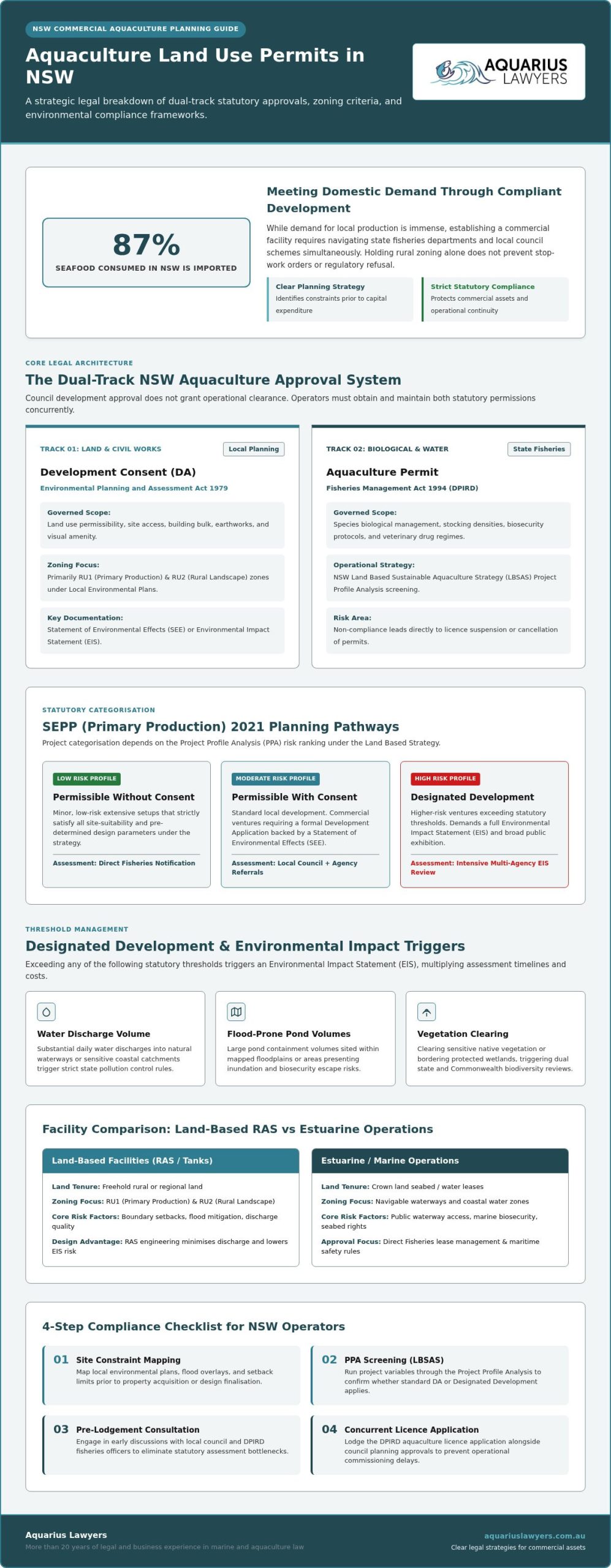
In New South Wales, an aquaculture land use authorisation isn’t a single certificate you buy over the counter. Instead, it represents a dual-track statutory framework bridging local land planning law and state fisheries governance. To operate legally, you must secure development consent under the Environmental Planning and Assessment Act 1979 alongside an operational aquaculture permit issued under the Fisheries Management Act 1994 by the Department of Primary Industries and Regional Development (DPIRD).
As commercial aquaculture production in Australia expands, regulatory scrutiny on water sources and coastal catchments tightens. Beginning earthworks or constructing containment ponds before securing an aquaculture land use permit NSW authorities endorse puts your entire venture at risk. Regulators issue stop-work notices and remediation orders swiftly, freezing project capital and endangering your commercial assets.
Distinguishing Land-Based Facilities from Estuarine Operations
Land-based facilities, such as recirculating aquaculture systems (RAS) and intensive tank culture, operate primarily on freehold rural or regional land. These setups contrast sharply with estuarine oyster farming or offshore marine ventures that require Crown land seabed leases. For land-based operations, local environmental plans dictate permissibility. Most commercial setups require development consent within standard primary production zones, such as RU1 (Primary Production) or RU2 (Rural Landscape), demanding strict boundary setbacks and proven flood mitigation.
The Distinction Between Planning Consent and Operational Licences
Many new operators fall into the trap of believing council development approval gives them complete operational clearance. It doesn’t. Planning consent governs land use, site access, building bulk, and visual amenity under local planning laws. An operational aquaculture licence from DPIRD controls what happens inside the water, governing species biological management, stocking densities, biosecurity protocols, and veterinary drug regimes. Holding one approval offers zero statutory immunity against breaching the other; successful operators manage both from day one.
Key Planning Frameworks Governing NSW Aquaculture Approvals
Every commercial aquaculture venture in New South Wales rests upon two primary planning pillars: state environmental planning policies and fisheries statutory controls. The State Environmental Planning Policy (Primary Production) 2021 (SEPP Primary Production) governs whether land-based facilities are permissible with or without consent across regional council areas. Operating under the Fisheries Management Act 1994 (NSW), DPIRD applies the NSW Land Based Sustainable Aquaculture Strategy (LBSAS) to screen operational proposals. Securing your aquaculture land use permit NSW approval means identifying exactly where your facility falls across these coordinated frameworks before lodging formal plans.
State Environmental Planning Policy (Primary Production) Categories
SEPP Primary Production provides statutory zoning rules for commercial producers. Under these rules, projects undergo a Project Profile Analysis (PPA) outlined in the LBSAS:
- Permissible without consent: Very minor, low-risk extensive setups that meet strict site-suitability and design parameters.
- Permissible with consent (Standard Local Development): Low-to-medium risk facilities requiring a development application (DA) backed by a Statement of Environmental Effects (SEE).
- Designated Development: Higher-risk ventures requiring broad public exhibition and intensive agency reviews.
Assessing Environmental Impact Assessment Triggers
Designated development rules trigger when operational risk indicators exceed established environmental thresholds. If your system involves substantial daily water discharges into natural watercourses, large pond volumes in flood-prone areas, or clearing sensitive vegetation, an environmental impact assessment must accompany your project proposal as an Environmental Impact Statement (EIS). Making smart engineering decisions early, like switching from flow-through systems to recirculating aquaculture systems, keeps assessment risks low and reduces statutory delay.
Commonwealth Legislation and Biodiversity Considerations
State approvals do not excuse federal oversight. If your proposed site borders declared Ramsar wetlands, intersects critical habitat, or affects listed migratory species, your venture triggers the environmental protection and biodiversity conservation act. This legislation requires a separate referral to the Commonwealth Department of Climate Change, Energy, the Environment and Water. Aligning operations with strict environmental stewardship standards delivers positive environmental sustainability outcomes while satisfying both state and Commonwealth regulators. When coordinating these multi-tiered submissions, consulting with experienced marine legal counsel helps you structure development filings smoothly.
How to Obtain an Aquaculture Land Use Permit in NSW
Securing an aquaculture land use permit NSW regulators will approve demands a methodical, step-by-step strategy. Rushing straight into a development application without prior agency consultation creates friction, triggers formal requests for information (RFIs), and stalls capital. Following a defined five-stage roadmap protects your time and commercial investment:
- Step 1: Carry out site zoning analysis and constraint mapping.
- Step 2: Hold pre-lodgement meetings with local council and DPIRD officers.
- Step 3: Prepare your technical Statement of Environmental Effects (SEE) and operational plans.
- Step 4: Lodge your DA under the integrated development approval pathway.
- Step 5: Obtain the operational aquaculture licence and clear pre-stocking site inspections.
Conducting Site Due Diligence and Pre-Lodgement Reviews
Every successful venture begins with comprehensive property due diligence. Check local environmental plan maps for flood planning levels, acid sulfate soil classifications, and bushfire exposure. Consult our property legal services team to evaluate land access agreements, crown road easements, and title encumbrances before committing funds. Identifying these physical and legal parameters early lets you draft engineering plans that fit your site rather than trying to retrofit an unsuitable design later.
Managing the Integrated Development Approval Process
Integrated development coordinates multiple statutory authorisations under section 4.46 of the Environmental Planning and Assessment Act 1979. When your council receives the DA, they refer it to DPIRD Fisheries and the Natural Resources Access Regulator (NRAR) for General Terms of Approval (GTA). Responding to inter-agency RFIs within strict 21-day statutory windows keeps the assessment clock moving. Coordinated documentation + proactive agency management = minimal administrative delays.
Securing Operational Endorsements and Business Registration
Once council grants development consent containing agency GTAs, DPIRD issues the final operational permit under the Fisheries Management (Aquaculture) Regulation 2024. Before stocking your tanks or ponds, state officers conduct physical site audits to verify that containment bunds, discharge filters, and quarantine systems match your approved Commercial Farm Development Plan. All production must align with national aquaculture rules and biosecurity standards to prevent pathogen transmission across regional waterways. For multi-jurisdictional ventures, consult with our team to understand how cross-border legal obligations affect your facility’s operational compliance.
Managing Legal and Environmental Risks in NSW Aquaculture
Operating an active aquaculture venture involves rigorous ongoing compliance. Once you secure an aquaculture land use permit NSW regulators shift their scrutiny toward daily operational controls and environmental limits. Commercial fish farming creates continuous biosecurity and environmental touchpoints with surrounding ecosystems. Without proactive legal risk mitigation, unforeseen compliance failures quickly trigger regulatory investigations, stop-work orders, or heavy statutory sanctions.
Water Access Entitlements and Effluent Discharge Standards
Water security dictates enterprise survival. You must hold valid water access licences under the Water Management Act 2000 before purchasing specialized equipment or stocking tanks. Discharging waste or drainage water into public catchments requires an Environment Protection Licence under the Protection of the Environment Operations Act 1997. These licences enforce exact concentration thresholds for nitrogen, phosphorus, and suspended solids. Exceeding these limits creates severe statutory pollution liabilities that can immediately derail your project.
Biosecurity Frameworks and Operational Data Governance
The Fisheries Management (Aquaculture) Regulation 2024 and the Biosecurity Act 2015 treat disease control as an enforceable legal obligation rather than discretionary farm management. Every commercial venture must execute a binding Biosecurity Management Plan addressing:
- Strict quarantine separation protocols for new fingerlings or broodstock.
- Sterilisation routines for equipment, nets, and visitor access zones.
- Documented disposal procedures for dead stock to prevent wild pathogen leaks.
- Compliance with data management requirements covering stock mortality records and daily water quality telemetry.
State inspectors carry out unannounced audits. Maintaining auditable compliance records protects you from immediate operational shutdown orders.
Safeguarding Commercial Assets Against Licence Suspension
The commercial fallout from regulatory intervention extends far beyond immediate financial penalties. A formal show-cause notice or licence suspension freezes stock sales, disrupts export contracts, and threatens your broader commercial assets. If a disease breach or unapproved chemical discharge occurs, regulators can revoke your aquaculture authority overnight. You cannot afford to treat compliance as an afterthought when commercial viability depends on regulatory good standing.
Structuring your operational assets, lease agreements, and corporate entities correctly isolates core investments from regulatory fallout. If you face compliance audits, regulatory inquiries, or an impending licence transfer, reach out to our seafood and marine legal services team to protect your business.
Why Partner with Specialist Marine and Aquaculture Legal Counsel?
Establishing an aquaculture enterprise requires bridging two distinct disciplines: land property planning and marine law. Generalist planning consultants often miss fisheries-specific statutory conditions, while marine specialists frequently overlook local environmental zoning limits. When you apply for an aquaculture land use permit NSW councils and state authorities expect total harmony between these regimes. Experienced legal counsel coordinates both tracks, cutting through bureaucratic red tape and preventing miscommunications that stall commercial deployments.
At Aquarius Lawyers, Katherine Hawes brings more than 20 years of legal and business experience to water-based enterprises. Our national practice works alongside commercial operators, turning convoluted statutory obligations into clear operational roadmaps. Cross-disciplinary expertise + early legal intervention = protected investments and accelerated project delivery.
Strategic Due Diligence for Aquaculture Infrastructure
Before executing land contracts or committing capital to intake pipelines, thorough legal due diligence is vital. Our team examines vendor title representations, historical planning consents, and crown land access easements to confirm site suitability. We draft commercial contracts with strict conditions precedent tied to development approvals, ensuring your capital remains secure if planning authorities refuse a proposal. By separating production operations, property holdings, and equipment leases across distinct corporate structures, we shield your primary commercial assets and maritime assets from trading liabilities.
Resolving Regulatory Disputes and Navigating Licence Transfers
Securing consent is only the first hurdle. When purchasing an existing farm, an operational aquaculture licence transfer requires formal clearance from DPIRD to avoid compliance pauses. If a local council attempts to impose oppressive conditions, such as unworkable monitoring schedules or disproportionate noise restrictions, you have legal remedies. We manage administrative appeals and conciliation conferences under the Land and Environment Court framework to negotiate balanced, workable outcomes. Connect with Aquarius Lawyers to secure decisive representation across every phase of your commercial aquaculture venture.
Position Your Aquaculture Venture for Statutory and Commercial Success
Navigating the complex approvals matrix for land-based fish farming doesn’t have to stall your commercial ambitions. Securing an aquaculture land use permit NSW regulators will readily endorse requires absolute cohesion between local government planning instruments and state fisheries standards. Proactively managing site constraints, water entitlements, and enforceable biosecurity plans from day one builds resilience directly into your business model.
Protecting your operational timeline and capital investment demands seasoned oversight. Led by Katherine Hawes, Aquarius Lawyers provides more than 20 years of legal and business experience across commercial water enterprises. Our strategic integration of marine law and property rights safeguards your commercial assets while cutting through regulatory red tape. Take the decisive step to establish your facility on a solid statutory foundation. Secure strategic legal advice for your aquaculture approval with Aquarius Lawyers and move your venture forward with complete confidence.
Frequently Asked Questions
Do I need council planning permission if I already hold an aquaculture licence?
Yes, holding a fisheries aquaculture permit doesn’t exempt you from municipal planning laws. Council planning consent governs land usage, earthworks, and physical structures under the Environmental Planning and Assessment Act 1979. A fisheries permit only authorises the cultivation of specified aquatic species. Securing your aquaculture land use permit NSW approval requires satisfying both local planning controls and state fisheries regulations simultaneously before stocking can begin.
What is the difference between designated development and advertised development?
The distinction lies in environmental risk scale and assessment depth. Advertised development involves standard local impacts, requiring community notification and a Statement of Environmental Effects. Designated development applies to high-risk intensive proposals, triggering mandatory preparation of an Environmental Impact Statement (EIS), formal multi-agency reviews, and extended public exhibition periods. Designated status also grants third parties broader objector appeal rights in the Land and Environment Court.
How does the environmental protection and biodiversity conservation act affect local projects?
Commonwealth environmental law applies whenever your aquaculture proposal risks significant impacts on Matters of National Environmental Significance. Even if your local council approves your land-based setup, proximity to declared Ramsar wetlands, listed threatened ecological communities, or migratory bird flyways triggers federal review. You must lodge a referral with the Commonwealth environment department to determine whether your project requires formal federal environmental assessment and approval.
Can an existing aquaculture licence transfer to a new property purchaser?
Yes, an aquaculture licence transfer is possible, but it doesn’t occur automatically through a real estate purchase contract. You must apply for a formal licence transfer through DPIRD. Regulators assess the incoming applicant’s commercial qualifications, compliance history, and operational farm plans before granting approval. Completing title conveyancing without securing the statutory fisheries transfer can leave you owning specialized infrastructure you cannot legally operate.
What happens if local council refuses an aquaculture development application?
You hold statutory appeal rights to challenge an unjustified council refusal. If council denies your application, you can request an internal review under section 8.2 of the planning legislation or lodge a Class 1 appeal with the NSW Land and Environment Court. Expert legal representation assists in conciliation conferences to resolve disputed planning conditions, visual amenity concerns, or effluent issues without protracted courtroom litigation.
What water access authorisations are required alongside a land use permit?
Intensive fish production requires secure water rights alongside your aquaculture land use permit NSW documentation. You must hold a valid water access licence and works approval from WaterNSW or the Natural Resources Access Regulator to extract surface water or groundwater. If you operate systems discharging water into local waterways, you also need an Environment Protection Licence establishing strict contamination limits.
How do biosecurity management plans influence permit approval decisions?
DPIRD mandates an approved Biosecurity Management Plan before issuing any operational permit. Under the Biosecurity Act 2015 and aquaculture regulations, regulators will refuse permits if your biosecurity arrangements fail to demonstrate disease control. Your plan must detail quarantine areas, stock sourcing, water filtration, and mortality disposal methods. Clear biosecurity documentation proves environmental stewardship and reassures authorities that your enterprise won’t endanger wild aquatic populations.