
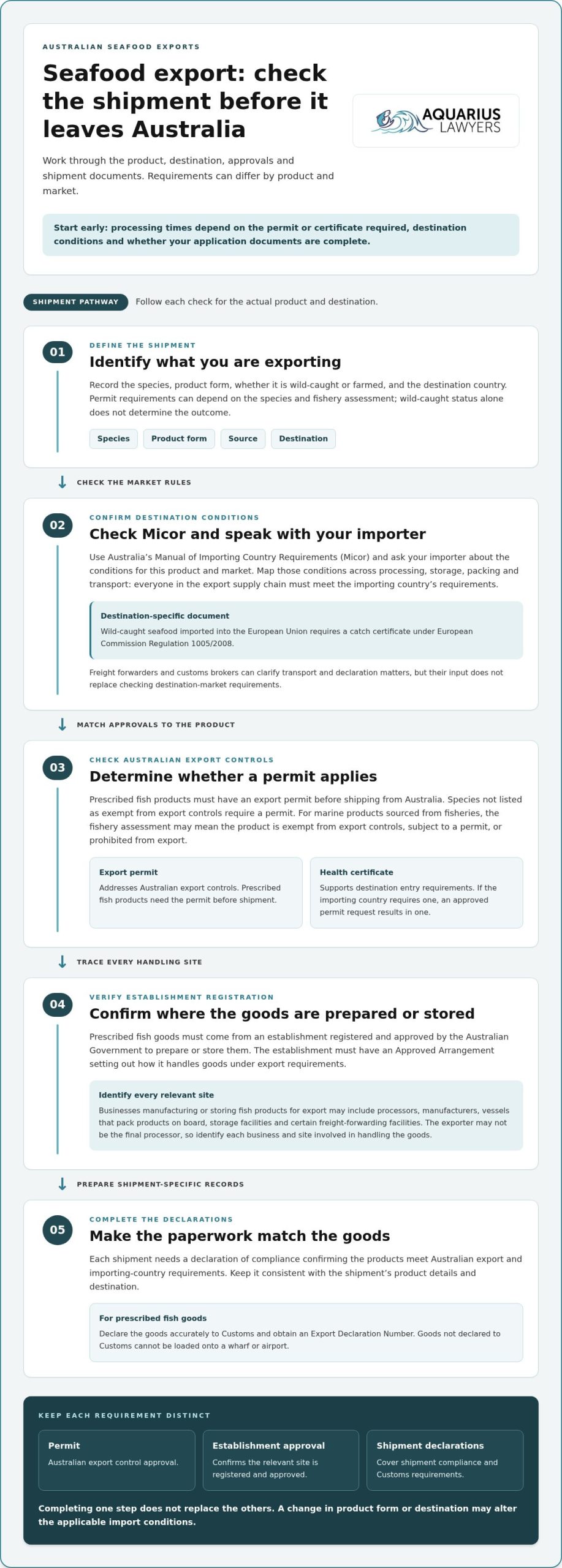
The paperwork, not the catch, can determine whether a seafood shipment is ready to leave Australia. A seafood export licence in Australia may involve an export permit, an export-registered establishment and shipment documents, depending on the product and its destination. Exporters of prescribed fish products must obtain an export permit before shipping the goods from Australia.
It’s understandable if the process seems to involve more than one licence: Australian export rules and the importing country’s conditions may both apply. Identify the requirements for your product and destination early so you can prepare the right documents before shipment.
This guide explains Australian rules, destination-country requirements and key export documents for fish and seafood. It also covers where to direct export enquiries and when marine, fisheries or aquaculture legal advice can help with issues involving permits, market access or commercial arrangements.
Key Takeaways
- Start with the destination market: use Australia’s Manual of Importing Country Requirements (Micor) and consult your importer, as conditions can vary by product and country.
- Exporters of prescribed fish products must obtain an export permit before shipping from Australia, and the products must come from an export-registered establishment.
- Register as an exporter to access export documentation systems. According to the Department of Agriculture, Fisheries and Forestry, fish product exporters can access NEXDOC after registering.
- Prepare shipment-specific paperwork, including a declaration of compliance. According to the Department of Agriculture, Fisheries and Forestry, it confirms the products meet Australian export and importing-country requirements.
- For Australian export enquiries, contact the Department of Agriculture, Fisheries and Forestry on 1800 900 090.
Importing country requirements
Destination-country requirements are the conditions an overseas market sets for accepting Australian seafood. Identify the requirements for your product and destination before arranging a shipment.
Processing times depend on the required permit or certificate, destination conditions and whether your application documents are complete. Plan your export schedule around the approvals and documents that apply to the specific shipment.
Fish product export conditions
Fish product export conditions are the Australian and importing-country rules that apply to seafood shipments. Australian requirements cover fish and fish products intended for human consumption, while overseas markets may impose additional conditions.
Businesses that manufacture or store fish products for export must register the relevant establishment. This may include processors, manufacturers, vessels that pack products on board, storage facilities and certain freight-forwarding facilities. The exporter may not be the final processor, so identify every business and site involved in handling the goods.
Everyone in the export supply chain must meet the importing country’s requirements. Ask your importer about conditions affecting the product, then map them to processing, storage, packing and transport. Freight forwarders and customs brokers can clarify transport and declaration matters, but their input does not replace checks on destination-market requirements.
Each shipment needs a declaration of compliance confirming that the products meet Australian export and importing-country requirements, according to the Department of Agriculture, Fisheries and Forestry. Keep the declaration consistent with the shipment’s product details and destination. Wild-caught seafood imported into the European Union requires a catch certificate under European Commission Regulation 1005/2008.
Permit triggers, fees and processing times
An export permit is approval required for certain marine products to leave Australia. Species not listed as exempt from export controls require a permit. The species and its fishery assessment can affect the applicable controls, so identify the product accurately before applying.
Prescribed fish products must have an export permit before shipment from Australia. If the importing country requires a health certificate, an approved permit request results in one. The documents serve different purposes: the permit addresses Australian export controls, while the health certificate supports the destination’s entry requirements.
Use this sequence to organise the shipment:
- Identify the species, product form and destination country.
- Review Micor and discuss market conditions with your importer.
- Determine whether an export permit or destination health certificate applies.
- Coordinate establishment registration, shipment declarations and supporting records.
Do not assume paperwork for one shipment covers another product or market. A change in destination or product form may alter the applicable import conditions. Match approvals and documents to the actual goods and destination before dispatch.
Australian export laws for fish and fish products
Wild-caught and farmed seafood must meet applicable Australian export controls and importing-country conditions. Permit requirements depend on the species, product and fishery assessment. Prescribed fish goods exported without required permits may be prohibited, and goods not declared to Customs cannot be loaded onto a wharf or airport.
Prescribed fish goods
Prescribed fish goods are fish products intended for human consumption where fish is the major ingredient. Their export is governed by the Export Control Act 2020 and the Export Control (Fish and Fish Products) Rules 2021.
Before export, goods must come from an establishment registered and approved by the Australian Government to prepare or store them. The establishment must have an Approved Arrangement setting out how it will handle goods under export requirements. The exporter may differ from the final processor, so identify which approved establishment handles each stage.
Prescribed fish exporters must obtain an export permit before shipping. They must also declare the goods accurately to Customs and obtain an Export Declaration Number. Treat the permit, establishment approval and Customs declaration as separate steps: completing one does not replace the others.
Wild-caught and farmed export rules
Wild-caught and farmed export rules are the controls applying to seafood according to its source and destination. The export framework covers prescribed fish products, while the Environment Protection and Biodiversity Conservation Act 1999 (EPBC Act) also regulates wildlife exports.
For marine products sourced from fisheries, the EPBC Act may make products exempt from export controls, subject to an export permit, or prohibited from export, depending on the fishery assessment. A permit to export marine products can only be issued for products sourced from a wildlife program approved under the EPBC Act. Wild-caught status alone does not determine the outcome.
For farmed seafood, establish whether the product meets the prescribed-fish definition and whether its species or source triggers other export controls. Then check the destination requirements. The importing country may impose conditions that differ from or add to Australia’s requirements, whether the seafood is wild-caught or farmed.
Risks of missing approvals
Missing approvals means attempting to export goods without permits or declarations required for that consignment. Goods covered by Australian export controls may be prohibited from export unless the necessary permits are obtained from the relevant issuing agency.
Prescribed fish goods that have not been declared to Customs cannot be loaded onto a wharf or airport, potentially stopping a shipment before departure. A missing approval or declaration may also prevent the exporter from meeting destination-country conditions, so the goods may not be accepted for import.
Check product classification, establishment approval, permits and Customs declarations as one document pathway. An approved Australian fish export permit request results in a health certificate if the importing country requires one. The destination’s requirements, not simply whether the product is wild-caught or farmed, determine whether a certificate is needed.
Department of Agriculture, Fisheries and Forestry contact details
The Department of Agriculture, Fisheries and Forestry handles Australian government export enquiries for fish and seafood. For help with an Australian export enquiry, call 1800 900 090.
Contact and food standards
Use the department’s contact number for questions about export requirements, permits and documentation. Have the product description, species, destination country and shipment details ready to make your enquiry specific.
The Australia New Zealand Food Standards Code sets food requirements, including contaminant limits. Schedules 19, 20 and 27 cover contaminant limits, maximum residue limits for therapeutants and antibiotics, and microbiological limits respectively. The stated requirements apply to fish and seafood products exported to Australia. Don’t confuse these import requirements with the conditions governing Australian seafood exports to overseas markets.
If your business handles imports and exports, record which direction each consignment is travelling. This distinction matters when identifying the relevant food standards and export controls. The Department of Agriculture, Fisheries and Forestry handles Australian export enquiries; importing-country conditions depend on the destination and product.
Air cargo and reefer container specifications
Reefer specifications describe a refrigerated container’s payload, internal space and tare weight. A 20 ft reefer container has a stated payload capacity of 27,400 kg and cubic capacity of 28.3 m³. Its tare weight is 3,080 kg, with internal dimensions of 5.44 m long, 2.29 m wide and 2.27 m high.
A 40 ft reefer container has a stated payload capacity of 27,700 kg and cubic capacity of 59.3 m³. Its stated tare weight is 4,800 kg. Use payload and internal capacity as separate planning measures: product weight and packed volume can constrain a load differently.
For air freight, up to 52 large polyfoam boxes can fit into an AKE/AVE air freight container, depending on the product. Treat that figure as a packing reference, not a substitute for checking the product’s dimensions and handling needs with your freight arrangements.
Tamper-evident and official container seals
A tamper-evident seal is a closure designed to show signs of interference if opened. An official seal is applied or recognised under an official process. The terms describe different functions, so do not assume every shipment requires the same seal.
Before loading, establish whether the shipment instructions require a particular seal and who applies it. As a practical tracking step, record the seal identifier against the relevant container and shipment paperwork. Keep it consistent across records, especially when freight documents identify the container by number.
Australian seafood export documentation
Export documentation records the approvals and shipment details needed to move seafood from Australia. To obtain a permit or health certificate, register as an exporter, identify the correct application system, provide supporting documents and apply before shipment.
Export paperwork
Export paperwork comprises the registrations, declarations and certificates that identify the exporter, goods and shipment. The Department of Agriculture, Fisheries and Forestry states that fish product exporters must register as exporters to access the Next Export Documentation System (NEXDOC).
Registration links your name and details to export documents. The permit application system depends on the document and current transition arrangements: Australia’s EXDOC system is transitioning to NEXDOC, so use the department’s guide to identify where to apply. Registration for one system does not complete separate permit or establishment requirements.
Export-registered establishments handle goods under applicable export requirements and may generate export documents and certificates. They must operate under an Approved Arrangement approved by the Australian Government. For a marine-product permit, include proof of legal acquisition, such as a State or Commonwealth collection permit or suitable purchase receipts.
Prescribed fish goods also require an accurate Customs declaration and an Export Declaration Number. A shipment declaration of compliance confirms that fish products meet Australian export and destination-country requirements. Keep product descriptions, exporter details and shipment records consistent across documents.
Permit and certificate application steps
A permit application requests approval to export regulated goods; a health certificate records health information required by the importing country. Follow the pathway that applies to your product and destination. A certificate is issued when the importing country requires one.
- Register as an exporter. Complete exporter registration so you can access the relevant documentation system. Fish product exporters can access NEXDOC after registering with the Department of Agriculture, Fisheries and Forestry.
- Identify the application system. Check the current EXDOC-to-NEXDOC guidance to determine where to submit your application. Check the applicable system’s registration requirements before applying online.
- Prepare supporting records. For a marine-product permit, attach proof of legal acquisition, such as a collection permit or purchase receipts. Ensure the records identify the product and its lawful source.
- Apply for the required permit. Prescribed fish product exporters must obtain their export permit before shipping. The permit application and shipment documents should match the actual goods and destination.
- Arrange any required certificate. An approved Australian fish export permit request results in a health certificate when the importing country requires one. Confirm the certificate requirement against the destination’s conditions.
The supplementary form used for exports of live animals does not apply to marine species. For help resolving a legal issue involving export paperwork or seafood trade, seek seafood and marine legal advice.
Aquarius Lawyers: Marine Law
Aquarius Lawyers advises seafood exporters on legal issues involving export controls, market access and commercial arrangements. Turn to the firm when permit conditions, fishery approvals, export contracts or aquaculture matters affect your business decisions.
Aquarius Lawyers’ Marine Law, Fisheries Law, Aquaculture Law and Commercial Law services connect regulatory questions with the practical needs of your operation. Legal advice can help you understand how an approval issue or contractual dispute may affect your seafood exports and commercial assets.
If you need advice about a seafood export matter, contact Aquarius Lawyers about marine and seafood law.
Make your next seafood export decision with clarity
Use a new market entry, product change or export agreement as a prompt to review the legal pathway before committing. A seafood export licence in Australia is only one part of the decision: consider how the proposed trade fits your broader commercial and operational plans.
Targeted legal advice can help assess the implications of an export issue, identify questions to resolve and support informed decisions about next steps. Aquarius Lawyers provides Marine Law, Fisheries Law and Aquaculture Law advice for seafood businesses dealing with legal matters connected to their operations and export activity.
Bring your export question into focus and decide on a practical way forward. Contact Aquarius Lawyers about seafood exports to discuss your matter. A clear legal pathway can help you move into your next decision with greater confidence.
Frequently Asked Questions
What export licences and registrations are required to export seafood from Australia?
Requirements depend on the seafood, its source and the export pathway. You may need exporter registration, an approved export establishment and a permit for the goods. Check each separately rather than assuming one approval covers the whole operation. Before committing to a shipment, list the businesses handling it, the species and form of the product, and the intended market. This overview helps identify applicable requirements.
How do I register an Australian seafood export establishment with the Department of Agriculture?
Before submitting an establishment registration application, prepare information about its operations. Identify the site’s role, the fish products it will handle and its activities, such as processing or storage. The establishment’s Approved Arrangement should explain how it manages export handling requirements. Keep application details consistent with operational records, particularly when separate sites handle different preparation or storage stages.
What Australian laws and export standards apply to seafood exports?
Australian export controls and food standards apply according to the product and its intended use. The Export Control Act 2020 framework and the Export Control (Fish and Fish Products) Rules 2021 govern prescribed fish exports, while wildlife export controls may also apply. For planning, classify the product first, then assess which legal pathway applies. Keep domestic food standards separate from export approval requirements, as they address different parts of the regulatory framework.
How do seafood export requirements differ by destination country and product type?
Requirements vary by market and may depend on species, processing method and product form. Create a destination matrix for each product line, recording applicable conditions and who in your supply chain is responsible for meeting them. Fresh, frozen and processed products, for example, may face different market rules. Use Micor alongside information from your importer, freight forwarder or customs broker when planning a shipment.
What documents are needed to export seafood from Australia, including catch and traceability records?
Prepare documents that link the goods to their source, processing and shipment details. Depending on the product and market, these may include proof of legal acquisition, a catch certificate, a compliance declaration and any required health certificate. Check that species names, product descriptions and shipment details match across records. Linking source records to consignment documents makes discrepancies easier to spot before dispatch.
How do exporters use the Australian Export Documentation system for seafood consignments?
Use the applicable online system to prepare export paperwork and link your business details to the consignment documents. Fish exporters may use NEXDOC, while permit applications may require EXDOC access during the system transition. Consult the department’s guidance to identify the correct application route. Before lodging, compare the exporter details, product description and destination in the system against your supporting records to catch mismatches early.
Disclaimer
Please note that legal rules change and this is not a substitute nor construed as legal advice. It is general information only.