
A fisheries compliance plan only works if it shapes what happens on deck, during catch handling and in the records your business keeps. For Australian operators, implementing a fisheries compliance plan means turning the obligations that apply to your fishery and operation into clear, repeatable actions, not just filing a policy away.
Requirements can depend on the fishery, licence conditions and whether your operation is subject to state or Commonwealth oversight. Responsibilities and records may also sit across different parts of the business. A written plan won’t close those gaps unless staff know what to do, what to record and when to raise a concern.
This guide explains how to build a plan around your operation: identify relevant obligations, assign responsibilities, organise records and set practical escalation steps. You’ll also learn when to review it as your operations or requirements change. Legal advice can help connect procedures with applicable obligations, while governance and compliance framework development can give staff a clearer pathway from written rules to consistent practice.
Key Takeaways
- When implementing a fisheries compliance plan, build it around your operation and applicable obligations. It supports compliance but does not replace licence conditions or legal requirements.
- Use current licence documents and relevant regulator guidance to identify obligations, assess risks, assign controls and keep evidence.
- Make procedures usable with role-specific instructions, staff training and accessible reference materials. Review them when your operation or requirements change.
- If a compliance concern arises, preserve accurate records and document the facts before drawing conclusions about liability or outcomes.
What does implementing a fisheries compliance plan mean for your operation?
Implementing a fisheries compliance plan means creating an internal framework that turns the obligations applying to your operation into everyday business practices. It sets out how work is done, who is responsible and what records support those practices. The plan complements your licence conditions and other legal obligations; it doesn’t replace or change them.
Your plan is also different from a government or industry-wide fisheries compliance strategy. A regulator’s strategy sets priorities for its approach to compliance. Your business plan translates the requirements relevant to your operation into practical procedures. Those requirements may vary with your fishery, activities, licences and applicable jurisdiction. The wider context is fisheries management, including the principles of fisheries management, but your procedures need to reflect your own circumstances.
Which parts of your fisheries operation should the plan cover?
Map what the business actually does before drafting procedures. Include relevant fishing activities, vessels, people, locations and business processes. Consider how a change in crew or operating arrangements affects who needs to follow a procedure, who oversees it and where related records are kept.
Next, identify each applicable licence, permit and condition using current source documents. Don’t rely on assumed industry defaults. Separate confirmed obligations from internal controls your business chooses to manage operational risk. For example, a licence condition is an obligation; a manager’s scheduled review of relevant records may be an internal control. Keeping that distinction clear helps staff understand what is legally required and what the business does to support consistent practice.
Why a generic fisheries compliance template can fall short
Fishing methods, operating arrangements and licence conditions can differ between businesses. A template may offer a starting structure, but it can miss a requirement specific to your operation or include procedures that don’t fit how your staff work. Vague instructions such as “keep records up to date” leave basic questions unanswered: who records what, when is it recorded and where does the information belong?
A fisheries compliance plan is an operation-specific framework for translating applicable obligations into assigned procedures and business practices. Clear roles make procedures easier to follow and help managers spot gaps. A legal review can help connect operational processes with applicable obligations. Fisheries and marine legal advice can support businesses refining their approach.
How to turn fisheries obligations into a workable compliance framework
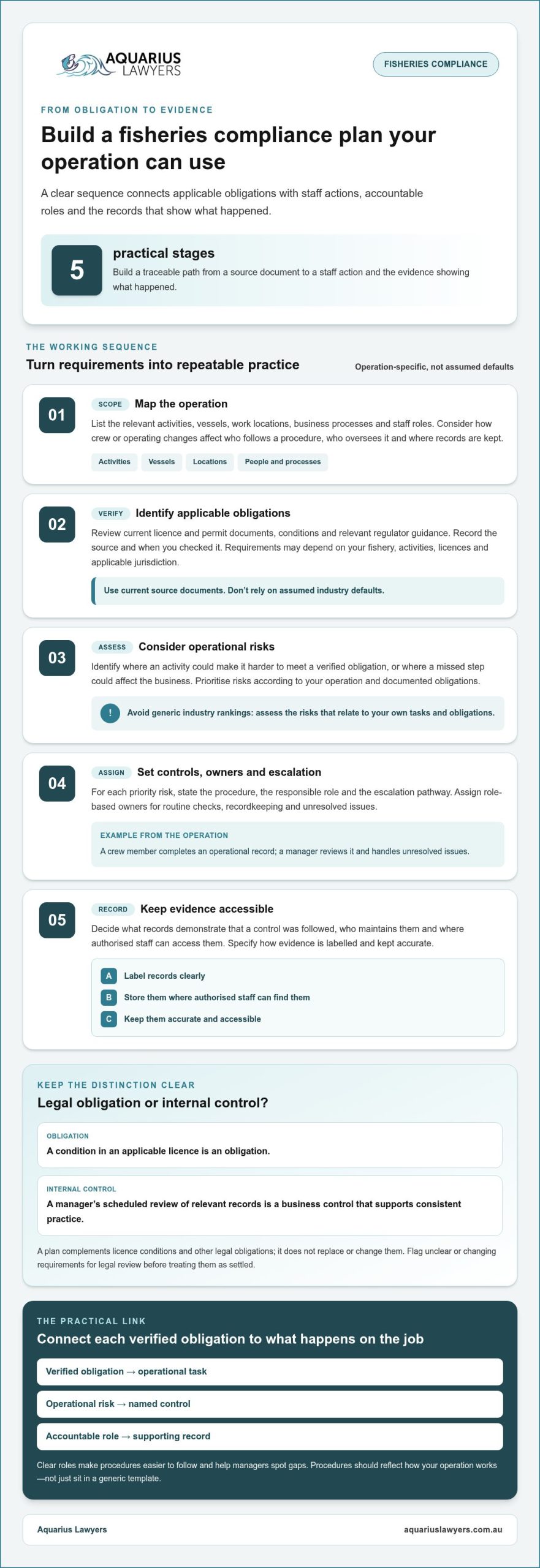
Build the framework in sequence. This creates a traceable path from a source document to a staff action and the evidence showing what happened. Keep the focus on obligations that apply to your operation rather than copying assumed industry defaults.
- Scope the operation. List relevant activities, vessels, work locations, business processes and staff roles.
- Identify obligations. Review current licence and permit documents, conditions and relevant regulator guidance. Record the source and when you checked it.
- Assess operational risks. Consider where your activities could make it harder to meet a verified obligation, or where a missed step could affect the business.
- Assign controls. Set out the procedure, responsible role and escalation pathway for each priority risk.
- Record evidence. Decide what records demonstrate that a control was followed, who maintains them and where authorised staff can access them.
Prioritise risks according to your operation and documented obligations, not a generic industry ranking. Monitoring, control and surveillance are recognised parts of fisheries compliance; the FAO guidelines on fisheries MCS provide broader context. Your internal controls should still be designed around your own tasks and records.
Map obligations to operational risks and controls
Use a simple matrix to connect each verified obligation with the operational task it relates to, the risk, the control, the responsible role and the record. For example, a crew handover procedure could specify who passes on relevant information, who is responsible for recording it and where the record is kept. These are business procedures, not automatically additional legal requirements. Flag unclear or changing requirements for legal review before treating them as settled.
Turn each verified obligation into a named control, an accountable owner and a record that shows what was done. This is the practical link between a document and the way your operation runs.
Assign responsibility and keep useful records
Assign role-based owners for routine checks, recordkeeping and escalation. For example, a crew member may complete an operational record while a manager reviews it and handles unresolved issues. Specify what evidence to retain, how it should be labelled and where authorised personnel can find it. Records should be accurate and accessible, rather than scattered across personal devices or unclear filing systems.
If you need help connecting procedures with obligations, fisheries legal advice for your operation can support a focused review of the framework.
How to put the fisheries compliance plan into practice and review it
A plan becomes useful when staff can apply it during ordinary work, not just find it in a folder. Introduce procedures in language suited to each role, explain where current reference materials are kept and show staff how to raise a question or report a gap. Implementing a fisheries compliance plan is an ongoing management task, not a one-off document exercise.
Train staff to follow the procedures consistently
Make training relevant to the work. Use practical scenarios based on the operation’s documented procedures, such as a crew handover or completing a business record. Ask staff to talk through the steps they would take, then clarify any uncertainty before it leads to inconsistent practice.
Record who completed training, which procedure it covered and whether follow-up is needed. Keep reference materials accessible to the people who use them, and provide a clear route for questions when instructions don’t match what is happening in practice. Aquarius Lawyers provides staff training on corporate governance and compliance to support businesses embedding clear procedures.
Review the plan when operations or obligations change
Set review triggers rather than relying only on a calendar reminder. Revisit the plan when activities or operating arrangements change, licence conditions are updated, an incident occurs or a check identifies a gap. Check the relevant source documents before revising a procedure; don’t treat an assumption as a settled obligation.
Assign someone to coordinate reviews, track actions and maintain the current plan version. An action log can record the issue identified, the decision made, the person responsible and whether the action is complete. Keep superseded versions controlled so staff can distinguish current instructions from outdated ones.
Managers may schedule routine checks or record reviews as internal controls to see whether procedures are working as intended. These checks are part of the business’s own plan, not universal statutory duties. If a review finds repeated errors, unclear instructions or missing records, investigate the cause and update the relevant process. Make sure the change reaches affected staff, rather than stopping at a revised document.
Staff who understand the procedure, know their responsibilities and keep reliable records give your compliance framework a practical foundation. If you need help aligning governance procedures with fisheries obligations, discuss a fisheries compliance framework with Aquarius Lawyers.
When fisheries compliance concerns arise, choose a clear next step
A possible compliance issue calls for a careful, documented response, not an instant conclusion. A missing record, unexpected event or infringement notice may raise questions, but the facts and applicable obligations determine what the issue means. Preserve information and assess the relevant documents before deciding what to do next.
What to do when a possible breach or notice needs attention
Start with a factual record. Note what was identified, relevant dates, people involved and the documents or events connected to it. Preserve existing records in their original form. Don’t edit, backdate or replace them. If further context is needed, record it separately and clearly identify when it was added.
Then review the relevant licence and condition, any regulator correspondence and the internal procedure that applied at the time. Keep copies of the documents considered and note any questions that remain. Avoid speculating about liability or assuming a particular outcome. If a notice sets out a response process or deadline, identify it promptly and seek legal advice if you’re unsure what action is required.
Where the facts, potential consequences or response obligations are unclear, obtain fisheries legal advice before deciding how to respond. A focused review can help you understand the documents and assess your options without treating an allegation as a settled finding.
How legal support can strengthen your framework
Legal review can also help after the immediate concern has been assessed. Comparing written procedures with what staff actually do may reveal unclear instructions, gaps in responsibility or records that are difficult to locate. Addressing those issues can help refine the framework, but it cannot guarantee a regulatory outcome.
Aquarius Lawyers provides governance and compliance framework development to help businesses structure procedures around applicable obligations and operational realities. Staff training on corporate governance and compliance can support consistent understanding across roles. For marine businesses, seafood and marine legal services can assist with fisheries-related legal issues and framework reviews.
Implementing a fisheries compliance plan means keeping the response pathway clear as well as the routine procedures. If a concern has exposed uncertainty in your obligations or process, book a Legal Strategy Session to discuss the legal issues and practical next steps.
Make your next review a practical step forward
A compliance plan should keep pace with the decisions that shape your operation. At each review, ask whether staff can still follow the procedures, whether records remain useful and whether a change has created an unresolved question. This helps prevent the plan from becoming a document that no longer reflects how work is done.
Choose one procedure and test it against a real work scenario. Note where the instructions are clear, where staff need support and what should be updated. If the issue turns on a licence condition or legal obligation, get advice before changing the procedure or treating an interpretation as settled. The aim of implementing a fisheries compliance plan is to make sound decisions part of ordinary business practice and respond carefully when uncertainty arises.
Aquarius Lawyers’ marine and fisheries focus can support businesses reviewing governance arrangements, compliance frameworks and staff understanding. Take the next step with a legal discussion tailored to your concerns: book a Legal Strategy Session.
A clear review pathway helps you keep the plan aligned with your operation and gives your team a practical basis for action.
Frequently Asked Questions
Does every commercial fishing business need a written fisheries compliance plan?
There’s no basis to assume every operation must have the same written plan. Requirements depend on the relevant fishery, activities, licence conditions and applicable jurisdiction. A written plan can help organise internal procedures, but it doesn’t replace the conditions or obligations that apply to your business. When implementing a fisheries compliance plan, check the current source documents for your operation and seek fisheries legal advice if you’re unsure whether a particular requirement applies.
Is a fisheries compliance plan the same as a government fisheries strategy?
No. A government strategy describes a broader approach to fisheries management or regulatory compliance. Your business plan is an internal tool for putting relevant obligations into practice. A public strategy may provide useful context, but it can’t establish which conditions apply to your licence or resolve how they affect a particular activity. Use the source documents relevant to your operation rather than treating a government strategy as a substitute for them.
Can a small fishing operation use a simple compliance plan?
Yes. A plan can be scaled to the size and structure of your operation. For a small business, concise instructions may be easier to use than a lengthy manual, provided they address relevant obligations and clearly show staff what to do. For example, make the current procedure accessible where the task is performed. Simplicity should make the plan usable, not leave important conditions or open questions out.
What records should a fisheries compliance plan refer to?
Refer to records that help show how your business carries out relevant procedures and manages applicable obligations. Depending on your operation, these might include completed operational records, an acknowledgement that a staff member received an instruction or a record of an internal check. Don’t assume each example is legally required. Confirm any recordkeeping obligation against current source documents, and make sure staff know which record applies to each task.
How often should a fisheries compliance plan be reviewed?
There isn’t a universal review interval that suits every operation. Set an approach that reflects how your business works, and identify who will check that the plan remains current. Record the review date, documents considered and any actions that follow. A planned review can sit alongside event-based reviews, such as after a change in operating arrangements or when a gap is identified. This creates a clear history of decisions without assuming the plan stays accurate on its own.
Does having a fisheries compliance plan prevent an infringement notice?
No plan can guarantee that an infringement notice or other regulatory action won’t occur. A plan helps organise internal processes, but it doesn’t decide whether an alleged breach occurred or determine the outcome. If you receive a notice, read it carefully, preserve relevant documents and identify any response instructions or dates stated in it. Get fisheries legal advice if you’re uncertain about the facts, applicable conditions or how to respond before drawing conclusions about liability.
Disclaimer
Please note that legal rules change and this is not a substitute nor construed as legal advice. It is general information only.