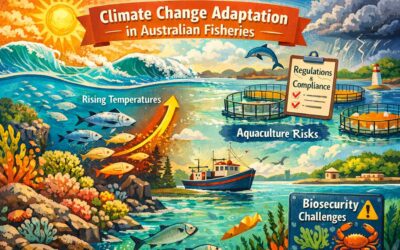
Climate change is reshaping Australia’s marine environment at a pace that is testing traditional fisheries management frameworks. Rising sea temperatures, marine heatwaves, ocean acidification, shifting species distribution and intensified storm events are no longer theoretical risks — they are measurable realities affecting catch composition, biomass estimates and operational stability.
Although Australian fisheries legislation does not always refer expressly to “climate adaptation obligations,” the legal architecture governing fisheries already embeds duties that require adaptive, precautionary and sustainability-focused decision-making. As climate impacts intensify, these existing statutory principles are increasingly interpreted through a climate lens. For commercial fishers, aquaculture operators and seafood enterprises, understanding how climate adaptation is operating within fisheries law is essential to protecting access rights and long-term viability.
The Legislative Framework Governing Fisheries
Australian fisheries operate within a layered regulatory structure at Commonwealth, State and Territory levels. Core legislative instruments include:
- The Fisheries Management Act 1991 (Cth)
- The Fisheries Administration Act 1991 (Cth)
- The Environment Protection and Biodiversity Conservation Act 1999 (Cth)
- State and Territory fisheries legislation
- Marine park statutes and management plans
- Subordinate regulations, harvest strategies and licence conditions
Across jurisdictions, fisheries are managed according to ecologically sustainable development principles. These principles require regulators to consider environmental, economic and social factors in an integrated manner. Climate change is increasingly recognised as directly relevant to these considerations.
Ecologically Sustainable Development and Climate Risk
Ecologically sustainable development requires long-term maintenance of biological diversity and ecological processes. Climate change directly affects these objectives by altering marine ecosystems and stock dynamics.
Legal implications include:
- Stock assessments must account for changing recruitment patterns
- Biomass reference points may need recalibration
- Management strategies must incorporate climate-driven uncertainty
- Decision-makers must consider cumulative environmental impacts
Failure to incorporate credible climate science into management decisions may expose those decisions to legal challenge on administrative law grounds, particularly if relevant considerations are ignored.
The Precautionary Principle in a Climate Context
The precautionary principle requires that lack of full scientific certainty should not delay protective measures where there is a risk of serious or irreversible environmental harm.
Climate change presents precisely this form of uncertainty. Fisheries managers may rely on precaution to justify:
- Lower total allowable catches
- Increased biomass buffers
- More conservative harvest control rules
- Spatial or seasonal closures
- Enhanced monitoring requirements
For commercial operators, precaution-driven adjustments may reduce short-term catch allocations, even where immediate stock collapse is not evident. Courts have generally upheld precautionary decision-making where supported by rational scientific basis.
Adaptive Management as an Emerging Norm
Adaptive management has become central to modern fisheries governance. It involves structured monitoring, review and adjustment of management settings as new data becomes available.
In a climate-affected marine environment, adaptive management may involve:
- Shorter review cycles for harvest strategies
- Trigger points for mid-season quota adjustments
- Enhanced environmental data collection
- Incorporation of climate modelling into stock assessments
Licence holders should anticipate more dynamic regulatory settings rather than fixed long-term parameters.
Marine Heatwaves and Emergency Powers
Marine heatwaves have caused sudden and severe impacts on Australian fisheries in recent years. Legislation typically provides regulators with emergency powers to respond to unexpected ecological stress.
These powers may permit:
- Immediate area closures
- Temporary suspension of fishing activity
- Rapid quota reductions
- Amendments to licence conditions
While designed to protect stock sustainability, such measures may significantly affect commercial viability. Compensation is not automatically available for closures implemented for conservation purposes.
Operators should review:
- The scope of emergency powers under applicable statutes
- Whether review or appeal mechanisms exist
- Insurance coverage for regulatory interruption
Understanding the breadth of ministerial discretion is critical in assessing business risk.
Climate Change and the EPBC Act
The Environment Protection and Biodiversity Conservation Act plays a central role in Commonwealth fisheries oversight, particularly in relation to:
- Strategic environmental assessments
- Wildlife Trade Operation approvals
- Listed threatened species protections
- Marine protected area management
Climate vulnerability of species and ecosystems is increasingly considered in these processes.
For export fisheries requiring Wildlife Trade Operation accreditation:
- Management arrangements must demonstrate ecological sustainability
- Climate resilience measures may be scrutinised
- Bycatch mitigation may need strengthening
Failure to address climate-related ecosystem risk may jeopardise export approvals.
Shifting Stock Distribution and Jurisdictional Challenges
Warming waters are causing certain species to migrate southward or into deeper waters. This creates legal and allocation challenges, particularly where stock movement crosses jurisdictional boundaries.
Potential consequences include:
- Disputes between State and Commonwealth management regimes
- Pressure to reallocate quota between regions
- Reassessment of historical catch-based allocation models
- Increased intergovernmental negotiation
Fisheries legislation does not automatically reassign access rights when ecological boundaries shift. Reform may require complex policy deliberation.
Operators near jurisdictional borders should monitor policy developments closely.
Aquaculture and Climate Adaptation Duties
Aquaculture operators face distinct climate adaptation challenges, including:
- Elevated disease prevalence
- Harmful algal blooms
- Increased storm damage
- Water temperature thresholds affecting species viability
Licences and environmental approvals often require biosecurity and environmental management plans. Climate change may prompt regulators to:
- Strengthen monitoring obligations
- Adjust stocking density conditions
- Impose additional reporting requirements
- Mandate infrastructure upgrades
Operators must ensure climate risk is integrated into operational planning and compliance systems.
Biodiversity Protection and Marine Spatial Planning
Expansion of marine protected areas is frequently justified by reference to climate resilience and biodiversity protection.
Climate adaptation within marine planning may lead to:
- Creation of additional no-take zones
- Restrictions on certain gear types
- Protection of climate refugia areas
- Integration of ecosystem-based management
These measures may intersect with fisheries management objectives, sometimes creating tension between conservation and commercial access.
Understanding how marine park legislation interacts with fisheries statutes is essential for assessing operational exposure.
Corporate Governance and Director Duties
Climate risk is not solely an environmental compliance issue; it is also a governance matter.
Directors of fisheries and aquaculture enterprises owe duties to exercise reasonable care and diligence. As climate impacts become more foreseeable and measurable, boards are expected to:
- Identify material climate-related operational risks
- Integrate climate considerations into strategic planning
- Monitor regulatory developments
- Disclose material risks where required
Failure to address foreseeable climate risks may expose directors to scrutiny from regulators or shareholders.
Climate adaptation should therefore be incorporated into enterprise risk management frameworks.
Insurance and Financial Risk Considerations
Climate-driven regulatory changes may also affect financial exposure.
Potential impacts include:
- Increased insurance premiums
- Exclusions for climate-related losses
- Reduced asset valuations
- Lending conditions tied to environmental risk
Businesses reliant on predictable catch volumes should assess whether financing arrangements account for regulatory variability driven by climate considerations.
Practical Steps for Industry Participants
To manage evolving climate adaptation obligations, fisheries businesses should consider:
Reviewing Management Frameworks
• Analyse harvest strategies for climate integration
• Monitor stock assessment methodologies
• Engage in consultation processes
Strengthening Data Collection
• Invest in environmental monitoring systems
• Maintain accurate catch reporting
• Document adaptive measures
Assessing Contractual Exposure
• Review supply contracts for quota variability
• Clarify force majeure provisions
• Address regulatory closure risk
Enhancing Governance
• Include climate risk on board agendas
• Document oversight processes
• Align sustainability disclosures with operational practice
Seeking Legal Advice
• Obtain guidance on emerging regulatory reform
• Assess review rights for adverse decisions
• Evaluate compensation pathways where relevant
Proactive preparation reduces reactive disruption.
Looking Ahead: Reform Trends
Several trends suggest climate adaptation obligations will intensify:
- Greater integration of climate modelling in fisheries science
- More frequent management reviews
- Expansion of ecosystem-based management frameworks
- Increased transparency of environmental performance
- Alignment of fisheries policy with national climate commitments
Climate change is unlikely to be addressed through a single legislative amendment. Rather, it will continue to shape interpretation and implementation of existing sustainability principles.
Conclusion
Climate change adaptation obligations under Australian fisheries law are emerging not through isolated statutory reform, but through evolving application of established principles of sustainability, precaution and adaptive management.
For commercial fishers and aquaculture operators, this means regulatory settings may become more dynamic, data-driven and conservative. Emergency interventions may increase. Export approvals may depend on demonstrated climate resilience.
Businesses that treat climate adaptation as a core legal and governance issue — rather than a peripheral environmental concern — will be better positioned to protect operational continuity and resource access.
In a changing marine environment, resilience is no longer optional. It is increasingly embedded in the legal framework governing Australia’s fisheries.