On 1 January 2026, the deck under the Australian commercial fishing industry shifted permanently. It’s no longer just about managing a resource; it’s about legal survival in a landscape defined by 50% quota cuts and total bioregion closures. You’ve likely spent years building your business, only to find that the latest fisheries regulation changes feel like a moving target that threatens your livelihood. The fear of an accidental breach or losing your commercial licence isn’t just stress; it’s a legitimate business risk that requires a proactive legal response.
We know the pressure from reduced quotas in the Kimberley and Pilbara, combined with permanent trawl closures, can feel overwhelming. This guide provides the expert legal insights you need to protect your assets and turn these complex reforms into a clear compliance strategy. Technical knowledge + tactical compliance = commercial security. We’ll break down the new bioregion-specific closures, explain how to avoid fisheries prosecution, and explore the specifics of the 2026 licence buy-back schemes to help you secure a path forward.
Key Takeaways
- Understand the shift toward Ecosystem-Based Fisheries Management (EBFM) and how this “Big Reset” fundamentally alters your day-to-day operational requirements.
- Master the specific 2026 fisheries regulation changes regarding new bag, size, and possession limits to ensure your catch remains fully compliant.
- Identify the precise boundaries of new bioregion closures from Augusta to Kalbarri and across NSW to keep your fleet within legal fishing zones.
- Implement a 5-step strategic compliance framework designed to update your internal manuals and withstand more rigorous enforcement protocols.
- Learn the critical timing for engaging Fisheries Law experts to appeal administrative decisions or protect your commercial licence from prosecution.
Understanding the 2026 Fisheries Regulation Landscape
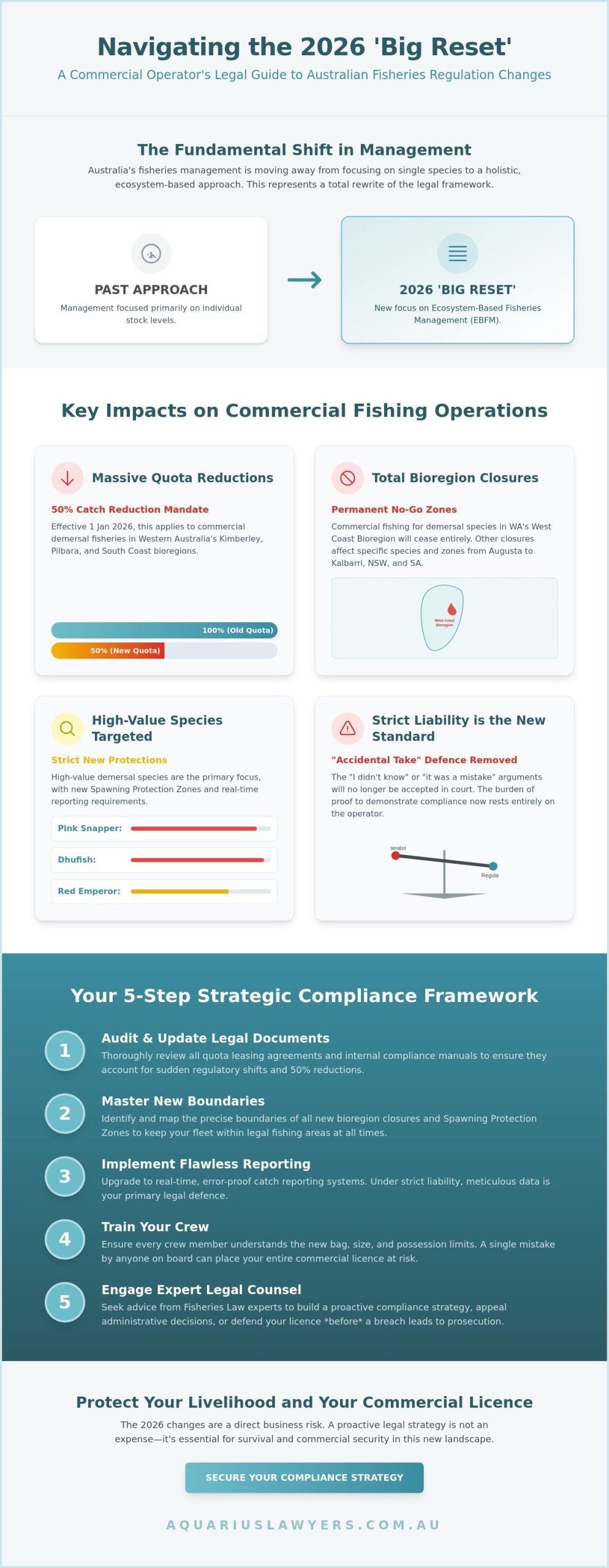
The 2026 “Big Reset” marks a fundamental shift in how Australian waters are policed. For decades, management focused on individual stock levels. Now, the priority has shifted toward Ecosystem-Based Fisheries Management (EBFM). This approach views the ocean as a single, interconnected unit where the removal of one species impacts the entire habitat. For commercial operators, this means the 2026 fisheries regulation changes aren’t just about smaller quotas; they represent a total rewrite of the legal framework governing both state and Commonwealth waters. You aren’t just managing a boat anymore; you’re managing a complex legal entity.
While the Australian Fisheries Management Authority (AFMA) handles Commonwealth-managed species, state-level Departments of Primary Industries (DPI) are tightening their grip on regional bioregions. This dual-layered enforcement ensures that any breach in state waters can have cascading effects on your federal permits. Compliance is no longer a “tick-the-box” exercise. It’s a core business function that requires the same level of attention as your engine maintenance or your payroll. Failure to adapt to this new landscape puts your commercial licence and your livelihood at immediate risk.
Sustainability vs. Legality: The New Standard
Sustainability has transitioned from a boardroom buzzword to a hard legal trigger. When a species is designated as “at-risk,” the DPI now has the power to implement immediate legal closures without the lengthy consultation periods of the past. This creates a direct conflict between traditional commercial fishing rights and modern environmental law. We’re seeing a shift where the burden of proof is moving toward the operator. You must prove you’re compliant, rather than the regulator proving you aren’t.
Bioregional Management is a legal enforcement tool that divides coastal waters into specific zones with unique, non-transferable compliance requirements based on local ecological health.
Key Species Under the 2026 Spotlight
The 2026 spotlight shines brightest on high-value demersal species. In Western Australia, commercial fishing for demersal species in the West Coast Bioregion is set to cease entirely on 1 January 2026. This includes strict protections for Pink Snapper and Dhufish. In the Kimberley and Pilbara, operators face a 50% catch reduction. These aren’t suggestions. They’re backed by the introduction of Spawning Protection Zones, which are strictly off-limits during peak reproductive months. Red Emperor and other demersal stocks are also under the microscope, with real-time reporting of high-risk catches commencing later in 2026.
The most dangerous change for operators is the removal of “accidental take” as a valid legal defence. If you’re caught with a prohibited species or exceeding a quota, the “I didn’t know” or “it was a mistake” argument won’t hold up in court. Strict liability is the new standard. This means your internal reporting systems must be flawless to avoid fisheries prosecution and potential licence forfeiture. Accessing expert legal advice for fishers before a breach occurs is the most effective way to ensure your reporting systems meet the new strict liability standard.
Major Changes to Commercial and Recreational Quotas
The 2026 reset isn’t just about closing zones; it’s about a radical redistribution of the Total Allowable Catch (TAC). In Western Australia, the 1 January 2026 deadline marks a 50% catch reduction for commercial demersal fisheries in the Kimberley, Pilbara, and South Coast bioregions. This isn’t a suggestion. It’s a legislative mandate that forces operators to rethink their entire business model. While much of the public focus remains on WA, the South Australian Fishing Regulation Changes implemented on 1 May 2026 show a similar trend, with closures for Southern Calamari and Southern Garfish in Gulf St Vincent. These shifts suggest a national move toward tighter, species-specific management that prioritises stock recovery over historical catch levels.
Commercial Quota Management and Leasing
Your Total Allowable Commercial Catch (TACC) is your most valuable asset, but in 2026, its legal standing is more precarious than ever. When quotas are slashed by half, the ripple effect on leasing agreements is immediate and often legally messy. If you’re leasing quota from another holder, you must review your contracts to ensure they account for these sudden regulatory shifts. A standard agreement might not protect you from a 50% reduction in available stock. Re-evaluating your business plan isn’t just about numbers; it’s about legal risk mitigation. If you’re unsure how these shifts impact your specific permits, seeking advice on Fisheries Law is a proactive step to secure your commercial interests before the next season starts.
Recreational Reforms and Charter Impacts
The government is attempting to balance the scales by introducing “Exclusive Recreational Fishing Zones.” In the West Coast Bioregion, this shift prioritises recreational access from September 2027, but the groundwork starts now. For charter operators, the 2026 fisheries regulation changes introduce new “tagging” systems for high-risk species and stricter real-time reporting requirements. To soften the blow for the recreational sector, WA has launched a $3.3 million program providing $50 vouchers to boat fishing licence holders to support local tackle shops. However, the legal distinction between “boat-based” and “shore-based” fishing remains a point of contention. Shore-based fishers often face different bag limits, and misidentifying your legal position can lead to heavy fines or equipment seizure.
For those looking to exit the industry, the WA government’s buy-back of all demersal commercial fishing licences in the West Coast Bioregion is a major development. This isn’t just a financial transaction; it’s a legal process that requires careful negotiation of licence conditions and surrender terms. You’re essentially trading your historical fishing rights for a fixed settlement. Whether you’re staying in the game or taking the buy-back, your strategy must be grounded in the new 2026 legal reality to ensure you aren’t left behind by these sweeping reforms.
The Impact of Bioregion Management and Closure Zones
Mapping the Australian coastline is no longer just a matter of identifying reefs and depth contours. In 2026, the ocean has become a complex grid of invisible legal boundaries. Crossing from one bioregion to another without the correct permit is a high-risk gamble that can lead to immediate licence suspension. These fisheries regulation changes have turned your GPS and Vessel Monitoring Systems (VMS) into the most critical compliance tools on your bridge. Enforcement agencies now use real-time data to track every movement. If your VMS shows you’ve spent time in a restricted zone like the Pilbara Trawl Closure area after 1 January 2026, the burden of proof shifts to you to explain your presence there.
The legal consequences of boundary breaches are severe. Under the new enforcement protocols, a single GPS ping inside a closed zone can trigger a full-scale investigation. You aren’t just being watched by patrol boats; you’re being monitored by a digital fence. This level of surveillance means that your logbooks must perfectly align with your vessel’s track history. Any discrepancy is viewed as a red flag by the Department of Primary Industries (DPI) or the Australian Fisheries Management Authority (AFMA). Compliance is no longer about intention. It’s about data accuracy.
Navigating the West Coast Bioregion Closure
The West Coast Bioregion, stretching from Augusta to Kalbarri, is the epicentre of the 2026 reforms. While commercial demersal fishing in this region officially ceases on 1 January 2026, the legal definition of “possession” is where many operators stumble. If you’ve caught fish in a legal zone but transit through a closure zone to reach port, you must ensure your catch is stored according to strict “possession” rules. Simply having prohibited species on board while inside a closure zone can be enough to trigger a prosecution. There are narrow exceptions for deep-drop fishing beyond the 250-metre isobath and specific shallow-water snapper opportunities, but these require precise navigation and documentation to withstand a DPI audit.
Regional Variations: NSW and Beyond
While Western Australia’s changes are drastic, NSW operators face their own set of regional shifts. The NSW Fisheries Management Act is being utilised to implement localised closures in regions like Shellharbour, while WA continues to tighten rules in Cockburn Sound. The key difference lies in how these states manage “emergency” closures. In NSW, a closure can be enacted via a government gazette with very little notice. You can’t rely on last month’s rules. Staying updated means checking the gazettes weekly or subscribing to real-time DPI alerts. A proactive approach to regional variations is the only way to protect your business from the “emergency” regulatory shifts that are becoming the new industry standard.
Strategic Compliance: Navigating the New Enforcement Protocols
Compliance in 2026 isn’t just about following the rules; it’s about building a legal fortress around your business. Most fisheries offences in Australia operate under strict liability. This means the prosecution doesn’t need to prove you intended to break the law, only that the breach occurred. Because the 2026 fisheries regulation changes have introduced such narrow margins for error, your “Fisheries Compliance Manual” needs more than a quick polish. It requires a total overhaul to reflect the new real-time reporting requirements and bioregion-specific limits. Effective systems + documented verification = a defensible commercial operation.
To protect your licence, we recommend a 5-step framework for commercial fisheries compliance:
- Inventory Audit: Physically verify that all gear on board matches the specific requirements for your current bioregion.
- Manual Update: Rewrite your operational protocols to include the 2026 bag, size, and spawning closure dates.
- Crew Training: Conduct formal, documented briefing sessions for all staff on new possession limits and “accidental take” risks.
- Digital Synchronisation: Ensure all electronic reporting apps are updated to the latest versions and synced with your VMS.
- Verification Logs: Maintain an internal audit trail that proves you check your catch against the TACC daily.
When a Fisheries Officer boards your vessel, your primary goal is professional transparency. You have the right to be treated with respect, but you also have a legal obligation to assist with the inspection. However, if an inspection turns into an investigation, you should seek immediate advice from a specialist in Fisheries Law. Knowing where the line sits between a routine check and a formal interview can be the difference between a minor fine and a criminal record.
Establishing a Due Diligence Defence
In a fisheries prosecution, a “Due Diligence” defence is often your only shield. To succeed, you must demonstrate that you took all reasonable steps to prevent the breach. This isn’t just a verbal claim. It requires a paper trail of staff training, written vessel protocols, and proof of regular equipment maintenance. A robust due diligence framework can mitigate penalties by proving that the offence occurred despite a comprehensive and professional compliance system being in place.
Digital Compliance and Technology
Real-time reporting of high-risk demersal fish catches will commence later in 2026, making digital literacy a mandatory part of your job. You’re now legally obligated to ensure your VMS and electronic reporting technology are fully operational and “tamper-proof.” Any failure in your hardware isn’t just an inconvenience; it can be interpreted as an attempt to bypass enforcement. While privacy concerns regarding VMS data are valid, your legal obligation to provide this data is clear under the 2026 reforms. Ensuring your technology is reliable is now just as important as ensuring your hull is seaworthy.
Protecting Your Livelihood: Legal Pathways and Representation
When the Department issues a formal notice, the clock starts ticking immediately. In the high-stakes environment created by the 2026 fisheries regulation changes, your response to a potential breach must be calculated and swift. Early intervention is almost always more effective than a last-minute court defence. Whether you’re dealing with a minor infringement or a threat to your entire commercial licence, the legal pathway you choose determines your operational future. Expert representation isn’t just about fighting a fine; it’s about protecting the commercial asset you’ve spent decades building.
Defending fisheries prosecutions in the Local and District Courts requires a deep understanding of both maritime law and the specific technicalities of the 2026 reforms. We’ve seen how the shift toward strict liability has made traditional defences harder to mount. Success in court now relies on a combination of technical data, such as VMS track history, and a robust interpretation of the law. A proactive fisheries prosecution defence strategy integrates this modern technology with traditional maritime expertise to ensure your side of the story is backed by hard evidence. Aquarius Lawyers moves beyond simple advocacy to provide a pragmatic, results-driven defence that prioritises your business continuity.
Challenging Licence Suspensions and Cancellations
If you receive a “show cause” notice, the regulator is essentially asking why they shouldn’t cancel or suspend your licence. This is a critical junction. The “show cause” process is your opportunity to present a legal argument against administrative action before it takes effect. In many cases, we can seek a stay of proceedings or an administrative review to keep you on the water while the dispute is resolved. Successfully navigating a quota dispute often involves challenging how the Department has calculated your TACC or how they’ve applied new bioregion boundaries to your historical catch data. These administrative appeals are a vital tool for operators who feel they’ve been unfairly targeted by the 2026 reset.
Expert Representation by Katherine Hawes
Specialised fisheries law expertise is essential in 2026 because the regulations are now too complex for a generalist solicitor to manage. Katherine Hawes, known as the “Fish Lawyer,” brings an “innovative veteran” perspective to every case. She understands the synergy between traditional fishing practices and the new digital enforcement landscape. This specialised approach ensures that you receive cost-effective legal solutions that are grounded in the reality of the Australian fishing industry. We value results over ceremony, offering a no-nonsense attitude that gets to the heart of your compliance issue quickly. If you’re facing a compliance issue, Contact Aquarius Lawyers for a confidential consultation to discuss your options and secure your future on the water.
Securing Your Commercial Future in a Regulated Ocean
The 2026 fisheries regulation changes represent a permanent shift in how you must operate. From the 50% quota reductions in the Kimberley to the strict demersal closures on the West Coast, the margin for error has disappeared. Survival now requires a combination of precise digital compliance and a proactive legal strategy. You’ve worked hard to build your business; don’t let a technical breach or an administrative oversight at the Department of Primary Industries take it away. Specialised knowledge + a robust compliance manual = business longevity.
Led by Katherine Hawes, “The Fish Lawyer,” Aquarius Lawyers provides a unique blend of traditional maritime experience and modern legal methodology. With a specialised niche in Marine and Fisheries Law and offices in Sydney and Shellharbour, we offer the grounded, no-nonsense advice you need to navigate these reforms. Whether you’re appealing a licence decision or updating your operational protocols, we’re here to provide clarity and confidence. Secure your commercial future—speak to The Fish Lawyer today.
You don’t have to face these tides alone. With the right protection and a steady, common-sense guide at your side, your business can thrive in this new landscape and continue to provide for the future.
Frequently Asked Questions
What are the main fisheries regulation changes in Australia for 2026?
The primary fisheries regulation changes for 2026 include a 50% reduction in commercial demersal catch limits for the Kimberley, Pilbara, and South Coast bioregions starting 1 January. Additionally, commercial demersal fishing in the West Coast Bioregion will cease entirely on the same date. These reforms are coupled with the introduction of real-time reporting for high-risk species and permanent closures of commercial trawling in the Pilbara.
Can I still fish for demersal species in the West Coast Bioregion?
Commercial boat-based fishing for demersal species in the West Coast Bioregion is prohibited from 1 January 2026. While recreational boat-based fishing in this zone remains closed until Spring 2027, commercial operators must cease operations within these boundaries immediately. Some narrow exceptions exist for deep-drop fishing beyond the 250-metre isobath, but these require specific permits and strict adherence to possession rules.
What happens if I accidentally catch a protected species under the new rules?
Strict liability is the new standard, meaning “accidental take” is no longer a valid legal defence in a prosecution. If you catch a protected or out-of-season species, you must return it to the water immediately with minimal harm. You are still at risk of being charged if you are found in possession of the fish or if your digital reporting doesn’t align with your vessel’s track history inside a closure zone.
How do the 2026 changes affect commercial fishing licence values?
The market value of commercial licences is expected to face downward pressure as Total Allowable Commercial Catch (TACC) allocations are slashed. When quotas are reduced by 50%, the underlying asset becomes less bankable and harder to lease. Operators should re-evaluate their business plans to account for the diminished commercial utility of licences in regions transitioning toward recreational priority.
Is there a buy-back scheme for commercial fishers affected by closures?
Yes, the Western Australian government has implemented a voluntary buy-back scheme for all demersal commercial fishing licences in the West Coast Bioregion. This program allows operators to surrender their licences in exchange for a financial settlement. It’s a permanent legal exit from the fishery, so it’s vital to have the surrender terms reviewed by a legal professional providing expert legal advice for fishers before signing.
Do I need a lawyer if I am issued a fisheries infringement notice?
You should seek advice from a specialist in Fisheries Law because an infringement notice can lead to a “show cause” process for licence suspension. A lawyer can help you lodge an administrative appeal or seek a stay of proceedings to keep your boat on the water. Protecting your licence history is essential, as multiple minor breaches can result in the permanent cancellation of your commercial rights.
How do the new rules apply to Indigenous and traditional fishing rights?
Traditional fishing for personal or communal needs is generally protected under Native Title frameworks and remains separate from commercial quota resets. However, any commercial fishing enterprise operated by Indigenous groups must still comply with the 2026 sustainability limits and reporting requirements. The law distinguishes between cultural practice and commercial exploitation, so operators must ensure they’re permitted for the specific activity they’re undertaking.
What are the penalties for non-compliance with the 2026 fisheries reset?
Penalties for breaching the new regulations include massive fines, the forfeiture of your vessel and gear, and criminal prosecution. Because enforcement agencies now use real-time VMS data, detections of boundary breaches are almost instantaneous. A single error in your digital logbook or a transit through a closed zone without proper storage can be enough to trigger a life-changing legal battle. Understanding your options for a robust fisheries prosecution defence in Australian courts before you face charges is the most effective way to protect your livelihood and your vessel.
Disclaimer
Please note that legal rules change and this is not a substitute nor construed as legal advice. It is general information only.