
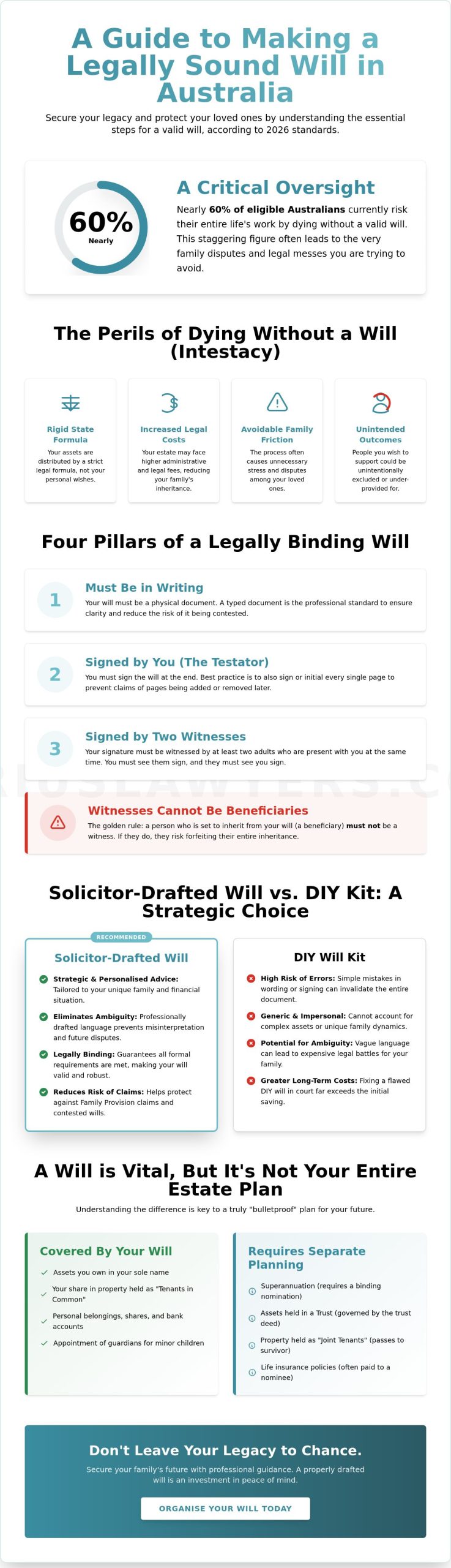
Did you know that nearly 60% of eligible Australians currently risk their entire life’s work by dying without a valid will? It is a staggering figure that often leads to the very family disputes and legal “messes” you are likely trying to avoid. You probably feel that protecting your family shouldn’t be this complicated. Between shifting state regulations and the fear of your final wishes being contested, the process can feel like a legal minefield. We understand that anxiety, but clarity is the best antidote to confusion.
This guide simplifies exactly how to make a legal will australia wide, ensuring your assets are protected and your loved ones are provided for according to the latest 2026 standards. We believe that professional expertise combined with practical strategy equals total peace of mind. By the end of this article, you will have a clear, step-by-step roadmap to creating a valid legal document, a firm grasp on the role of an executor, and the confidence to secure your family’s future without the guesswork.
Key Takeaways
- Learn why dying without a will, known as intestacy, creates unnecessary legal hurdles and financial strain for your surviving family members.
- Master the essential formalities of how to make a legal will australia requires, including the specific signature rules that ensure your document is binding.
- Discover a strategic approach to inventorying your estate, from physical property and shares to your modern digital legacy.
- Identify the common triggers for Family Provision claims and learn how to use exclusion notes to protect your final wishes from being contested.
- Understand the strategic advantage of a solicitor-drafted will over a DIY kit to eliminate ambiguity and prevent future litigation costs.
Understanding Wills in the Australian Legal Landscape
A Last Will and Testament is a legal document that serves as your final set of instructions. It outlines exactly how you want your assets distributed and who should look after your children after you pass away. While you can find general information on wills that covers global concepts, the Australian legal system operates with specific local nuances. In New South Wales, for example, the Succession Act 2006 dictates the rules of validity. Learning how to make a legal will australia requires more than just listing your belongings; it’s about creating a document that stands up to the scrutiny of the Supreme Court.
Dying without a valid will is known as “intestacy.” This is a risky outcome that leaves your family’s future to a rigid legislative formula. The state doesn’t know your family dynamics or your personal wishes. It simply follows a predetermined sequence of distribution that might leave a domestic partner or a specific child without the support they need. This often leads to delays, increased legal costs, and avoidable family friction. A valid will acts as a shield against this uncertainty.
Why a Will is Essential for Every Australian
A will is the only way to ensure your partners and children aren’t left in legal limbo. Without one, your estate might be carved up in a way that forces the sale of a family home or excludes someone you intended to support. To create a valid document, you must meet the threshold of testamentary capacity. Testamentary capacity is the mental ability to understand the implications of making a will. This ensures that the person making the will is doing so with a clear mind and without undue influence from others.
The Difference Between a Will and Estate Planning
It’s a common mistake to think a will covers everything. A will is a vital component, but it’s only one part of a broader estate planning strategy. While a will deals with assets you own personally, it doesn’t automatically control your superannuation or assets held in a private trust. Strategy equals security. You must also distinguish between how you own property. Assets held as “joint tenancies” automatically pass to the surviving owner, whereas assets held as “tenants in common” are distributed according to your will. Understanding how to make a legal will australia involves mapping out these ownership structures clearly. Combining a solid will with a Power of Attorney and an Enduring Guardian appointment creates a truly “bulletproof” plan for your future.
Formal Requirements: How to Ensure Your Will is Legally Binding
Understanding the mechanics of how to make a legal will australia requires a strict focus on formalities. If you miss a single step in the signing process, the entire document could be deemed invalid, leading to the very intestacy issues discussed in the previous section. In New South Wales, the law is uncompromising. Your will must be in writing. While a handwritten (holographic) will is technically legal, a typed document is the professional standard. It reduces ambiguity and is far less likely to be challenged in court. It’s a simple equation: clarity plus compliance equals security.
The signature rule is your first major hurdle. You must sign the document at the end, but we strongly recommend signing or initialling every single page to prevent any claims of page-swapping later. This signature must be made in the presence of at least two adult witnesses. All three of you, the testator and both witnesses, must be in the same room at the same time. You must see them sign, and they must see you sign. This “all present” rule is a non-negotiable legal safeguard designed to prevent fraud and ensure the document truly reflects your wishes.
Choosing Your Witnesses Wisely
Selecting the right people to watch you sign is more than a formality. Your witnesses must be over 18 and possess full legal capacity. There is one golden rule: a beneficiary should never witness your will. If a person named to inherit from you signs as a witness, they may legally forfeit their entire inheritance. To keep your plan secure, choose independent adults who have no financial stake in your estate. Having them initial every page alongside you creates a clear, verifiable trail of intent that is difficult to dispute.
The Role of the Executor
Your executor is the person who steps into your shoes to manage your affairs after you pass. They don’t just read the will; they locate assets, pay debts, and distribute what’s left to your beneficiaries. This role requires a high degree of organisation and resilience. You might choose a trusted family member, but if your estate involves complex business structures or potential family friction, a professional executor may be the better choice. As an executor, you will also need to understand the probate application process to ensure the estate is administered correctly through the Supreme Court. If you feel overwhelmed by these decisions, seeking advice on wills and estates can provide the strategic clarity you need. Accuracy in these early stages is the foundation of a document that actually works when it’s needed most.
Asset Mapping: Organising Your Estate from Property to Digital Legacy
Mapping your estate is the vital first step in securing your legacy. It’s more than a simple list; it’s a strategic inventory that bridges the gap between what you own and who receives it. When considering how to make a legal will australia, many people stop at the family home and the car. However, a truly robust will accounts for every financial corner, from diverse share portfolios to the specific balances in your everyday bank accounts. Sentimental items and family heirlooms also require clear instructions. Without them, even the smallest trinket can become a focal point for family tension.
Our background in specialised sectors gives us a unique edge when handling complex assets. If your wealth includes commercial fishing quotas, aquaculture leases, or registered marine vessels, a standard “off-the-shelf” will kit simply won’t suffice. These assets are governed by specific commercial and maritime regulations that must be harmonised with your estate plan. We treat these holdings with the technical precision they deserve, ensuring your commercial interests don’t sink into legal uncertainty. Precision in asset mapping is the difference between a smooth transition and a litigious nightmare.
The Digital Legacy: Crypto, Social Media, and Online Accounts
Modern wealth is increasingly intangible. 2026 estate planning must account for digital value as much as physical property. This includes everything from cryptocurrency wallets and NFTs to monetised social media accounts and digital storefronts. Access is the primary hurdle. You must provide clear pathways for digital executors to manage these assets without breaching privacy laws or platform terms of service. Securely managing cryptocurrency private keys is critical. If your executor can’t find the “keys to the vault,” that value is lost forever.
Superannuation and Life Insurance: The Non-Estate Assets
One of the most common misconceptions in Australian law is that your will automatically covers your superannuation. In reality, super is often a “non-estate” asset. The trustee of your super fund generally decides who receives your balance unless you have a valid Binding Death Benefit Nomination (BDBN) in place. Your will and your BDBN must work in tandem. If your life insurance is held within your super fund, the same rules apply. Ensuring these payouts align with your will’s intent is a strategic necessity that prevents your wealth from being distributed in ways you never intended. Mastery of how to make a legal will australia requires looking beyond the document itself to these external nominations.
Avoiding Disputes: How to Minimise the Risk of a Contested Will
Creating a document is only half the battle. The true test of your planning is whether it can survive a legal challenge after you’re gone. In Australia, approximately 74% of contested wills result in a court-ordered change of distribution. Most of these disputes stem from Family Provision claims. In New South Wales, “eligible persons”, including spouses, children, and certain dependents, can apply for a larger share of the estate if they feel they haven’t been left with adequate provision. Understanding how to make a legal will australia-wide involves anticipating these claims before they happen. Strategy plus transparency equals conflict minimisation.
If you intend to exclude someone or leave an unequal distribution, do not include the “reasons why” inside the will itself. Once probate is granted, your will becomes a public document. Airing family grievances in a public forum often fuels the fire of litigation. Instead, we recommend a separate, private statement of wishes or a statutory declaration. This provides the court with your reasoning without handing your family a public insult. We also watch for signs of “undue influence”. This occurs when a beneficiary pressures a testator into changing their will. To prevent this claim, ensure you meet with your solicitor alone to demonstrate that your decisions are entirely your own.
Strategies for Equal (and Unequal) Distribution
Blended families and former partners add layers of complexity to estate mapping. You might feel a moral obligation to one party but a legal obligation to another. Using a Testamentary Discretionary Trust can protect vulnerable beneficiaries while providing tax efficiencies. This “steady guide” approach allows you to manage expectations during your lifetime. By explaining your choices to your family now, you reduce the “shock factor” that often leads to a courtroom. If you’re worried about potential friction, contact our wills and estates team to build a strategy that protects your legacy.
Keeping Your Will Up to Date
A will is not a “set and forget” document. In NSW, marriage usually revokes an existing will entirely, while divorce typically revokes any gifts or appointments related to your former spouse. We recommend a review every 3 to 5 years or immediately after major life events like the birth of a child or a significant property purchase. When property changes hands as part of a deceased estate settlement, understanding how to manage a transfer of property title in NSW is an essential part of ensuring your estate is administered correctly. Do not use “Codicils” to make small changes. These separate attachments are often lost or create confusion that leads to disputes. It’s far safer to create a fresh will that reflects your current circumstances. Learning how to make a legal will australia requires staying current with both your life and the law.
Professional Guidance: Why a Solicitor-Drafted Will Outperforms DIY Kits
Choosing a DIY will kit might save you a few hundred dollars today, but it often invites a financial storm for your heirs. While these kits provide a basic template, they lack the strategic foresight required for modern Australian estates. When you research how to make a legal will australia, you will find many options, but only professional guidance offers a true guarantee of validity. Learning how to make a legal will australia requires more than just filling in the blanks; it involves crafting a document that is resilient against technical challenges. A single misplaced word or an improperly witnessed signature can render the entire document void. We believe that professional expertise plus pragmatic strategy equals total peace of mind.
Solicitors ensure your language is legally “bulletproof” by applying decades of case law to your specific circumstances. They don’t just record your wishes; they stress-test them. For example, a solicitor will identify if your wording accidentally excludes a child or creates a tax liability that could have been avoided. Beyond the drafting, professional storage is a critical benefit. If the original document cannot be found after you pass, the court may presume you intended to revoke it. We provide secure storage to ensure your final instructions are available when they are needed most. Accuracy in storage is just as vital as accuracy in drafting.
DIY Kits vs. Solicitor-Drafted Wills
The comparison between a newsagency kit and a solicitor-drafted will is a matter of cost versus long-term risk. A kit cannot advise you on the 30% minimum tax on discretionary trusts effective from 2028 or how to handle complex commercial assets like aquaculture leases. A small investment in a solicitor now prevents a massive legal bill for your family later. Professional advice also covers:
- Asset protection strategies for beneficiaries facing bankruptcy or relationship breakdowns.
- Tax-effective distribution to minimise the impact of new Capital Gains Tax rules.
- Clear pathways for digital assets, crypto wallets, and international holdings.
Next Steps: Securing Your Legacy with Aquarius Lawyers
We take a “no-nonsense” approach to estate planning, moving easily between traditional property law and complex commercial interests. Whether you are based in Sydney or regional NSW, our team is ready to act as your trusted advisor. To prepare for your first meeting, gather a list of your assets, your superannuation details, and the names of your chosen executors. Taking this proactive step today is the best gift you can leave your family. Ready to organise your future? Contact Aquarius Lawyers to start your legal will today.
Take Control of Your Future Today
Securing your legacy is a combination of meticulous asset mapping and strict legal compliance. We have explored how a valid will protects your family from the uncertainties of intestacy and ensures your digital and physical wealth is distributed exactly as you intend. Understanding how to make a legal will australia requires a strategy that balances traditional property rights with modern complexities like crypto and commercial fishing quotas. Accuracy in the drafting stage is the only way to prevent costly family disputes later.
Led by Katherine Hawes, known as “The Fish Lawyer,” our team brings deep expertise in managing both standard and highly specialised assets. We value results over ceremony, offering fixed-fee arrangements for estate planning so you can move forward with financial clarity. Don’t leave your life’s work to chance or a generic template. Protect your family’s future-book a consultation with our Wills and Estates specialists today. You have worked hard to build your estate; let us help you build the roadmap that preserves it for the next generation.
Frequently Asked Questions
Can I write my own will in Australia?
Yes, you can legally draft your own will using a DIY kit or even a plain sheet of paper. While it’s technically possible, it’s often a high-risk strategy because small errors in wording or witnessing can lead to the document being ruled invalid by the Supreme Court. Professional oversight ensures your intentions are legally enforceable and protected from common challenges.
What makes a will valid in NSW?
A valid will in New South Wales must be in writing, signed by the testator, and witnessed by at least two people who see you sign the document. These witnesses must also sign the will in your presence. This specific process is the foundation of how to make a legal will australia recognises, ensuring the document is your final, uncoerced wish.
Does a will need to be notarised in Australia?
No, Australian wills don’t require a notary public’s seal to be valid for domestic use. The legal requirement is satisfied by the signatures of two independent witnesses who are present at the same time as the testator. Notarisation is generally only necessary if you own international assets and the document needs to be recognised in a foreign jurisdiction.
What happens if I die without a will in Australia?
Your estate will be distributed according to the “rules of intestacy” set out in state legislation, such as the Succession Act 2006 in NSW. This follows a rigid formula that prioritises spouses and children but may not reflect your actual family dynamics or personal relationships. It often results in higher legal costs and significant delays for your grieving family members.
Who can be a witness to a will in Australia?
Any adult over 18 with full legal capacity can be a witness, provided they are not a beneficiary in the will. If a beneficiary witnesses the document, they risk losing their entire inheritance under the “beneficiary witness” rule. It’s best practice to choose independent adults, such as neighbours or professional colleagues, who have no financial stake in your estate.
How much does it cost to make a legal will with a solicitor?
Costs vary depending on the complexity of your assets and whether you require additional structures like testamentary trusts. While industry-wide fees fluctuate, many firms offer fixed-fee arrangements for standard estate planning. This investment provides a robust document that saves your family from the massive expense of potential litigation or probate complications later on.
Can a family member be an executor and a beneficiary?
Yes, it’s very common for a spouse or an adult child to serve as both an executor and a major beneficiary. This often makes sense because they have a personal interest in ensuring the estate is settled efficiently. However, you should ensure they have the organisational skills to handle the administrative burden and are unlikely to face conflicts with other family members.
Where should I store my original will?
You should store your original will in a secure, fireproof location, such as a solicitor’s safe custody vault or a bank safety deposit box. Never keep it in a place where it could be accidentally lost or destroyed. You must also tell your executor exactly where the original is kept, as a copy is often not sufficient for a Grant of Probate application.
Disclaimer
Please note that legal rules change and this is not a substitute nor construed as legal advice. It is general information only.