A tidy folder of signed contracts can still hide legal gaps. An annual business legal health check gives Australian businesses a structured way to review whether their business structure, contracts, employment practices, privacy processes and customer-facing practices still reflect how they operate. The aim is to identify issues early and decide what needs attention.
Reviewing documents only when a problem arises can leave other risks unnoticed. A scheduled check looks beyond the immediate issue and helps you assess contractor arrangements, privacy practices and key business documents. It can also turn the findings into a focused plan for the year ahead, with legal advice where interpretation or next steps need clarification.
Key Takeaways
- Review your business structure, governance documents and ownership records when the way you operate or who owns the business changes.
- Check that contractor arrangements reflect the actual working relationship, and review employment records and processes for compliance gaps.
- Map the personal information your business collects and assess whether your privacy policy, consents and disclosures match how you handle it.
- Keep written agreements organised and accessible so you can quickly identify which documents need updating or legal review.
- Seek legal input when a review uncovers complex commercial, marine, fisheries or aquaculture risks that need a clear plan.
What Is A Legal Health Check For Your Business?
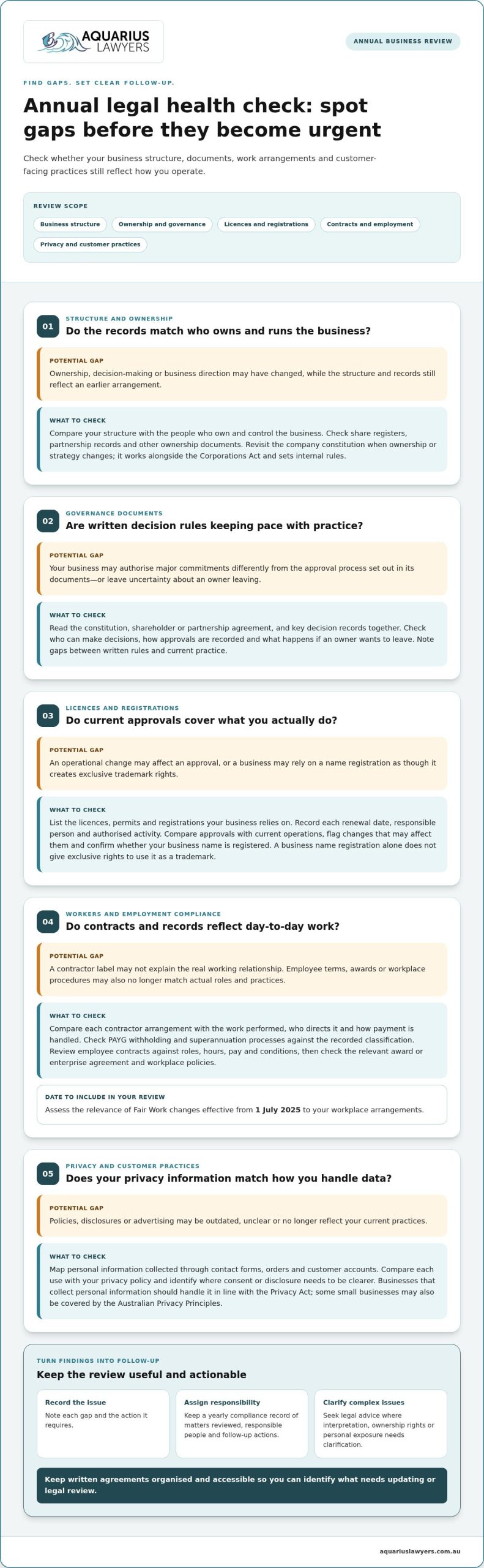
An annual business legal health check assesses whether your structure, ownership records and key documents still match your operations. Review business structure, intellectual property protection, contracts, Australian Consumer Law compliance and employment practices, then record each issue and the action it requires.
-
Review business structure and ownership
Compare your business structure with the people who own and control the business. Check that share registers, partnership records and other ownership documents reflect changes in ownership, decision-making or direction. A company constitution works alongside the Corporations Act and sets internal rules, so revisit it when ownership or strategy changes. Because structure can affect obligations and liability, identify any mismatch before signing new agreements or taking on new activities. Seek legal advice if a proposed change could affect ownership rights or personal exposure.
-
Check governance documents
Read your constitution, shareholder or partnership agreement, and key decision records together. Check who can make decisions, how approvals are recorded and what happens if an owner wants to leave. For example, compare the agreement’s approval process with how your business actually authorises major commitments. Record any gaps between written rules and current practice, and note whether changes in ownership or strategy call for updated governance documents. A documented review gives owners a clear basis for discussing changes and addressing legal risks.
-
Review licences and registrations
List the licences, permits and registrations your business relies on. For each, record the renewal date, responsible person and activity it covers. Review requirements relevant to your industry and operations, including approvals for regulated work. Compare each current approval with the activities it authorises, and flag operational changes that may affect it. Confirm whether your business name is registered, too. Registering a business name does not, by itself, give you exclusive rights to use it as a trademark.
A proactive legal health check helps businesses address legal concerns before they become urgent, rather than waiting for a problem to arise.
Contractor classification, PAYG withholding and superannuation
Review employment compliance each year, including worker arrangements, contracts, awards, PAYG withholding and superannuation. The Fair Work Act 2009 (Cth) is a law Australian employers need to consider when ensuring employment compliance, according to the Australian Government Federal Register of Legislation.
Check changes relevant to your business, including Fair Work changes effective from 1 July 2025. Use the review to identify whether your records and workplace practices need updating.
-
Check contractor classification and payments
Review each contractor arrangement against the work performed and the terms in the contract. Compare the recorded arrangement with day-to-day practice, including who directs the work and how payment is handled. Check whether PAYG withholding and superannuation processes align with the classification you have recorded. Keep the reasoning and supporting documents together so a later payroll or employment review can follow how the decision was made.
-
Review employment contracts and awards
Compare each employee contract with the role, hours, pay arrangements and conditions currently offered. Identify the relevant award or enterprise agreement, then check that the contract and workplace practices align with it. Review performance incentives as well: document how eligibility is assessed, which conditions apply and who approves changes. A written process helps managers apply incentive terms consistently across comparable roles.
- Review how employees and contractors are engaged across each work area. A contractor agreement should describe the work and payment arrangement, while an employment contract should reflect the employee’s role and workplace terms. If actual practice has changed, record the difference and assess whether the arrangement needs review. Don’t rely on a contractor label or business name alone to explain the working relationship.
- Review workplace policies alongside contracts and actual procedures. Check that employees and managers can readily find current guidance on conduct, performance management, leave and workplace concerns. For example, compare how a supervisor addresses performance with the process set out in your documents. Record who owns each policy and update outdated versions. This connects written obligations with everyday employment decisions.
- Maintain a yearly compliance record that lists the matters reviewed, the person responsible and follow-up actions. Include changes to employment contracts, awards, enterprise agreements, PAYG withholding and superannuation processes. Note the Fair Work changes effective from 1 July 2025 and assess their relevance to your workplace arrangements. Where a classification, contract or award issue is unclear, seek legal advice before changing the arrangement or applying new terms.
Privacy and data protection
Review the personal information your business collects, how it uses that information and what your website tells customers. An annual compliance review can reveal outdated policies, unclear disclosures or advertising that no longer reflects your practices.
-
Review privacy and data protection
Map the personal information your business collects, including details submitted through contact forms, orders and customer accounts. Compare each use with your privacy policy and identify where consent or disclosure needs to be clearer. Businesses that collect personal information should handle it in line with the Privacy Act; some small businesses may also be covered by the Australian Privacy Principles. Record what information you hold, why you collect it and who can access it.
-
Check website terms and privacy policies
If your business sells products online, review its sales terms and conditions, website privacy policy and terms of use. Compare each document with the customer journey, from browsing and placing an order to receiving follow-up messages. For example, if checkout collects information for a new purpose, make sure the policy explains that use and any relevant consent or disclosure. Update documents when your website, sales process or customer communications change.
-
Assess risks of skipping a review
Compare your current privacy and advertising practices with the documents customers see. An outdated policy may describe a different process from the one your business follows, while unclear terms can leave customers uncertain about orders or information use. Review advertisements and promotional material regularly to ensure they don’t mislead or deceive consumers. Record each gap, the affected document or practice, and who is responsible for correcting it.
- Check how staff handle confidential information in their everyday work. Identify where customer records are stored, who can access them and how information is shared within the business. If staff take notes during customer discussions, define what the notes record, their purpose and where they should be kept. Give staff a clear process for handling requests to correct information or restrict its use, and remove access when a worker no longer needs it.
- Include intellectual property and business risks in the review. Check whether website content, customer data and marketing material are used consistently with your terms and conditions and privacy disclosures. For example, compare an advertising campaign’s claims with the product or service actually offered. Record each identified risk, the conduct that could create it and the action needed. This gives you a practical update list, rather than an isolated policy review.
Legal health check documents and lawyer involvement
Work through the review in stages: gather records, identify gaps and assign actions. A lawyer with commercial law experience can help assess the legal risks and clarify which issues need attention.
- Gather current documents in one secure place, including written agreements, employment contracts, workplace policies, insurance records and governance documents. Note where each original is stored and who maintains it. Keep signed documents, drafts and records of later variations clearly distinguished so decisions are based on current terms.
- Match each agreement to the business activity it governs. Check whether the contract reflects current operations, allocates risk clearly and sets out payment terms. For example, compare a supplier agreement with the goods or services currently supplied. Flag missing terms, inconsistent clauses or guarantees that no longer match the arrangement.
- Create a register of legal issues and link each one to a relevant document or business process. Record what could happen, who may be affected and what information is still needed. A director can use the register to separate urgent matters from routine updates and assign responsibility for each follow-up action.
- Review corporate governance records alongside the relevant constitution and ownership agreements. Check that approvals and decisions are recorded, and that the documents match how the business operates. ASIC’s Regulatory Guide 217 summarises director responsibilities; use it as a prompt to identify governance questions requiring legal advice.
- Include employment contracts and workplace policies in the document review. Compare written conditions with current roles and practices, then list inconsistencies for follow-up. This can show where a policy, contract or management process needs attention. Focus on the relationship between the written document and actual conduct.
- Seek legal advice on issues involving interpretation, significant risk or competing obligations. A legal review should do more than mark documents as present or missing. It should explain the risk, outline practical ways to address it and distinguish urgent matters from planned updates.
- After the review, turn the findings into a written action plan. The report should identify business risks and explain ways to mitigate them. Assign each action to a responsible person, record the supporting documents and set a follow-up point. Keep the report with the relevant policies and agreements so directors can track progress and revisit unresolved matters.
Keep written agreements organised and note where documents are stored. A report after the review can identify business risks and advise on ways to mitigate them.
Aquarius Lawyers: Marine Law
Aquarius Lawyers can assist when a review identifies legal issues affecting marine, fisheries or aquaculture operations. Its Marine Law, Fisheries Law and Aquaculture Law services address matters such as commercial fishing vessel arrangements, fisheries interests and aquaculture licences. Commercial Law advice can also help assess business agreements and other commercial issues identified during the review.
Consider legal advice when a proposed licence transfer, ownership change, contract dispute or operational change raises questions about your obligations or commercial assets. A lawyer can assess the documents and explain practical options for addressing the issue. If your business operates in the marine, fisheries or aquaculture sectors, contact Aquarius Lawyers to discuss the legal matter identified in your review.
Turn your review into a clear next step
Use your annual business legal health check as a decision-making tool, not simply a folder of notes. Turn each finding into an action, assign responsibility and record the outcome. The result is a practical reference for future decisions, especially when your business changes direction, enters a new arrangement or faces a dispute.
When an issue raises questions about legal obligations or commercial risk, get advice before acting. Clear guidance can help you understand your options and decide what to address first. You don’t need to wait for a problem to disrupt operations before seeking legal input.
Contact Aquarius Lawyers for legal advice about an issue identified in your review. Take the next step with a clearer view of the decision ahead and a plan you can put into practice.
Frequently Asked Questions
Can I do a legal compliance review myself?
Yes. Start by listing key decisions, agreements and processes, then compare them with how the business operates. For example, note a supplier arrangement that differs from its written terms or a policy staff can’t locate. Record the issue, who is affected and what needs investigation. This creates a useful working register and helps focus follow-up on specific questions, rather than searching through records again.
What is an annual business legal health check in Australia?
It’s a planned review that helps identify legal issues affecting your business and decide what to address. Treat it as a decision-making exercise, not just a document collection. Start with current priorities, such as a planned expansion or a change in key suppliers, then identify the legal questions connected with those decisions. The result should help set practical priorities and keep a record of actions taken.
How often should Australian businesses review contracts, policies and legal compliance?
Set a regular yearly review as your baseline, then revisit relevant documents when a significant business change occurs. A new service, major supplier relationship or ownership change, for example, may make existing terms or procedures unsuitable before the next scheduled check. Keep a change log recording what changed, which documents may be affected and who will review them. This helps focus updates without restarting the review from scratch.
What Australian privacy and data protection rules should businesses review annually?
Consider the Privacy Act and Australian Privacy Principles when reviewing how your business handles personal information. Go beyond reading the policy: trace customer information from collection through use, access and disposal. For instance, check whether details entered in a booking form reach only the people and systems needed for that task. Record any difference between the stated process and actual practice, then assign a clear action to address it.
What is included in an Australian business legal health check service?
The process can include a questionnaire or document review, a discussion of issues affecting your operations and a written report identifying risks and advising on ways to mitigate them. To prepare, gather records relevant to current decisions and note where the business has changed. A useful outcome is a prioritised action plan showing what needs attention, what information is needed and who will manage each next step.
How does a legal health check differ from an audit or general business review in Australia?
A legal health check examines legal questions and potential exposure arising from your business arrangements. A general business review may instead focus on commercial performance, workflows or growth plans. An audit has a defined scope, so its purpose depends on the type of audit. For example, an operational performance review may not answer whether a proposed partnership agreement clearly allocates decision-making rights. Identify the question you need answered before setting the review’s scope.
Disclaimer
Please note that legal rules change and this is not a substitute nor construed as legal advice. It is general information only.