
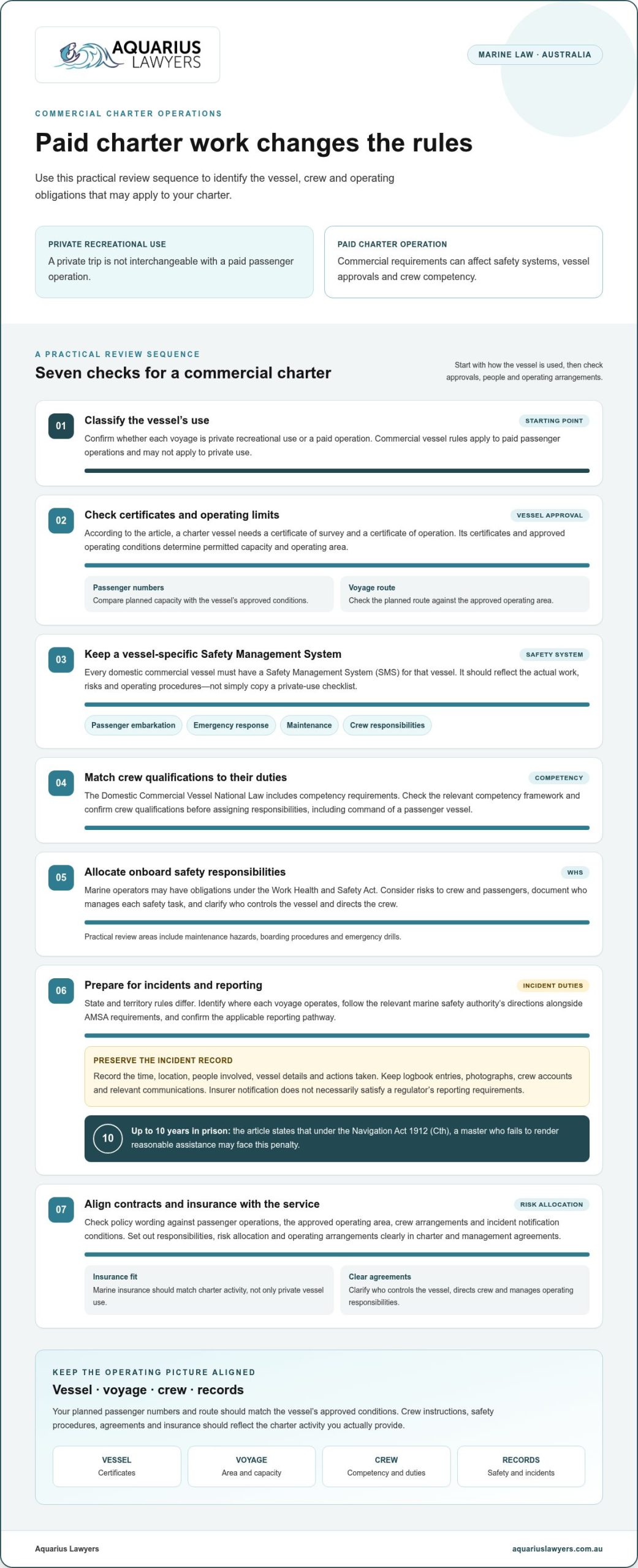
A charter boat may look like a recreational vessel, but paid operations are subject to different rules. According to the Australian Maritime Safety Authority (AMSA), every domestic commercial vessel must have a Safety Management System for that vessel. Commercial operators also face competency and survey requirements under the Domestic Commercial Vessel National Law. That distinction is central to legal advice for charter boat operators in Australia.
Safety procedures matter at sea, but the legal framework also affects how you manage incidents, engage crew and set expectations with customers and vessel managers.
This article explains how commercial and recreational vessel rules differ, what duties may apply after an incident, and how charter and management agreements can shape your responsibilities. It offers a practical overview of the legal issues to consider when operating and protecting a charter business.
Key Takeaways
- Identify whether your vessel’s use is commercial or recreational, because that classification affects the rules and obligations that apply.
- According to the Australian Maritime Safety Authority, every domestic commercial vessel must have a Safety Management System for that vessel.
- Know what assistance and incident obligations may apply, and make sure your response process is clear before an emergency occurs.
- Check how the vessel’s operating area and activity affect which Australian laws and requirements apply.
- Set out responsibilities, risk allocation and operating arrangements clearly in charter and management agreements.
Marine incident reporting and assistance obligations
State and territory rules differ in marine safety administration, local operating requirements and incident reporting. Identify the jurisdiction where each voyage operates, then follow its marine safety authority’s directions alongside Australian Maritime Safety Authority (AMSA) requirements. A private recreational trip and a paid charter should not be treated as interchangeable. Legal advice for charter boat operators in Australia can help clarify how these overlapping rules affect your operation.
AMSA’s domestic commercial vessel rules do not set one passenger limit or operating area for every charter boat. Permitted capacity and operating area depend on the vessel’s certificates and approved operating conditions. Before selling a trip, compare your planned passenger numbers and route with those documents. According to AMSA, a charter vessel needs a certificate of survey and a certificate of operation to operate legally. Make sure booking information and crew instructions reflect those limits.
After an incident, record the time, location, people involved, vessel details and actions taken. Preserve logbook entries, photographs, crew accounts and relevant communications. Then identify the applicable reporting pathway and provide the required information to the relevant marine safety authority. Do not assume that notifying an insurer also satisfies a regulator’s requirements. A master’s assistance duties matter too: the Navigation Act 1912 (Cth) provides for a master who fails to render reasonable assistance to face up to 10 years in prison.
Marine insurance should match the charter activity, not just the vessel’s private use. Compare the policy wording with passenger operations, the approved operating area, crew arrangements and incident notification conditions. If a claim arises, preserve the policy, trip records and incident evidence, and notify the insurer as required. A mismatch between the voyage and insured use can lead to a dispute about cover. Legal advice for charter boat operators in Australia can help assess policy wording against the services you provide.
Marine repair agreements should specify the authorised work, how variations are approved, when payment is due and how the vessel will be released. Marina and repair operators seeking to enforce a lien must follow the applicable state’s uncollected goods procedure. Mishandling a lien or sale procedure may expose an operator to a conversion claim exceeding the debt owed. Keep repair authorisations, invoices and vessel handover records together.
For marina and berth leasing, set out access, maintenance, permitted use, fees and responsibility for damage in writing. Distinguish wet-lease rights from dry-lease rights where both apply. A marina restructure involving two associated marina complexes illustrates why berth interests and lease terms need clear documentation. Before signing or changing an arrangement, identify which party controls the berth, vessel access and maintenance obligations.
States and territories differ in how they administer marine safety, set local operating requirements and handle incident reporting. Identify where each voyage takes place and follow that jurisdiction’s marine safety authority directions alongside AMSA requirements.
What’s different about commercial vs recreational vessel work?
Paid passenger operations bring commercial vessel requirements that may not apply to private recreational use. The distinction affects safety systems, vessel approvals and crew competency.
Safety management requirements
Every domestic commercial vessel in Australia must have a Safety Management System (SMS) for that vessel. It should reflect the vessel’s actual work, risks and operating procedures, not simply copy a private-use checklist. Charter fishing boats almost certainly need a written SMS. Review it against daily operations, including passenger embarkation, emergency response, maintenance and crew responsibilities.
Safety and competency obligations
The Domestic Commercial Vessel National Law applies to domestic commercial vessels, including competency, survey and SMS requirements. Commercial vessel operators must also meet AMSA requirements for vessel operation and construction. Match each role to the relevant competency framework, then compare crew qualifications with their duties. For example, check a proposed skipper’s competency before assigning command of a passenger vessel.
Work health and safety liability
Marine operators may have obligations under the Work Health and Safety Act. Consider risks to crew and passengers, and document who manages each safety task. A practical review can cover maintenance hazards, boarding procedures and emergency drills. Commercial agreements should clarify who controls the vessel and directs the crew. Legal advice can help assess how those responsibilities interact with your operating arrangements.
COVID-19 plans are a time-specific example, not a standing rule to assume today. At the time of writing, commercial vessel operators were typically required to implement a COVID-19 Safety Plan covering social distancing, hygiene and contact-tracing records. For any government direction affecting your operation, identify its scope and duration, then update procedures and records to match. Keep the plan connected to actual crew and passenger practices.
Fire readiness should be practical and specific to your vessel. If smoke appears during a passenger trip, crew need to know how to raise the alarm, guide passengers and communicate clearly. Assign responsibilities in onboard procedures and make sure crew know where to find them. Test whether the procedures suit the vessel’s layout and passenger arrangements. A written plan is useful only if crew can apply it under pressure.
Australian commercial and recreational boating jurisdiction
Commercial or international maritime activity may engage federal laws, while domestic recreational boating is governed by state and territory laws and regulations. For a charter, assess the vessel’s actual use and each operating area to identify the relevant legal framework.
Operator regulatory obligations
The Marine Safety National Law applies to domestic commercial vessels, while state and territory rules govern domestic recreational boating. The Crimes at Sea Act 2000 (Cth) extends Commonwealth criminal jurisdiction to Australia’s territorial sea. These frameworks may affect an operation in different ways, depending on its activity and location.
Record the service offered, the vessel’s routes and the basis for its operating arrangements. If a voyage crosses into another jurisdiction, reassess which rules and authorities apply rather than relying on the framework used for another trip. These records can help explain your compliance decisions if a regulator raises a question or a claim follows an incident.
Commercial use of recreational vessels
A vessel’s previous private use does not determine the rules for a later paid operation. The Marine Safety (Short term marina accommodation) Exemption was proposed in 2018 to let recreational boat owners use vessels as holiday accommodation without complying with the full requirements of the Marine Safety (Domestic Commercial Vessel) National Law Act 2012. That narrow accommodation context is not a general charter exemption.
Describe the planned service precisely, whether it involves passenger transport, fishing or short-term accommodation. Then assess the rules against that activity and its operating area. A vessel’s recreational history does not establish that commercial requirements do not apply.
Commercial agreements and contracts
Use contracts that reflect the operation, not just vessel ownership. Specify the service, routes, customer arrangements and who controls daily decisions. For example, clarify who manages bookings and who directs operational staff. Written responsibilities make it easier to identify who must act when arrangements change or a dispute arises.
Review agreements when the activity, route or management changes. Compare the contract with the actual operating arrangements and insurance wording. If the documents describe different services or responsibilities, a claim or disagreement can be harder to resolve. Record agreed changes in writing and keep the current version accessible to those managing the vessel.
Survey, registration and safety equipment
For survey, registration and safety equipment, use the vessel’s applicable approvals and operating conditions as a checklist. Before advertising a trip, compare the planned activity and route with those documents and the relevant authority’s directions.
There is no single national permit list covering every charter activity. For a fishing trip, assess the authorisations that apply to the activity and area. If it enters a marine park, establish whether the activity requires park approval. Environmental approvals also depend on the proposed activity and its location. Identify the relevant authority and permits before confirming the itinerary or taking bookings.
Charter agreements and management agreements
Your charter contract should describe the service customers are booking and explain how the business handles changes. State the trip type, route, departure arrangements, inclusions and customer responsibilities. Use consistent wording across booking pages, confirmation messages and staff instructions. If fishing trips and sightseeing charters operate differently, describe each service clearly rather than relying on one broad description.
Australian boat sellers may have obligations under the Australian Consumer Law (ACL). If a vessel has a manufacturing fault, customers may have rights under consumer law. Keep the vessel sale relationship separate from the charter service contract. Set out how customers can cancel, how the operator communicates a cancellation, and what happens if a trip is rescheduled. Clear, consistent terms explain the agreed process if a booking dispute arises.
Before accepting a booking, make the applicable cancellation and refund terms easy to find. Explain how a customer can cancel and how the operator will communicate a change to the trip. Keep the booking, the terms shown at the time and later messages on record. If a customer disputes a cancellation outcome, those records help establish which terms were presented and what the parties discussed.
A management agreement should distinguish the vessel owner’s decisions from the manager’s delegated authority. Identify who handles bookings, engages crew, arranges maintenance and communicates with customers. Set limits on who can approve extra work or commit the business to a changed service. If a manager acts for the owner, define their decision-making authority and reporting responsibilities. This gives both parties a practical reference when responsibilities overlap.
Record repair approval and handover procedures in writing. Specify who can authorise work, how variations are documented, and who receives updates and invoices. Address access to the vessel, keys, booking records and operational documents. When management ends, set out how the owner regains control of those materials. These steps reduce uncertainty during a changeover and preserve a usable record of the vessel’s condition and work history.
The Eye-Spy bareboat charter ran for 14 days beginning 6 February 2015. Its defined duration illustrates why agreements should specify when possession starts and ends, who controls the vessel, and which party handles operational decisions during the hire. Review terms whenever the service or management arrangement changes. For help with documents for a marine operation, review marine legal services.
Aquarius Lawyers: Marine Law
Aquarius Lawyers provides Marine Law and Commercial Law services for legal issues affecting charter operations. Turn to the firm to assess vessel arrangements, charter or management contracts, regulatory obligations, or a dispute involving your marine business.
For operations involving fishing or aquaculture, Fisheries Law or Aquaculture Law may also be relevant. The appropriate legal response depends on the issue: a booking dispute calls for different steps from a vessel compliance concern or disagreement over operational responsibilities. Clear advice can help you understand your position and decide what to do next.
Contact Aquarius Lawyers about marine legal matters to discuss your charter operation.
Set your next steps with confidence
Your next legal step depends on the issue at hand. A contract concern may call for a different response from a regulatory dispute or a matter involving fishing or aquaculture operations. Identify the decision you need to make, gather the relevant agreements and records, and consider how that decision could affect your vessel and business.
If you’re seeking legal advice for charter boat operators in Australia, Aquarius Lawyers provides Marine Law, Fisheries Law and Aquaculture Law. Advice in the relevant area can help you assess the legal questions affecting your operation and plan a practical way forward.
Take the next step when you’re ready. Contact Aquarius Lawyers to discuss your charter operation and move ahead with greater clarity.
Frequently Asked Questions
What laws and regulations apply to commercial charter boat operators in Australia?
Commercial charter operations are governed by the Domestic Commercial Vessel National Law alongside relevant state or territory rules. The applicable framework depends on the vessel’s use, operating location and service. According to the Australian Maritime Safety Authority (AMSA), a charter vessel needs a certificate of survey and certificate of operation to operate legally. Keep bookings, insurance documents and operating procedures consistent about the service you provide.
What licences and qualifications do Australian charter boat operators need?
Approvals and qualifications depend on the vessel, its operations and each crew member’s role. AMSA’s domestic commercial vessel framework includes competency requirements, so match each crew member’s qualifications to their assigned duties. For example, check who is competent to command the vessel before scheduling a trip. Employment or contractor agreements should also reflect crew responsibilities and applicable award arrangements.
What insurance does a charter boat business in Australia need, and how much does it cost?
Your insurance should cover the commercial charter activity you actually conduct. Review the policy schedule and wording for the insured vessel, permitted use, covered parties, exclusions and claim-notification requirements. Check how the policy treats passenger operations, fishing trips and management arrangements relevant to your business. Keep current policy documents accessible to those responsible for bookings and incident response, so they can follow the correct notification process if a claim arises.
What workplace, crew training and maritime safety obligations apply to charter boat businesses?
Charter operators may have obligations under the Work Health and Safety Act, as well as maritime safety and competency requirements. Set out crew duties, supervision and safety procedures in employment or contractor agreements. Align crew arrangements with the applicable award and AMSA competency framework. For instance, document who gives passenger safety instructions and who responds to a vessel hazard, then train crew to follow those procedures in practice.
What legal risks and penalties do Australian charter boat operators face, and how can they reduce them?
Risks include regulatory action, contractual disputes, insurance disagreements and claims arising from how a trip is operated. Penalties depend on the relevant offence and circumstances, so do not assume one consequence applies to every breach. Reduce exposure by documenting approvals, crew roles, passenger terms and incident decisions. Review those records whenever the vessel’s service, route or management arrangements change.
What steps are required to start a charter boat business in Australia?
Start by defining the service and operating area, then assess the requirements that follow. Build your launch plan around the vessel, crew, customer terms and risk controls.
- Describe the proposed charter activity and routes.
- Identify the applicable commercial vessel approvals and safety procedures.
- Match crew roles with competency and employment arrangements.
- Prepare booking, cancellation, insurance and management documents that reflect the operation.
Disclaimer
Please note that legal rules change and this is not a substitute nor construed as legal advice. It is general information only.