
What if the nearest mediator isn’t the right fit for your commercial dispute? While Aquarius Lawyers provides nationwide support, choosing mediation services for commercial disputes often involves looking beyond your immediate postcode. The mediator’s role, the issues in dispute and how you want to participate all shape the process.
It’s reasonable to want clarity before committing to mediation. A mediator facilitates discussion but does not decide the outcome. You remain in control of whether you reach an agreement, while confidentiality arrangements and the venue can affect how the process works in practice.
This article explains what commercial mediation involves, what to consider when engaging a mediation lawyer, and how confidentiality and location may factor into your decision. It also outlines what may happen if mediation does not resolve the dispute, helping you assess the options ahead.
Key Takeaways
- Choose a dispute-resolution pathway that fits the issue, and plan what to do if mediation doesn’t lead to agreement.
- A mediator facilitates discussion; the parties retain control over whether they reach an outcome.
- Understand how confidentiality and without-prejudice communications may apply before sharing sensitive business information.
- Consider how the mediator’s location and your preferred way of participating affect the practical fit.
- Commercial legal advice can help you assess your position and prepare for mediation or the next step in a dispute.
Commercial dispute resolution options in Sydney
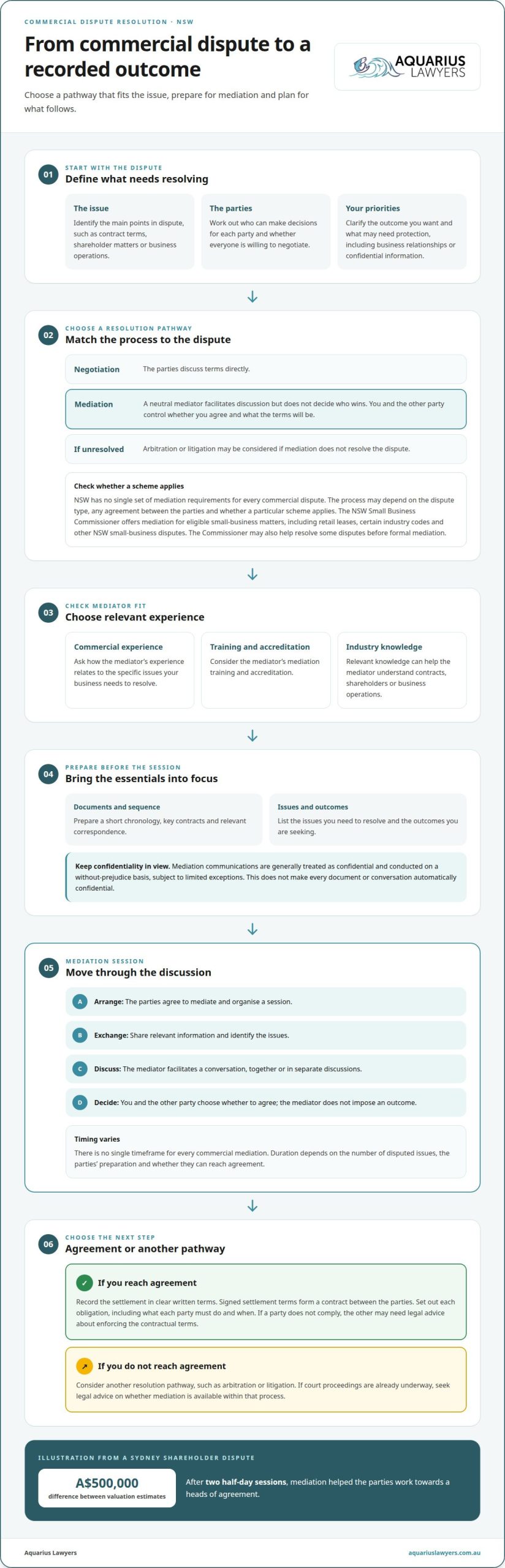
Commercial disputes can move through direct negotiation, mediation, arbitration or litigation. The right pathway depends on the issue, the parties’ willingness to negotiate and the outcome they need. Negotiation lets parties discuss terms directly; mediation adds a neutral facilitator. Arbitration and litigation are options if mediation does not resolve the dispute. When considering mediation services for commercial disputes in Sydney, weigh each pathway against your commercial priorities.
When choosing a commercial mediator, consider relevant commercial experience, mediation training and accreditation. Industry knowledge can help a mediator understand disputes involving contracts, shareholders or business operations. The mediator facilitates discussion but does not decide who wins. Ask how their experience relates to the specific issues your business needs to resolve.
NSW does not have one set of mediation requirements for every commercial dispute. The process may depend on the dispute type, any agreement between the parties and whether a particular scheme applies. For example, the NSW Small Business Commissioner offers mediation for eligible small-business matters. If you are considering mediation services for commercial disputes in Sydney, first identify whether a relevant scheme covers your dispute.
A mediated settlement can become legally binding: signed settlement terms form a contract between the parties. Set out each obligation clearly, including what each party must do and when. If a party does not comply, the other may need legal advice about enforcing the contractual terms.
Commercial mediation generally moves from arranging the session to exchanging relevant information, discussing the issues with the mediator and recording any agreed terms. Before booking, identify who can make decisions for each party and clarify the dispute’s main points. The mediator facilitates discussion; any settlement should be recorded in clear written terms.
There is no single timeframe for every commercial mediation in Sydney. The length depends on the number of disputed issues, the parties’ preparation and whether they can reach agreement. A focused contract disagreement may be simpler to address than a dispute involving several parties or complex business records.
For government-supported mediation in NSW, the NSW Small Business Commissioner handles eligible matters involving retail leases, certain industry codes and other NSW small-business disputes. The Commissioner may also help resolve some disputes before formal mediation. If court proceedings are underway, seek legal advice on whether mediation is available within that process.
Prepare a short chronology, key contracts, relevant correspondence and a clear list of the issues and outcomes you seek. Consider what you can agree to and what needs protecting, such as ongoing business relationships or confidential information. Mediation requires a willingness to negotiate; without agreement, parties may consider arbitration or litigation.
What is Commercial Mediation?
Commercial mediation is a voluntary, confidential process for resolving a business dispute. A neutral mediator helps the parties discuss the issues and explore possible solutions but does not impose a decision. The parties control whether they reach an agreement and what its terms will be.
The process gives each side a structured setting for negotiation. A mediator may help clarify the disagreement, identify shared interests and test whether proposed terms are workable. For example, parties disputing a contract could discuss payment, delivery or future performance separately instead of treating the dispute as one indivisible problem.
Commercial mediation can address shareholder disagreements, contract claims and workplace conflict between business owners or senior staff. In a Sydney shareholder dispute, the parties’ business valuation estimates differed by A$500,000. Mediation helped them work towards a heads of agreement after two half-day sessions. The example shows how discussion can focus on practical terms, even when the parties begin far apart.
In one shareholder dispute, the parties disagreed about ownership of video footage and resolved the matter in a half-day mediation. In a separate matter involving two senior executives, mediation helped uncover past issues and misunderstandings behind their poor working relationship. The executives left with a plan for handling future issues more constructively. Each dispute needs an approach suited to its subject matter and the relationship between the parties.
Usually, the parties first agree to mediate and arrange a session with a mediator. They then identify the issues, share relevant information and attend a facilitated discussion. The mediator may speak with everyone together or hold separate discussions. If the parties agree on terms, they can record them in writing; otherwise, they can consider another resolution pathway.
Mediation is not a trial. It does not determine legal rights through a decision imposed by a judge or arbitrator. Instead, it gives parties space to assess their options and shape an outcome themselves. That flexibility can be useful when preserving a supplier relationship, business partnership or workplace arrangement matters alongside resolving the immediate dispute.
If you need to assess a commercial disagreement before negotiation, consider obtaining commercial dispute advice on the issues and your preferred outcome.
Confidentiality and without-prejudice communications
Commercial mediation gives parties a confidential setting to discuss a business dispute. Mediation communications are generally treated as confidential and conducted on a without-prejudice basis, subject to limited exceptions. This framework can support frank negotiation, but it does not make every document or conversation automatically confidential.
The NSW Small Business Commissioner treats information provided for mediation confidentially. In a small-business dispute handled through that process, parties can discuss sensitive concerns in a setting intended to protect mediation information. They should still understand how confidentiality applies to their particular process before sharing commercially sensitive material.
Without-prejudice communications are generally made as part of settlement discussions. For example, a supplier and customer could discuss revised delivery terms without treating the proposal as an admission about the underlying contract dispute. The label alone is not a guarantee: context and applicable rules matter.
Before mediation, identify what information each party needs to understand the dispute. A business might share relevant contract clauses, invoices or correspondence while limiting disclosure of unrelated client records. Keep materials focused on the issues under discussion and clarify how documents will be handled during the process.
Confidentiality can help parties speak openly about practical resolutions without exposing sensitive negotiations more widely. That may matter when they still have a workplace, supplier or customer relationship to manage. However, confidentiality is not absolute. Limited exceptions can apply, so do not assume every statement, record or agreement is protected in every circumstance.
At the outset, clarify who may attend, what information will be exchanged and how the mediator will manage private discussions. If the mediator meets each party separately, ask how information shared privately may be used in joint discussions. This helps prevent surprises and lets participants make informed decisions about what they disclose.
After reaching terms, put the agreement in writing and specify each party’s commitments. Distinguish final settlement terms from earlier negotiation proposals, and make the intended outcome clear. If a clause could affect clients, ongoing supply arrangements or confidential business information, settle its wording before signing.
Careful preparation helps protect business relationships and keep discussion focused. When parties understand the confidentiality arrangements, they can decide what to share, what needs protection and how to pursue an agreement without losing sight of their commercial interests.
Mediation lawyer locations around Sydney
Sydney listings show 111 mediation lawyers, with 31 offices within five kilometres of Sydney 2000. Those figures show a concentration near the city centre, but an office address alone doesn’t tell you whether a mediator suits your dispute. Match location with commercial experience, availability and the needs of all participating parties.
Start by mapping where each decision-maker will attend from. A city-centre venue may suit parties working nearby, while a neutral location may be more practical when businesses operate in different areas. The aim is a setting that lets participants focus on settlement, not a difficult journey or unequal access.
Before you select a mediator, confirm the proposed venue, attendance arrangements and whether remote participation is available. These practical details can matter when a director, witness or adviser is travelling from outside central Sydney. If court proceedings are already underway, clarify how the mediation fits the formal timetable.
Location should support neutrality, not give one party an advantage. For example, if one business controls its usual boardroom, the other may prefer a neutral meeting place. Ask how the venue will accommodate private discussions and joint sessions. The mediator’s role remains facilitative wherever the meeting takes place.
Assess the mediator on more than proximity. Consider relevant commercial dispute experience, mediation training and familiarity with the issues in your matter, such as a shareholder disagreement or contract dispute. A nearby office may reduce travel, but a suitable mediator and workable process matter more than the postcode.
Use this practical sequence: identify who must attend, agree on a location accessible to both sides, then confirm the mediator and session arrangements. If the parties cannot agree on a venue, raise the issue while arranging mediation. Settling logistics early leaves time for the substantive issues and possible settlement.
For Sydney mediation, choose location and neutral process together. If you need legal guidance on preparing for a commercial dispute resolution process, discuss your mediation options.
Aquarius Lawyers: Commercial Law
Aquarius Lawyers provides mediation and legal advice for commercial disagreements that need a structured resolution process. Its Commercial Law and Mediation services can assist with business disputes involving contracts, shareholders, suppliers or business operations. A practical next step is to identify the issue, the outcome you want and whether negotiation remains possible.
Consider the legal position alongside your commercial priorities before mediation. A contract dispute, for example, may involve an alleged breach, outstanding performance and the value of continuing the relationship. Legal advice can help you assess these issues, clarify your position and identify terms that may resolve the disagreement.
Preparation also means understanding what you can agree to and what needs protection. If a proposed settlement affects payment obligations, future supply or business responsibilities, those terms need careful attention. Aquarius Lawyers can advise on the legal issues in a commercial dispute and help you approach mediation with a clearer view of your options.
Mediation can be useful when parties want to explore a negotiated outcome before pursuing a more formal dispute pathway. A mediator facilitates discussion, while the parties decide whether to settle. If they reach agreement, clear written terms record each party’s commitments. If they do not settle, legal advice can help assess next steps, including another dispute-resolution option.
Some commercial disputes involve specialised business assets or regulated operations. A disagreement about a fishing business, for instance, may raise commercial issues alongside marine or fisheries matters. Aquarius Lawyers’ Marine Law and Fisheries Law services address those areas when relevant to a business dispute. Understanding the subject matter can help frame the mediation issues and define what a workable outcome needs to cover.
Turn to Aquarius Lawyers when a dispute affects a contract, business relationship or commercial decision, or when you need to prepare for mediation. The focus is on understanding the legal and commercial issues, then choosing a practical path forward. You can discuss the background, relevant documents and outcome you are seeking so the matter can be considered in context.
Contact Aquarius Lawyers to discuss your commercial dispute and mediation options.
Choose your next step with confidence
A commercial dispute can affect decisions well beyond the immediate disagreement. Before taking your next step, consider what a workable resolution needs to protect: ongoing operations, key relationships, contractual rights or valuable business assets. Clear priorities can help you decide whether to pursue mediation, continue negotiations or prepare for another dispute pathway.
If your business operates in marine or aquaculture industries, the dispute may involve specialised assets or sector-specific interests. Aquarius Lawyers offers Marine Law, Fisheries Law and Aquaculture Law, alongside Commercial Law and Mediation. These services may be relevant when a dispute connects commercial arrangements with marine, fisheries or aquaculture matters.
Seeking advice before discussions progress can help you understand the issues, assess your position and prepare for a practical conversation. If you’re considering mediation services for commercial disputes in Sydney, take the next step with a clear account of the disagreement and the outcome you want to pursue.
Contact Aquarius Lawyers to discuss your commercial dispute and possible next steps. A considered approach can put you in a stronger position to move forward.
Frequently Asked Questions
Is court action the only option?
No. You can try direct negotiation, mediation or, where suitable, arbitration before pursuing court action. For example, a business with an unpaid invoice might first negotiate a payment arrangement, while a disagreement about ongoing contract performance may benefit from a facilitated discussion. If these options do not resolve the issue, litigation remains available. The appropriate pathway depends on the dispute, the parties’ positions and the outcome sought.
What are the benefits of mediation compared with litigation?
Mediation gives parties a chance to shape practical terms rather than asking a court to determine the dispute. It may help preserve a working relationship, such as between business partners who still need to manage shared operations. Litigation is a formal process in which a court determines issues based on the case presented. Mediation suits parties willing to negotiate; litigation may be necessary when a decision is required.
What are the most common mediation matters in Sydney, NSW?
Commercial mediation can address disagreements about business contracts, shareholder arrangements, commercial leases, supplier obligations and workplace relationships. For instance, a tenant and landlord might discuss lease terms, while a supplier and customer could negotiate a response to an ongoing delivery problem. The NSW Small Business Commissioner also offers mediation for eligible small-business matters, including retail lease disputes and certain industry-related disputes.
What is the role of the mediator?
The mediator is a neutral facilitator, not a judge or decision-maker. They help parties identify the issues, communicate their positions and explore possible terms. A mediator may ask each side what it needs, then help assess whether proposed options are workable. They do not decide who is right or force a settlement. Each party decides whether to accept an agreement.
What commercial dispute mediation services are available in Sydney?
Mediation services for commercial disputes in Sydney include private mediation and eligible NSW Small Business Commissioner programs. The Commissioner’s services cover retail lease disputes, general commercial leasing disputes involving small-business tenants, and certain disputes under industry codes or legislation. The suitable pathway depends on the dispute and program eligibility. Private mediation can also be tailored to the parties’ issues and preferred process.
Can mediation help prevent the same business dispute from happening again?
Yes. Parties can use mediation to discuss the source of a disagreement and consider practical ways to manage similar issues in future. For example, business partners might agree on clearer communication about decisions, or a supplier and customer might consider how to raise delivery concerns promptly. Record any agreed future arrangements clearly so each party understands its commitments.
Disclaimer
Please note that legal rules change and this is not a substitute nor construed as legal advice. It is general information only.