
Commercial litigation in Australia depends on the work needed to resolve a dispute. Disputed evidence, expert input, procedural steps and the time a matter takes can all affect how it proceeds.
It’s understandable to want clarity before deciding what to do. The next steps depend on how the dispute develops, whether the parties settle and whether court representation is needed. Settlement may avoid some steps involved in a trial, while unresolved issues can require more preparation and hearing time.
This article explains the main factors that shape commercial litigation, how negotiation and mediation can affect the path forward, and what changes when a matter proceeds to court. It also outlines the financial and strategic implications of your options.
Key Takeaways
- Assess the dispute’s complexity, evidence and likely procedural steps to understand what may drive the work involved.
- Consider negotiation and mediation early; resolving disputed issues before trial can change the path a case takes.
- Account for court representation separately from solicitor work, including the possible role of barristers and expert evidence.
- Clarify what work your lawyer will undertake and who will handle each part of your matter.
- Get legal advice promptly if you receive court documents or face risks to business assets, reputation or operations.
What drives commercial litigation?
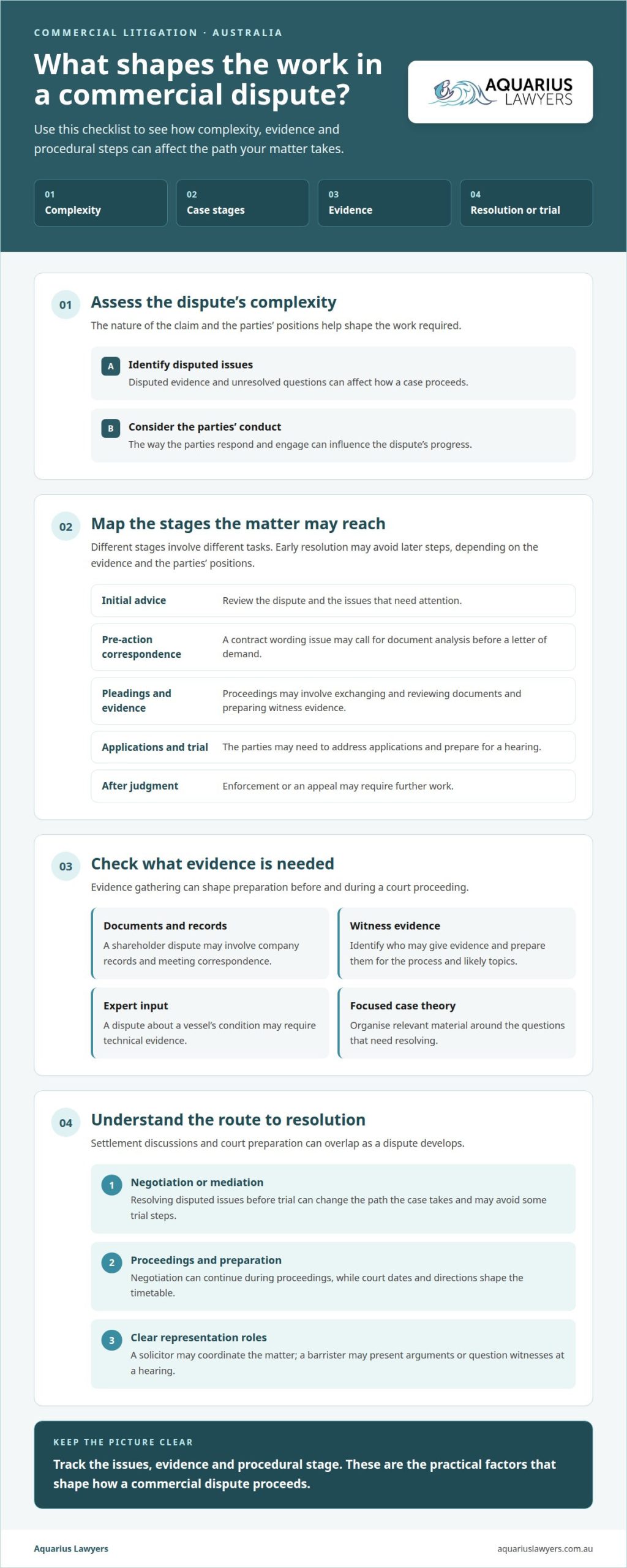
The work required in a commercial dispute depends on its evidence, complexity, procedural steps and the parties’ conduct. These factors shape a case from early advice through judgment and any later enforcement.
Commercial dispute stages
Legal work may arise during initial advice, pre-action correspondence, pleadings, evidence gathering, applications and trial. Each stage involves different tasks, so a case’s progress matters as much as the claim itself.
For example, a dispute about contract wording may require document analysis before a letter of demand. If proceedings follow, the parties may need to exchange and review documents, prepare witness evidence and deal with applications before trial. After judgment, enforcement or an appeal may require further work. Early resolution can avoid later steps, depending on the parties’ positions and evidence.
Keep the stages distinct when assessing the work ahead. Ask which work is covered, what assumptions apply and how significant changes will be explained. This helps you understand how procedural developments may affect the dispute.
Costs disclosure and agreements
Costs disclosure explains how a lawyer charges and what work an agreement covers. In Queensland, part 3.4 of the Legal Profession Act 2007 (Qld) deals with costs disclosure and costs agreements. Where section 308 applies, disclosure includes the charging basis and an estimate, or a range with an explanation of major variables.
Sections 307A and 311 address thresholds and exceptions; section 307B provides for abbreviated disclosure, and section 310 addresses timing. Under section 315, substantial changes must be disclosed in writing as soon as reasonably practicable after the practice becomes aware. Review the agreement’s scope and assumptions so you can identify what could change during the dispute.
Federal Court costs scale
The Federal Court costs scale sets amounts allowed for specified work, rather than describing every charge a party may face. The Federal Court of Australia Schedule 3 applies to work done and services performed on or after 11 June 2026.
The scale includes units for lawyer attendances requiring a lawyer’s skill, as well as provisions for other work. It does not replace your costs agreement or establish the full amount of your legal bill. When considering how the scale applies to a proceeding, check which work period and court process are relevant.
Adverse costs and security for costs
An adverse costs order may require you to contribute to the other party’s legal expenses as well as meet your own. Queensland rule 681 of the Uniform Civil Procedure Rules 1999 makes costs discretionary, generally following the event unless the court orders otherwise. Rules 702 and 703 address standard and indemnity assessment.
Australian courts may order security for costs, taking into account the plaintiff’s financial position, the claim’s strength and whether security would stifle a genuine claim. Neither an adverse costs order nor a security for costs order determines the outcome of the underlying dispute.
Negotiation, settlement and court representation
The legal work can change as a commercial dispute moves from private discussions into court. The legal team’s role, the evidence and procedural demands shape the work at each stage.
Court fees and disbursements
Court fees and disbursements are payments connected with proceedings, separate from a solicitor’s professional work. Federal Court and state Supreme Court filing and hearing fees follow published schedules current when a case is filed. The filing stage therefore helps determine which court charges apply.
Other disbursements can include document service, expert evidence, barrister work and mediator expenses. For example, a business dispute about a vessel’s condition may require technical evidence, while a contract dispute may turn on written records. These expenses arise for different reasons, so grouping them together can hide what the case actually requires.
Build a clear estimate by separating solicitor work from court charges and external providers. Identify which evidence may need an expert, whether counsel may be briefed and which procedural steps trigger payments. Keep invoices and records organised as the case progresses. This gives you a practical view of each expense category without assuming every item will arise.
Court proceedings and trial
Court proceedings require parties to present their positions through formal documents and evidence. Representation may involve a solicitor coordinating the matter and a barrister presenting arguments or questioning witnesses at a hearing.
Before trial, the legal team can organise key documents, prepare witness evidence and identify disputed issues. For example, a shareholder dispute may involve company records, meeting correspondence and competing accounts of decisions. A focused case theory helps keep the court’s attention on the questions that need resolving.
Trial preparation also involves deciding who gives evidence and which documents support each position. Witnesses need to understand the process and the topics they may be asked about. The legal team must organise the case materials so relevant evidence can be located and used at the hearing.
Negotiation can continue while proceedings are underway, but court dates and directions shape the timetable. The parties may need to prepare for a hearing while still discussing resolution. Clear responsibilities are important: your legal team should explain what preparation is underway and which decisions need your input.
When reviewing an estimate, ask how solicitor and barrister responsibilities fit together, which court-related payments sit outside professional work, and what assumptions underpin the proposed representation. These details help you understand the practical demands of going to trial, rather than treating court representation as a single task.
Early settlement, mediation, and negotiation
Early resolution can change how a commercial dispute develops and which steps become necessary. Define the disputed issues, organise key documents and get legal advice before positions harden.
Settlement offers
A settlement offer puts proposed terms on the table. Its practical value depends on whether it addresses the real dispute, not simply whether the other party accepts it.
Before responding, compare the offer with the contracts, invoices, correspondence and other evidence supporting each side’s position. Identify what the offer resolves, what obligations remain and whether there is enough time to assess it meaningfully. A proposal that leaves ongoing performance or confidentiality unresolved may not settle the underlying commercial problem.
Formal offers under the Uniform Civil Procedure Rules have specific requirements. Legal advice can help assess whether an offer is appropriately framed and how the evidence compares with its terms. Keep a record of offers and responses, including the reasons for a decision, so the parties’ conduct is clear.
Businesses can narrow the issues in dispute. For example, parties may agree which contract terms are not contested, leaving one question of interpretation for negotiation. Clear particulars and organised documents make discussions more focused and help establish whether a practical resolution is available.
Settling before trial
Settlement before trial is an alternative to continuing to a final hearing. Most commercial disputes do not reach a final hearing, making timely discussion a practical part of managing a claim.
Mediation gives each party a structured opportunity to explain its position and consider proposed terms with a mediator’s assistance. Before attending, identify the decision-maker, the important documents and the outcomes the business could accept. For a supply disagreement, this might mean discussing both an unpaid invoice and future delivery arrangements.
Negotiation can begin before proceedings or continue after they start. A letter of demand may explain the basis of a claim and the response sought. Without-prejudice discussions allow parties to explore resolution without treating each proposal as an admission. Alternative dispute resolution, including mediation or arbitration, can offer a route outside a final court hearing.
Early legal advice helps a business test its position, clarify disputed issues and support its claim with documents. It can also help identify urgent concerns, such as court documents received, threats to business assets or reputation, or a need for injunctive relief. These issues may need prompt attention alongside settlement discussions.
Most commercial disputes benefit from a clear assessment of the desired outcome and available evidence. Set out the issues, decide which terms would resolve them and keep discussions focused on practical obligations. This helps you make an informed choice between continuing negotiations and preparing for the next court step.
Working with an Australian litigation lawyer
Commercial litigation involves different tasks at each stage of a dispute. An advice conference and a contested court application require different preparation, even if the same lawyer handles both. Understanding the work involved can help you make informed decisions about how to proceed.
In Australia, lawyer seniority and the work assigned can affect how a matter is managed. A junior lawyer may prepare a chronology or review documents, while a senior lawyer may advise on strategy or appear in court. A partner may oversee the case and make decisions about its direction. The practical question is which level of experience each task requires.
The amount and complexity of the evidence also matter. Reviewing a small set of clear contracts differs from sorting extensive records with disputed dates or inconsistent terms, where complex discovery often requires dedicated managed review services to examine high volumes of evidence efficiently. If the other party brings an application, lawyers may need to assess the evidence, prepare submissions and attend a hearing. These steps can add work beyond the initial advice.
When planning for commercial litigation in Australia, connect the proposed approach to the work required. A useful breakdown identifies who is expected to handle each task, which stages it covers and what assumptions affect it. It should also explain how you’ll be told if the scope changes. Australian solicitors generally must explain their charging basis in writing at the outset and update clients when estimates change.
The next steps in a dispute may be uncertain, particularly if the parties have not resolved their differences. A defined task, such as preparing an application, has a different scope from ongoing advice as the matter develops. Neither approach tells you the likely outcome. Weigh the lawyer’s role, the evidence required, the procedural steps ahead and your ability to progress the matter.
Commercial litigation can develop in different ways. For a commercial dispute, ask for a stage-based outline covering advice, document review, negotiation, any application and court preparation. Discuss which tasks require senior input and which can be handled by other members of the legal team. Clear scope and timely updates help you track progress and make informed decisions about dispute resolution.
Before proceeding, make sure you understand the work included and how changes will be communicated. Discuss your litigation options before committing to a course of action.
Aquarius Lawyers: Commercial Law
Aquarius Lawyers provides Commercial Law advice and Litigation services for businesses dealing with commercial disputes, including court representation. The firm can help you assess the dispute, consider resolution options and understand the steps involved if proceedings are needed.
For disputes involving marine operations or fisheries interests, Marine Law and Fisheries Law may also be relevant. Early advice can help clarify the issues, evidence and commercial interests at stake before you decide how to proceed.
Contact Aquarius Lawyers to discuss your commercial dispute and the available legal options.
Make your next decision with clarity
Before taking the next step, decide what a workable resolution needs to achieve for your business. Consider the commercial relationship, operational priorities and any assets or licences affected by the dispute. This wider view can help you weigh legal options against the outcome your business needs.
For businesses in marine, fisheries or aquaculture industries, a dispute may also involve specialised commercial interests. Aquarius Lawyers offers Marine Law, Fisheries Law and Aquaculture Law alongside Commercial Law and Litigation.
Bring the key documents and a clear account of the issue to a legal discussion. That gives you a practical starting point for assessing the dispute and possible next steps. Discuss your commercial dispute with Aquarius Lawyers and move forward with a clearer view of your options.
Frequently Asked Questions
What should I consider before starting commercial litigation?
Each commercial litigation matter involves different work. A contract dispute resolved through early discussions differs from a matter requiring extensive document review, expert evidence or a trial. To assess a specific dispute, identify the issues, evidence and likely court steps, then seek advice on the proposed scope and assumptions.
Can litigation work be limited to a specific task?
Litigation work can be defined by task, depending on the agreement. For example, an agreement might cover a specific task rather than every step through trial and enforcement. Before accepting one, clarify what work is included, what falls outside its scope and how additional work will be handled. A defined scope describes the work covered, not the likely outcome.
Can you recover your legal costs if you win?
You may receive a costs order, but winning does not automatically mean the other party will pay your entire legal bill. Courts have discretion over costs, and a Queensland costs order does not guarantee full reimbursement or payment. The other party’s ability to pay and the enforcement steps required can also affect what you recover. Include these risks when weighing a judgment against settlement.
Does an agreement cover the whole dispute?
No. An agreement covers only the work described in it; it does not automatically cover the entire dispute. For instance, an agreement covering an initial application may not extend to responding to further applications, preparing for trial or enforcing a judgment. Read the scope alongside any assumptions and exclusions to understand what happens if the dispute takes a different path.
How do I know if my commercial dispute is worth litigating?
Compare the likely commercial benefit with the evidence, time commitment and risks of pursuing the claim. Consider whether key contracts and communications support your position, whether the other party can meet a judgment, and how proceedings could affect business operations or reputation. Weigh negotiation or mediation too. A strong claim may still be impractical if enforcement prospects are poor or disruption outweighs the likely outcome.
What work can a commercial dispute involve?
A commercial dispute can involve solicitor work, barrister representation, expert evidence, court procedures and other disbursements. For example, a technical disagreement may require an expert report, while proceedings can involve filing, hearing and document-service steps. Mediation may involve separate legal preparation and mediator involvement. Ask for a clear outline that distinguishes professional work from external services and explains which stages or tasks it covers.
Disclaimer
Please note that legal rules change and this is not a substitute nor construed as legal advice. It is general information only.