
A charge can carry serious consequences even if the alleged conduct did not succeed. For stalking and intimidation in NSW, the offence is set out in section 13 of the Crimes (Domestic and Personal Violence) Act 2007: the maximum is 5 years’ imprisonment in the District Court or 2 years’ imprisonment in the Local Court. An attempt is punishable as if the offence had been committed.
Repeated following, watching or unwanted contact through technology may be relevant to a stalking allegation. Intimidation can involve harassment, threats or conduct that causes a reasonable apprehension of harm. The prosecution must prove the charge beyond reasonable doubt. Intention, knowledge and the surrounding context may matter, and the prosecution does not have to prove that the other person actually feared harm.
This guide explains what conduct may fall within the offence, how the court pathway affects the maximum penalty, and how attempts are treated. It also covers how the prosecution may address intention and context, and what issues may support a defence. Understanding the difference between an allegation and what the prosecution must prove can help you decide what to do next.
Key Takeaways
- Learn which patterns of following, contact, harassment or threats may be relevant to a charge.
- Understand why the prosecution’s case may focus on what you intended or knew, not only on how another person reacted.
- See how the surrounding circumstances and evidence may shape a defence.
- Compare how the court hearing the case affects the maximum penalty.
- Understand why an unsuccessful attempt can still carry serious criminal consequences.
What are the maximum penalties for stalking and intimidation in NSW?
The maximum penalty depends on whether the case is heard in the Local Court or District Court. The court’s jurisdiction determines the maximum imprisonment term and fine available for **stalking and intimidation NSW** offences.
Maximum penalties by court
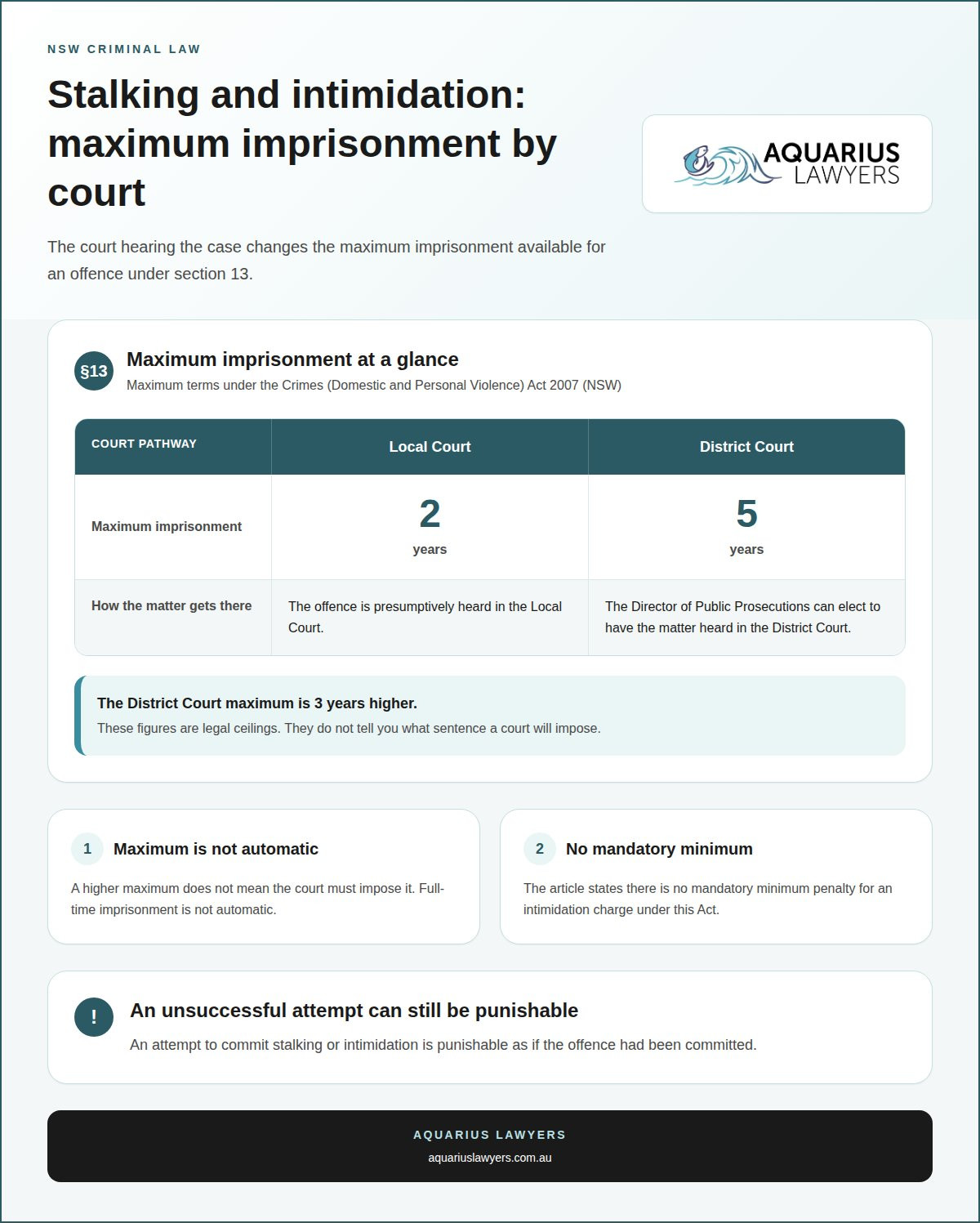
Maximum penalties set the legal ceiling, not the sentence every person receives. In the Local Court, the maximum is 2 years’ imprisonment and a fine of 50 penalty units, equivalent to A$5,500. In the District Court, the maximum is 5 years’ imprisonment and a fine of A$11,100. These limits matter because the same offence can carry different maximums depending on the court hearing it.
Local and District Court penalties
The Local Court generally deals with stalking or intimidation matters, while some cases can proceed to a higher court. The offence is a Table 2 offence, presumptively heard in the Local Court, but the Director of Public Prosecutions can elect to have it heard in the District Court. The court pathway therefore affects the available maximum penalty. There is no mandatory minimum penalty for an intimidation charge under the Crimes (Domestic and Personal Violence) Act 2007 (NSW).
Most matters are finalised in the Local Court. A case may be heard in the District Court or Supreme Court if either party does not consent to a summary hearing. A higher maximum does not mean the court must impose the maximum. Sentencing depends on the alleged conduct, its seriousness and the person’s circumstances. Full-time imprisonment is not automatic.
You can report stalking or intimidation to a NSW police officer at a local police station. Describe the conduct clearly and provide relevant records, such as messages or emails. For tailored legal guidance regarding a matter in New South Wales, Aquarius Lawyers can assist you through the court process.
Support may include police assistance and victim support services across NSW. Some services are free, while others may charge. Ask about a service’s terms before accessing support.
Confronting or replying to a suspected stalker may escalate contact or create further conflict. Avoid direct engagement if it feels unsafe. Keep a dated record of incidents and preserve messages, emails and other relevant material. NSW Police advises against handling packages or gifts believed to have come from a stalker, as they may provide forensic evidence.
The prosecution must prove the offence beyond reasonable doubt, and the maximum penalty does not predict the outcome. A case may also involve an Apprehended Domestic Violence Order (ADVO), which is separate from the criminal penalty. Consider the allegations, available evidence and court pathway together when assessing the legal risks.
NSW stalking and intimidation offence
Section 13 of the Crimes (Domestic and Personal Violence) Act 2007 creates the NSW offence. Sections 7 and 8 explain what intimidation and stalking can involve.
Elements of the offence
To prove a section 13 charge, the prosecution must establish the offence beyond reasonable doubt. For stalking, it must prove the accused intended to cause another person to fear physical or mental harm. The prosecution need not prove that the person actually felt fear, but must prove the accused knew the conduct was likely to cause it. That distinction shapes how the allegation and evidence are assessed.
Distinguishing related conduct
Section 8 includes following someone, watching places they attend, or contacting them through the internet or other technology. Section 7 covers intimidation, including harassment or molestation and conduct causing reasonable apprehension of injury, violence or property damage. Harassment alone does not automatically establish the section 13 offence; the statutory elements must be proved. A domestic relationship is not required for a stalking allegation.
Context matters. A court may consider a pattern of violence when deciding whether conduct amounts to intimidation. Fear of harm may relate to another person with whom the affected person has a domestic relationship. For example, repeated social media messages may need to be assessed alongside other alleged conduct, rather than in isolation.
Evidence to prove the offence
The evidence must support the particular elements alleged, not merely show that contact occurred. Messages, emails, social media communications, witness accounts and records of repeated approaches may help establish a pattern or explain the context. For an intimidation allegation, evidence may also bear on whether the conduct caused reasonable apprehension and what the accused intended or knew.
Preserve original communications and note when incidents occurred. A single message may have a different significance from repeated contact or a threat accompanied by other conduct. The prosecution must prove its case beyond reasonable doubt; an accusation alone is not proof. If you’re charged, legal advice about criminal proceedings can help you assess the charge and evidence.
Personal violence offences and AVOs
A stalking or intimidation charge and an Apprehended Violence Order (AVO) are related but distinct legal processes. A final AVO commonly follows a conviction for a section 13 offence, while breaching an AVO or APVO is a separate offence under section 14. This distinction matters: an alleged breach is not the same charge as stalking or intimidation.
If you’re in immediate danger, move to a safer place if possible and contact NSW Police. You can report the conduct to a police officer at a station. Police may investigate the alleged behaviour and its context.
Defences based on intention and context
A defence to a section 13 charge focuses on whether the prosecution can prove every required element. The charge is not established merely because contact occurred or someone felt distressed. The evidence must support the accused’s required intention or knowledge and the conduct alleged. A defence may therefore test how messages, timing, prior communications and surrounding events fit the prosecution’s account.
For stalking, the prosecution must prove an intention to cause another person to fear physical or mental harm. For intimidation, section 13(3) requires proof that the accused knew their conduct was likely to cause that fear. Section 13(4) means actual fear does not need to be proved. A key defence issue can be whether the evidence establishes the relevant state of mind, rather than simply showing communication or contact.
Context can change how a message or approach is understood. A message about arranging a practical matter, for example, may mean something different from repeated unwanted messages after contact has stopped. The full exchange, its timing and any preceding conversation may help explain why someone was contacted. A stated benign purpose does not settle the issue; the court assesses the conduct and available evidence.
The alleged fear and conduct must also be assessed against the legal test. For intimidation, reasonable apprehension is assessed objectively, not solely by the complainant’s subjective reaction. A defence may examine whether the alleged conduct could reasonably create apprehension of injury, violence or property damage. A court may also consider a pattern of violence, so the wider history can matter alongside an individual incident.
Examine what the evidence shows and what remains unclear. Compare complete message threads with selected screenshots, check whether dates and participants are identifiable, and consider whether independent records support either account. A gap in the record does not itself prove innocence, but it may affect the strength of an allegation. The prosecution must still prove the criminal charge beyond reasonable doubt.
Physical contact is not required for a stalking or intimidation offence, so a defence should address the conduct actually alleged. A verbal threat, repeated approaches or online contact may be examined in light of section 7 or section 8 and the prosecution’s case about intention or knowledge. Build the argument around the precise allegation, the surrounding context and whether each legal element is proved, rather than relying on a general denial.
Attempts to commit stalking or intimidation
Section 13(5) of the Crimes (Domestic and Personal Violence) Act 2007 provides that an attempt to commit stalking or intimidation is punishable as if the offence had been committed. The conduct need not result in completed stalking or intimidation for an attempt charge to carry the same maximum penalty. That is the key point: an alleged attempt is not automatically treated as a lesser offence.
This rule makes the alleged purpose and actions central. For example, a prosecution might allege that a person tried to follow or contact someone to cause fear of physical or mental harm, but did not complete the alleged conduct. The charge still requires proof of an attempt to commit the section 13 offence. An intention alone should not be confused with proof that the offence was attempted.
The distinction between an attempt and completed conduct can depend on the facts. A person might be accused of trying to approach someone, arrange unwanted contact or carry out harassment, even if the intended contact never occurs. The precise allegation matters: the court must assess the conduct said to amount to an attempt, rather than assume an unsuccessful plan proves the charge.
The prosecution must prove a stalking or intimidation charge beyond reasonable doubt. For stalking, its case must address the required intention to cause another person to fear physical or mental harm. Under section 13(3), it must prove the accused knew the conduct was likely to cause that fear, even though actual fear need not be proved. Those requirements remain relevant when the charge concerns an attempt.
Context can help explain what happened before an alleged attempt stopped. A partial message, an interrupted approach or a change of plan may be interpreted differently when considered alongside the full sequence of events. Relevant records may include complete message threads, call logs, dates and witness accounts. Keep original material intact, as a cropped screenshot may omit what came before or after.
Police may investigate conduct connected to domestic violence or harassment, but an allegation does not establish guilt. A conviction requires the court to find the charge proved. The fact that no one was contacted, followed or made to fear harm does not, by itself, determine whether an attempt occurred. The prosecution still needs evidence supporting the alleged attempt and the offence’s required elements.
If police contact you about conduct alleged to be an attempt, avoid making assumptions about the charge based only on whether it succeeded. Get legal advice before an interview and preserve relevant communications without altering them. Get advice about an alleged attempt before responding to police.
Aquarius Lawyers
Aquarius Lawyers can advise you on how a stalking or intimidation allegation may affect your criminal proceedings. If police have contacted you or you’ve been charged, early advice can help you assess the allegations, evidence and legal options before deciding how to respond.
Each matter depends on its particular facts. The alleged conduct, communications, surrounding context and prosecution case all require careful consideration. Aquarius Lawyers can help you understand the issues and prepare for the next stage of the process.
Contact Aquarius Lawyers to discuss your situation.
Take a considered next step
A police interview, court date or proposed response can shape what happens next. Before acting, consider how your next step may affect the evidence and your position in the proceedings. Advice tailored to a stalking and intimidation matter in NSW can help you make informed decisions about the legal issues.
Aquarius Lawyers provides criminal law advice, as well as Marine Law, Fisheries Law and Aquaculture Law. If you’re facing an allegation, discuss the circumstances and next steps with the firm.
Contact Aquarius Lawyers for legal advice and take a clear, considered step forward.
Frequently Asked Questions
What actions might constitute intimidation or stalking?
Conduct may include repeatedly waiting near someone’s home or workplace, or using social media to contact them after they have asked for no further contact. The surrounding circumstances can change how an act is understood. If you’re concerned about an allegation, preserve complete communications and record the sequence of events, rather than relying on a single message or an isolated recollection.
What counts as intimidation under NSW law?
Intimidation under section 7 also includes coercion, deception or a threat intended to make a person enter a forced marriage. The provision refers to a child under section 93AC of the Crimes Act 1900 and a person under section 270.7A of the Commonwealth Criminal Code. These specific forms of conduct show why an allegation should be considered against the statutory wording, not just everyday use of “intimidation”.
What is stalking?
Stalking can involve a series of actions directed at one person, rather than conduct that happens face to face. For example, repeatedly appearing at someone’s regular destination may be relevant even without conversation or physical contact. The key issue is the alleged course of conduct and its purpose. Keep a clear chronology of separate incidents if you need to explain what happened.
Can I be charged over verbal threats alone?
Yes. A verbal threat may lead to a charge, depending on its content and circumstances. A heated exchange, an ambiguous remark and a specific threat may carry different evidential weight. If police ask about a conversation, avoid reconstructing it from memory alone. Preserve any contemporaneous messages or notes that may help establish what was said before and after the exchange.
Does the complainant have to actually fear me?
No. The complainant’s failure to express fear does not, by itself, determine whether the charge can be proved. The prosecution’s case may turn on other evidence about the interaction, including the words used and the surrounding circumstances. The practical issue is to assess the evidence about what you allegedly intended or knew, rather than treating the complainant’s reaction as the only relevant factor.
Does the other person have to be fearful for stalking and intimidation to have occurred?
Not necessarily. The law distinguishes an actual reaction from what the accused intended or knew their conduct was likely to cause. A calm response or the absence of a direct complaint does not automatically settle the issue. When assessing an allegation, focus on the evidence about the conduct and the accused’s state of mind, rather than assuming visible fear is essential.
Disclaimer
Please note that legal rules change and this is not a substitute nor construed as legal advice. It is general information only.