If you are connected to the sea, Australia’s role in shaping the law of the sea began before the modern treaty was complete. The law of the sea convention in Australia is the United Nations Convention on the Law of the Sea (UNCLOS), adopted in 1982 and now the primary international treaty governing ocean activities. Australia is a party to the Convention.
It can seem like a distant set of international rules, but UNCLOS helps define Australia’s rights and responsibilities at sea, including how maritime zones and marine resources are managed. Australia also took part in three United Nations conferences on the Law of the Sea, held in 1958, 1960 and 1973-82. That history offers a useful way to understand the rules and Australia’s place in regional discussions.
This article explains what UNCLOS covers, how Australia’s maritime zones and baselines work, and why these rules matter to businesses and communities connected to the sea. It also looks at key Asia-Pacific issues and Australia’s participation in Law of the Sea conferences, placing the Law of the Sea Convention in Australia’s maritime context. The focus is practical: connecting the international framework with Australia’s maritime interests and the questions it raises.
Key Takeaways
- Understand how Australia’s maritime zones and baselines shape your jurisdiction at sea, including the limits of the contiguous zone.
- See how UNCLOS sets the framework for your rights and responsibilities as a coastal State, including resource jurisdiction in the exclusive economic zone.
- Recognise why regional questions such as the South China Sea award and climate-related sea-level rise matter to your Asia Pacific maritime discussions.
- Trace Australia’s participation in Law of the Sea conferences from 1958 through the negotiations that led to UNCLOS.
- Identify when your maritime, fisheries or aquaculture activity may raise legal questions that need focused advice.
Australian maritime zones and baselines
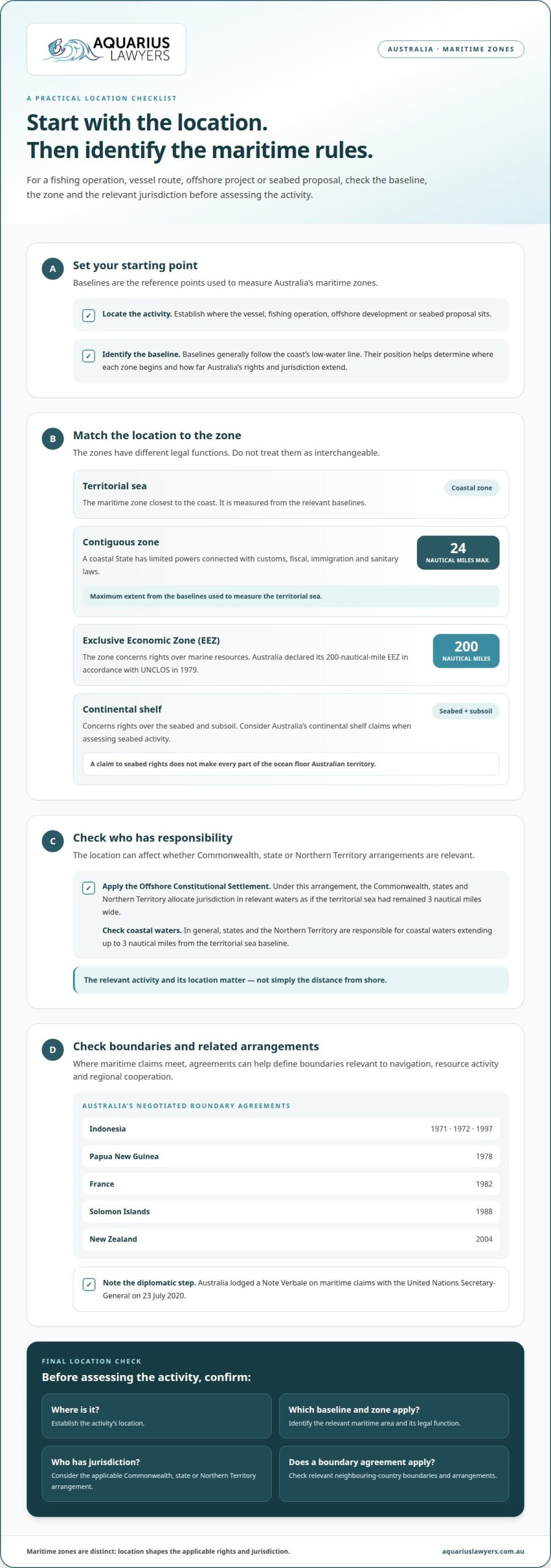
UNCLOS defines Australia’s territorial sea, contiguous zone, exclusive economic zone and continental shelf. Baselines are the starting points for measuring these maritime zones and generally follow the coast’s low-water line. Their position helps determine where each zone begins and how far Australia’s rights and jurisdiction extend. For a vessel operator, fisher or offshore project, identifying the relevant zone is an essential first step.
The territorial sea lies closest to the coast. Beyond it, the contiguous zone gives a coastal State limited powers connected with customs, fiscal, immigration and sanitary laws. According to the United Nations, a coastal State’s contiguous zone may extend no more than 24 nautical miles from the baselines used to measure its territorial sea. Australia declared its 200-nautical-mile Exclusive Economic Zone in accordance with UNCLOS in 1979. These zones have distinct legal functions, so they should not be treated as interchangeable.
The exclusive economic zone concerns rights over marine resources, while the continental shelf concerns the seabed and subsoil. UNCLOS provides a framework for identifying Australia’s interests in these areas. For seabed mining, first locate the proposed activity within the applicable maritime zone and consider Australia’s continental shelf claims. These claims concern seabed rights; they do not make every part of the ocean floor Australian territory.
State and Commonwealth responsibilities add another layer. Under the Offshore Constitutional Settlement, the Commonwealth, states and Northern Territory arrange jurisdiction in relevant waters as if the territorial sea had remained 3 nautical miles wide. In general, states and the Northern Territory are responsible for coastal waters extending up to three nautical miles from the territorial sea baseline. The relevant activity and location therefore matter, not simply the distance from shore.
Australia’s maritime boundaries also reflect agreements with neighbouring countries. Australia negotiated agreements with Indonesia in 1971, 1972 and 1997, Papua New Guinea in 1978, the Solomon Islands in 1988, France in 1982 and New Zealand in 2004. Maritime boundary negotiations can help define boundaries where claims meet. These agreements help define boundaries where maritime claims meet, a practical issue for navigation, resource activity and regional cooperation.
Australia lodged a Note Verbale on maritime claims with the United Nations Secretary-General on 23 July 2020. That diplomatic step sits alongside the domestic arrangements and treaties that shape how maritime zones operate. When you assess a fishing operation, offshore development or seabed proposal, establish its location, identify the relevant baseline and zone, then consider the boundary agreement and jurisdictional arrangement that apply. That sequence helps reveal which legal framework is relevant.
1982 UN Convention on the Law of the Sea
UNCLOS establishes an international framework for ocean use, navigation and marine resources. For Australia, it links rights at sea with responsibilities to other states and the marine environment.
Convention framework
The United Nations Convention on the Law of the Sea is the main international treaty governing activities in oceans and seas. Adopted in 1982, it entered into force on 16 November 1994, and Australia is a party. Its framework matters when your work involves shipping, fishing, offshore resources or marine conservation, because it sets shared rules for states’ rights and responsibilities.
UNCLOS covers navigational rights and the conservation and management of living marine resources, treating them as distinct aspects of ocean use. For Australian businesses, the key question is how the Convention’s international framework applies to the activity and location. A vessel’s passage and a commercial fishing operation, for example, raise different questions under the same treaty.
Navigation and innocent passage
UNCLOS sets rules for navigation and passage through territorial seas, including the concept of innocent passage. This framework matters to vessel operators because passage through Australian waters takes place within a defined legal setting, not along an unrestricted route. The applicable maritime zone and the nature of the vessel’s activity help frame the legal question.
The Convention also requires states exercising rights in their exclusive economic zones to have due regard to the rights and duties of other states. This balance matters where navigation and coastal-state interests meet. For example, a vessel operator planning a route near an offshore resource area should consider both navigation and the legal framework for the relevant zone.
Fishing and marine resources
UNCLOS recognises coastal states’ jurisdiction over resources in the waters, ocean floor and subsoil of an Exclusive Economic Zone extending 200 nautical miles from the shore, according to the United Nations. This includes the framework for living marine resources. For Australian fishing operators, the EEZ’s resource rules make the activity’s location central to understanding which rights and responsibilities apply.
The Convention supports the conservation and management of living marine resources alongside other ocean uses. Fishing rules do not apply identically in every zone. A commercial operator considering fishing activity should identify the maritime area and the resource activity involved. This distinction helps clarify the relevant legal questions without confusing navigation rights with resource jurisdiction.
Environmental protection and pollution
UNCLOS addresses marine environmental protection through its framework for ocean use, pollution control and conservation. These rules matter to Australian operators because a pollution incident can raise questions about its location and the vessel involved. The Convention also links the use of marine resources with their conservation and management.
For pollution-control violations by foreign vessels beyond the territorial sea, only monetary penalties may be imposed. That distinction shows why the zone and vessel’s status matter when considering enforcement. If an offshore operation or vessel incident raises questions about marine rules, marine and seafood legal advice can help assess the legal issues in context.
Asia Pacific regional law of the sea issues
UNCLOS provides a shared legal framework for considering maritime disputes involving Australia. Australia has also negotiated maritime boundaries with neighbouring states. Regional questions may involve competing claims, marine biodiversity or climate-related sea-level rise.
The 2016 South China Sea Arbitral Award remains a key regional reference point. Australia considers the award final and binding on the parties. That position matters because maritime disagreements can affect how governments frame claims and engage with regional rules. It does not mean every Asia Pacific dispute concerns the same legal issue or parties.
To understand how a dispute may be addressed, identify the issue and the states involved. UNCLOS provides a common framework for assessing maritime rights and responsibilities, while negotiated boundary agreements are one way states settle boundaries. The relevant facts, claims and positions shape the available pathway. Australia’s regional stance should be read in context, rather than assumed to resolve every disagreement.
Marine biodiversity beyond national jurisdiction is another regional issue. When negotiations resumed in 2022, Australia encouraged states to work towards concluding an agreement on biodiversity beyond national jurisdiction. The subject concerns biodiversity in areas beyond national jurisdiction, so it differs from disputes over a boundary between neighbouring states. For regional operators, the distinction matters: a question about resource activity in a defined maritime area is not automatically a question about biodiversity beyond national jurisdiction.
Climate-related sea-level rise presents a distinct challenge for Pacific states. The International Law Commission’s Study Group First Issues Paper recognised the development, economic and environmental challenges posed by sea-level rise. Australia encourages states to support the Pacific Islands Forum Declaration on preserving maritime zones in the face of climate change-related sea-level rise. This issue links changing physical conditions with the stability and future treatment of maritime zones.
For a business operating across the Asia-Pacific, these discussions can inform planning. A seafood operator considering regional activity should distinguish between a national maritime zone, a boundary question and biodiversity beyond national jurisdiction. A proposed operation near a disputed area calls for careful attention to its location and the claims involved. These distinctions help identify the legal issue before commercial decisions are made.
Australia’s regional approach combines positions on specific disputes with support for broader cooperation. The 2016 award, the negotiations resumed in 2022 and the Pacific Islands Forum Declaration each address a different concern. Together, they show why the law of the sea in the Asia Pacific is not limited to drawing boundaries: it also involves biodiversity and climate impacts on maritime zones.
Australia’s participation in Law of the Sea conferences
Australia participated in three United Nations conferences on the Law of the Sea: those held in 1958, 1960 and 1973-82. The sequence shows how international discussion developed into the modern treaty framework that now shapes maritime rights and responsibilities.
Australia is a party to the United Nations Convention on the Law of the Sea (UNCLOS). Participation in the conferences is distinct from the legal acts of signing and ratifying the treaty. Adoption and entry into force are also separate milestones, so they should not be confused with Australia’s individual signature and ratification dates.
The first United Nations conference in this sequence took place in 1958, followed by a second in 1960. Australia participated in both. These conferences preceded the later negotiations that produced UNCLOS, showing that international law of the sea developed through successive rounds of state discussion rather than a single meeting.
The Third United Nations Conference on the Law of the Sea was convened in New York in 1973. Representatives of 160 nations took part. That scale matters: the negotiations brought a broad range of national interests into discussion about shared ocean rules. The conference continued until 1982, when UNCLOS was adopted.
For Australia, participation in these conferences forms part of the history behind the rules that now apply to maritime activity. The 1958 and 1960 meetings preceded the Third Conference, while the 1973-82 negotiations culminated in the Convention. This chronology helps you distinguish Australia’s participation in conference negotiations from its later status as a party to UNCLOS.
The practical takeaway is to read the conference history as a progression. The early meetings established a setting for international discussion; the Third Conference brought 160 nations into extended negotiations; and the 1982 adoption produced the treaty framework. The 1994 entry into force marks a further legal milestone. Each date describes a different stage, so they should not be used interchangeably.
For Australian businesses, this history helps explain why maritime questions involve a shared international framework as well as domestic arrangements. A shipping, fishing or offshore resource issue may involve rules shaped by UNCLOS alongside Australia’s national legal system. Australia’s participation in all three conferences provides context, but the relevant legal analysis still depends on the activity and location.
Australia’s conference participation is more than a historical footnote. It connects the country to the negotiations that led to UNCLOS and helps explain the treaty’s place in contemporary maritime affairs. When considering a claim about Australia’s rights at sea, distinguish conference participation, treaty adoption, entry into force and party status. This provides a clearer basis for understanding the issue.
Aquarius Lawyers
Aquarius Lawyers can help assess how the law of the sea intersects with Australian commercial activity. If your work involves a vessel, fishing operation, aquaculture project or offshore asset, questions may span maritime boundaries, resource rights and commercial arrangements. The relevant issues depend on the activity and where it takes place.
Through Marine Law, Fisheries Law, Aquaculture Law and Commercial Law, Aquarius Lawyers advises on legal matters affecting marine businesses and operators. Turn to the firm when you need to understand the legal implications of a maritime decision, transaction or dispute. To discuss your situation, contact Aquarius Lawyers.
Put your maritime plans on a clear legal footing
Australia’s law of the sea convention framework matters most when it affects a real decision: where you operate, which resources you rely on, or how you structure a marine venture. Before committing to a project or transaction, connect the international rules with your commercial arrangements and the specific activity involved. This practical assessment can help identify legal issues early and support informed decisions.
Aquarius Lawyers offers Marine Law, Fisheries Law and Aquaculture Law for matters involving marine operations and resources. Its Commercial Law offering can also address business arrangements connected with those activities. Start with the decision you need to make and the legal question behind it.
Contact Aquarius Lawyers to discuss your maritime or commercial matter. A clear understanding of the legal position can help you move forward with confidence.
Frequently Asked Questions
What is the Law of the Sea?
The Law of the Sea is international law governing how states use and manage sea areas. For a vessel crossing an Australian maritime zone, it helps distinguish navigation rights from coastal-state authority and resource management. It is not a single rule that resolves every operational question. The location, activity and applicable Australian legislation can all affect the legal analysis before you plan a route or marine operation.
What is the Seas and Submerged Lands Act?
The Seas and Submerged Lands Act 1973 is an Australian statute concerning the seas and submerged lands. A related constitutional point came from the High Court in 1975: it determined that the Commonwealth has sovereignty over waters to the edge of the territorial sea, including the seabed beneath them. This distinction can matter when working out which government’s legal authority applies to a maritime activity.
How does UNCLOS define Australia’s territorial sea, contiguous zone and exclusive economic zone?
UNCLOS treats these as distinct maritime zones measured from baselines, each with a different legal function. In the contiguous zone, a coastal State may take necessary control measures to prevent or punish infringement of specified customs, fiscal, immigration or sanitary laws within its territory or territorial sea. For an Australian operator, identifying the zone helps clarify whether the issue concerns passage, enforcement or marine resources.
What maritime boundaries and rights does UNCLOS give Australia?
UNCLOS provides the framework for Australia’s maritime entitlements, but a specific boundary question may also depend on an agreement with a neighbouring state. For an operation near a boundary, distinguish the activity’s coordinates from the legal right being considered. Navigation, resource use and seabed interests are separate questions. A practical assessment starts by identifying the location, activity and any relevant boundary arrangement.
What Australian laws implement UNCLOS, and how do they relate to the convention?
Australian legislation addresses different parts of the domestic framework alongside UNCLOS. The Seas and Submerged Lands Act 1973 concerns Australia’s seas and submerged lands; the Crimes at Sea Act 2000 addresses the operation of state criminal law offshore where required; and the Offshore Petroleum and Greenhouse Gas Storage Act 2006 covers administration of offshore petroleum and greenhouse gas activities. The relevant statute depends on the activity in question.
Disclaimer
Please note that legal rules change and this is not a substitute nor construed as legal advice. It is general information only.