
Is simply paying your NSW penalty notice the safest move, or is it actually a tactical error that could cost you your licence? For many drivers, the immediate impulse is to settle the debt to avoid further trouble, but doing so is an admission of guilt that triggers demerit points instantly. If you’re worried about hitting your 13-point threshold or can’t afford a $496 mobile phone fine during a cost-of-living crisis, you need to know how to fight a traffic fine nsw using a methodical, evidence-based strategy.
We understand that the legal system can feel like a maze designed to keep you confused. You’ve likely felt the frustration of staring at a “Court Election” notice and wondering if the risk is worth the reward. This guide provides the clarity you need, mapping out the exact path from requesting a Revenue NSW internal review to presenting a case for leniency in the Local Court. You’ll discover how to seek a caution instead of a penalty and the specific steps required to keep your driving record clean.
Key Takeaways
- Identify the critical 28-day deadline to act before a penalty notice escalates into a more serious enforcement order.
- Master the specific methodology of how to fight a traffic fine nsw by categorising your case under Mistake, Special Circumstances, or Leniency.
- Determine if you qualify for a formal caution instead of a penalty, a common outcome for minor offences with a 10-year clean driving history.
- Assess the strategic risks and rewards of a Court Election, including the possibility of a non-conviction versus the risk of increased fines.
- Avoid common pitfalls by using professional legal strategy rather than generic advice to protect your licence and avoid demerit point accrual.
Understanding the NSW Penalty Notice System
Receiving a letter from Revenue NSW is more than just a bill; it’s a formal legal notice alleging a breach of road rules. In New South Wales, Traffic infringement notices (TIN’s) serve as the primary mechanism for enforcing everything from minor parking breaches to high-range speeding. Revenue NSW operates as the state’s central engine for fine management, handling the collection and processing of millions of notices annually. Their role is administrative, but the consequences of their notices are strictly legal.
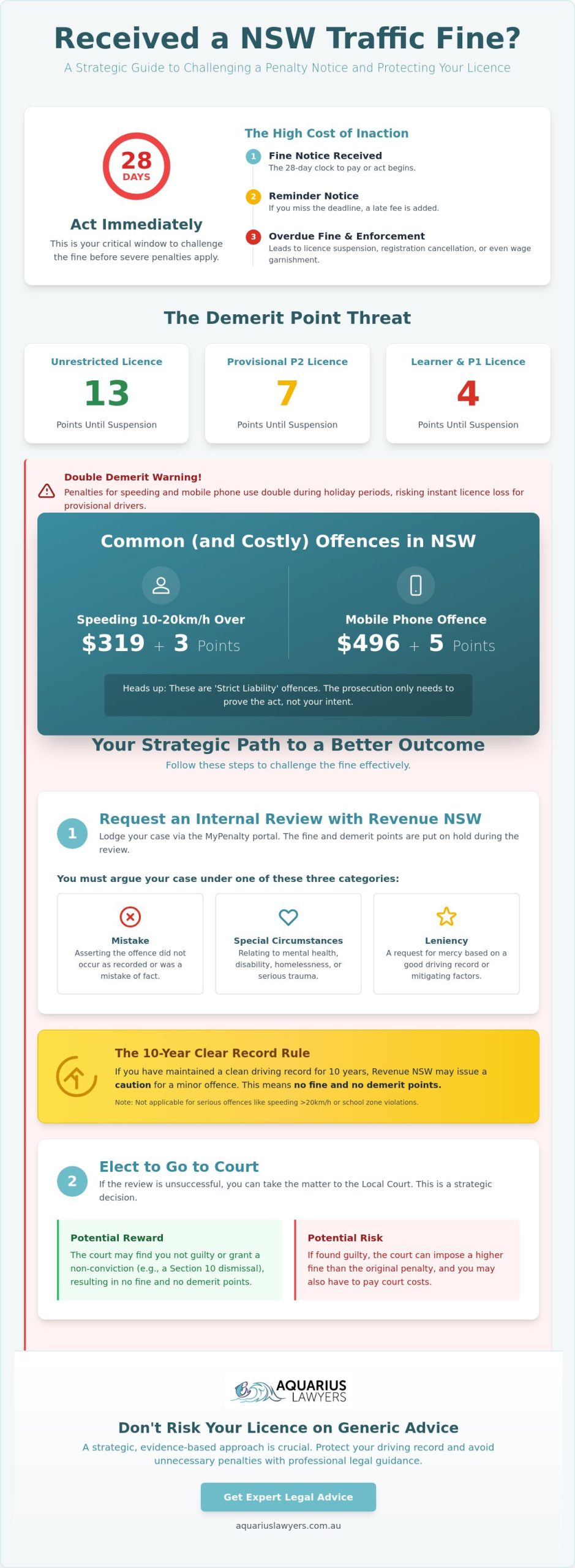
Timing is everything. You typically have 28 days from the date of the penalty notice to take action. If you miss this window, the initial Fine Notice escalates into a Reminder Notice, which adds a late fee to the original amount. Should the matter remain unresolved, it becomes an Overdue Fine. At this stage, Revenue NSW gains the power to suspend your driver licence, cancel your vehicle registration, or even garnish your wages. If you are researching how to fight a traffic fine nsw, your first priority must be acting before these enforcement costs and restrictions take hold.
The Impact of Demerit Points
While the financial cost of a fine is immediate, the demerit points are a lingering threat to your mobility. Points are recorded against your licence once the fine is paid or the 28-day period expires. For unrestricted licence holders, the threshold is 13 points. However, the margin for error is much smaller for others. Provisional P2 drivers face suspension at 7 points, while P1 and Learner drivers have a limit of just 4 points. During double demerit periods, such as the King’s Birthday or Labour Day long weekends, the stakes double for speeding and mobile phone offences. A single mistake during these windows can result in an instant licence loss for P-platers.
Common Traffic Offences in NSW
The majority of notices issued in NSW relate to speeding, red-light cameras, and mobile phone usage. For instance, exceeding the speed limit by 10-20 km/h currently attracts a $319 fine and 3 demerit points for light vehicles. Mobile phone offences are particularly heavy, carrying a $496 fine and 5 points. A traffic offence is typically a strict liability offence, meaning the prosecution only needs to prove you committed the act, regardless of whether you intended to break the law. This reality makes a strategic approach essential when considering how to fight a traffic fine nsw, as simple excuses rarely hold weight in a legal context.
Step 1: Requesting an Internal Review via Revenue NSW
The most efficient way to challenge a penalty is through an administrative internal review. This process allows you to present your case directly to Revenue NSW before the matter ever reaches a courtroom. You can submit your request through the MyPenalty portal, providing a written explanation and any supporting documentation. Once your application is lodged, the fine is placed on “hold.” This means the 28-day payment clock stops, and no enforcement action will be taken while your case is being assessed.
When considering how to fight a traffic fine nsw at this level, your argument must fall into one of three categories: Mistake, Special Circumstances, or Leniency. A “Mistake” claim asserts that the offence simply didn’t happen as recorded. “Special Circumstances” covers situations involving mental health issues, intellectual disability, or immediate trauma that contributed to the offence. Finally, “Leniency” is a request for mercy based on a strong driving record or specific mitigating factors. The outcome will be one of three things: the fine stands, you receive a formal caution, or the fine is cancelled entirely.
Gathering Compelling Evidence
Revenue NSW rarely grants leniency based on a simple “I’m sorry.” Success requires objective proof. If you’re claiming a mistake, dashcam footage with embedded GPS data or telematics from a fleet vehicle can be decisive. For medical emergencies, a signed certificate from a doctor detailing the urgency of the situation is mandatory. If you weren’t the driver, you must lodge a Statutory Declaration to nominate the correct person. If the legal complexities of gathering this evidence feel overwhelming, seeking advice from experts in criminal law can help ensure your submission is airtight.
The 10-Year Clear Record Rule
NSW has a specific policy for drivers who have maintained a clean driving record for at least 10 years. If you meet this criteria, Revenue NSW may issue a caution instead of a penalty for minor offences. This means you won’t pay the fine and, crucially, you won’t accrue demerit points. However, this rule isn’t an automatic “get out of jail free” card. Serious offences, such as exceeding the speed limit by more than 20km/h or school zone violations, are typically excluded from this policy. Before you apply, it’s wise to request your driving record through Service NSW to verify your eligibility. A single forgotten parking ticket from five years ago could reset your 10-year clock.
Leniency and Special Circumstances in NSW
Determining how to fight a traffic fine nsw often involves looking beyond the incident itself to the personal context surrounding it. Revenue NSW recognises that life is complex. Their “special circumstances” category is designed for drivers facing significant hurdles such as mental health conditions, cognitive impairments, or even homelessness. These aren’t just excuses; they are legally recognised factors that may have impaired your judgment or your ability to comply with road rules at that specific moment.
If you’re struggling with the high cost of fines during the current cost-of-living crisis, financial hardship alone isn’t usually enough to have a fine cancelled. However, it can open the door to the Work and Development Order (WDO) scheme. This initiative allows eligible people to “pay off” their fines through unpaid work, counselling, or vocational courses instead of cash. It’s a pragmatic solution that clears your debt while providing a constructive pathway forward. Mechanical failure is another common plea, though it’s a narrow gate to walk through. To succeed, you must prove the failure was sudden and unforeseeable, like a total brake collapse on a well-maintained car, rather than a neglected speedometer you’ve known about for months.
The Leniency Framework
When you request a review, Revenue NSW assesses your “good character” by looking at your long-term driving behaviour. While we previously discussed the 10-year rule, the demerit point reward program is another modern incentive. Drivers who remain offence-free for 12 months can have one demerit point removed from their record under legislation introduced in early 2026. It’s vital to remember that leniency is a discretionary power exercised by the reviewing officer, not an automatic right you can demand. Your application must be respectful, evidence-backed, and focused on why a caution is a more appropriate outcome than a financial penalty.
When Leniency is Unlikely
The NSW government maintains a “zero tolerance” stance on certain high-risk behaviours. If your fine involves any of the following, an internal review for leniency is almost certain to fail:
- School Zone Offences: Speeding or illegal parking in school zones is treated with extreme severity to protect children.
- High-Range Speeding: Exceeding the limit by more than 20km/h generally disqualifies you from receiving a caution.
- Mobile Phone and Seatbelt Offences: These are viewed as deliberate safety breaches rather than lapses in judgment.
- Repeat Offenders: If you have a history of multiple recent demerit point losses, Revenue NSW will likely view the fine as a necessary deterrent.
In these instances, the administrative review process is rarely the solution. If the fine stands and you still believe you have a case, your next strategic move is to evaluate the risks and rewards of a Court Election.
Step 2: Electing to Have the Matter Heard in Court
If your internal review is rejected or you know your case requires a Magistrate’s discretion from the outset, you must “elect” to go to court. This action shifts the matter from the administrative hands of Revenue NSW into the judicial system of the NSW Local Court. It is a high-stakes decision that requires a clear-eyed assessment of the evidence. Once you tick that box on your penalty notice or via the online portal, you are committed to a legal process that cannot be easily undone. You’ll receive a Court Attendance Notice (CAN) detailing when and where you must appear.
The transition to court introduces a new set of risks and rewards. On the positive side, a Magistrate has the power to grant leniency that Revenue NSW simply cannot. However, the stakes are higher. If you’re unsuccessful, the court can impose a fine up to the maximum statutory limit, which is often significantly higher than the original penalty. You will also be liable for a $117 court attendance fee. In some cases, a conviction could even lead to a criminal record. Because of these complexities, engaging experts in litigation is a strategic move to protect your driving privileges and your future.
Seeking a Section 10 Dismissal
For many drivers researching how to fight a traffic fine nsw, the goal is a Section 10 dismissal. This refers to a specific order where the Magistrate finds you guilty but chooses not to record a conviction. It’s the “holy grail” of traffic law because, without a conviction, no demerit points are applied to your licence. To win this, you must demonstrate that your prior good character, your age, and the specific nature of the offence make a conviction inappropriate. It’s not an easy win; it requires a sophisticated argument that balances the seriousness of the road rules with your personal circumstances.
Pleading Guilty with an Explanation
There are times when the facts of the offence are indisputable, but the context warrants a reduced penalty. This is known as pleading guilty with an explanation. Instead of fighting the charge, you focus on a “plea in mitigation” to reduce the fine or avoid a licence suspension. This involves preparing a “Subjective Case” for the Magistrate. You should gather high-quality character references, a sincere letter of apology, and evidence of any rehabilitative steps you’ve taken, such as completing a traffic offender program. A well-prepared subjective case shows the court that you take the matter seriously and are unlikely to reoffend.
Why a Strategic Legal Approach Wins
Deciding how to fight a traffic fine nsw isn’t just about showing up; it’s about the precision of your argument. Many drivers fall into the “Google Lawyer” trap, presenting generic excuses they’ve found on internet forums. Magistrates hear these recycled stories every day. When you walk into a courtroom with a professional strategy, you immediately distinguish yourself from the crowd. A strategic approach combines deep, traditional legal credentials with a modern understanding of how the NSW judicial system operates in practice.
At Aquarius Lawyers, we leverage our expertise in Criminal Law and Litigation to provide a level of advocacy that goes beyond simple paperwork. We understand that a traffic matter often sits at the intersection of administrative rules and criminal proceedings. By applying high-level strategic thinking to what others might see as a “simple fine,” we identify procedural errors or evidentiary gaps that the average person would miss. This synergy between experience and methodology is what produces consistent results for our clients.
Hiring a solicitor is a calculation of value. While there’s an upfront cost, the long-term financial impact of losing your driver licence can be devastating. Think about the cost of Ubers, the potential loss of employment, or the spike in your insurance premiums once a conviction is recorded. Professional representation is an investment in your mobility and your livelihood. It’s about choosing a pathway that minimises risk while maximising the chance of a non-conviction or a successful withdrawal of the fine.
Pragmatic Advice for NSW Drivers
We provide a no-nonsense assessment of your situation. If your case is weak, we’ll tell you straight. We don’t believe in over-promising; we believe in results. Our role is to act as your trusted advisor, stripping away the stress of court appearances by handling the advocacy on your behalf. Whether we’re negotiating with police prosecutors or addressing a Magistrate, our focus remains on protecting your ability to stay on the road. We move quickly to get to the heart of the matter, ensuring your case is presented with clarity and confidence.
Next Steps: Protecting Your Licence
If you’re facing a licence suspension or a heavy fine that you simply can’t afford to accept, it’s time to move from confusion to action. We can help you organise your evidence, from character references to technical data, ensuring every piece of information serves a clear purpose in your defence. Don’t leave your driving record to chance or half-baked internet advice. Reach out to us for a confidential consultation to discuss your options. You can get a steady, common-sense guide for your traffic matter and start building a defence that actually works.
Secure Your Driving Future Today
Protecting your licence requires more than just hope. It demands a calculated response to the NSW penalty system. We’ve explored how a methodical internal review or a well-prepared court election can shift the outcome from a mandatory fine to a formal caution or a Section 10 dismissal. Mastering how to fight a traffic fine nsw gives you the power to challenge administrative errors and present your personal circumstances with clarity.
Success relies on the synergy between technical legal knowledge and practical courtroom experience. Principal Katherine Hawes is a recognised legal expert in NSW who leads our team with specialised expertise in both criminal and administrative law. With multiple office locations in Sydney and Shellharbour, we provide the strategic advocacy needed to protect your livelihood. Don’t let a single notice derail your mobility. Book a consultation with our Sydney traffic lawyers to secure a steady, common-sense guide for your case. You have the right to a fair hearing. We are here to ensure your voice is heard.
Frequently Asked Questions
Can I fight a speeding fine if I was only 5km/h over the limit?
You can certainly contest a minor speeding offence, especially if it’s your first lapse in a decade. NSW policy allows for a caution for exceeding the limit by less than 20km/h if your driving history is spotless for the previous 10 years. If you don’t meet that specific criteria, you’ll need to provide evidence of a technical error or a genuine emergency to have the fine withdrawn.
What happens if I ignore a NSW traffic fine?
Ignoring a penalty notice is a recipe for escalating costs and serious legal trouble. After the initial 28-day window, Revenue NSW issues a reminder with an additional late fee. If the debt remains unpaid, they can suspend your driver licence, cancel your vehicle registration, or even garnish your bank account. It’s always better to act early than to deal with a restrictive enforcement order.
Will I lose my licence if I elect to go to court and lose?
There is a real risk of licence loss if you elect to go to court and the Magistrate records a conviction. Once a conviction is made, the statutory demerit points are applied to your record immediately. If these points push you over your specific threshold, Transport for NSW will issue a suspension notice shortly after the court date. Understanding how to fight a traffic fine nsw involves weighing this risk against the strength of your defence.
How long does a traffic fine review take in NSW?
Most internal reviews through the Revenue NSW MyPenalty portal are finalised within two to six weeks. During this period, the fine is placed on a formal hold, which means you don’t need to worry about late fees or demerit points accruing while you wait for a decision. You’ll receive a notification via email or post once the assessment of your case is complete.
Can I get a caution if I have a 10-year clear record but the offence was in a school zone?
Leniency is almost never granted for school zone offences, even if you have a perfect 10-year driving record. NSW authorities maintain a zero-tolerance stance in these areas to ensure child safety. While you can still request a review, the official policy specifically excludes high-risk areas like school zones and hospital zones from the standard caution guidelines.
What is a Section 10 dismissal and does it apply to traffic fines?
A Section 10 dismissal is a court order where the Magistrate finds you guilty but chooses not to record a conviction. It’s a vital outcome when learning how to fight a traffic fine nsw because it prevents demerit points from being deducted. This result is typically reserved for drivers with excellent character who can demonstrate that a conviction would have an outsized impact on their livelihood.
How much does it cost to have a lawyer represent me for a traffic fine?
Legal fees vary depending on the complexity of your case and whether you’re pleading guilty with an explanation or fighting the charge entirely. While hiring a solicitor involves an upfront cost, it’s often more affordable than the long-term financial fallout of a licence suspension and increased insurance premiums. We recommend a confidential consultation to get a clear understanding of the costs relative to your specific situation.
Can I nominate someone else for a fine if I received the notice late?
You can still nominate the actual driver if the notice arrived late, but you must act as soon as you become aware of the fine. You’ll need to provide a statutory declaration explaining who was driving and why the nomination is being made after the initial due date. If the fine has already reached the enforcement stage, you may need to prove you were hindered from managing the fine earlier.
Disclaimer
Please note that legal rules change and this is not a substitute nor construed as legal advice. It is general information only.