
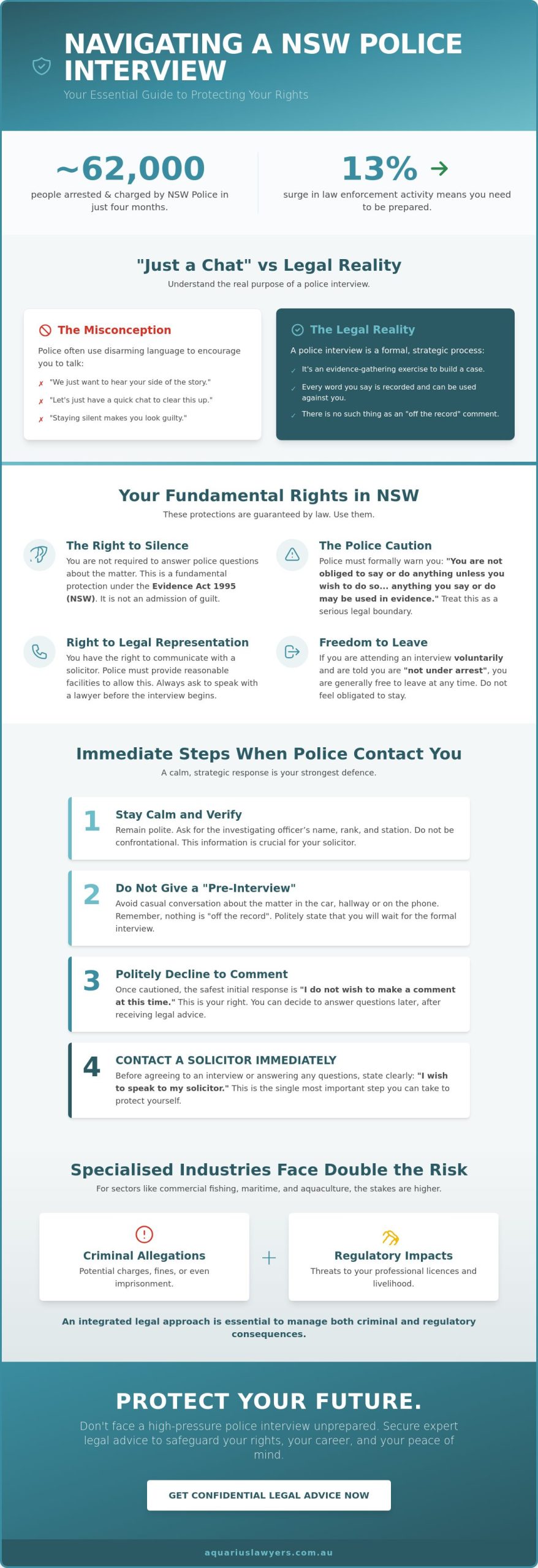
Did you know that NSW Police arrested and charged nearly 62,000 people in just the four months leading up to March 2026? This 13% surge in law enforcement activity means more Australians than ever are facing the high-pressure environment of a station interview room. When you’re asked to come in for a “chat,” it’s easy to feel overwhelmed by the stress of dealing with authority and the fear of accidental self-incrimination. Securing expert police interview legal advice isn’t about obstructing justice; it’s about ensuring your rights are respected in a system that’s more active than ever before.
You likely feel that a single slip-up could jeopardise your future, and you’re right to be cautious. We promise to help you master the essential steps to handle a NSW police interview with total confidence so you can protect your legal interests. This guide provides a clear breakdown of the “right to silence,” explains how to bypass confusing jargon, and helps you understand why finding a solicitor who knows your specific industry, such as fisheries or commercial law, is a strategic necessity. Knowledge plus preparation equals a protected future.
Key Takeaways
- Understand why a police interview is a formal evidence-gathering exercise rather than a casual chat, and how your words dictate your legal trajectory.
- Identify your fundamental protections under the Evidence Act 1995 (NSW), including the right to silence and the true meaning of a police caution.
- Discover when to utilise the “no comment” strategy as a protective shield to prevent accidental self-incrimination during the early stages of an investigation.
- Access practical police interview legal advice on the immediate steps to take when approached, from staying calm to verifying the investigating officer’s details.
- Learn how an integrated legal approach can safeguard your future by managing both criminal allegations and complex regulatory impacts at the same time.
Understanding the High Stakes of a NSW Police Interview
A police interview isn’t a friendly exchange of information. It’s a strategic evidence-gathering exercise designed to build a case. Many people enter the room thinking they can simply explain their way out of trouble. This rarely works. In reality, every word you say is recorded and analysed to find inconsistencies. If you’re involved in a niche industry like commercial fishing or aquaculture, the stakes are even higher. A poorly handled interview doesn’t just lead to criminal charges; it can trigger regulatory investigations that threaten your livelihood and commercial licences. Seeking expert police interview legal advice is the first step in protecting your professional future.
In NSW, you generally have a choice to attend a “voluntary” interview. However, some regulatory frameworks, particularly in marine or environmental law, may involve “compulsory” questioning where different rules apply. Knowing which situation you’re in is vital. Mixing up the two can lead to unintended legal consequences that follow you for years. A person being interviewed by police in NSW has a fundamental right to silence under common law and the Evidence Act 1995 (NSW). Using this right effectively requires a calm, strategic mindset that most people struggle to maintain under the weight of authority.
The Role of Evidence in 2026
Policing has changed. In 2026, the NSW Police Force is more tech-savvy than ever. With the widespread use of body-worn cameras and advanced digital forensics, your interview doesn’t exist in a vacuum. Police will compare your statements against GPS data, CCTV footage, and digital records in real-time. Consistency is your greatest asset. Any deviation from previous statements can be framed as a lie, even if it’s just a lapse in memory. Before the questioning starts, police must give you a “caution.” This is a formal warning that you don’t have to say anything, but anything you do say can be used as evidence against you. Treat this warning as the serious legal boundary it is.
Why “Just a Quick Chat” is a Legal Red Flag
Officers often use disarming language to encourage voluntary admissions. They might tell you they just want to “clear things up” or “hear your side of the story.” Don’t be fooled. There’s no such thing as an “off the record” comment with a police officer. Anything you say in the car, the hallway, or the lift is admissible in court. Police are trained investigators. Their goal is to gather enough evidence to secure a charge, not to prove you’re innocent. Common tactics include:
- Building a false sense of rapport to make you lower your guard.
- Suggesting that staying silent makes you look guilty.
- Minimising the seriousness of the situation to encourage you to talk.
Because the dynamic is so heavily skewed in favour of the investigator, obtaining police interview legal advice before you step foot in the station is the only way to level the playing field.
Your Fundamental Rights: Silence, Cautions, and Legal Representation
Understanding your rights is the difference between a controlled legal process and a chaotic one. In NSW, the most powerful tool at your disposal is the right to silence. This isn’t a loophole; it’s a core principle of the Evidence Act 1995 (NSW). Before questioning begins, police must issue a caution. They’ll state that you don’t have to say anything, but anything you do say can be used in evidence. This caution is your cue to pause and think. If an officer mentions you are “not under arrest,” it typically means you’re attending voluntarily. In these cases, you’re generally free to leave at any time. Don’t let the formal setting of a station trick you into staying if you aren’t legally required to be there.
You also have the right to communicate with a friend, relative, or solicitor. Police must provide reasonable facilities for this. For vulnerable people, such as those with intellectual disabilities or from non-English speaking backgrounds, an independent third party should be present. This person ensures you aren’t being pressured or confused by the process. If you find yourself in this high-pressure environment, reaching out for expert criminal law support ensures your rights remain the priority from start to finish.
The Right to Silence: NSW Exceptions
While the right to silence is broad, it isn’t absolute. You must provide your name, residential address, and date of birth when requested. Under LEPRA, police have specific powers to demand identification in certain circumstances, and refusing can lead to separate charges. Be aware of Section 89A of the Evidence Act. In some serious indictable offences, a court might draw an “unfavourable inference” if you fail to mention a fact during the interview that you later rely on in your defence. This is exactly why specialised police interview legal advice is critical; you need to know when silence protects you and when it might complicate your case.
Accessing Legal Advice in Sydney
Never waive your right to call a solicitor. A legal representative does more than just sit in the room. They act as a barrier against loaded or unfair questions that are designed to trip you up. They ensure the interview follows the strict requirements of the law and can intervene if police tactics become overly aggressive. Your solicitor’s role is to manage the flow of information and ensure that the recorded version of events is fair and accurate. They transform a one-sided interrogation into a balanced legal procedure.
The “No Comment” Strategy: When to Speak and When to Stay Silent
Choosing between silence and speech is the most critical decision you’ll make in the interview room. A “no comment” interview isn’t an admission of guilt. It’s a strategic pause. By declining to answer questions, you prevent the police from using your own words to fill gaps in their evidence. This is particularly vital in complex commercial or marine investigations where technicalities matter. Professional police interview legal advice helps you determine if staying silent is a temporary shield or a long-term necessity. It’s about controlling the narrative rather than reacting to it.
Many people fall into the trap of “selective silence.” They answer easy questions about their background but refuse to answer questions about the incident itself. This is a dangerous path. It often makes the refusal to answer look suspicious rather than like a principled exercise of your rights. If you choose the “no comment” route, it’s usually best to apply it consistently. Answering some questions while dodging others gives the prosecution room to argue that you were only willing to talk when it suited you.
When a Statement Might Help Your Case
There are rare situations where an early explanation can stop an investigation in its tracks. If you have a rock-solid alibi or a specific permit that proves your actions were lawful, staying silent might actually prolong the stress. In industries like aquaculture or commercial fishing, “front-loading” your defence by providing evidence of compliance can sometimes prevent charges from being laid at all. However, you should never provide this information on the fly. The safest middle ground is often a formal written statement prepared by your solicitor. This provides the necessary facts without the risk of a high-pressure interrogation where your words could be twisted.
The Risks of Self-Incrimination
Seemingly harmless details often become the foundation of a prosecution. You might think you’re just explaining why you were at a specific wharf or who you were talking to, but police can use those details to establish intent or presence at a crime scene. Once a statement is on the record, it’s incredibly difficult to “fix” or retract later. The safest default position is to say nothing until your legal representative has reviewed the available evidence. Silence is a controlled environment; talking is an unpredictable one. Because of this, the “no comment” approach remains the gold standard for protecting your legal future in the face of uncertainty. If charges do proceed after the interview, understanding what comes next is equally important — working with an experienced sentencing hearing lawyer can make the critical difference between a fair outcome and an unnecessarily harsh penalty.
Step-by-Step: What to Do When Police Request an Interview
The moment an officer asks for a “chat” is when your legal strategy begins. Adrenaline often triggers a “fight or flight” response, but the most effective reaction is disciplined composure. If you receive a phone call or a knock on the door, follow these steps to ensure you don’t accidentally compromise your position before you’ve even reached the station. This practical police interview legal advice is designed to keep you in control of a high-pressure situation.
- Step 1: Stay calm and clarify your status. Politely ask the officer: “Am I under arrest or am I free to leave?” If you are free to leave, you aren’t required to stay for questioning.
- Step 2: Record the details. Request the name, rank, and station of the investigating officer. If they’re on the phone, ask for a direct call-back number.
- Step 3: Use the script. State clearly: “I wish to exercise my right to silence until I have spoken to my solicitor.” Do not offer “preliminary” explanations or engage in small talk.
- Step 4: Seek professional support. Reach out to contact our marine and criminal law specialists immediately to organise a pre-interview consultation.
- Step 5: Document the request. Write down the time, date, and location of the interaction, along with exactly what the officer said they wanted to talk about.
Special Guidance for Fisheries and Maritime Matters
Interviews involving the commercial fishing or aquaculture sectors are unique. Fisheries Officers often operate under the Fisheries Management Act 1994 (NSW), which grants them different search and questioning powers compared to standard NSW Police. Katherine Hawes, known as “The Fish Lawyer,” provides a specialised advantage in these niche cases. She understands the synergy between criminal allegations and the heavy regulatory penalties that can follow. If you’re facing a joint operation between maritime authorities and police, you need a solicitor who speaks both “police” and “industry” to ensure your commercial licences aren’t at risk.
Preparing for the Interview Room
When you head to the station, leave your mobile phone in the car or with a trusted friend. Modern digital forensics mean police may request to search your device on the spot. Bring a bottle of water and any necessary medication, but avoid bringing documents or notebooks that haven’t been reviewed by your solicitor. While waiting, do not chat with officers about the weather, your job, or your family. These interactions are often noted and used to build a profile of your character. During the Electronic Recorded Interview of a Suspected Person (ERISP), stay focused on your prepared strategy and let your solicitor manage the rhythm of the recording.
How Aquarius Lawyers Protects Your Future
Aquarius Lawyers operates as an “innovative veteran” in the Australian legal market. We blend high-level professional expertise with a down-to-earth, pragmatic approach. Dealing with authority is stressful, but our team provides a grounded, reassuring presence. We don’t just offer standard criminal law support; we specialise in the synergy between traditional defence and forward-thinking strategy. This is especially critical for clients in the marine and aquaculture sectors where a single interview can impact commercial licences and personal freedom at the same time.
We value results over ceremony. Our methodology prioritises the proactive resolution of issues, aiming to settle matters efficiently and cost-effectively. By securing expert police interview legal advice from a firm that understands the specific nuances of your industry, you gain a trusted advisor who moves easily between different legal focus areas. We offer high-level strategic thinking combined with relatable, everyday wisdom to guide you through the most complex situations. Knowledge plus preparation equals a protected future.
Strategy Beyond the Interview
Our work doesn’t end when the recording stops. We manage the critical post-interview period by engaging in negotiations with the Prosecution to potentially have charges reduced or dropped entirely. Where charges do proceed to court, our team includes an experienced sentencing hearing lawyer who builds a rigorous, evidence-based case focused on rehabilitation and future potential — particularly important following the NSW Government’s 2026 changes to sentencing law. We protect your broader interests, including:
- Securing commercial fishing quotas and maritime licences.
- Preserving your professional reputation within your specific industry.
- Managing debt recovery or employment law issues that may arise from legal proceedings.
We maintain a “no-nonsense” attitude. You’ll receive clear, direct communication about the progress of your case without the dense, archaic jargon often found in the legal profession. We act as a facilitator of outcomes, clearing the pathway toward a resolution.
Book Your Confidential Consultation Today
Timing is everything. Securing legal protection before you speak to the police is the most effective way to safeguard your future. With offices in Sydney and Shellharbour, we provide regional accessibility and niche authority to clients across NSW. Don’t leave your legal outcome to chance or rely on a “quick chat” to resolve a serious matter. Protect your rights and organise your legal strategy with Aquarius Lawyers today.
Take Control of Your Legal Strategy
A police interview is a high-stakes event where your words become permanent evidence. As we have explored, the right to silence remains your most effective shield against accidental self-incrimination. Whether you’re facing a standard criminal matter or a complex regulatory investigation, the key is preparation rather than reaction. Securing expert police interview legal advice ensures you don’t walk into the station alone or unprepared. It’s about transforming a stressful interrogation into a managed legal process.
Principal Katherine Hawes, widely known as “The Fish Lawyer,” provides the niche expertise required for maritime and fisheries law cases. Our team offers authoritative representation in NSW Local and District Courts, blending traditional defence experience with a modern, tech-savvy methodology. We focus on efficient, proactive solutions that protect both your reputation and your commercial interests. Secure expert police interview legal advice-Contact Aquarius Lawyers now. You have the right to a fair process; let’s ensure you use it.
Frequently Asked Questions
Do I have to go to the police station if they call me for an interview?
You aren’t legally required to attend the station for a voluntary interview. If police haven’t arrested you, you’re free to decline the request. However, it’s wise to check your status first. Ask the officer directly if you’re under arrest or free to leave. If you’re involved in a regulatory matter, such as a fisheries investigation, specific rules might apply, so always confirm with a solicitor before making a final decision.
What happens if I refuse to answer questions during a police interview?
In most cases, refusing to answer questions is a valid exercise of your right to silence. Apart from providing your name, address, and date of birth, you don’t have to say anything. Police will record your “no comment” responses. While it might feel awkward, this is a standard protective strategy. It prevents you from making accidental admissions before you’ve received professional police interview legal advice based on the full evidence.
Can I change my mind and ask for a solicitor halfway through the interview?
Yes, you can stop the interview at any time to request legal representation. Even if you’ve already started answering questions, you have the right to pause the process and call a solicitor. Police must provide you with reasonable facilities to make this contact. It’s often better to stop halfway than to continue if you feel confused, pressured, or realise the questioning is heading into dangerous territory.
Will I look guilty if I exercise my right to remain silent?
Exercising your right to remain silent isn’t an admission of guilt. In a courtroom, the prosecution generally can’t use your silence as evidence that you’ve committed a crime. However, for certain serious indictable offences, a court might draw an “unfavourable inference” if you fail to mention a fact you later rely on. This complexity is why you must speak with a lawyer to understand how silence impacts your specific case.
Do I have to give police the PIN to my phone or computer during an interview?
You don’t have to provide your PIN or passwords simply because an officer asks for them. In NSW, police generally need a Data Access Order issued by a Magistrate or Judge to legally compel you to unlock a device. If you’re asked for this during an interview, politely decline until you’ve spoken to your solicitor. Handing over access without a warrant can expose your private data to unnecessary scrutiny.
What is the difference between a voluntary interview and being arrested?
The primary difference is your freedom to leave. In a voluntary interview, you’re there by choice and can walk out of the station at any time. When you’re arrested, you’re in legal custody and are not free to leave until the investigation period ends or you’re granted bail. Knowing your status is the first step in determining how much control you have over the situation and whether you should stay.
How long can the police hold me for questioning in NSW?
Police in NSW can hold you for an initial investigation period of six hours. This time can be extended by a further six hours if a warrant is granted by a court. It’s important to know that “timeouts,” such as travel time, rest breaks, or waiting for a solicitor to arrive, don’t count towards these six hours. This means you could effectively be at the station for much longer than the standard limit.
Can I see the evidence the police have against me before the interview?
You don’t have a right to see the police brief of evidence before an interview. Police are under no obligation to show you what they have. They often withhold key information to see if your story contradicts the evidence they’ve already gathered. Because you’re operating in the dark, obtaining police interview legal advice is essential to ensure you don’t inadvertently trap yourself with a statement that clashes with undisclosed facts.
Disclaimer
Please note that legal rules change and this is not a substitute nor construed as legal advice. It is general information only.