
Treating individual transferable quota units as mere operational catch limits rather than high-value commercial assets is the fastest way to expose your commercial fishing business to severe regulatory risk. If you harvest rock lobster across southern waters, you already know that shifting seasonal Total Allowable Commercial Catch limits and mandatory digital catch logs can disrupt your operations overnight. In an environment where minor reporting errors trigger serious penalties, mastering southern rock lobster quota management has become a vital strategic discipline rather than a routine administrative exercise.
This guide gives you the practical clarity needed to maintain strict compliance with fisheries authorities, protect your statutory fishing entitlements, and execute transfers without administrative delays. You’ll discover how to coordinate dual security registrations across state licensing registers and the Commonwealth Personal Property Securities Register (PPSR), structure enforceable leasing contracts, and safeguard your commercial assets against costly licence impacts during business restructures or eventual enterprise exits.
Key Takeaways
- Understand how statutory southern rock lobster quota management translates annual harvest limits into distinct individual transferable quota shares while supporting long-term stock sustainability.
- Identify mandatory data management requirements and digital reporting rules to avoid strict liability offences that trigger immediate licence suspension or forfeiture.
- Treat quota units as secure commercial assets by executing dual registrations across both state fisheries registers and the Commonwealth Personal Property Securities Register (PPSR).
- Draft enforceable quota leasing and transfer agreements with clear title warranties to prevent costly operational disputes during fleet sales or corporate restructures.
- Apply a structured legal audit framework to detect documentation blind spots early and defend your statutory fishing entitlements against adverse regulatory actions.
What Is Southern Rock Lobster Quota Management in Australia?
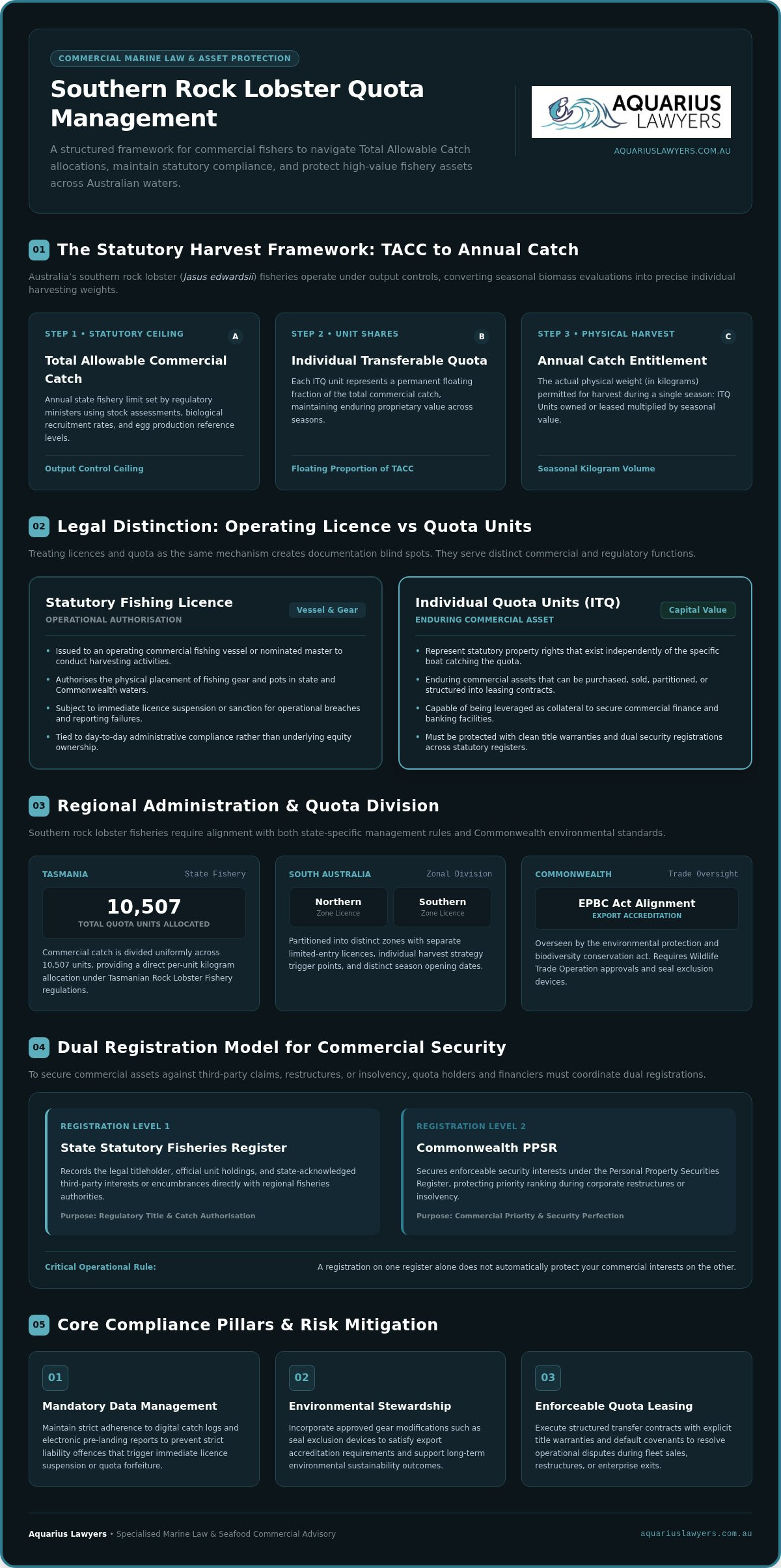
Australia’s southern fishery operates under strict statutory output controls. Rather than limiting how many days you can spend at sea, the regulatory framework directly caps the volume of catch landed. At its core, southern rock lobster quota management governs the harvest of southern rock lobster (Jasus edwardsii) across South Australia, Tasmania, and Victoria. State fisheries agencies establish an annual Total Allowable Commercial Catch (TACC). They then divide that resource into tradeable Individual Transferable Quota (ITQ) units, balancing commercial profitability with verifiable environmental sustainability outcomes.
Legally, quota units are not merely administrative catch permissions. They represent statutory property rights granting exclusive harvesting entitlements. Commonwealth trade oversight under the environmental protection and biodiversity conservation act further conditions these rights. Continued export accreditation requires active proof of environmental stewardship, including gear modifications like seal exclusion devices to protect marine biodiversity.
The Core Objectives of Output-Controlled Fisheries
Output control frameworks protect both benthic habitats and enterprise balances. By moving past legacy input restrictions like pot-lift limits, quota systems secure three primary operational goals:
- Stock conservation: Eliminating the race to fish prevents biological overfishing through hard biomass limits.
- Economic efficiency: Licence holders align fishing effort with high-value seasonal market windows.
- Export security: Rigorous catch monitoring maintains statutory alignment with Commonwealth Wildlife Trade Operation approvals.
Statutory Entitlements vs Operating Licences
A frequent blind spot for seafood operators is treating a commercial fishing licence and quota units as identical assets. They are distinct legal mechanisms. Your statutory fishing licence serves as an operational authorisation issued to a commercial fishing vessel or nominated master. In contrast, ITQ units are enduring commercial assets that exist independently of the boat catching them.
While an operating licence allows you to place gear in the water, the underlying quota units represent the actual proprietary value. State statutory registers document these unit holdings alongside registered encumbrances. Because quota units can be bought, leased, divided, or leveraged as collateral for commercial finance, securing clean title is paramount. Engaging dedicated legal counsel for seafood and marine legal services ensures your statutory fishing entitlements are properly registered, defended against administrative disputes, and insulated from sudden regulatory actions.
How Total Allowable Commercial Catch and ITQ Units Operate
Fisheries authorities set annual harvest limits based on rigorous stock assessment science, biological recruitment rates, and egg production reference levels. State ministers translate this data into a Total Allowable Commercial Catch (TACC). Each Individual Transferable Quota (ITQ) unit represents a floating fraction of that statewide total. Because the statutory total changes each year, the physical weight of each unit fluctuates in response.
Quota administration varies across state borders. Under Tasmanian Rock Lobster Fishery regulations, the commercial catch is divided across exactly 10,507 quota units, yielding a straightforward kilogram allocation per unit. In South Australia, the fishery is partitioned into separate Northern and Southern zones, each with distinct limited-entry licences, harvest strategy trigger points, and season opening dates. Understanding this mathematical structure is central to southern rock lobster quota management, ensuring fleet operators never confuse fixed unit holdings with static catch weights.
Determining Annual Catch Entitlements (ACE)
Your actual harvest limit for any given year is your Annual Catch Entitlement (ACE). It is calculated with a simple formula: multiply your owned or leased ITQ units by the seasonal kilogram value determined by the fisheries department. However, state authorities can issue mid-season spatial closures or regional catch caps when local biomass triggers are met. Before running gear, a proactive review with seafood and marine legal services ensures your harvest operations match your exact seasonal allocation, shielding your commercial fishing vessel from accidental over-catch liabilities.
Permanent Unit Holdings Compared to Seasonal Leasing
Commercial operators must choose between holding permanent quota units or leasing seasonal catch entitlements. Both approaches carry distinct commercial trade-offs:
- Permanent Unit Ownership: Delivers long-term asset value, serves as balance-sheet equity to secure commercial loans, and provides certainty across decades. However, it requires significant capital and leaves the owner directly exposed to statewide TACC reductions.
- Seasonal Entitlement Leasing: Provides agile harvesting capacity without capital outlays on underlying property. The downside lies in annual price volatility, variable quota availability, and complete dependence on third-party unit holders.
If you lease quota to external skippers, the legal risks multiply. An operational breach by a nominated skipper can trigger statutory demerit points against your underlying licence. Carefully drafted leasing agreements must include indemnity clauses, strict catch reconciliation timelines, and immediate default triggers to protect your underlying maritime assets.
Compliance Risks, Reporting Requirements, and Statutory Offences
Operating in commercial fisheries demands relentless administrative precision. Commercial operators must navigate stringent data management requirements across digital portals, electronic logbooks, and mandatory catch disposal records. Minor documentation discrepancies can trigger formal regulatory investigations and severe statutory penalties. State fisheries legislation imposes strict liability offences for exceeding allocated quota. Proving you acted without malicious intent provides no legal defence when landings exceed your verified balance.
When discrepancies occur, the legal fallout extends beyond administrative fines. Regulatory breaches jeopardise your underlying commercial assets through potential vessel seizure, quota forfeiture, or immediate licence suspension. In the Victorian commercial rock lobster quota system, as in South Australia and Tasmania, statutory authorities cross-reference vessel tracking traces against landed weights. Engaging an experienced fisheries lawyer early during an inspection protects your operational rights before formal criminal proceedings commence.
Mandatory Traceability and Landings Protocols
Modern compliance frameworks eliminate paper-based ambiguity through real-time electronic auditing. To keep your fishing authority secure, you must maintain three core landing controls:
- Pre-landing notifications: You must hail into port within specified statutory windows before crossing harbor limits.
- Catch verification: Weighing, tagging, and biological checks must occur before crated lobsters leave the designated point of landing.
- Biological compliance: Possessing undersized catch, soft-shell lobsters, or female lobsters carrying eggs is an immediate statutory breach.
- Vessel Monitoring Systems (VMS): Transponders must transmit positional data continuously, because equipment failure can be treated as an unauthorised voyage.
Managing Over-Catch and Statutory Reconciliation
Catch accounting errors happen at sea. Heavy weather, scale variations, and sorting errors can result in weights that exceed remaining seasonal quota. Most state fisheries frameworks provide narrow administrative reconciliation windows, allowing operators to acquire quota units or quota transfers to cover minor balance deficits within a strict statutory timeframe.
Ignoring an over-catch notice transforms an administrative adjustment into an immediate enforcement prosecution. If regulatory authorities issue incorrect deemed values or calculate landed weights based on flawed dockside calibration, you have the right to challenge those findings through administrative review. Exercising that right demands immediate preservation of digital logs, batch weights, and certified dock receipts before agency enforcement takes hold.
Commercial Structuring, Transfers, and Security Interests in Lobster Quota
Statutory quota units represent significant commercial assets that underpin enterprise balance sheets and corporate borrowing capacity. When purchasing or selling quota, treating transactions like basic equipment sales creates immense legal exposure. Effective southern rock lobster quota management requires rigorous contract drafting, clean title verification, and protective ownership structures long before transaction paperwork arrives at state fisheries licensing branches.
Drafting Compliant Quota Sale and Purchase Contracts
State fisheries transfer forms record ownership changes, but they offer zero contractual protection to the parties. A formal quota purchase agreement must include enforceable title warranties confirming the units are free from administrative freezes, disputed leases, or statutory demerit actions. Clear completion mechanics must define whether current seasonal catch entitlements remain with the seller or transfer to the purchaser. Well-drafted dispute resolution clauses ensure that commercial valuation disagreements are resolved swiftly through expert determination rather than protracted court proceedings.
Registering Security Interests and Financing Commercial Quota
Securing third-party finance against statutory rock lobster quota requires a coordinated legal approach across state and federal registers:
- Personal Property Securities Register (PPSR): Statutory quota units are personal property under the Personal Property Securities Act 2009 (Cth). Financiers must register on the Commonwealth PPSR to gain legal priority against insolvency claims.
- State Fisheries Registers: Lenders must simultaneously record third-party interests with the state authority (such as PIRSA in South Australia or NRE Tas in Tasmania) to block unapproved transfers.
- Tri-Partite Deeds: Enforceable agreements between financier, licence holder, and operating skipper protect recovery rights if operating agreements fail.
Separating quota ownership from daily vessel operations through strategic asset protection strategies insulates these core maritime assets against operational liabilities and commercial creditor actions.
Succession and Estate Planning for Family Fishing Enterprises
Many commercial lobster enterprises are multi-generational family businesses. Placing permanent quota units into discretionary family trusts allows senior operators to retire, retain capital value, and lease seasonal entitlements to operating entities managed by the next generation. Without bespoke business succession planning, an unexpected death can trigger probate freezes that ground vessels and cause critical seasonal catch windows to lapse.
Securing your commercial marine enterprise requires structured legal preparation. Contact the specialist team at Aquarius Lawyers for seafood and marine legal services to structure your next quota transaction or review your corporate holdings.
Safeguarding Your Fishery Entitlements: Legal Audit and Dispute Strategy
Waiting for fisheries enforcement officers to board your boat or serve an administrative notice is a reckless way to manage statutory property. Preserving the integrity of your fishing rights demands an active governance framework. Regulatory authorities operate under rigid statutory rules where administrative oversights swiftly escalate into prosecution. In modern southern rock lobster quota management, disciplined compliance audits are your strongest commercial shield.
Conducting an Operational Compliance and Governance Audit
A rigorous audit uncovers internal documentation flaws before regulators launch a formal inspection. Take these practical audit steps across your enterprise:
- Reconciliation checks: Cross-examine skipper logbooks, electronic pre-landing reports, and fish processor receipts to identify accounting discrepancies early.
- Contractual clarity: Review all crew and skipper agreements to verify that compliance responsibilities, logbook duties, and liability allocations are legally enforceable.
- Security confirmation: Check the Personal Property Securities Register (PPSR) to confirm that expired third-party financing interests have been discharged.
Responding to Show-Cause Notices and Licence Sanctions
Receiving a statutory show-cause notice means your commercial licence is under immediate threat. You generally face strict statutory deadlines, often as short as 14 to 28 days, to respond in writing. Never treat this correspondence as an informal query. Review the alleged statutory breach carefully, preserve digital logbook data, and gather vessel tracking records immediately.
Your written submission must provide precise operational facts and clear legal grounds showing why administrative penalties or licence suspension should not proceed. A well-reasoned response prepared by an experienced team can dismantle allegations before a departmental delegate makes an adverse finding.
Appeals and Tribunal Representation
If a departmental delegate cancels units, reduces catch balances unfairly, or suspends your licence, internal department channels rarely offer relief. You have the statutory right to seek independent merits review through state administrative tribunals, such as the South Australian Civil and Administrative Tribunal (SACAT) or Tasmanian planning and review bodies.
When an arbitrary administrative ruling threatens to lock your vessels at port mid-season, timing is critical. Your legal team can apply for urgent interim injunctive relief to stay licence suspensions while the substantive dispute is heard. Engaging dedicated practitioners in marine law and fisheries law ensures your evidence is presented persuasively. With more than 20 years of legal and business experience across Australian jurisdictions, Aquarius Lawyers delivers the strategic advocacy needed to protect your statutory fishing rights and keep your commercial marine business operating.
Secure Your Commercial Fishing Rights for the Long Term
Operating a sustainable, profitable seafood enterprise demands treating your statutory fishing entitlements as high-value commercial assets rather than simple annual permissions. Mastering southern rock lobster quota management means staying ahead of shifting regional catch caps, establishing dual PPSR and state registry protections, and enforcing disciplined dockside record-keeping. Taking control of these legal frameworks insulates your business against sudden regulatory shifts and protects your balance sheet from catastrophic licence impacts.
With more than 20 years of specialised marine and commercial law experience, Aquarius Lawyers is a recognised niche authority in Australian fisheries compliance and asset protection. Our practice maintains a proven track record defending commercial fishers in regulatory disputes nationwide, giving operators the tactical support needed to challenge administrative notices, structure resilient partnerships, and safeguard family legacies. When regulatory challenges arise, you don’t have to navigate them alone. Protect your commercial fishing entitlements with strategic legal counsel from Aquarius Lawyers.
Frequently Asked Questions
What is the difference between Total Allowable Commercial Catch and Individual Transferable Quota?
The Total Allowable Commercial Catch (TACC) is the aggregate statutory harvest weight set annually by state fisheries authorities for the entire commercial fishery. In contrast, an Individual Transferable Quota (ITQ) unit is an individual, tradeable share of that total pool. While the TACC represents the overall resource limit, ITQ units determine the exact percentage of catch allocated to each commercial licence holder for the fishing season.
Can a commercial fisher lease southern rock lobster quota units without selling the licence?
Yes, commercial fishers can lease seasonal catch entitlements derived from quota units without transferring or relinquishing the underlying licence. In southern rock lobster quota management, owners frequently separate long-term unit ownership from operational harvesting. You can retain your permanent statutory units as commercial assets while executing formal, written seasonal lease contracts that allow an independent commercial fishing vessel to harvest the allocated Annual Catch Entitlements.
How are security interests registered over commercial rock lobster quota in Australia?
Registering a valid security interest over commercial rock lobster quota requires a coordinated dual-registration strategy. Financiers and asset owners must register their security interest on the national Personal Property Securities Register (PPSR) to establish legal priority under federal law. Concurrently, you must lodge formal documentation with the relevant state fisheries registry to record the encumbrance and prevent unapproved transfers, dealings, or surrender of the quota units.
What happens if a commercial fishing vessel accidentally exceeds its allocated seasonal quota?
Landing rock lobster beyond your active quota balance constitutes a strict liability offence under Australian state fisheries legislation. If an over-catch occurs, you must notify fisheries authorities immediately and utilise statutory reconciliation mechanisms, such as acquiring quota transfers or leasing additional units within the prescribed administrative window. Failing to reconcile the deficit can trigger departmental enforcement notices, forfeiture of catch, or formal prosecution in court.
Can fisheries authorities suspend a commercial fishing licence for minor reporting errors?
Yes, persistent or unrectified reporting discrepancies can result in administrative sanctions, including licence suspension. Regulators treat accurate data management requirements, electronic logbooks, and pre-landing notifications as strict compliance obligations. While minor clerical errors are often managed administratively, repeated failures or inaccuracies in catch disposal records can prompt the issuance of statutory show-cause notices that directly jeopardise your active commercial fishing authority.
How does the Personal Property Securities Register apply to southern rock lobster quota?
The Personal Property Securities Register (PPSR) governs priority disputes regarding commercial security interests and insolvency claims over intangible assets. Because statutory fishing rights constitute personal property under the Personal Property Securities Act 2009 (Cth), registering on the PPSR perfects a lender’s or lessor’s interest. Relying solely on state fisheries registers leaves financial interests unperfected and vulnerable to competing creditor claims during liquidation or bankruptcy.
Is southern rock lobster quota classified as personal property under Australian law?
Australian courts and statutory frameworks recognise individual transferable quota units as personal property with significant proprietary value. In southern rock lobster quota management, these statutory entitlements can be bought, mortgaged, held in discretionary trusts, and transferred between commercial entities. However, because their harvesting parameters remain subject to state fisheries legislation and annual regulatory adjustments, they require specialised contractual drafting and active governance.
What legal steps are required when transferring quota units between family members?
Transferring quota units between family members requires reviewing business structures, executing formal transfer contracts, and securing regulatory approvals. You must verify that the quota units are free of undisclosed encumbrances, update registrations on state statutory registers, and address potential capital gains and duty obligations. Structuring these transfers through family trusts or structured business agreements ensures smooth succession without disrupting seasonal harvesting operations.
Disclaimer
Please note that legal rules change and this is not a substitute nor construed as legal advice. It is general information only.